
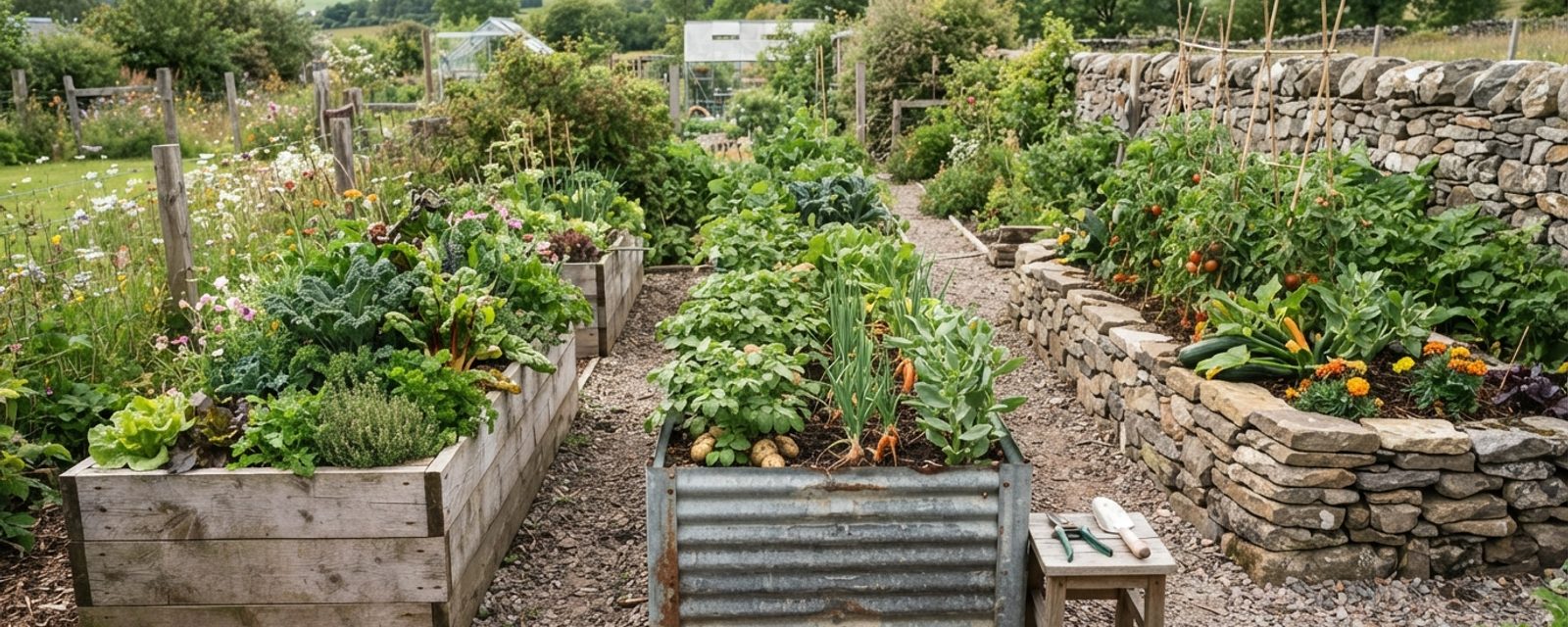
Standing in the timber aisle at the garden centre, sleeper in one hand, a flat-pack galvanised kit in the other, the question is never really "which material builds a raised bed", any of them will. It's whether you're paying for five years or twenty five, whether you want the soil warming up before the neighbours' does, and whether you're happy with a preservative-treated board six inches from your carrots. None of that gets easier by staring at price tags in a shed on a Saturday. Working through it properly, material by material, does.
Wood: softwood, hardwood, and the treated-timber question
New softwood, the stuff sold as edging boards, planed timber, or kit raised beds, is the cheapest way into a raised bed and RHS treats pressure-treated ("tanalised") softwood as the standard, workable option, noting it's "an attractive and economical alternative to hardwoods like oak, and will last for many years." Left untreated, the same softwood is short-lived: RHS is blunt that untreated timber "will only last one or two years" in ground contact, which in Scotland's wetter climate is more likely to land at the shorter end than the longer one, sustained damp keeps softwood fibres wet for longer, which is exactly the condition rot fungi need.
Hardwood, oak in particular, costs considerably more up front, but its density is naturally resistant to the same damp-driven rot that shortens softwood's life, so it doesn't need treating to survive ground contact for many years. In a climate where timber stays wet for longer stretches, that natural resistance is doing the same job pressure-treatment does for softwood, just without the treatment: pay more now, treat it never, and get a frame that shrugs off exactly the damp conditions rot fungi favour.
The question people actually stall on in the aisle is whether pressure-treated timber is safe to grow food against. The honest, current answer is: yes, for the treatments sold in the UK today, but it wasn't always yes, and it's worth knowing why. Older CCA (chromated copper arsenate) preservatives, timber treated green, containing arsenic and chromium, were withdrawn from UK sale from 1 September 2006, and wood already treated with them before the ban isn't affected retrospectively, but it does mean CCA hasn't been legally sold here for two decades. What replaced it are water-based copper preservatives, alkaline copper quaternary (ACQ) and copper azole among them, and under the Biocidal Products Regulation and Control of Pesticides Regulations, the UK's Health and Safety Executive requires any wood preservative product to be formally authorised before it can legally be sold or used at all. For ground-contact garden and landscaping use specifically, the Wood Protection Association, the UK timber-treatment industry's trade body, publishes buying guidance pointing towards Use Class 4-rated timber, the specification rated for permanent, frequent-wetting ground contact, which is what a raised bed's uprights and lower boards actually experience.
Reclaimed scaffold boards are a common budget variant worth a specific mention: thick, dense softwood, often available cheaply secondhand, that builds a sturdy bed for less than buying new timber. The same rot and treatment considerations above still apply, though, an unweathered, untreated scaffold board sitting permanently in Scotland's wet ground rots on the same short timeline as any other untreated softwood, not a longer one just because it's substantial. Reclaimed boards also carry the same unknown-history caveat as reclaimed sleepers below: a board that's spent years on a building site has no guaranteed record of what it's been exposed to, oils, solvents, or treatments never intended for food-growing contact, so a genuinely unknown-origin board is worth keeping to non-edible structures, or lining, the same way a treated bed can be lined.
None of that is a guarantee that zero leaching occurs, copper is still a biocide, doing the job of deterring wood-rotting organisms, but it's a different substance and a different regulatory picture from the arsenic-era product some older gardening advice is still implicitly warning about. If you want to remove the question entirely rather than rely on the current treatment being fine, RHS's fallback is simple: line the inside faces of a treated timber bed with old compost bags or recycled plastic sheeting so the soil itself never sits directly against the treated wood.
Railway sleepers: new is not the same question as reclaimed
This is the one where the two purchase paths genuinely diverge, and treating them as one product is where most confusion starts.
New sleepers, sold specifically for garden and landscaping use, are pressure-treated with the same modern, regulated preservatives covered above, not creosote. Bought this way, they're functionally a thick, long-lived version of pressure-treated softwood: expensive relative to boards, but substantial, and covered by the same current safety picture.
Reclaimed or ex-railway sleepers are a different material with a real, well-established food-safety concern: creosote. Creosote-treated timber was legislated out of retail and domestic use in Great Britain by the Creosote (Prohibition on Use and Marketing) Regulations 2003, which prohibit creosote-treated wood from sale to the general public and from use in situations involving frequent skin contact, gardens, playgrounds, and the manufacture of growing containers among them. It remains legal today only for specific industrial and safety-critical applications: current permitted end uses in Great Britain are things like railway sleepers and fence posts on highways, equestrian and animal-security fencing, and overhead power and telecoms poles, professional infrastructure use, not retail garden products. Creosote is also classified as a category 1B carcinogen under GB hazard regulations. RHS's schools-gardening guidance states plainly that creosote-treated railway sleepers are "no longer permitted to use in the garden, due to the risk associated with frequent (daily) skin contact," and where older sleepers are already in place, recommends protective clothing when handling them. Gardeners' World gives the same steer from the opposite direction, its advice is to avoid tar-treated sleepers because they "can leach toxins into the soil" and can mark clothing on contact.
In practice: an ex-railway sleeper bought secondhand, at a reclamation yard, or inherited with a garden should be treated as a probable creosote risk unless you can confirm otherwise, and kept away from edible growing. A sleeper bought new from a garden centre or landscaping supplier, sold and labelled for that purpose, is a preservative-treated timber product under current regulation, not a creosote one.
Metal: corten and galvanised steel
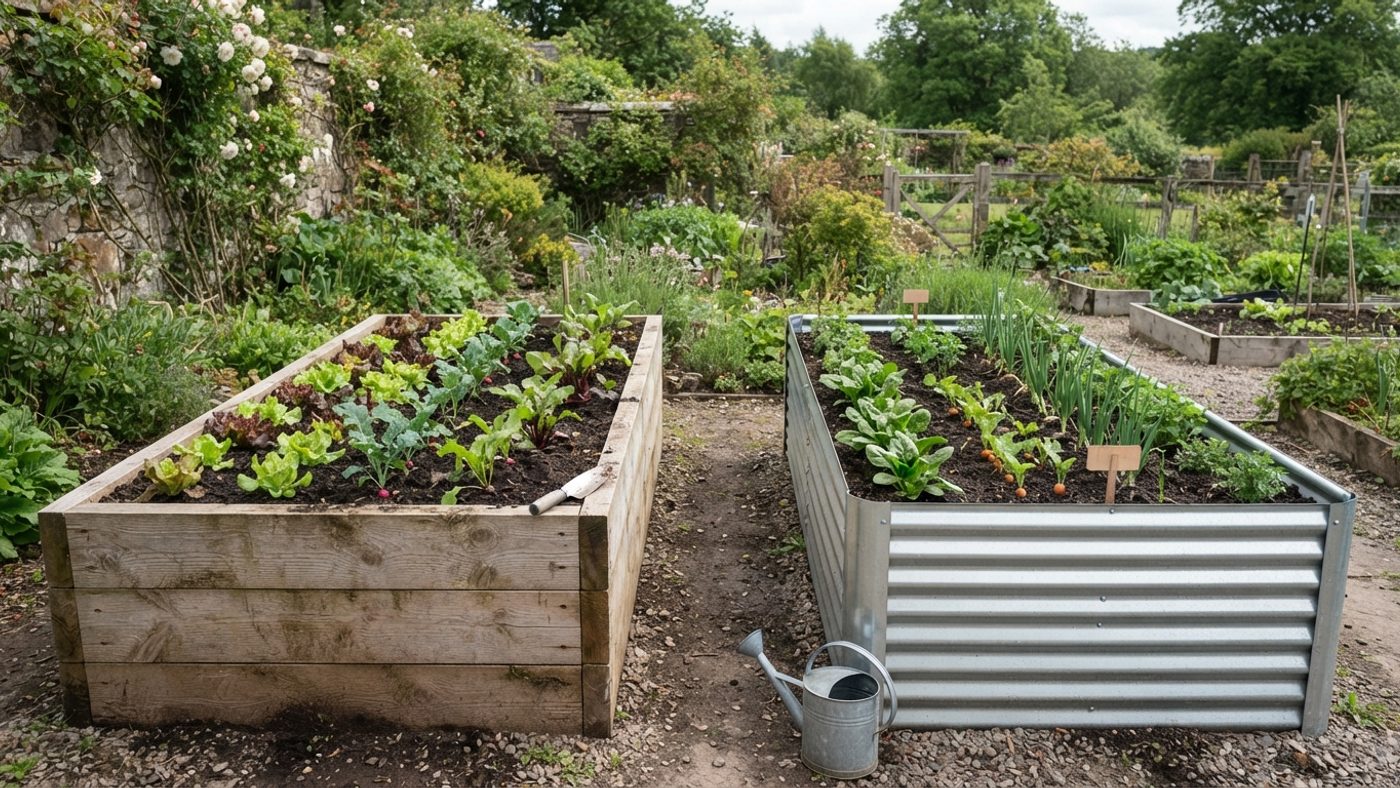
Metal beds, corten (weathering steel) and galvanised steel, are the newest entrants to most garden centres' raised-bed ranges, and the material where thermal behaviour is genuinely part of the pitch rather than an afterthought.
Steel conducts heat far more readily than timber, which cuts both ways. In spring sun, a metal-walled bed's soil warms faster than an equivalent timber bed, because heat moves through the metal wall and into the soil near the edges more quickly than it moves through timber, a real advantage in Scotland's shorter, cooler growing season, where getting soil workable even a little earlier can be the difference between direct-sowing on schedule and waiting. The same conductivity runs in reverse on a cold clear night: a metal bed loses heat back out to the air faster than a timber one, so the insulating advantage timber holds in a spring heatwave becomes a small disadvantage on a frosty night, when a wooden bed's walls are doing more to slow heat loss than a thin steel sheet can. Both effects are strongest right at the edges of the bed, where the wall itself is doing the conducting, and taper off towards the centre where most actively growing roots sit. It's a genuine trade-off either way, not a one-sided win, and gardeners using metal through a cold snap sometimes add interior insulation (rigid board, cardboard, straw) against the walls to blunt the night-time heat loss.
Galvanised steel's zinc coating is what gives it a realistic multi-decade lifespan outdoors before rust becomes a structural issue; once the coating is breached (a deep scratch, a cut edge) rust can start locally. Corten is designed to do the opposite, it's meant to rust, forming a stable oxide "patina" that then slows further corrosion, rather than being coated to prevent it in the first place. Both are a heavier upfront cost than softwood, broadly comparable to or above hardwood, and both a firmly one-time buy rather than something replaced every decade. On an exposed coastal site, salt-laden wind speeds up corrosion on any bare or breached metal surface, galvanised and corten alike, so a coastal garden is where that zinc coating or protective patina earns its keep the most.
Stone and block
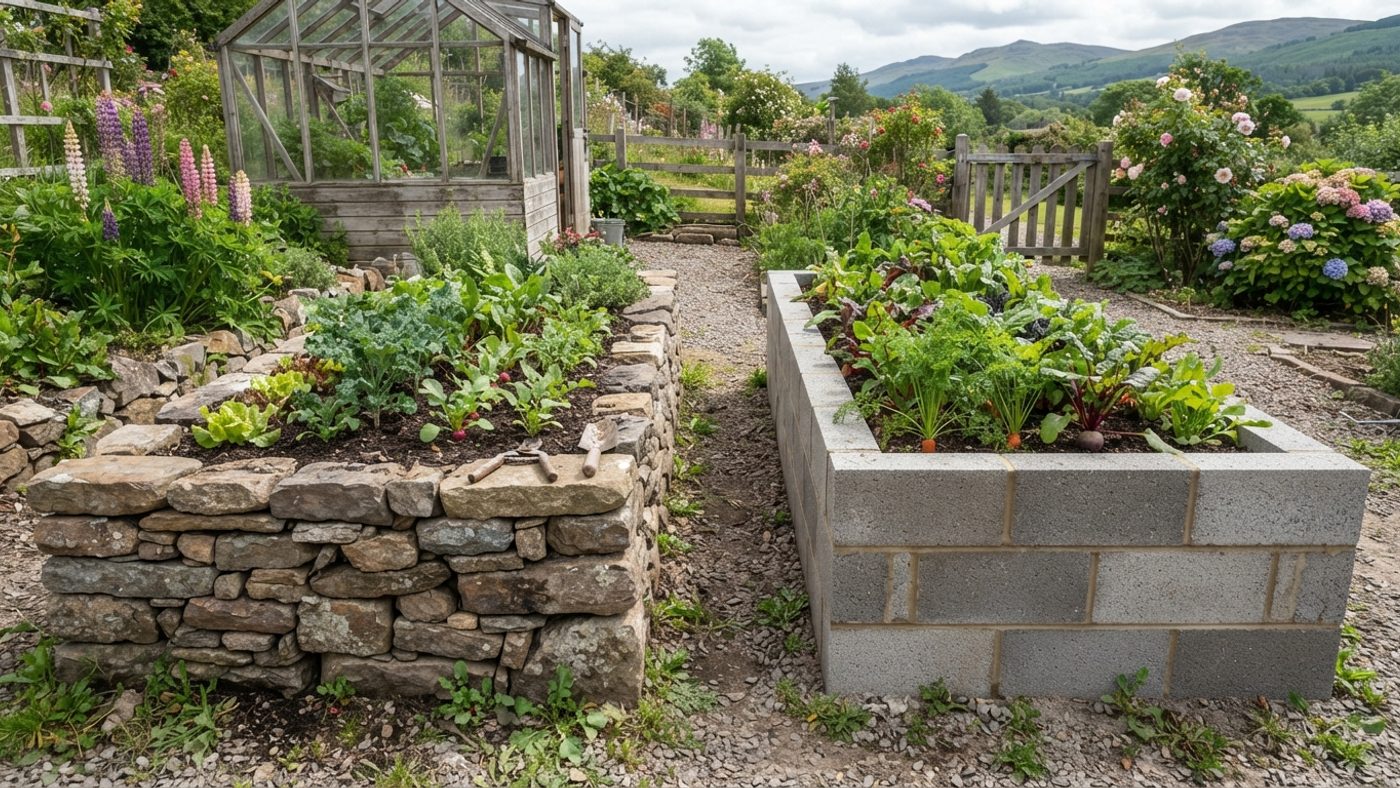
Stone is the most expensive route into a raised bed and RHS is straightforward about why: beyond the material cost, proper stone or prepared walling stone "usually requires skilled labor and concrete footings," which is labour cost on top of material cost. Dry stone (no mortar) is cheaper to build than mortared stone or block but less forgiving of poor levelling and settles or shifts over time, repeated freeze-thaw through a Scottish winter, ground water expanding as it freezes then contracting as it thaws, is exactly the kind of movement that gradually works unmortared joints loose. Mortared block or brick is more work and expense up front but, done properly with footings, is close to a permanent structure, measured in decades rather than years, with no wood or metal replacement cycle to plan for. Locally quarried stone, whinstone, sandstone or granite depending on the area, is often the cheapest way into a genuine dry-stone bed, since it avoids the transport cost of stone brought in from elsewhere. Gardeners' World's practical alternative for the budget end of this category is breeze block, which gets close to stone's permanence at a fraction of the material cost, if you're willing to accept the aesthetic.
Gardeners' World also names gabions, wire mesh cages packed with stone, as a middle ground worth knowing about: cheaper than dressed or mortared stone since the stone inside doesn't need to be shaped or laid, no mortar or footings required, and free-drainingSoil that lets water pass through quickly rather than pooling, so roots aren't sitting in wet ground after rain. Full definition → by design, which suits a wet climate better than a solid mortared wall can.
Recycled-plastic and composite raised bed kits are worth a brief mention alongside these, since they're now a common flat-pack option in garden centres: no rot, no rust, and no food-safety question comparable to treated timber or creosote, though as a newer product category they don't yet have the decades of real-world track record that timber, metal and stone all do.
Cost, lifespan and thermal behaviour compared
| Material | Relative cost | Realistic lifespan | Spring soil warming | Food-safety question |
|---|---|---|---|---|
| Untreated softwood | £ | 1-2 years in ground contact | Neutral (no conductivity advantage) | None |
| Pressure-treated softwood | ££ | Many years | Neutral | Resolved under current UK regulation; line beds if you want zero direct contact |
| Hardwood (e.g. oak) | £££ | Many years without treatment | Neutral | None |
| New sleepers (garden-grade) | £££ | Long, thick section, modern preservative | Neutral | Same as pressure-treated softwood |
| Reclaimed/ex-railway sleepers | £-££ (cheap to buy, real risk) | Long, but origin uncertain | Neutral | Real risk of creosote, avoid for edibles unless origin confirmed |
| Galvanised steel | £££ | Multi-decade before coating fails | Faster spring warming, faster night cooling | None |
| Corten steel | £££-££££ | 50+ years | Faster spring warming, faster night cooling | None |
| Dry stone | £££ | Decades | Neutral, high thermal mass | None |
| Mortared block/brick | £££-££££ | Decades, close to permanent | Neutral, high thermal mass | None |
Scotland's rainfall and drainage
Scotland's Atlantic-driven weather means high rainfall is simply part of gardening here, and that has a real bearing on two of the choices above rather than being background colour. Untreated softwood in permanent ground contact is already short-lived per RHS's own figure; in a climate where timber stays damp for longer stretches between dry spells, that "one or two years" is realistic rather than pessimistic, and it strengthens the case for either treating the timber or lining it, or simply not building in untreated softwood at all if the bed needs to last. Drainage matters more than material choice in isolation, a bed on heavy clay benefits from a free-draining base layer, and a mulch on top once planted helps hold that moisture balance regardless of what the walls are built from, and for wood especially, keeping the lowest boards clear of standing water, regardless of which material makes up the walls.
Which one, honestly
There isn't a single correct answer, because the materials aren't optimising for the same thing. Treated softwood remains the sensible default for most gardens: cheapest to get growing, and the regulatory picture on it is genuinely settled rather than something to keep second-guessing. Reach for hardwood, steel or mortared block specifically when the upfront cost is worth it to stop thinking about replacement for decades, and reach for metal specifically when an earlier start to the season matters more than the extra outlay. The one piece of this whole comparison worth being properly wary of isn't any of the current, regulated products above, it's a free or cheap secondhand sleeper of unknown history, which is where the real risk still sits.
Common questions
Is it safe to grow vegetables in a bed made from pressure-treated timber?
Under current UK regulation, yes, though not a zero-leaching guarantee: copper is still a biocide, just a different, regulated substance from the arsenic-based CCA treatments that caused genuine concern before their 2006 ban. Timber sold as pressure-treated today uses copper-based preservatives authorised separately. If you want to remove any doubt, line the inside of the bed with plastic sheeting so soil doesn't sit directly against the treated wood.
Can I use old railway sleepers for a raised bed?
Only if you know they're new, garden-grade sleepers treated with a modern preservative. Reclaimed or ex-railway sleepers very often carry creosote, which is restricted by law to industrial and safety-critical uses precisely because of the skin-contact and health risk, it isn't legal to sell for garden use, and shouldn't be used for growing edibles unless you can confirm the timber's treatment history.
Do metal raised beds get too hot for plants in summer?
Metal conducts heat faster than wood, which mainly shows up as faster soil warming near the bed's edges in spring, an advantage for an early start. Most root growth happens away from the walls, in the centre and depth of the bed, where the difference is much smaller.
What lasts longer in Scotland's climate, wood or metal?
Untreated softwood is genuinely short-lived in a wetter climate, often a year or two before it needs replacing. Pressure-treated softwood, hardwood, galvanised or corten steel, and stone or block all comfortably outlast that, with steel and stone/block generally reaching multi-decade lifespans.
Is corten (weathering) steel safe to use around food crops?
There's no equivalent food-safety concern for corten or galvanised steel comparable to the treated-timber question, the issues with those materials are cost, and the thermal trade-off of faster heat gain and faster heat loss, not a leaching or toxicity concern.
Sources
9 sources, recorded with what each was used for
- RHS: How to make a raised bed: Timber lifespan (untreated vs pressure-treated), stone/brick/paving cost and labour comparisons, and lining beds against chemical leaching
- RHS School Gardening: Creating raised beds: Creosote-treated railway sleepers no longer permitted for garden use, and handling advice for existing creosoted sleepers
- NetRegs (SEPA and the Northern Ireland Environment Agency): Wood preservatives: The 2006 UK ban on CCA (arsenic/chromium) wood preservatives and current approved copper-based alternatives (ACQ, copper azole)
- The Creosote (Prohibition on Use and Marketing) Regulations 2003: The legal basis of the UK domestic/retail ban on creosote-treated wood and the restriction to industrial/professional use
- HSENI: Changes to the permitted uses for creosote and creosote treated wood under BPR: Creosote's current status as a regulated biocidal product restricted to specific industrial end uses
- HSE: Industrial timber treatment plants: Confirmation that wood preservative products require approval under the Control of Pesticides Regulations (COPR) and the Biocidal Products Regulations (BPR) before sale or use
- HSE: Biocides, introduction to regulation, supply and use: Confirmation that a biocidal product, which covers wood preservatives, must be formally authorised before it can be made available on the market
- The Wood Protection Association: Make Sure it's 4: The Use Class 4 specification recommended for ground-contact garden and landscaping timber (industry trade body, buying-guidance detail only)
- Gardeners' World: Gardening tips for raised beds: Scaffold board, breeze block, sheet metal and gabion options, and the advice to avoid tar-treated sleepers