
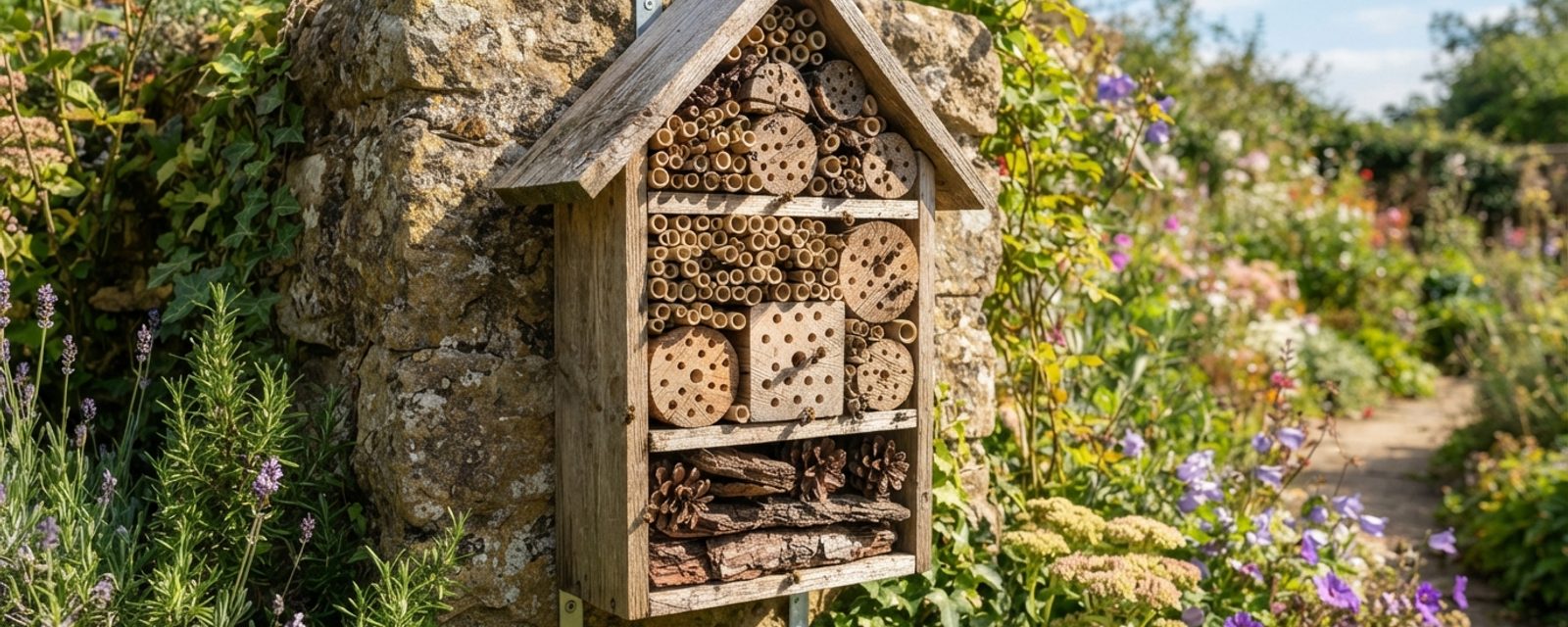
Red mason bees start appearing from late March, with the first males on the wing from early April in most of the UK, and they spend their entire adult lives, often only six to eight weeks of it, searching for a cavity to nest in. A bee hotel put up in April is competing for occupants with every hollow stem, old nail hole and crumbling wall cavity already in a garden; a bee hotel put up in May has missed the first wave of house-hunters entirely, because a female mason bee that has already found and sealed a nest elsewhere isn't coming back to check a new one.
Leafcutter bees follow later, from late spring into summer, so a hotel hung in good time isn't wasted if the mason bees pass it by, but the mason bees won't wait. Emergence is temperature-driven: colder overwinteringKeeping a plant alive and intact through the cold months, whether left outdoors, moved under cover, or stored dormant. Full definition → conditions delay it, so a slow, cold Scottish spring can push actual emergence closer to the later end of that window rather than the earlier one, a reason to have the hotel up in good time regardless, rather than banking on the earliest possible date.
That means late winter to very early spring is the real deadline, not April itself. Get a hotel sited and secured while the garden still looks dormant, so it's already weathered-looking and in place before the first males emerge.
Diameter matters more than anything else
A tube's diameter decides which bee, if any, uses it, get it wrong and a hotel can look full of activity while doing almost nothing for the species it was meant to help:
| Bee group | Typical diameter | Notes |
|---|---|---|
| Red mason bee and other mason bees (Osmia) | 6-10mm | Usually first to occupy a hotel each year, from March/April |
| Leafcutter bees (Megachile) | 4-8mm | Active later, late spring into summer; look for neat semicircular leaf cuts sealing each cell |
| Smaller solitary bees | 2-4mm | A hotel with only large holes shuts out the smaller species entirely |
A hotel packed with only one diameter attracts only one kind of bee; mixing sizes gives the widest range of species something usable, and holes much wider than the table above mostly go unused. To work out which bee has actually moved in, once one turns up, see the beneficial wildlife guide's solitary bees entry.
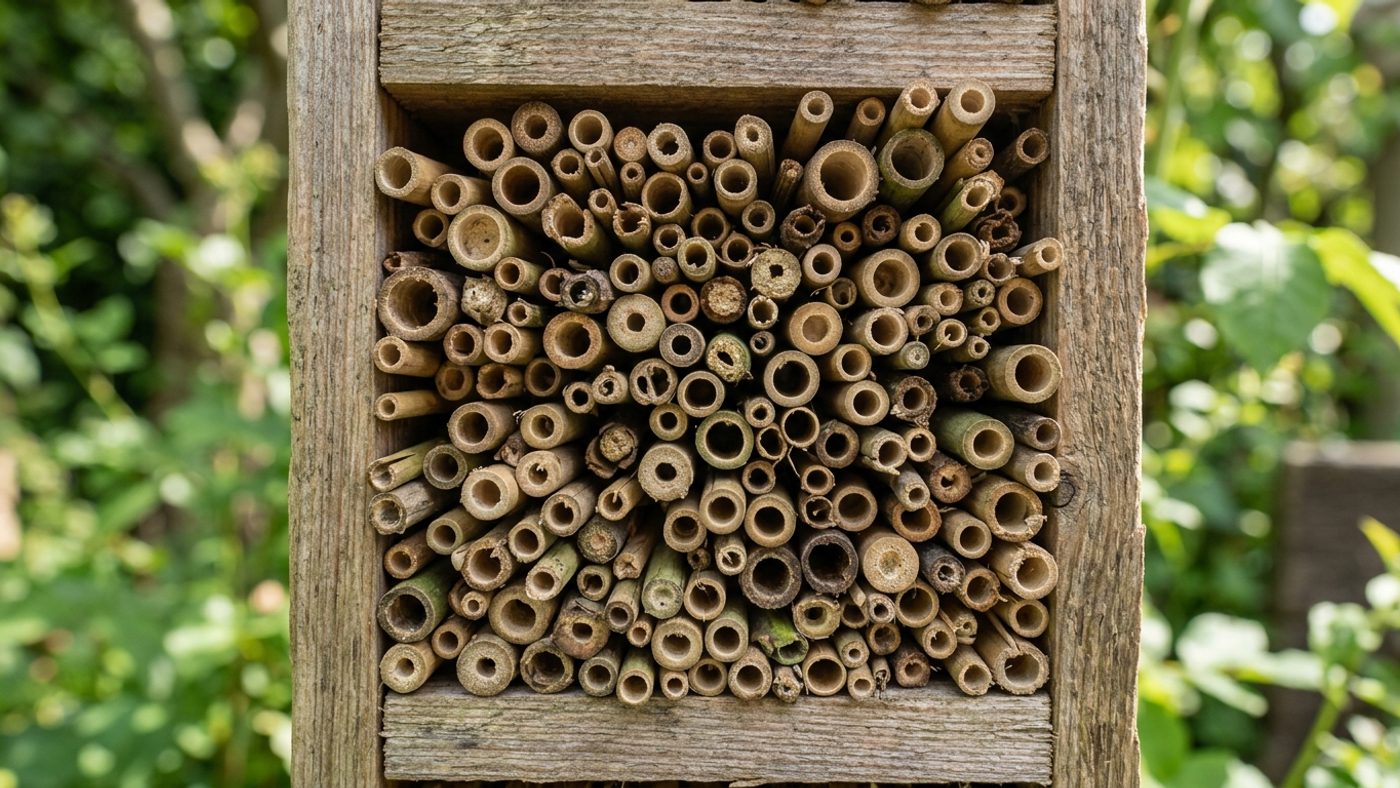
Length matters almost as much as width. Tubes need to be around 15cm long with a closed or dead end, not open at both ends. Solitary bees lay female eggs at the back of a tunnel and male eggs nearer the entrance, so a tube that's too short skews the ratio toward males, and an open-ended tube isn't recognised as a nest cavity at all, since nothing in nature looks like it.
What the tubes are actually made of
This is where most commercially sold bee hotels fail. Many garden centre hotels are built from resin-bonded or varnished tubes packed too densely to inspect or replace: moisture condenses inside the sealed tubes with nowhere to go, and that damp becomes the growing medium for fungal mould and mite infestations, which then spread from one packed-in tube to the next.
| Material | Verdict | Why |
|---|---|---|
| Plastic or glass tubes | Avoid | Non-porous, condensation has nowhere to escape, and damp inside a sealed tube encourages fungal growth and parasites |
| Varnished, painted or treated wood/tubes | Avoid | Coatings trap moisture in the same way, and treated timber can carry chemicals never meant for a nest cavity |
| Cheap cardboard tubes with no removable liner | Avoid | Can't be opened to check or clean, so mould and mites build up invisibly year after year |
| Untreated hollow stems: bramble, reed, bamboo | Works well | Porous and breathable, cheap to replace entirely each year rather than cleaned |
| Drilled untreated hardwood blocks, smooth-bored holes | Works well | Durable, but only if the holes are drilled cleanly (splintered wood damages bees' wings) and the block can be split or fitted with paper liners for cleaning |
| Paper tube liners inside stems, bamboo or drilled holes | Best for maintenance | Lets a whole cocoon-filled liner be lifted out and replaced without disturbing the rest of the hotel |
Scotland's cooler, wetter growing season means sealed or non-porous tubes spend more days damp than they would further south, which is a reason to lean toward the more breathable materials, untreated reed, bamboo, hollow stems, or paper liners that can be swapped out, rather than solid plastic or resin tubes.
Building the frame
A simple wooden frame, open on one side, holds the tubes in place: a plank of untreated, sustainably sourced timber around 1.5cm thick works for the box itself, with a solid back so no tube is open at both ends. Pack the tubes in tightly enough that they don't rattle loose, mixing diameters rather than filling each row with one size.
A roof with a genuine overhang, deep enough to keep driving rain off the tube openings, matters more than the material it's made from, the same damp-tube problem as the materials above, caused by weather rather than the tube itself, and worth taking seriously given how much rain a Scottish garden gets through the year. A flat or minimal roof, one of the most common faults in cheap commercial hotels, leaves the tube ends exposed to weather side-on.
Siting: sun, shelter, height
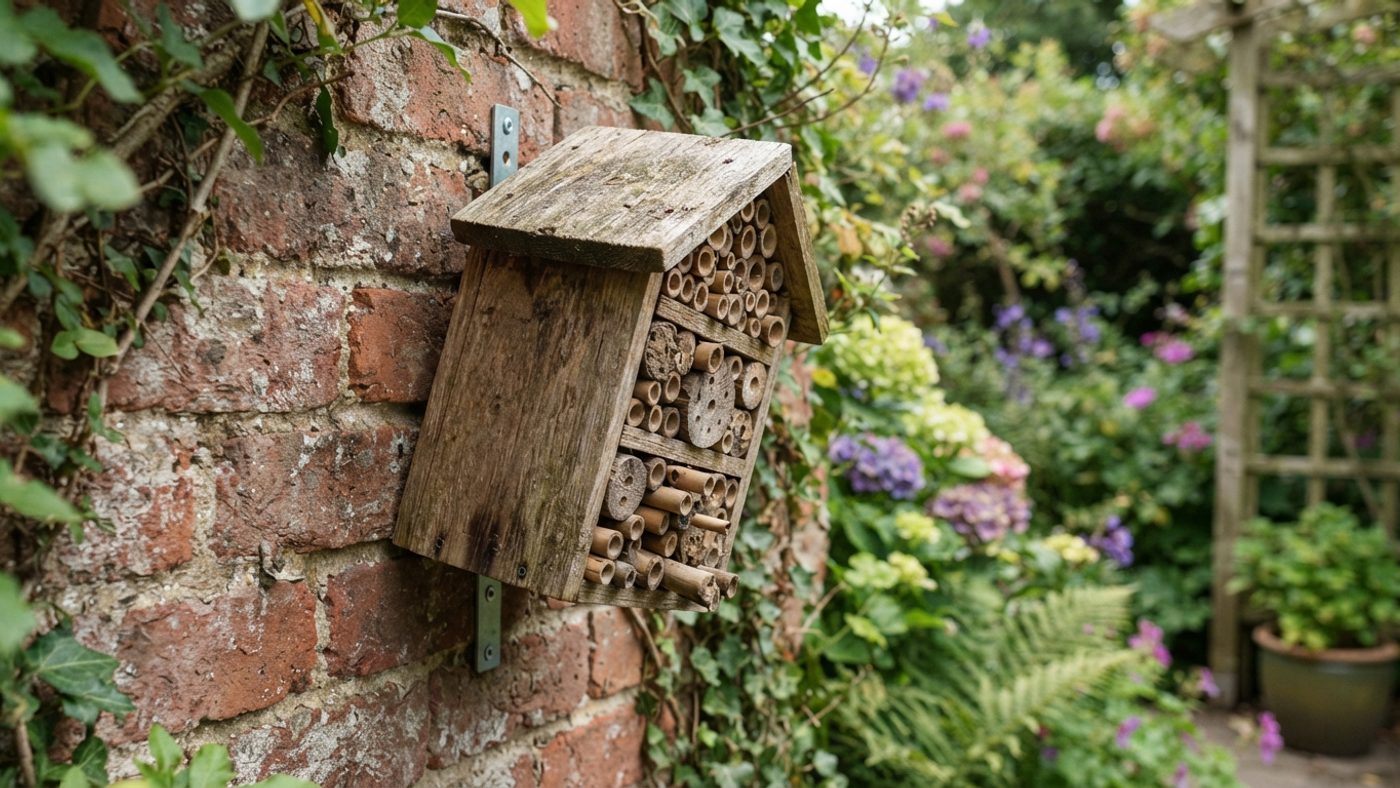
Face the hotel south or south-east, so it catches the morning sun, solitary bees are cold-blooded and need that early warmth to become active enough to forage. Position it somewhere sheltered from driving rain and wind, under an eave or wall overhang if possible, not in the open. Fix it securely: a hotel that sways or swings in wind is a hotel bees won't use. Raise it well off the ground, at a height where it's easy to see and check without disturbing it, rather than leaving it low down where it's more exposed to damp, slugs and ground predators.
A hotel also needs somewhere to forage. Occupancy depends on the whole garden having pollen-rich flowers in bloom through Scotland's March-to-October pollinator season, not just around the hotel itself, and free of pesticides, with willow and other early-flowering plants mattering particularly for the first mason bees out in spring.
Where a species is genuinely scarce in an area to begin with, no amount of correct diameter, siting or forage will produce activity, the red mason bee, the most likely first occupant further south, is itself uncommon in Scotland, and which solitary bees are actually present locally is worth checking in the beneficial wildlife guide's solitary bees entry before assuming a quiet hotel means something was done wrong.
Seasonal maintenance: the part cheap hotels skip entirely
A bee hotel isn't a one-off purchase; it needs yearly attention, and a hotel that can't be opened for that attention will eventually spread disease among its own occupants rather than support them.
| Season | What's happening | What to do |
|---|---|---|
| Late summer-autumn | Larvae developing inside sealed cells | Leave the hotel alone, this is not the time to interfere |
| Winter | Cocoons overwintering as fully formed adults | Keep the hotel in place, sheltered, through the cold months |
| Early spring, before new emergence | The maintenance window | Check each tube for mould or mites; discard any affected tube, move clean occupied ones to a sheltered spot nearby, replace what's removed with fresh tubes or liners |
Most garden centre hotels can't go through any of this, because they're built with sealed resin tubes and glued-in cardboard with no removable liners, a design fault, not a maintenance failure on the owner's part.
Common questions
How many tubes should a bee hotel have?
There's no fixed number, but a hotel with only a handful of tubes will support only a handful of nests. A reasonable-sized hotel with dozens of tubes across a mixed range of diameters gives more species a genuine chance, without needing to be enormous.
Will a bee hotel attract wasps as well as bees?
Some solitary wasps do use similar cavities, and are generally harmless garden predators rather than a problem. The bigger risk is not wasps moving in deliberately, but parasitic species exploiting poorly maintained tubes that are never cleaned or replaced, another reason regular inspection matters.
Can a bee hotel be too close to the house?
No, solitary bees are not aggressive and rarely sting unless handled roughly, so a hotel fixed to a house wall, shed or fence in a sunny, sheltered spot is fine and often the most practical option.
Why aren't there any bees using the hotel?
Wrong diameter tubes, a shaded or exposed site, and poor forage nearby are the most common causes beyond timing. Check it's genuinely south or south-east facing, sheltered from rain, and that the tube diameters are actually in range for the local bees before assuming there's nothing nearby to use it.
Do ground-nesting bees need a bee hotel at all?
No, a bee hotel only helps cavity-nesting species like mason and leafcutter bees. Many other solitary bees, including most mining bees, nest in bare or lightly vegetated soil instead, and are helped by leaving patches of ground uncovered rather than by any built structure.
Sources
8 sources, recorded with what each was used for
- RHS: Bees in your garden: General solitary bee biology, nesting habits, activity timing
- RHS: Leaf-cutting bees: Leafcutter nesting cavities, leaf-cell construction, activity period
- Buglife: How to be the best bee hotel manager: Tube diameter and length limits, the documented problems with garden centre bee hotels, siting and seasonal maintenance protocol
- Buglife: Red Mason Bee species page: Emergence timing, males emerging before females, nesting cavity preferences
- The Wildlife Trusts: How to make a bee hotel: Untreated wood and hollow stem materials, diameter range, siting, annual cleaning
- RSPB: Build a Bee Hotel: Tube length and dead-end requirement, timber dimensions, roof overhang for weatherproofing
- NatureScot: Pollinators get busy, get involved: Scotland's pollinator flowering window
- Fründ, Zieger & Tscharntke et al.: Overwintering temperature and body condition shift emergence dates of spring-emerging solitary bees (PMC): Colder overwintering conditions delaying solitary bee emergence