
Solitary Bees can't be bought. The way to get more in the garden is to create the right conditions, and here's how.
What does it look like?
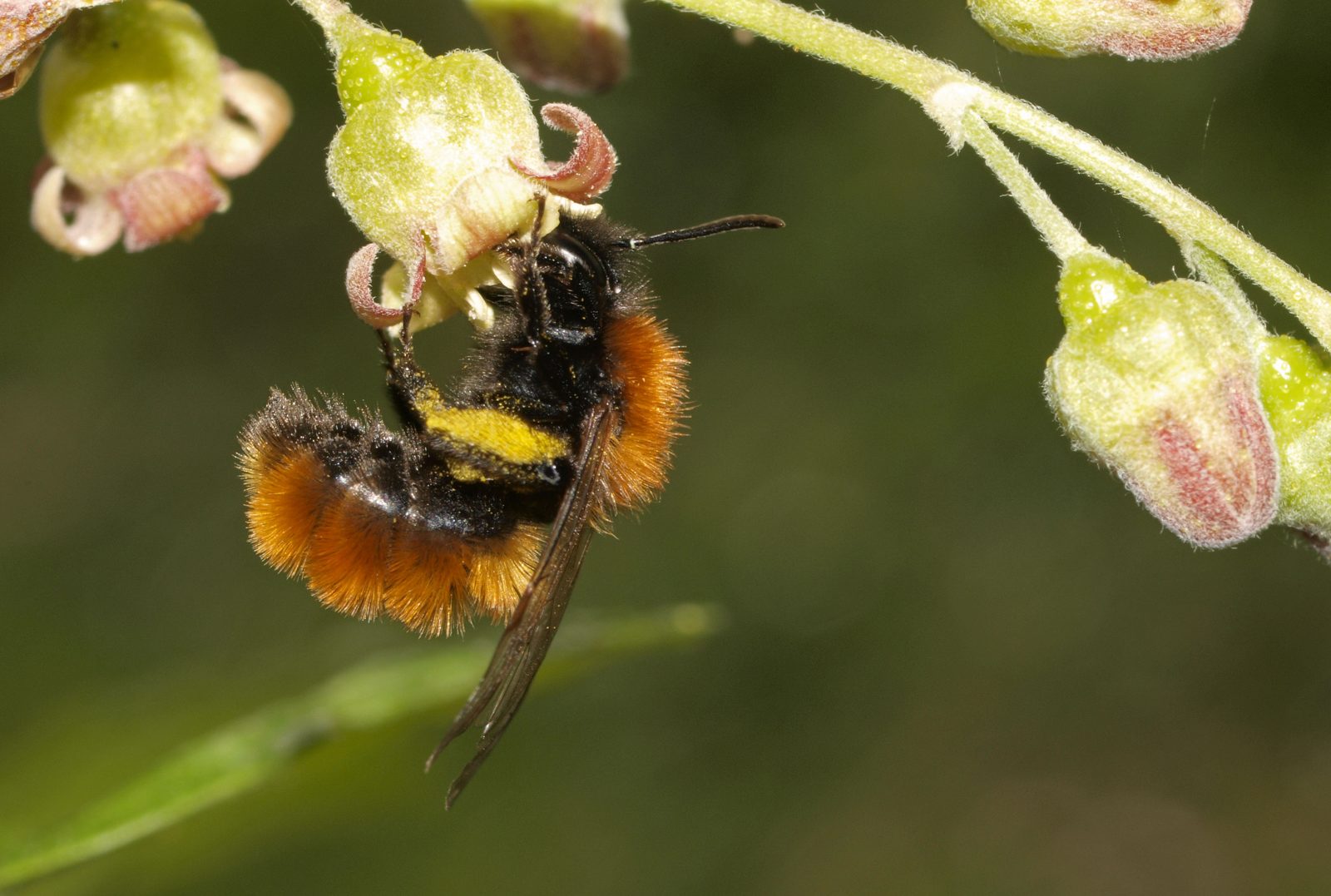
Solitary bees are a far more varied group than bumblebees or the single honeybee species: over 250 British species, ranging from 5mm to over 15mm long, and no single description covers them. Mining bees (Andrena, around 65 British species) nest in the soil and are behind the small volcano-shaped spoil heaps sometimes found in lawns in spring, most often from the tawny mining bee, bright foxy-red and common in gardens; the ashy mining bee is black with two broad grey bands. Mason bees (Osmia, 11 species) build nests sealed with mud in hollow stems, old masonry and other cavities; the red mason bee is Britain's most familiar solitary bee generally, but genuinely uncommon in Scotland and Ireland. Leafcutter bees (Megachile, 7 species) cut neat semicircles from leaves to line their nest cells, needing up to 40 leaf pieces for just one cell. Sweat bees (Lasioglossum and Halictus, around 40 species) are small, often metallic, ground-nesting bees. The wool carder bee scrapes downy plant hairs to build its nest; unusually for a solitary bee, its females emerge before the much larger, territorial males. All female solitary bees can sting, but they're not aggressive and only do so if handled roughly.
Life cycle
There's no worker caste and no colony: each female builds and provisions her own nest alone, then dies before the next generation emerges the following year, so there's no queen surviving to start again either. Ground-nesting species can still be gregarious, with many individual nests packed close together even though each female works alone. Most species are active for a single flight period in spring or summer rather than year-round.
How to encourage it
Fill a garden with nectar- and pollen-rich flowers through as much of the year as possible, the same starting point as any pollinator. Some solitary bee species are specialists, provisioning their nest with pollen from just one plant or plant family, so a few specific choices genuinely make a difference beyond general flower cover.
Many species nest in bare or lightly vegetated soil, so leave some patches of ground uncovered rather than mulching or planting every inch; a small sandy patch of lawn sprouting volcano-shaped spoil heaps in spring is a mining bee nest, not lawn damage, and is gone again within a few weeks. Others use hollow plant stems, old beetle holes in dead wood, or crumbling mortar in old walls: leaving some of these features in place, rather than tidying them all away, is itself a form of encouragement. A purpose-built bee hotel genuinely attracts leafcutter and mason bees: pack untreated hollow stems, bramble, reed or bamboo, cut to fit a simple wooden frame, mixing hole diameters from 2-10mm with plenty at the bees' preferred 3-5mm, discarding any bent or knobbly ones. Hang it on a sunny wall sheltered from rain, and clean it once a year to remove built-up fungi, debris and parasites.
Avoid pesticides wherever possible, and never spray a flower that's open, since that's exactly when a pollinator is likely to be on it.
Plant these to help:
- Willow: an early-spring nectar source for several mining bee species, including Clarke's mining bee, which specialises on it.
- Lamb's ear: its downy leaves are what the wool carder bee scrapes to build its nest, not just a nectar source.
- Ivy: flowers late, in autumn, when little else is in bloom, a genuine late-season nectar source for whichever solitary bees are still flying. The specialist ivy bee that depends on it entirely is currently found mainly in southern England and Wales, not yet established in Scotland.
The key window for a garden to be in flower for pollinators runs from March to October.
Why it matters
Over 250 British species between them means solitary bees are pollinating alongside bumblebees in most gardens, often unnoticed since none of them form the kind of visible colony a bumblebee nest does. Bumblebees nest in existing cavities, tunnels and long grass and can't be given a purpose-built home; several solitary bee groups, leafcutter and mason bees especially, take readily to one, giving a gardener a genuine, active way to help beyond planting. The red mason bee is efficient enough at pollinating fruit trees that it's sometimes deliberately introduced to orchards further south, though it's genuinely uncommon in Scotland itself.
Why this matters in Scotland
The tawny mining bee, common and familiar in English gardens, is a genuinely thinner presence in Scotland: only 81 Scottish records on NBN Atlas Scotland, well below the thousands recorded for a well-established garden insect like the marmalade hoverfly.
Scotland's real solitary-bee story, though, isn't the common species arriving, it's a specialist already here and nowhere else in the UK: the northern colletes mining bee, tied to coastal sand dunes and machair in the Hebrides and south-west Scotland, and one of the priority species in NatureScot's Species on the Edge conservation programme. A gardener in most of Scotland won't meet it, but it's a genuine reason this group matters here specifically, not just generically.
Frequently asked questions
Can I buy solitary bees?
Not usefully: solitary bees released into a garden with nothing to hold them there simply leave. Creating the right habitat and food source is what actually keeps a population around; see "How to encourage it" above.
When will I actually see solitary bees in the garden?
It depends on the stage in their life cycle — see "Life cycle" above for when they're active and what to expect through the year.
Sources
7 sources, recorded with what each was used for
- RHS: General solitary bee biology (no worker caste, nesting habits, sting behaviour), on RHS's own dedicated bees-in-your-garden page, the same page used for bumblebees and honeybees.
- Wildlife Trusts: Species-level identification across the main solitary bee groups (mining bees, mason bees, leafcutter bees, sweat bees, flower bees, wool carder bee, yellow-faced bees), written by an entomologist specialising in solitary bees, including the red mason bee's Scottish rarity.
- Wildlife Trusts: A genuine, specific bee-hotel building guide: preferred hollow-stem diameter (3-5mm, with a 2-10mm range to attract a range of species), siting (a sunny wall sheltered from rain) and annual cleaning.
- NatureScot: The northern colletes mining bee as one of three Buglife-led priority species in NatureScot's Species on the Edge programme in the Inner Hebrides and Argyll, alongside the great yellow bumblebee.
- Buglife: The northern colletes' habitat (coastal sand dunes and machair) and its first British record, from south-west Scotland in July 1899.
- RHS: Specific plant-to-specialist-bee pairings: willows for several mining bee species including Clarke's mining bee, lamb's ear for the wool carder bee, ivy for the ivy bee, dandelions for the pantaloon bee among others.
- NBN Atlas Scotland: The tawny mining bee's Scottish record count (81 records), confirming it's genuinely present but still thinly recorded in Scotland compared with its common, familiar status in England.