
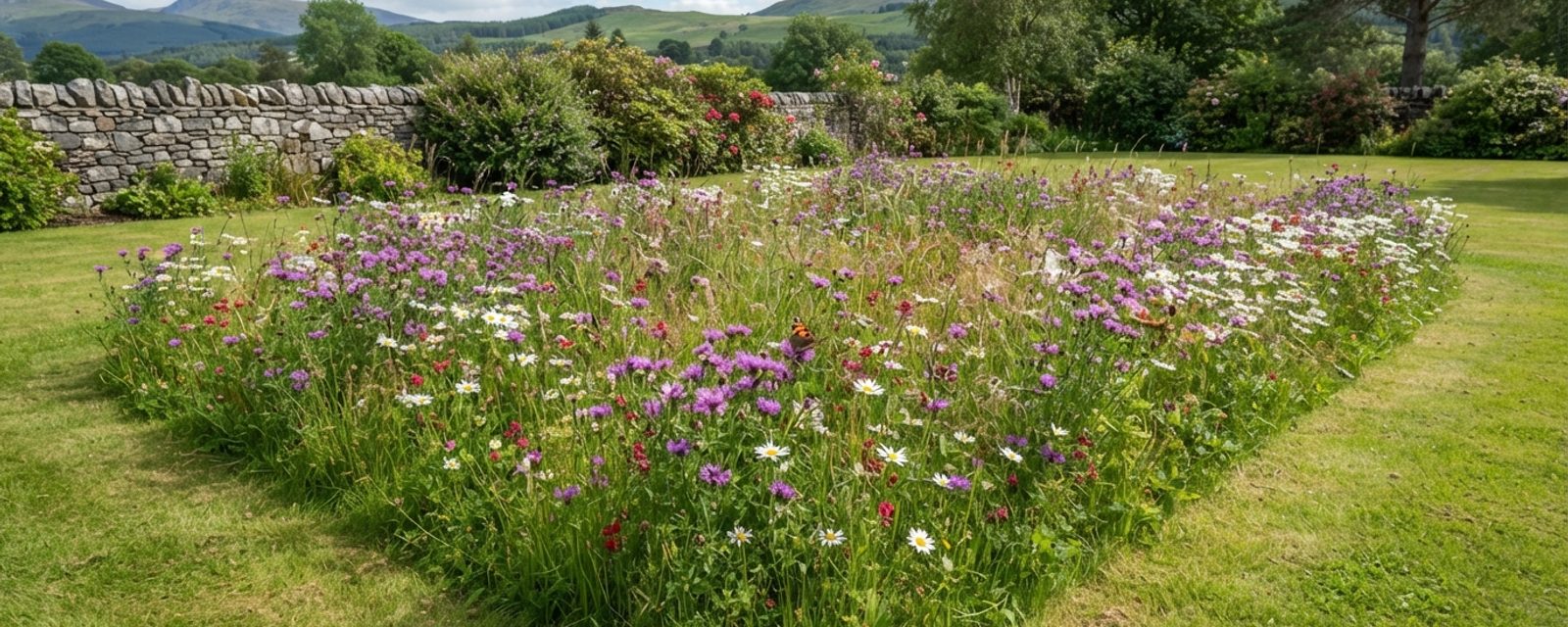
Most attempts to grow a wildflower patch fail for one reason, and it isn't the weather, the seed mix, or bad luck: the soil is too good. Garden soil that's been fed, dug over, and improved for vegetables or nursed into a thick lawn is rich in nitrogen and phosphorus, and that richness is exactly what wildflowers can't compete with. On fertile ground, coarse grasses, nettles, and docks grow fast and tall, closing over the soil surface and shading out the low-growing seedlings of species like knapweed, bird's-foot trefoil, and ox-eye daisy before they've had a chance to establish. The result is a patch that looks green and healthy and produces almost no flowers at all, not because the sowing failed, but because the vigorous plants won the race for light before the wildflowers were tall enough to compete.
This is the opposite of how most of us are used to gardening. Everywhere else in the garden, the instinct is to improve the soil: add compost, feed the lawn, dig in manure. For a wildflower patch, that instinct has to be reversed. Wildflowers native to the UK evolved on unimproved, nutrient-poor ground, old hay meadows, road verges, rough pasture, precisely because that's the only place vigorous competitors can't dominate. The same principle is why Scotland's own unimproved grasslands, upland hay meadows and, on the west coast and in the Hebrides, machair, still carry a wealth of wildflowers that richer ground nearby lost decades ago: they were never fertile enough for coarse grass to take over. Low fertility isn't a compromise you accept for a wildflower patch; it's the mechanism that makes one work at all.
The pollinator-friendly gardening guide covers the lighter version of this idea, simply letting an existing patch of lawn grow long and go uncut, relying on whatever clover, self-heal, and other low-growing species are already present in the turf, cut once a year with the clippings removed to gradually run the soil down. That's a good, low-effort starting point. This piece is about the next step up: stripping back an area properly and sowing a genuine native wildflower and grass mix into it, which gives a far richer and more colourful result but needs its own site preparation, seed choice, and patience to get right.
Preparing the ground: taking fertility out, not putting it in
Before any seed goes in, the site needs its fertility reduced. There are two realistic routes, and which one suits a given patch depends on its size and existing soil.
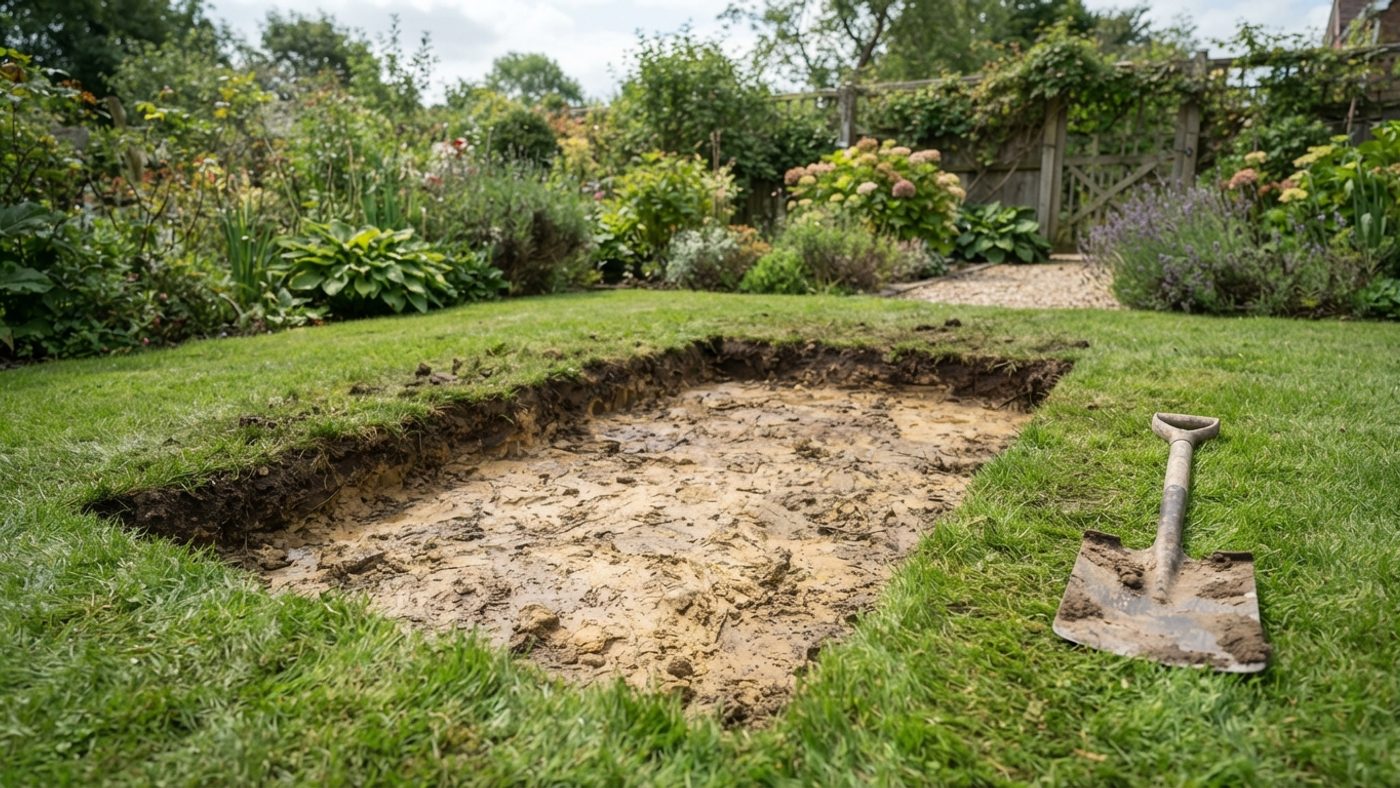
The most reliable method for a garden-sized patch is to strip the turf and topsoil off entirely, removing the top layer to expose the less fertile subsoil beneath, then sow directly into that. For a small area this can be done by hand with a spade; larger areas usually call for hired turf-stripping equipment. The stripped-off turf and topsoil don't need to go to waste, they can be stacked to make topsoil for use in a vegetable bed or a border elsewhere in the garden, where the nutrients are actually wanted.
Where digging out turf isn't practical, a large area, or soil that's already thin, a cropping method can run fertility down over a season instead: sow a fast-growing, nutrient-hungry cover crop such as mustard or oil-seed rape, let it grow through summer, then dig or clear it off before it seeds, taking that top growth away rather than digging it back in. It draws down nitrogen and phosphorus from the soil as it grows, the same way a hungry vegetable crop would, just with nothing added back at the end. One season is usually enough to make a real difference on already-middling soil; heavier clay or already organic-rich ground holds onto its fertility more stubbornly and a cover crop alone often won't shift it fast enough within a season to be worth the wait, turf-stripping is the more reliable route on that kind of ground.
Whichever method is used, avoid the temptation to add anything back in afterwards, no manure, no general fertiliser, no "helping it along" with a soil improver.
Soil pH is worth checking too, since it decides which species actually thrive once fertility is low enough for any of them to get a look in: knapweed, ox-eye daisy, and bird's-foot trefoil all do best on neutral-to-alkaline ground, while acidic upland soil, common across much of Scotland, suits a different set of species (tormentil, heath bedstraw, betony among them). A cheap soil pH test before buying seed avoids sowing a mix that's fighting the ground it's in from day one.
Choosing a seed mix: native perennial, not "meadow in a can"
This is where most attempts at a wildflower patch go wrong before a single seed hits the soil. A lot of the pre-mixed "wildflower meadow" seed sold in garden centres and online is what's sometimes called a cornfield-annual mix: mostly non-native annuals like corn poppy, cornflower, corn marigold, and corn chamomile. These are genuinely beautiful for a single summer, the kind of image people have in mind when they picture a wildflower meadow, but they're annuals. They flower once, set seed, and die, and unless the ground is disturbed and re-sown every year, the display doesn't come back. They also germinateA seed sprouting: breaking dormancy and putting out its first root and shoot, given the right warmth and moisture. Full definition → readily on richer soil, which is exactly why they're the mix sold for people who haven't stripped their turf: they're forgiving of fertility in a way genuine meadow perennials aren't.
A proper wildflower patch, the kind that establishes, spreads, and comes back stronger every year without re-sowing, needs a perennial native wildflower and grass mix instead: species such as knapweed, self-heal, bird's-foot trefoil, ox-eye daisy, red clover, and yarrow sown together with fine, non-competitive native grasses, not the vigorous ryegrass sold for ordinary lawns and playing fields, and not the coarse, thuggish grasses, cock's-foot and Yorkshire fog are the two named repeatedly on restoration sites in Scotland, that will swamp a meadow mix just as effectively as an unmown lawn would.
These mixes take longer to get going and won't produce the instant, saturated colour of an annual cornfield mix in the first summer, but they persist. Look specifically for a mix described as a native perennial wildflower and grass meadow mix, ideally one that names its provenance, UK-sourced, native-origin seed is worth seeking out over an unspecified "wildflower" blend, since it's more likely to be genuinely suited to local conditions and less likely to be dominated by imported cultivated varieties bred for garden colour rather than for meadow survival. Some commercial mixes blend a proportion of cornfield annuals into a perennial base specifically to give quick colour in year one while the slower perennials establish underneath, that's a reasonable compromise if the packet is explicit about what's in it, but it's not a substitute for choosing a genuine perennial mix as the core.
| Mix type | Typical species | First-summer display | Comes back without resowing | Best suited to |
|---|---|---|---|---|
| Cornfield annual mix | Poppy, cornflower, corn marigold, corn chamomile | Strong, saturated colour | No, needs annual disturbance and resowing | A one-off display bed on richer soil, not a lasting patch |
| Native perennial wildflower and grass mix | Knapweed, ox-eye daisy, bird's-foot trefoil, self-heal, red clover, yarrow, fine native grasses | Sparse, mostly foliage and grass | Yes, spreads and thickens over subsequent years | A dedicated no-mow strip meant to establish long-term |
| Annual/perennial blend | A mix of the above, ratio varies by supplier | Colourful in year one, thinning as annuals fade | Partially, perennial component persists once established | Bridging the gap while a perennial mix establishes, if labelled clearly |
When to sow
Seed can go in at two points in the year: early to mid-spring, or early autumn. Which one suits a given patch comes down mainly to soil type and location:
| Situation | Better sowing window | Why |
|---|---|---|
| Light, free-drainingSoil that lets water pass through quickly rather than pooling, so roots aren't sitting in wet ground after rain. Full definition → soil | Early autumn | A full winter of cold and damp before spring is what wildflower seed naturally needs to break dormancy and germinate strongly |
| Heavy clay soil | Early to mid-spring | Clay sits cold and wet over winter and can rot seed sown too early in autumn |
| Anywhere in Scotland, sowing in spring | Later than the same advice further south | Scottish springs are generally cooler and arrive later than in southern England |
| Unsure, or want to avoid the guesswork | Early autumn | The seed sits dormant through winter regardless of exactly when the ground warms up the following spring |
Whichever season is chosen, rake the stripped or cleared soil to a fine, crumbly, level surface immediately before sowing, mix the seed with dry sand to help spread it evenly (wildflower seed is often very fine and easy to over- or under-apply by eye), scatter by hand in two directions to even out coverage, then rake lightly or roll to press the seed into contact with the soil. Wildflower seed mostly needs light to germinate and shouldn't be buried deep.
Bare, freshly raked soil is also exactly what slugs and snails go looking for, and Scotland's damp climate keeps them active for more of the year than a drier southern garden. Newly germinated wildflower seedlings have no defence against them, so a night check with a torch in the first few weeks after germination, and picking off or barrier-protecting anything being grazed, is worth doing on a patch that's taken this much preparation to get to bare soil in the first place.
Yellow rattle: weakening the grass so wildflowers can compete
Yellow rattle (Rhinanthus minor) is the standard tool for tipping the balance of an establishing meadow away from grass and towards flowers, and it's worth understanding what it actually does rather than just adding it because guides say to. It's a semi-parasitic annual: its roots tap directly into the roots of nearby grasses and draw water and nutrients from them, which measurably weakens the grass's vigour. A meadow with a good population of yellow rattle has visibly thinner, less dominant grass than one without it, and that reduction in grass competition is what gives the sown wildflowers, and any others that arrive naturally, room to establish and set seed themselves.
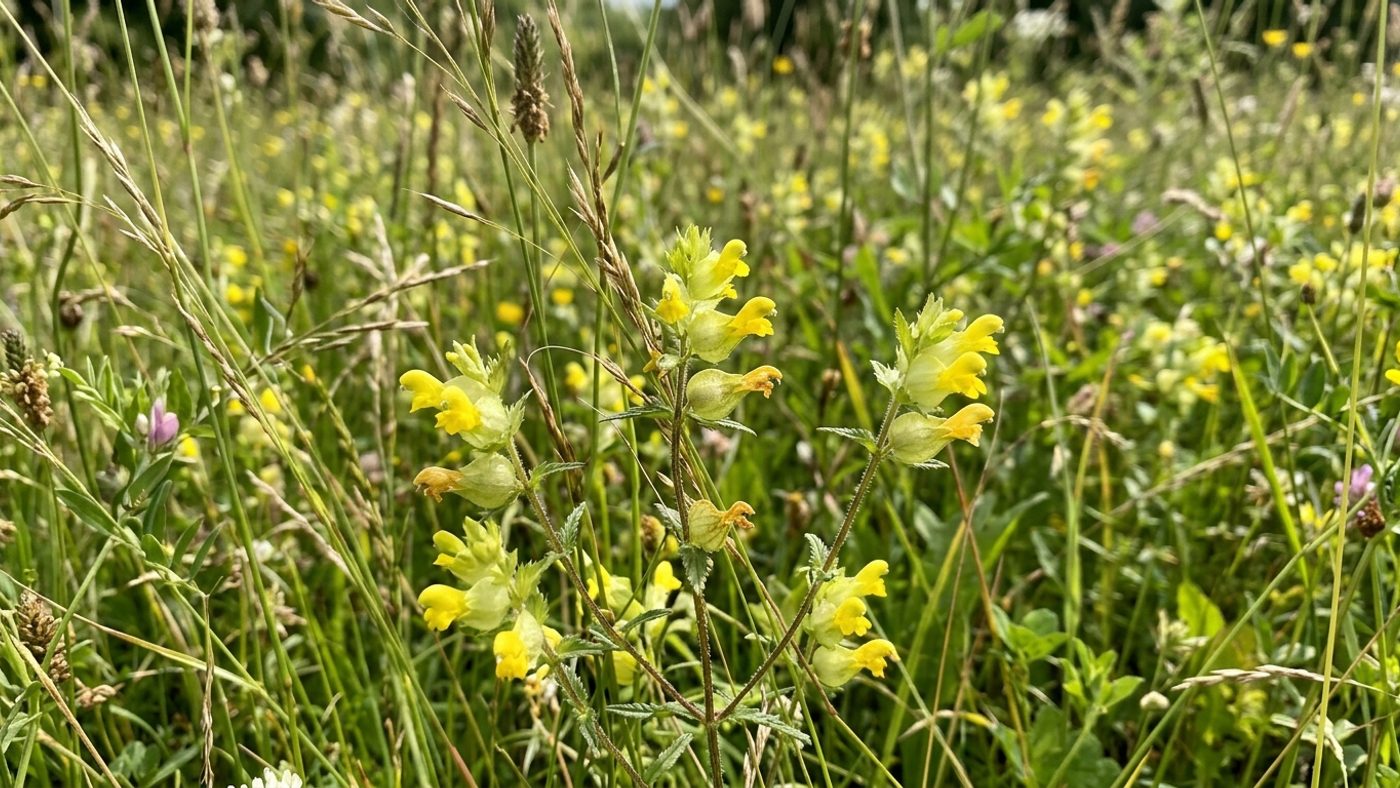
Because it's semi-parasitic on grass roots rather than free-living, yellow rattle needs to be sown into ground that already has grass present, or into the same sowing as a grass-inclusive wildflower mix, not into bare soil on its own. It's typically scattered onto ground that's been cut short, in late summer or early autumn, and once it's established it will self-seed and reappear each year unmanaged, provided the meadow isn't cut before it's had the chance to set its own seed. It's an annual, so a population that fails to set seed one year can vanish the next, one of the reasons the first cut of the year needs to be timed after yellow rattle has shed its seed, not before.
There's no specific evidence that Scotland's cooler, wetter growing conditions change how yellow rattle behaves mechanically, it parasitises grass roots the same way regardless of region, but a shorter, cooler growing season does mean it may need a little longer to establish a strong self-sustaining population, which is one more reason to expect a meadow to take a few years to hit its stride rather than one.
The first year will look like a disappointment: that's normal
This is the point most generic guides skim past, and it's the single most common reason people conclude their wildflower patch has failed when it hasn't. In year one, a newly sown wildflower patch typically looks thin, patchy, weedy, and mostly green. Perennial wildflowers put their first-year energy into roots and a low rosette of leaves rather than into flowering, so a meadow that was sown with a proper perennial mix can go through an entire first summer with barely a bloom in sight, while opportunistic annual weeds, the kind that colonise any patch of bare, disturbed soil, flush up in their place and make the whole area look scruffy and uncontrolled rather than deliberate.
This is expected, not a sign anything has gone wrong, provided the mix and preparation were right. Perennial wildflowers commonly take at least two years to flower well from seed, and a meadow usually needs several years of the right cutting regime before it reaches anything like its full display. The first year's job is mowing, not flowering: cut whenever growth reaches around 10-20cm, taking it back down to roughly 5-7cm, repeating this through the first growing season, anywhere from one to four cuts depending on how fast things grow, and always removing the cuttings afterwards rather than leaving them to rot down and feed the soil. This cutting regime is what knocks back the weeds and stops them from swamping the slower-growing perennial seedlings underneath, buying the wildflowers the time they need to get established.
From the second year onwards, the regime relaxes to the normal meadow pattern, leaving the patch uncut through spring and summer to let everything flower and set seed, then cutting once in late summer or early autumn, always removing the cuttings. Late summer/autumn also keeps the cut clear of the main nesting season for ground-nesting birds and the main breeding period for the caterpillars and other invertebrates a longer-grass patch tends to attract, one more reason the annual cut sits where it does in the calendar rather than earlier.
Framed as a rough timeline, a realistic expectation looks like this:
| Stage | What to expect | What to do |
|---|---|---|
| Year one | Patchy, mostly green, weedy annuals visible, few or no perennial flowers | Mow repeatedly through the season (5-7cm, whenever growth hits 10-20cm), always remove cuttings |
| Year two | First real flowering from the sown perennials; still uneven | Switch to the standard regime: leave uncut through spring/summer, one cut in late summer/early autumn, remove cuttings |
| Year three onwards | Fuller, more even flowering; self-seeded species filling gaps; yellow rattle (if sown) reappearing on its own | Maintain the annual late-summer cut, keep removing cuttings, spot-weed any coarse dominant patches |
Weeding out obvious problem species, docks, thistles, and coarse perennial weeds, by hand through the first year or two also pays off, since these compete just as hard as grass does and are far easier to pull individually while the patch is still establishing than once it's thick with wanted growth.
A mown strip or path around the patch's edge makes a real difference to how it reads to anyone else looking at the garden, especially while it's still going through its scruffy first year. A tidy border around an untidy centre is a well-known way of signalling "this is deliberate" rather than "this got forgotten about", the same instinct covered in more detail in the guide to rewilding a lawn section, and just as useful applied to a sown patch as to an uncut strip.
Common questions
Can I just scatter wildflower seed onto my existing lawn without stripping the turf?
Not with much success. Established turf is usually too fertile and too densely rooted for wildflower seed to get the bare soil contact and low-competition start it needs. Direct sowing works reliably only after fertility has been reduced and at least some of the existing grass cover has been cleared or opened up, otherwise the seed either fails to germinate or germinates and is quickly outcompeted.
How big does a wildflower patch need to be to be worth doing?
There's no real minimum. A patch a couple of metres square, sown with a genuine perennial mix and prepared properly, will establish and flower just as reliably as a much larger area, it will simply support fewer plants and a smaller range of species. Size matters more for the range of wildlife it can support than for whether the sowing itself succeeds.
Do I need to buy yellow rattle separately, or is it in most wildflower mixes?
It depends on the supplier, some native perennial meadow mixes include it, others sell it separately as an add-in. Check the mix description before buying; if it isn't listed as an ingredient, it's usually available to buy on its own and can be scattered into an already-sown or existing grassy area in late summer or autumn.
My patch is mostly grass with hardly any flowers after a year, did something go wrong?
Not necessarily, especially if it's still in its first year, that's the expected look. Past year two, though, a still grass-dominant patch is worth investigating rather than waiting out further: re-test the soil pH and fertility, check whether yellow rattle actually established, and check whether deer or rabbits have been grazing the wildflower seedlings back down to nothing while leaving the tougher grass alone, a real risk on any rural or semi-rural patch.
What's the difference between this and just leaving a strip of lawn to grow long?
Leaving an existing lawn strip uncut relies entirely on whatever's already present in the turf, usually common lawn survivors like clover, self-heal, and daisies, and improves gradually as the uncut, cuttings-removed regime slowly lowers soil fertility over several years. Sowing a proper wildflower mix into a prepared, stripped patch introduces a much wider range of native species from the outset and, on the right soil, gets to a colourful result faster and with more variety than waiting for the existing turf to change on its own.
Sources
5 sources, recorded with what each was used for
- RHS: Creating wildflower meadows: Turf-stripping and cover-crop methods of reducing soil fertility, annual vs perennial mix distinction, sowing windows, yellow rattle sowing method, first-year mowing regime
- The Wildlife Trusts: How to grow a wild patch or mini meadow: The soil fertility principle, ground preparation depth, cornfield-annual mix use on high-fertility soil, first-year cutting heights and frequency
- Plantlife: No Mow May: Framing on leaving areas of grass unmown and common wildflower species that establish in lightly-managed grass
- Plantlife: Managing grassland: General confirmation of wildflower meadows as habitat and grassland management principles
- Scottish Wildlife Trust: Making room for meadows: The Scottish native meadow species list and the vigorous grass species (cock's-foot, Yorkshire fog) that outcompete wildflowers on Scottish sites