
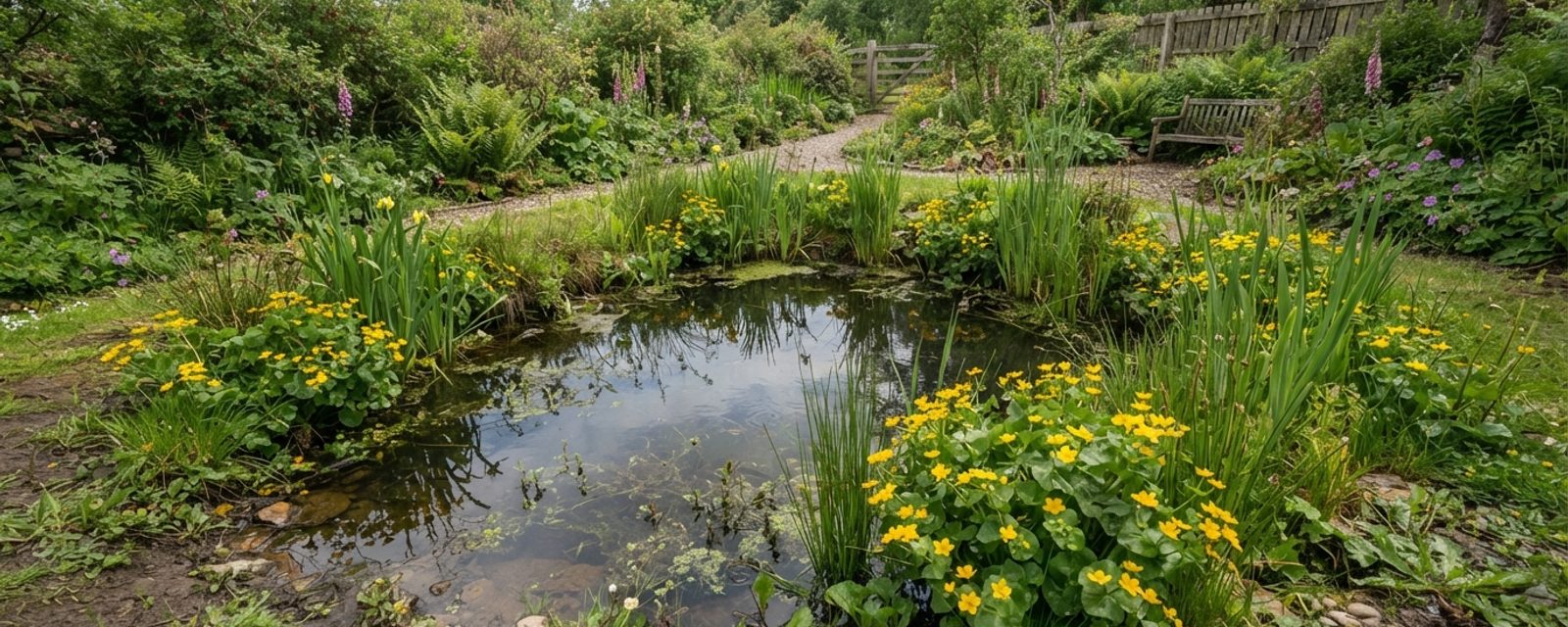
Most Scottish gardeners who get dragonflies at all get the same version of it: a hawker patrols the lawn on a warm July evening, hunting flies over the grass, and is gone within the hour. Maybe a red damselfly perches on a bean cane for a few minutes. It happens most summers, sometimes more than once, and yet nothing ever seems to build on it. No larvae turn up. No papery cast skins appear on stems in spring. No population that returns and grows year after year.
What's visiting is a hunting adult, not a resident. Adult dragonflies and damselflies range widely from where they hatched, and a garden with flying insects to eat and a sheltered spot to perch in will draw them in to feed. But feeding is not breeding. For that, the insect needs water, specifically, water it can lay eggs in and where its young can develop for months or years before ever taking wing. A garden with no water feature at all can be a good hunting ground. It cannot be a breeding ground.
Telling them apart
The reliable field mark is what the wings are doing when the insect is at rest. Dragonflies hold their wings open, out to the sides, roughly at right angles to the body. Damselflies fold theirs back, closed, along the length of the body. It holds even when size and colour are ambiguous.
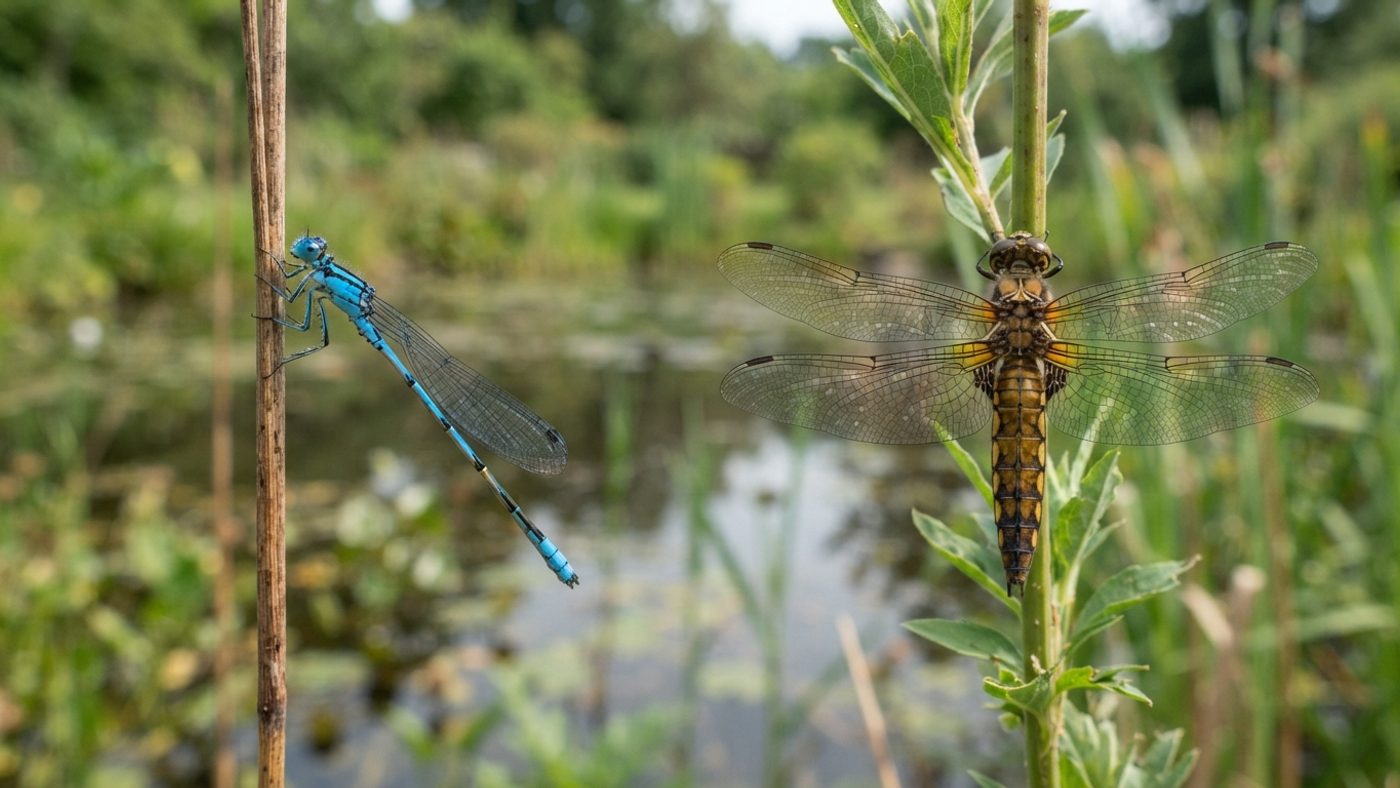
A few supporting points, useful once you've got the wing position:
- Body build. Dragonflies are chunkier and shorter-bodied; damselflies are slimmer, longer, and more delicate, often described as twig-like.
- Eyes. A dragonfly's eyes are large and touch, or nearly touch, across the top of the head. A damselfly's eyes are smaller and set apart, with a visible gap between them.
- In flight. Dragonflies, especially the hawkers, are powerful, fast, direct fliers that can hover and even fly backwards while hunting on the wing. Damselflies are lighter and less forceful in the air, usually seen close to marginal vegetation rather than patrolling open water.
Both groups belong to the same insect order, Odonata, whose ancestry goes back roughly 300 million years, long before birds existed.
Why they're worth having: the pest-control case
The reason to want dragonflies and damselflies around isn't purely aesthetic. Adults are active hunters that take other flying insects on the wing, and midges and mosquitoes are named prey items. It's one of the more direct forms of biological pest control a garden can host, see the guide to gardening around the midge for managing midges directly.
A dragonfly hunting over the garden on a July evening is a bonus, not a control programme: it won't meaningfully suppress a midge population on its own. A resident breeding population hunts the same patch continuously, which is where the pest-control value actually adds up over a season.
The part that isn't optional: water to breed
Dragonflies and damselflies lay their eggs in or near fresh water, usually into aquatic vegetation, and the larvae, which live entirely underwater as fierce little predators of other invertebrates, take anywhere from several months to several years to develop, depending on the species, before crawling out of the water to moult into an adult.
A pond, or at minimum a small water feature built to the right design, is the one non-negotiable addition that turns passing visitors into residents.
What makes a pond actually work for them
Not every pond does the job. A neat, steep-sided ornamental pond with a fountain and goldfish looks like water habitat and functions as almost none. Four things separate a pond that will produce breeding dragonflies and damselflies from one that won't:
| Feature | What to aim for | Why it matters |
|---|---|---|
| Edges | Shallow and sloping, not vertical, a ramp if retrofitting a formal pond | Larvae have to climb physically out of the water to emerge as adults; a straight-sided pond traps them |
| Depth | Varying across the pond, roughly 20-60cm | Suits most pond plants and animals; most pond wildlife lives in the shallows, not the deep centre |
| Plants | Native emergent plants with tall stems (water iris is a good example), submerged oxygenating plants, and floating plants such as waterlilies | Emergent stems give larvae something to climb; submerged plants give them cover underwater; floating plants double as adult basking platforms |
| Fish | None | Fish are effective predators of dragonfly and damselfly larvae, a fish pond can still attract hunting adults, but it won’t produce a resident population |
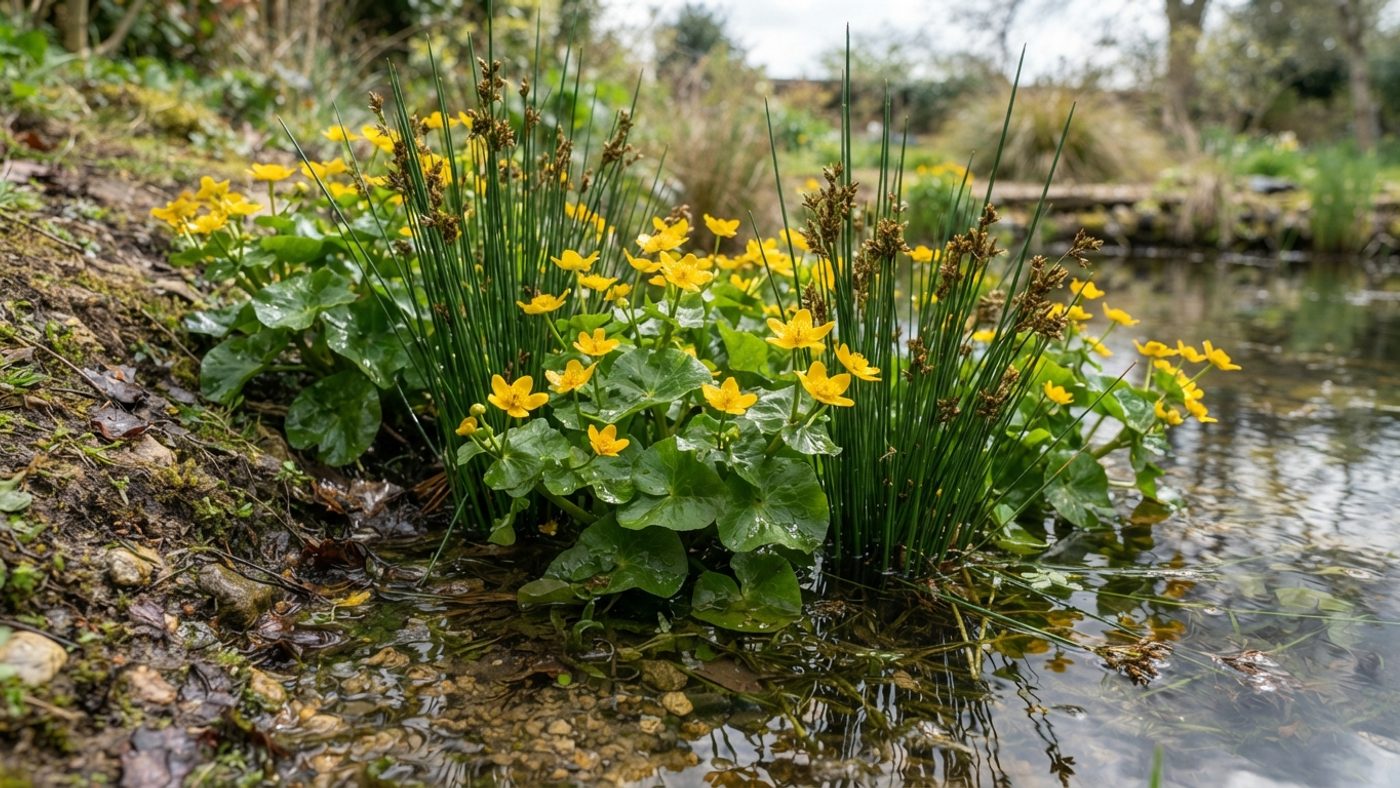
The "no fish" rule is the one that catches people out most, because a pond can look perfect, sloped edges, the right plants, plenty of sun, and still fail on this alone. The white-faced darter, a rare dragonfly restricted to a handful of acidic Highland peat bogs rather than anything a typical garden pond could host, names fish as one of the direct threats to its remaining populations, a striking illustration of how seriously the "no fish" rule matters even at the most specialised end of the scale. A gardener with an existing ornamental fish pond doesn't need to empty it to get dragonflies breeding, a second, smaller wildlife pond elsewhere in the garden, built without fish, does the job instead.
Pesticides and slug pellets used anywhere near the pond, not just in it, wash or leach into the water and kill larvae along with the smaller invertebrates they feed on, undoing a well-built pond's design just as effectively as steep sides or fish would. And whatever plants go in, buy or source them from a reputable supplier rather than taking cuttings from the wild or an unknown pond: several popular pond plants are now banned from sale in the UK because of how aggressively they spread once they escape into open water.
Flat stones or bare patches of ground at the pond edge give adults somewhere to bask and warm up between hunting flights, alongside the perching spots tall marginal plants already provide.
Full sun over at least part of the pond also matters, warming the water faster in spring and benefiting egg-laying and larval development, worth prioritising specifically in a cooler Scottish garden, where a slow-to-warm pond delays the whole season. Shade over another part of the pond helps keep algae down.
There's no fixed minimum size: even a small container pond can support some breeding activity, but a larger pond with more varied depth and planting generally supports more species. A new pond with sloping, planted edges is also a genuine drowning risk for young children in the same way any garden pond is, fence or supervise it until the household's circumstances change, the same caution that applies to any water feature.
Leave marginal vegetation standing over winter rather than cutting it back, and avoid clearing or netting the pond in spring and summer when larvae are active near the surface preparing to emerge, a well-timed autumn tidy does far less damage than the same job done in May.
The reward for getting all of this right shows up as a papery, empty exoskeleton, an exuvia, left clinging to a pond-marginal stem in late spring or summer, the shed casing of a larva that has just climbed out of the water and moulted into an adult. The blue-tailed damselfly is one species known to leave its exuvia in plain sight on low waterside vegetation, making it a good one to watch for. Finding any exuvia at all is the clearest sign a pond has gone from hosting visitors to actually breeding them.
What you'll realistically see in Scotland
The British Isles have 56 breeding dragonfly and damselfly species in total. Scotland's realistic garden-pond list is a much shorter subset of the widespread ones, plus a handful of cold-adapted specialists most gardens will never see.
Record counts from NBN Atlas Scotland make the pattern concrete. Widespread species that regularly use garden ponds have tens of thousands of Scottish records; southern species that occasionally stray north have only a few hundred.
| Species | Scottish NBN Atlas records | When on the wing (UK-wide) | Notes |
|---|---|---|---|
| Common blue damselfly (Enallagma cyathigerum) | 24,913 | April-September | Scotland’s most-recorded damselfly; regular garden visitor |
| Large red damselfly (Pyrrhosoma nymphula) | 32,577 | April-August | Usually the first damselfly to emerge each year |
| Common hawker (Aeshna juncea) | 20,466 | Late June-October | Regular garden-pond breeder, widespread across Scotland |
| Black darter (Sympetrum danae) | 14,276 | June-October | UK’s smallest resident dragonfly; moorland, heath and bog |
| Golden-ringed dragonfly (Cordulegaster boltonii) | 13,576 | May-September | Larvae favour running water and can take up to 5 years to develop |
| Azure hawker (Aeshna caerulea) | 1,547 | — | Vulnerable on the conservation Red List; a cold, high-altitude Highland specialist, not a garden-pond species |
| Emperor dragonfly (Anax imperator) | 618 | — | A large, mainly southern species; present in Scotland only in small numbers |
The azure hawker is the clearest example of a genuinely Highland specialist: a cold, high-altitude species of acidic upland pools and peat bogs rather than garden ponds, and one a typical garden isn't the place to expect. A well-built garden pond in most of Scotland is realistically aiming for the common, widespread species in the table above, not specialists like it.
Does Scotland's cooler climate change anything?
Development time for dragonfly and damselfly larvae varies a great deal by species: most complete their underwater stage in about a year, but some of the larger species take two to five years, and the golden-ringed dragonfly's larvae can spend as long as five years developing in a stream bed before emerging.
Scotland's own cold-adapted specialists, the azure hawker among them, are adapted to cold, acidic, high-altitude habitats a garden can't replicate. The flying-season dates given above are UK-wide figures, not Scotland-specific ones, since no source in this article's library breaks emergence timing down by region; a Scottish garden's own dates may run a little later, particularly in a cold or slow-to-warm spring, without changing which species are realistically present. A slower-to-warm pond in a cooler garden delays egg-laying and larval activity at the start of the season, which is the practical reason full sun over at least part of the pond matters more here than it would further south.
The species list isn't fixed, either: migrant hawkers have been extending their range northward in recent decades, a shift consistent with the wider pattern of insect ranges tracking a warming climate. Which species turn up in a Scottish garden pond may keep changing rather than staying static.
Common questions
Will a small water feature without a full pond attract dragonflies?
It can bring in hunting adults looking for prey, but breeding needs something more substantial: enough open water with shallow, planted margins for egg-laying and for larvae to develop and climb out. A tiny container feature is unlikely to support the full life cycle, though even a modest wildlife pond can.
Do I need to remove fish from an existing garden pond?
If the goal is breeding dragonflies and damselflies specifically, yes, fish are effective predators of the larvae, and reduce a garden pond’s overall wildlife value. A fish pond can still attract hunting adults; it’s unlikely to produce a resident population.
How long before a new pond has breeding dragonflies?
There’s no fixed answer, but larval development itself takes anywhere from about a year to several years depending on the species once eggs are laid, so a new pond is a multi-year project even after the first adults find it. Watch pond-marginal stems for exuviae, the papery, shed casing a larva leaves behind when it climbs out and moults into an adult, as the clearest sign it’s actually working.
Are dragonflies dangerous or likely to sting?
No, they don’t sting, and they’re not aggressive toward people. They’re active predators of other insects, not of anything larger.
Which Scottish species should I actually expect in a garden pond?
Realistically, the common blue damselfly, large red damselfly and common hawker are the most likely regular visitors and breeders in a well-built pond across most of Scotland, based on how heavily they’re recorded here. Highland specialists such as the azure hawker are bog and upland-pool species, not garden visitors.
Curious about other wildlife your garden might be overlooking? See earthworms, garden spiders and lacewings.
Sources
19 sources, recorded with what each was used for
- RHS: Wildlife ponds, how to make them: Pond depth, sloping sides, native emergent/oxygenating plants, sun exposure, fish as predators reducing biodiversity
- RHS: Water habitats: Shallow margins, sloping sides vs vertical formal ponds, container ponds for dragonflies/damselflies in small spaces
- NatureScot: Dragonflies and damselflies: Wing position ID, prey (midges, mosquitoes and others), breeding species counts, egg-laying and larval development, breeding in ponds and lochs
- NBN Atlas Scotland: Azure Hawker: Scottish record count, Red List status
- NBN Atlas Scotland: Common Hawker: Scottish record count, conservation status
- NBN Atlas Scotland: Common Blue Damselfly records: Scottish record count
- NBN Atlas Scotland: Large Red Damselfly records: Scottish record count
- NBN Atlas Scotland: Golden-ringed Dragonfly records: Scottish record count
- NBN Atlas Scotland: Black Darter records: Scottish record count
- NBN Atlas Scotland: Emperor Dragonfly records: Scottish record count (comparison species)
- Wildlife Trusts: Common hawker: Flying season, habitat, comparison to azure hawker
- Wildlife Trusts: Large red damselfly: Flying season, garden pond association, earliest emerger
- Wildlife Trusts: Common blue damselfly: Flying season, most common UK damselfly
- Wildlife Trusts: Golden-ringed dragonfly: Flying season, larval development time (up to 5 years)
- Wildlife Trusts: Black darter: Flying season, distribution
- Wildlife Trusts: Blue-tailed damselfly: Exuvia/emergence description
- Wildlife Trusts: Where to see dragonflies and damselflies: UK species totals, general wing/body ID, seasonal timing
- Buglife: White-faced Darter: Scottish Highlands stronghold, fish as a threat, biennialA plant that completes its life cycle over two years: growth in year one, then flowering, seeding and dying in year two. Full definition →-or-longer life cycle
- Buglife: Migrant Hawker Dragonfly: Larval development time generally, recent range expansion northward