
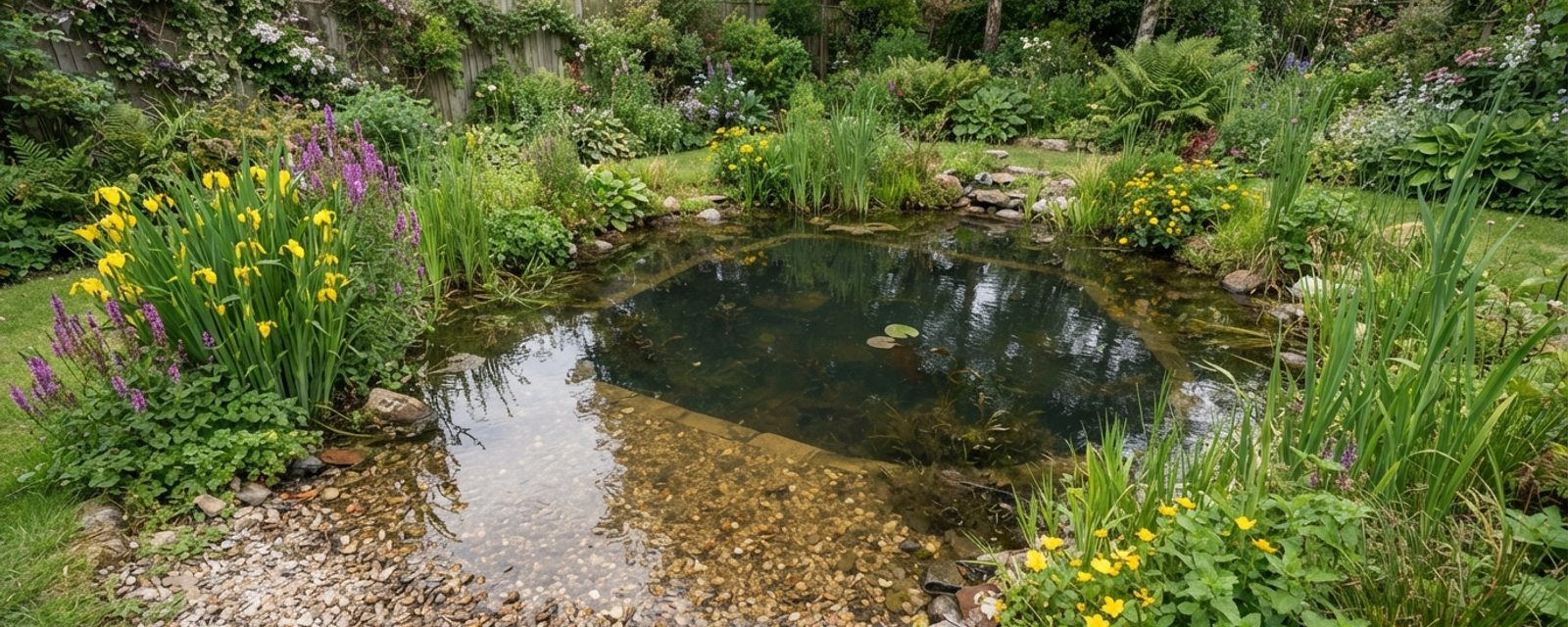
Frogs, toads, newts, dragonflies, damselflies, and a long list of aquatic invertebrates all share one requirement that no amount of good garden design elsewhere can substitute for: still, open water. It's not a preference, it's a mechanical necessity built into how these animals reproduce. A frog's spawn has to float on a water surface to develop. A damselfly larva has to live submerged for months, sometimes years, breathing through gills, before it can climb a stem and moult into a flying adult. A newt's courtship display happens in open water, not on land. None of that can happen in a damp border, a boggy corner, or a birdbath, those features support different wildlife, but they don't offer the one thing a breeding cycle in water actually needs: a body of standing water deep and stable enough to hold a life stage through to completion.
Dragonflies and damselflies are one example already covered on this site in more depth; this piece is the build itself, from siting and digging through to planting, and one decision that matters more than any other once it's finished: don't stock it with ornamental fish.
Siting the pond
Aim for a spot that gets sun for at least part of the day. Warmth speeds everything a pond needs to do, it helps water warm up in spring, which brings frogs and toads into spawning condition earlier, and it keeps submerged and marginal plants growing well enough to support the invertebrates and larvae living among them. At the same time, some shade over another part of the pond helps keep water temperatures more stable and reduces the algae growth that full, all-day sun on still water tends to encourage.
Keep the pond away from overhanging trees. Falling leaves in autumn rot down in the water, using up oxygen as they decompose and silting up the bottom faster than is useful, a problem that compounds with the ice-cover risk covered below, since a pond already carrying a heavy load of rotting leaf litter has less oxygen in reserve for whatever's overwinteringKeeping a plant alive and intact through the cold months, whether left outdoors, moved under cover, or stored dormant. Full definition → in it.
Avoid siting a pond where fertiliser or lawn feed can run off into it after rain, nutrient-rich runoff from an adjacent lawn or border is one of the more common causes of a new pond turning green with algae within its first season. A spot near a building where rainwater naturally drains off a roof, or where a downpipe can be diverted into the pond, is a practical bonus.
A practical upside for much of Scotland: the west and Highlands sit among the wettest parts of the UK, over 4 metres of rain a year at the wettest sites, driven by the mountains forcingCovering plants to exclude light and speed early, tender growth in the dark, most associated with rhubarb and sea kale in late winter. Full definition → moist westerly air upward, so a pond there typically needs less deliberate topping up during dry spells than the same pond would further south. The UK's overall rainfall divide runs broadly northwest to southeast, though, so that benefit is strongest in the west and weakest toward Scotland's own drier southeast; either way, a prolonged dry spell can still drop the water level enough to need a top-up.
A well-planted, well-stocked wildlife pond also does double duty as a hunting ground for adult dragonflies, which take midges on the wing, worth knowing for a west-coast or Highland garden where midges are a genuine nuisance; see managing them directly in the guide to gardening around the midge.
Digging the profile: shelves, slopes, and one deep section
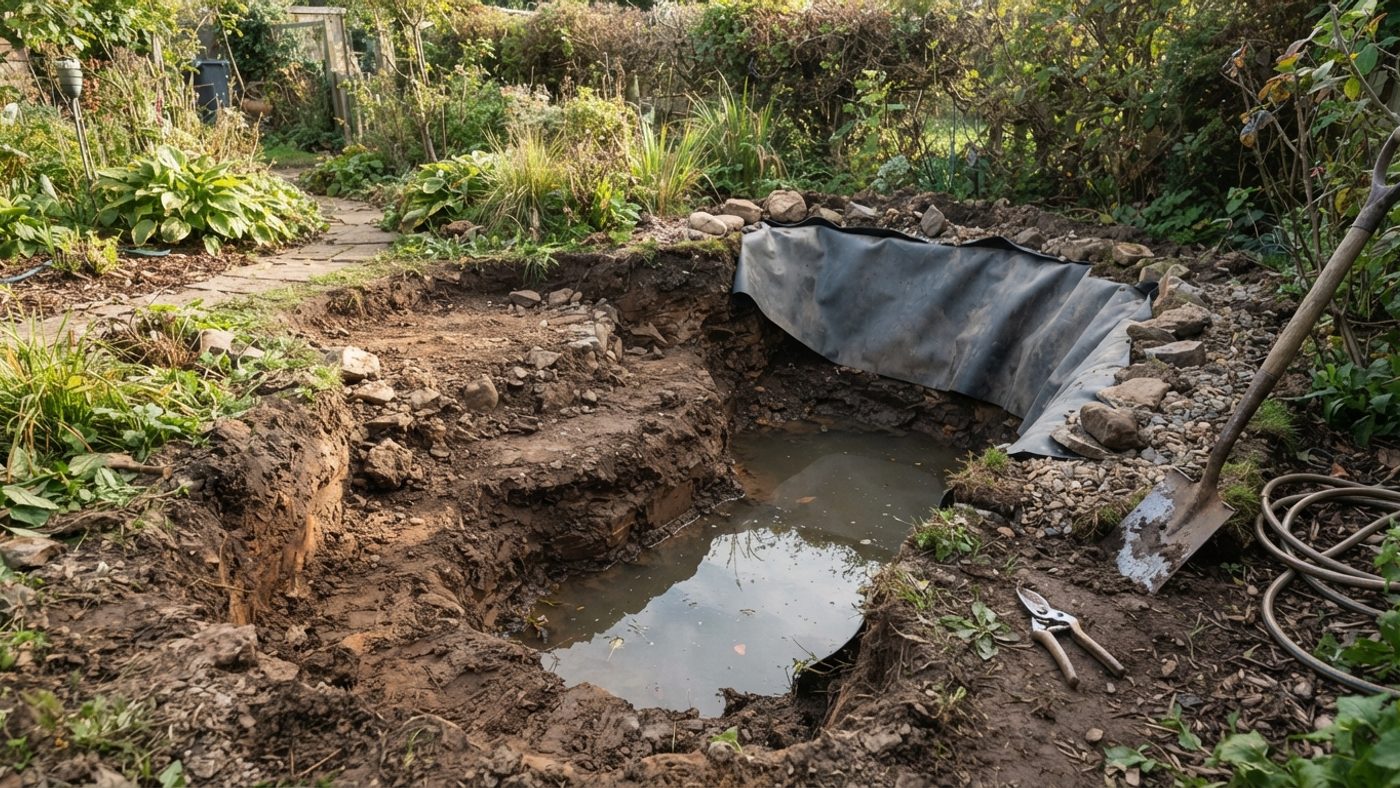
The shape of the hole matters more than almost anything else in this guide. A pond dug as a uniform bowl, or worse, a formal pond with straight vertical sides, is close to useless for wildlife: amphibians and invertebrates that fall or climb in can't climb back out, and the wide, gently graded shallow margins where most pond wildlife actually lives simply don't exist.
The fix is a shelving, sloped profile rather than a single depth:
- At least one long, shallow-sloping edge, often called a "beach", running from the water's edge down into the pond at a gentle gradient. This is the single most important access feature: it lets frogs, toads, hedgehogs, and birds walk in and out under their own power rather than needing to jump or climb a vertical face, and it's also where most of a pond's plant and invertebrate life will actually establish.
- A shelf partway down, typically in the 20-30cm range, wide enough to hold marginal and shallow-water plants in pots or planting baskets.
- At least one deeper section, ideally around 60cm at its deepest point, positioned centrally or wherever suits the pond's shape.
Check that the rim is level all the way round before lining, a plank laid across the hole with a spirit level on top is enough to catch a lopsided dig, which otherwise shows up as an ugly exposed liner edge on one side once the pond is full.
If rock or heavy clay subsoil close to the surface makes reaching a full 60cm awkward in one spot, shift the deep section sideways to wherever the ground actually allows it rather than forcing it dead centre, position matters less than getting the depth itself right.
Why the deep section matters in Scotland
The 60cm figure isn't arbitrary. Frogs regularly overwinter at the bottom of ponds, burying themselves in the silt and breathing through their skin rather than leaving the water for the coldest months, and a deep central section gives them somewhere to do that without the water above them freezing solid. Even a pond just 10cm deep should hold onto some liquid water at the bottom in an ordinary UK winter, but a longer, more severe cold snap, the kind more likely in an inland or upland Scottish garden than further south, is what pushes ice all the way through a shallow pond. A pond frozen solid top to bottom traps decomposition gases that would otherwise escape and starves anything overwintering underneath of oxygen, the practical reason a genuinely deep section matters, not just a nice-to-have.
It's also why excess silt shouldn't be scraped out of the deep section during pond maintenance, that layer is exactly where overwintering frogs are likely to be, and why a frozen surface should never be smashed to open it up: the shards can tear a liner and the shockwave through the water can kill whatever's underneath. Floating a ball on the surface before a hard freeze sets in, or standing a pan of hot water on the ice to slowly melt a hole, opens a gap for gas exchange without the risk.
Lining options
| Lining type | How it works | Best for |
|---|---|---|
| Flexible liner (butyl rubber) | A single sheet of durable, flexible rubber laid over a sand or underlay base and shaped to the dug profile | Most garden ponds — handles curves, slopes and irregular shapes well |
| Preformed/moulded liner (plastic or fibreglass) | A rigid pre-shaped shell dropped into a hole dug to match its outline | Small, simple ponds where speed and a fixed shape are acceptable, but most don't include a proper shallow, sloping edge |
| Puddled clay / sodium bentonite | A thick clay layer compacted to form a watertight base with no synthetic liner at all | Larger ponds, or a genuinely traditional approach; more labour and site-dependent than a liner |
Whichever liner goes in, protect it from anything sharp underneath, a layer of soft sand or proprietary underlay across the whole dug profile before the liner goes down prevents stones from puncturing it later, once the weight of the water is pressing down. Measure the liner size needed before buying: length and width of the hole, each plus twice the maximum depth, plus a little extra on each side to overlap the edges.
Late autumn to late winter is a reasonable time to build: a pond started then has longer to settle and establish planting before the following spring's breeding season gets underway.
Once the liner's down, conceal the exposed rim with gravel or pebbles banked up around the edge, or a proprietary stone liner bonded to the top of it. Turf laid right up to and over the edge looks natural at first, but grass roots grow into the water within a season and wick it away, so it's worth stopping turf a little short and covering the rim by another method instead.
Planting zones: what goes where and why
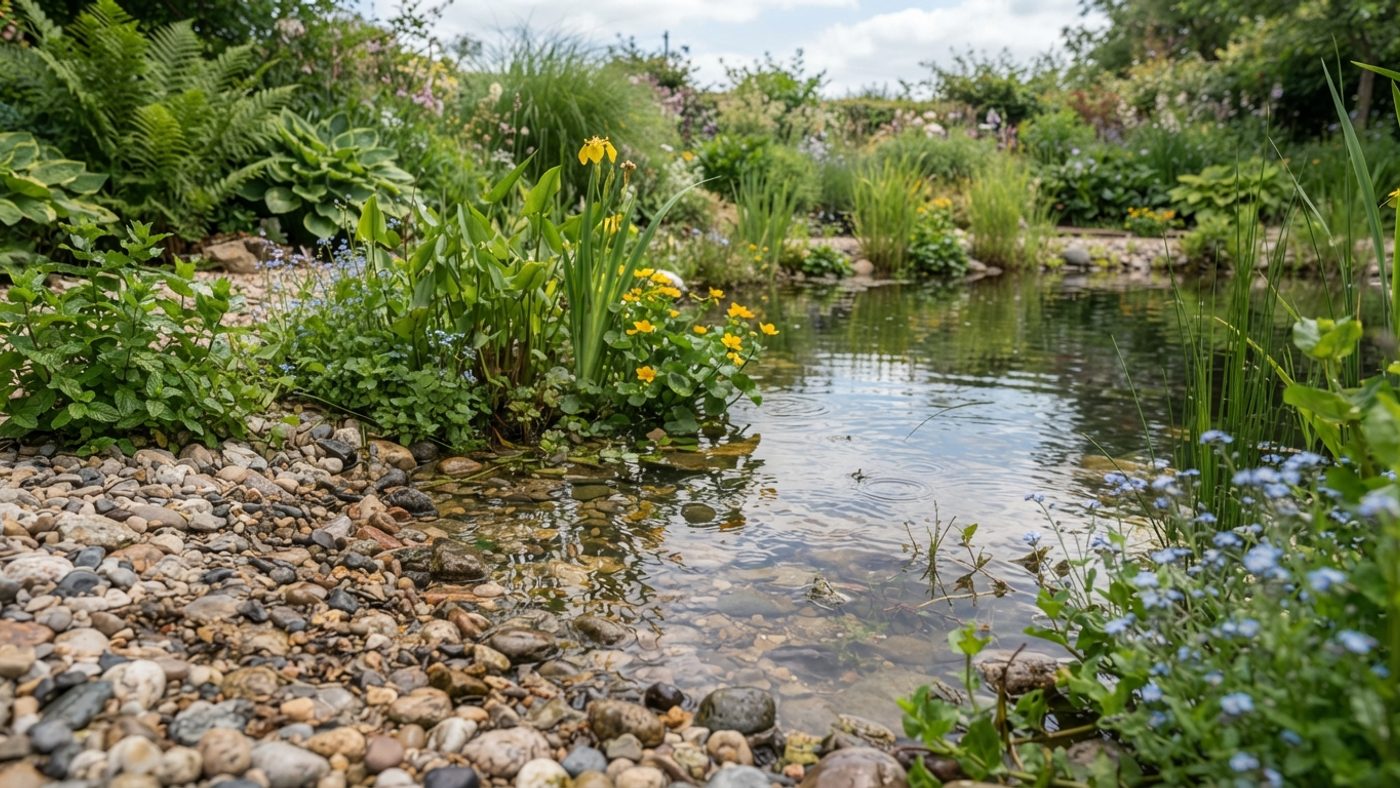
A wildlife pond works in layers, not as one uniform mass of water, and each planting zone does a different job.
| Zone | Typical depth | What it does | Examples |
|---|---|---|---|
| Submerged (oxygenating) | Fully underwater, often the deepest parts | Grows entirely below the surface, releasing oxygen and giving small invertebrates and larvae cover to hide in | Hornwort, native pondweed |
| Floating-leaved | Rooted in deeper water, leaves at the surface | Shades part of the surface (helps control algae); leaves double as basking/resting platforms for adult insects | Native white waterlily |
| Marginal / emergent | Shallow water and the pond edge | Tall stems give larvae something to climb when ready to moult into flying adults, and give amphibians cover | Yellow flag iris, marsh marigold, rushes |
Stick to native aquatic plants bought from a reputable supplier rather than taking cuttings from an unknown pond or the wild. New Zealand pigmyweed (Crassula helmsii) and floating pennywort (Hydrocotyle ranunculoides) are both banned from sale in the UK, and both are capable of forming a dense mat across the entire water surface, blocking light and oxygen from everything living beneath it, exactly the kind of plant an unfamiliar cutting can carry in without any way to tell until it's established. Moving frogspawn, pond plants, sediment or water between ponds is best avoided too: it's one of the ways ranavirus, a disease that can cause mass frog deaths, spreads between sites, so keep new planting to bought stock and avoid transferring anything from another pond, however healthy that pond looks.
Do not stock the pond with ornamental fish
Don't add ornamental fish, goldfish, koi, or anything else, to a pond built for wildlife. Fish are effective predators of frog and toad spawn, tadpoles, and newt larvae, and they eat the same invertebrates that dragonfly and damselfly larvae rely on for cover and food. A pond stocked with fish can still attract hunting adult insects and the occasional passing amphibian, but it won't reliably produce a resident breeding population of any of them, the fish simply eat the eggs and young before they get the chance to develop. Fish waste also raises nutrient levels in the water, which tends to feed exactly the algae growth a well-planted, well-sited pond is otherwise built to avoid.
If there's already an ornamental fish pond in the garden and rehoming the fish isn't an option, the practical answer is a second pond, built without fish, purely for wildlife, not converting the existing one.
Child safety
A pond built to the profile above, with a gently sloping beach edge rather than a sudden drop, is already safer than a steep-sided formal pond, but it's still open water and a real drowning risk for a young child, the same caution that applies to any garden pond regardless of size. A low picket fence around the pond keeps access controlled while still leaving the water visible, and close supervision around it for as long as young children are in the household is worth treating as standard, not optional.
After the pond: what else helps nearby
A pond covers the water side of amphibian life, but frogs, toads, and newts spend most of the year on land, and many need frost-free shelter to survive winter once they've left the water. A hibernaculum built nearby, a simple buried mound of logs, stone, and rubble, gives them somewhere to overwinter on land, and pairs naturally with a pond built to the profile above.
Common questions
How long before a wildlife pond attracts anything?
Some visitors, particularly insects, can find a new pond within days or weeks of it filling. Amphibians often take a season or more to find it and begin breeding, and a resident population of pond invertebrates or dragonfly and damselfly larvae is a multi-year project even once the first adults arrive, since larval development itself can take from several months to several years depending on the species.
Do I need to top up the pond during dry spells?
Yes, if the water level drops noticeably, rainwater is preferable to tap water where there's a choice, since tap water can carry chlorine and higher mineral content. In much of Scotland, naturally higher rainfall reduces how often this comes up compared with drier parts of the UK, but it doesn't remove the need entirely, especially in a dry summer or in the drier eastern counties.
Is a smaller pond worth building if there isn't room for a large one?
Yes. There's no fixed minimum size for wildlife value, even a modest pond with the right shelving profile, at least one deeper section, and appropriate planting can support breeding activity. A larger pond with more varied depth and planting will generally support more species, but a well-built small pond beats a badly shaped large one.
What about existing ornamental fish, do they have to go?
Not necessarily. If removing fish from an established pond isn't practical, building a second, smaller pond elsewhere in the garden without fish gets the wildlife benefit without disturbing the existing pond.
When's the best time of year to do the digging and construction work?
Late autumn through late winter, when most amphibians are least active, is the least disruptive window, and it gives new planting a head start before the following spring's breeding season.
Sources
9 sources, recorded with what each was used for
- RHS: Wildlife ponds, how to make them: Sloping shallow edges vs vertical formal-pond sides, depth range, sun/shade balance, liner types, four-zone planting structure, fish as top predators reducing pond biodiversity
- RHS: Water habitats: Siting near a building to catch rainwater/roof runoff, avoiding fertiliser runoff
- Wildlife Trusts: How to build a pond: Siting, sloping "beach" edge construction, checking level, butyl rubber liner, four planting zones, best time of year to build
- Froglife: Creating or improving ponds (FAQ): Fish-predation warning, 60cm minimum deep-section depth, sloping sides, frogs overwintering in silt
- Met Office: How much does it rain in the UK?: Scotland's higher rainfall relative to the rest of the UK, and the west/Highland vs. drier south-east contrast
- RHS: Aquatic weeds: New Zealand pigmyweed and floating pennywort as banned-from-sale invasive species
- Froglife: Disease — Ranavirus: Ranavirus as a cause of mass frog deaths, and advice against moving frogspawn/plants/sediment between ponds
- RSPB: How to make a wildlife pond: Pond fencing and child supervision
- Froglife: Frozen Frogs: Winter ice-cover risks, and safe methods for opening a hole in ice