
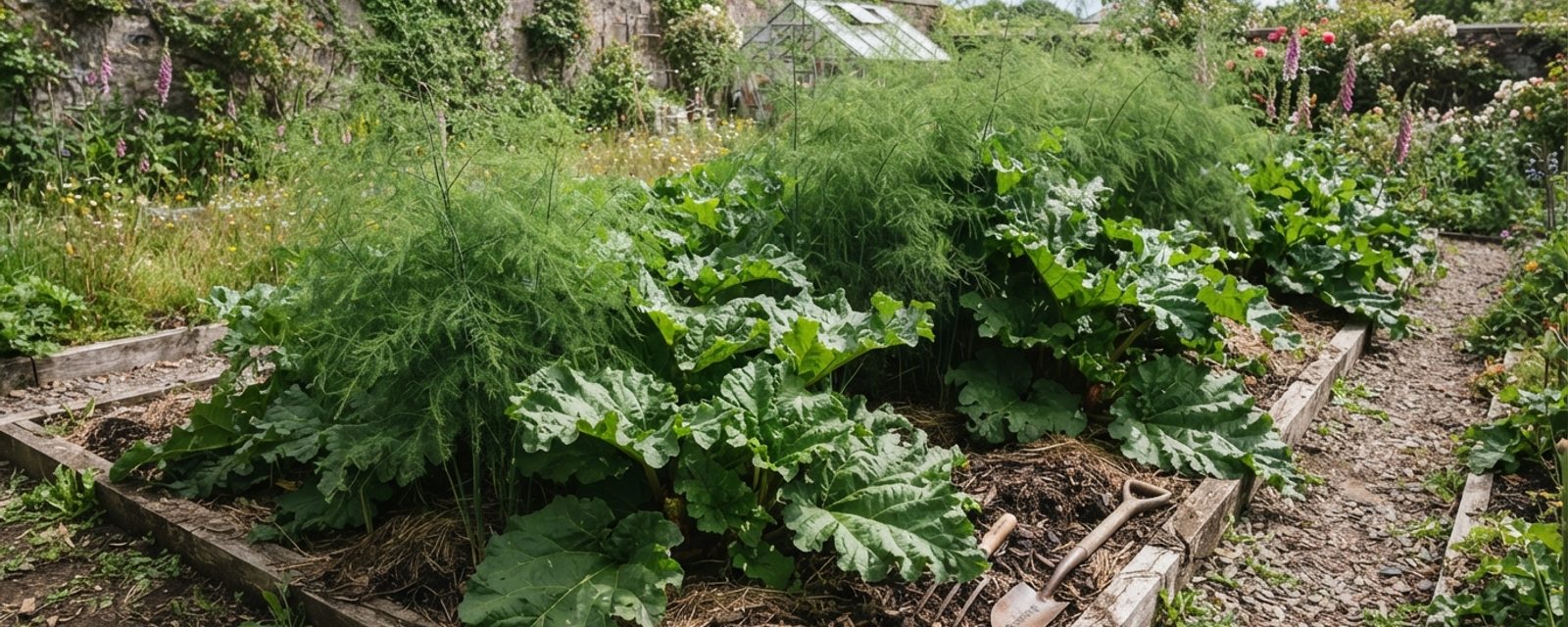
An asparagus crownThe base of a perennial plant where roots and shoots meet, often sold and planted as a ready-made dormant plant rather than grown from seed. Full definition → does something an annual vegetable cannot: it goes underground for winter with a root system already built, and comes back up in spring without being sown, pricked outMoving individual seedlings from the crowded tray they germinated in into their own space, once they have their first true leaves. Full definition →, or transplanted. That's the entire mechanism behind every perennial vegetable on this page. A carrot or a cabbage starts each season from a seed with no reserves of its own, you supply everything from scratch, every year. A perennial vegetable starts each season from a crown, clump, or tuberA swollen underground stem or root a plant uses to store energy, which can also grow into a new plant, the classic example being a potato. Full definition → that already has roots in the ground and stored energy left over from the previous year. It doesn't need to rebuild a root system before it can put energy into leaves, stems, or spears, it already has one, and it just resumes.
That difference is why perennial vegetables behave so differently in a garden plan. It's also why they ask for a completely different kind of bed than the one you dig over every March. This article is about deciding whether that trade is worth making, and if so, how to build a bed that will still be doing its job in ten years.
What counts as a perennial vegetable
A perennial vegetable is a vegetable crop that lives, and keeps cropping, for more than two years from the same root system, as opposed to an annual (sown, cropped, and cleared within one year) or a biennialA plant that completes its life cycle over two years: growth in year one, then flowering, seeding and dying in year two. Full definition → (which normally flowers and dies in its second year, unless you keep interrupting it, as with perennial kale below). Botanically, several of the most familiar "perennial vegetables" aren't vegetables at all: rhubarb is a perennial plant grown and eaten as a vegetable, even though a 1947 US court ruling famously classified it as a fruit for tariff purposes because of how it's used in the kitchen.
Here's the core list, with what's eaten and how each behaves as a perennial.
Four widely grown crops
Asparagus (Asparagus officinalis), the spears are the immature shoots, cut in spring before they open into fern. A crown, once planted, can go on producing for up to 20 years, but the RHS is clear that you don't cut any spears for the first two years: the crown needs that time to build enough root reserve to support both a harvest and the fern growth that feeds it back, a discipline covered step by step in the asparagus growing guide.
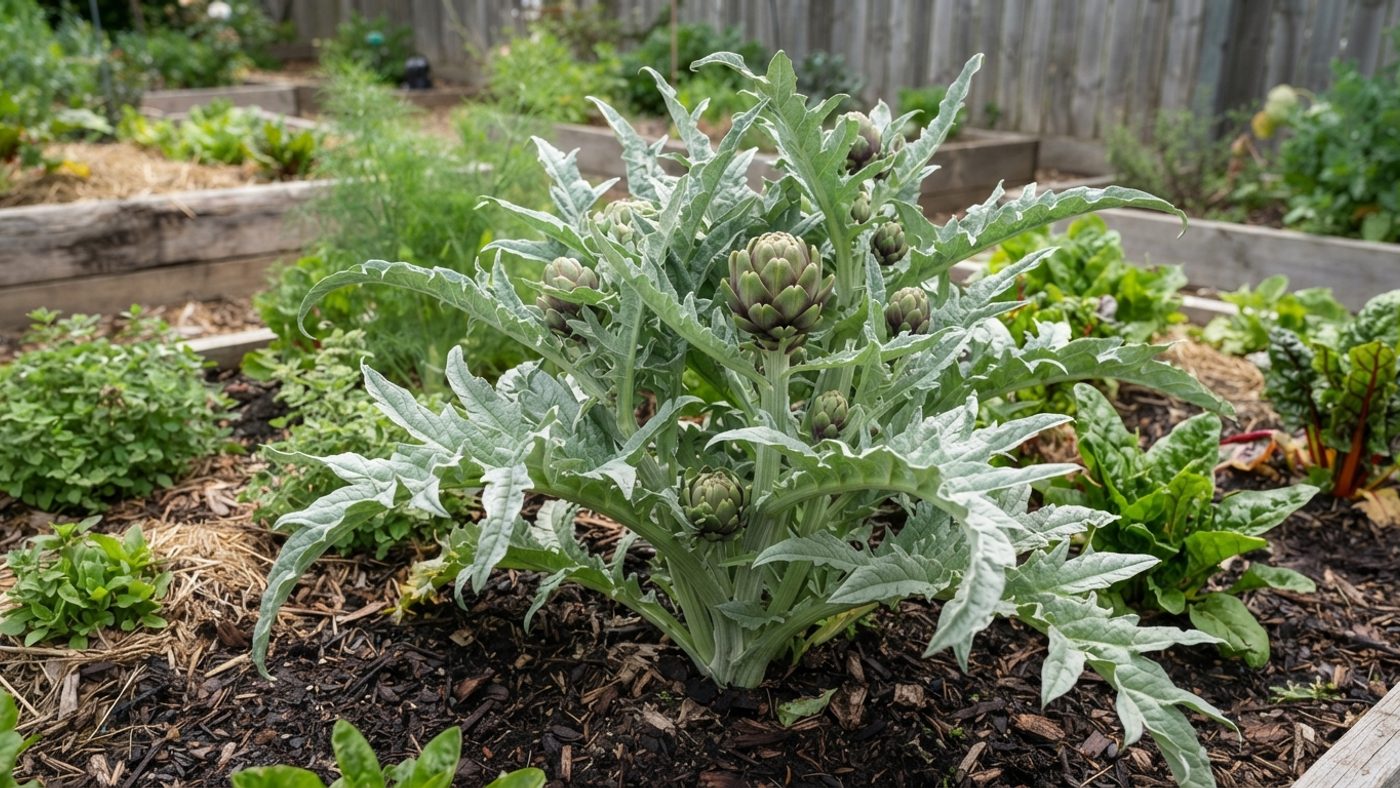
Globe artichoke (Cynara cardunculus Scolymus Group), the immature flower buds are the edible part, cut before the scales open. Established clumps build in productivity over three to five years and are usually lifted and dividedPropagating a clump-forming perennial by digging it up and splitting it into several smaller pieces, each with roots and shoots attached. Full definition → every four to six years to stop them declining. The RHS doesn't give it an H-number, but is clear that young plants are vulnerable in their first winter and need a mulchA layer of material spread over the soil around plants to suppress weeds, retain moisture, and improve soil structure as it breaks down. Full definition → plus clochesA small, portable clear cover placed over an individual plant or short row to trap warmth and keep off wind, rain and pests. Full definition → or fleeceA lightweight, breathable fabric laid or draped over plants to trap a little warmth and keep off frost, wind and some flying pests. Full definition → in hard frost, and that even established clumps benefit from their crowns being covered with spent foliage and a thick mulch of straw or compost going into a cold winter, guidance the globe artichoke growing guide sets out in full.
Sea kale (Crambe maritima), a native coastal perennial traditionally forcedCovering plants to exclude light and speed early, tender growth in the dark, most associated with rhubarb and sea kale in late winter. Full definition → and blanchedExcluding light from part of a growing plant, usually by earthing up, wrapping or covering, so it grows pale, tender and less bitter. Full definition → in spring for pale, sweet shoots, in the same tradition as forced rhubarb. It doesn't need resowing once planted, and is cut back in autumn each year, resprouting from the same rootstockThe root system and lower stem a fruit tree is grafted onto, chosen to control the tree's eventual size rather than for its own fruit. Full definition → the following spring, a process the sea kale growing guide walks through in detail.
Rhubarb (Rheum x hybridum), botanically a vegetable (it's the leaf stalk that's eaten, the leaf blade itself being toxic), though almost always cooked and eaten as if it were a fruit. The RHS advises no harvesting at all in the first year after planting, only a few stems in the second, and a normal harvest, up to a third of the stalks at a time, from the third year on, the schedule the rhubarb growing guide lays out year by year.
Five lesser-known perennials worth knowing
Perennial kale (BrassicaThe cabbage family: cabbage, kale, broccoli, cauliflower, Brussels sprouts, kohlrabi, swede, turnip and more, sharing the same pests, diseases and rotation rules. Full definition → oleracea, various forms, including 'Daubenton's' and 'Taunton Deane') is grown for its leaves like an ordinary kale, but it rarely sets viable seed and instead persists as a single plant, propagated by cuttings that root easily in compost or straight into the ground. Where an annual kale is finished after one season, a perennial kale like Daubenton's can keep cropping for five, six, or reportedly up to ten years before it needs replacing. 'Nine Star Perennial' broccoli/ cauliflower is often grouped with these, though technically it's a hardy biennial that can be kept going for three to four years by removing every flower head before it opens, genuinely perennial it isn't, but it behaves like one if you never let it seed. (Hardiness ratings below use the RHS's H-scale, where a higher number means a plant survives a colder winter: H3The RHS's H1a–H7 scale for how much cold a plant can survive outdoors, H1a being tender indoor-only and H7 hardy anywhere in the UK. Full definition → copes with about -5°C, H5 with about -15°C, and H7 with anything below -20°C.)
Good King Henry (Blitum bonus-henricus, syn. Chenopodium bonus-henricus), an old cottage-garden green, sometimes called Lincolnshire asparagus or wild spinach, grown for its arrow-shaped leaves, which are eaten raw or cooked with a flavour close to spinach. It's propagated from seed, tolerates full shade to partial shade and most soil types, and is rated RHS H5 (hardy to about -15°C), which covers a typical Scottish lowland winter without protection, though a sharp cold snap in an inland frost hollow can still go colder than that. The advice is to pick lightly in the first year, then keep picking regularly afterwards both for tender leaves and to stop the plant running to seed.
Welsh onion (Allium fistulosum), a clump-forming, non-bulbing onion relative, harvested cut-and- come-again like chives but with more bite; the shoots can also go into salads. It's propagated from seed, evergreen for most of the year, and takes two to five years to reach full maturity as a clump. It's rated only RHS H3 (hardy in coastal and relatively mild parts of the UK, to about -5°C), which is worth knowing before planting one in an exposed inland Scottish garden.
Egyptian walking onion (Allium x proliferum, also called the tree onion), instead of flowering normally, it produces small bulbils in a cluster at the top of the stem. As the stem ripens it becomes top-heavy, topples over, and the bulbils root where they land, hence "walking." It's normally started from a clump of bulbils rather than seed. The greens and immature bulbs can be used like scallions from the first year, and a clump slowly relocates itself around the bed year on year, which is worth factoring into where you site it.
Chinese artichoke (Stachys affinis, also crosne or Japanese artichoke), grown for its small, knobbly white tubers, which can be eaten raw, cooked, or pickled and have a mild, nutty, water-chestnut-like crunch. Tubers are planted in spring in fertile, humus-rich, well-drained soil, and lifted from November onwards as needed; established clumps can also be divided. RHS gives a time to first useful harvest of one to two years. It's rated H7, hardy even in the coldest continental winters below -20°C, which makes it one of the toughest plants on this list for a Scottish garden.
Sorrel (Rumex acetosa, or the smaller, milder buckler-leaf sorrel Rumex scutatus) is another true perennial worth a mention, grown for its lemon-sharp leaves and usually treated more like a cut-and-come-again herb than a vegetable, which is why its planting and cutting method sits with the herbs rather than here, in the sorrel growing guide.
The real trade-off: years of waiting versus no more sowing
Perennial vegetables aren't less work in year one, the work moves. A perennial bed asks for a much bigger up-front investment of patience, then very little of the annual labour of clearing, digging, sowing, and thinning ever again.
The waiting is real and it isn't small, anywhere from one to five years depending on the crop, set out in full in the table further down. Perennial kale and Good King Henry are the fastest, giving a modest picking within the first year; asparagus and globe artichoke are the slowest, at two and three-to-five years respectively before a proper crop.
Garden Organic frames the saving plainly: for a genuinely perennial crop, "seed, potting compost, water, fertiliser, all saved, as well as your time." Gardeners' World adds a second, less obvious benefit, perennial vegetables often crop hardest in the "hungry gap," the late-spring stretch when last year's stored crops are finished and this year's aren't ready, and again from late autumn into winter, filling gaps that annual sowings structurally can't.
Perennial vegetables are not immune to disease just because they're perennial, though. ClubrootA soil-borne fungal disease of the brassica family that swells and distorts roots, and survives in soil for years. Full definition →, white rot, and allium leaf miner can build up in soil that's never rotated and can spread into it from neighbouring plantings, so the advice is not to rely on perennials for your entire vegetable output, to keep them out of the same ground as your annual rotationMoving each crop family to different ground each year, on a multi-year cycle, so pests and diseases that build up in soil don't get a repeat host. Full definition →, and to move or divide perennial brassicas every few years to keep them healthy.
Planning a permanent bed
Because this ground won't be dug over annually the way an ordinary vegetable bed is, the preparation you do before planting has to do work that would otherwise get repeated, and corrected, every year.
Site it deliberately, and separately from the rotation. The RHS treats perennial vegetables as sitting outside crop rotation altogether, recommending that a vegetable plot be divided into rotation sections for annuals plus one further, separate section reserved permanently for crops like asparagus and rhubarb. That separation matters for the disease reasons above: keep perennial brassicas away from annual brassicas, and keep the allium perennials (Welsh onion, walking onion) away from your annual onion and garlic ground, so a leaf miner or white rot problem in one doesn't have a permanent reservoir to sit in.
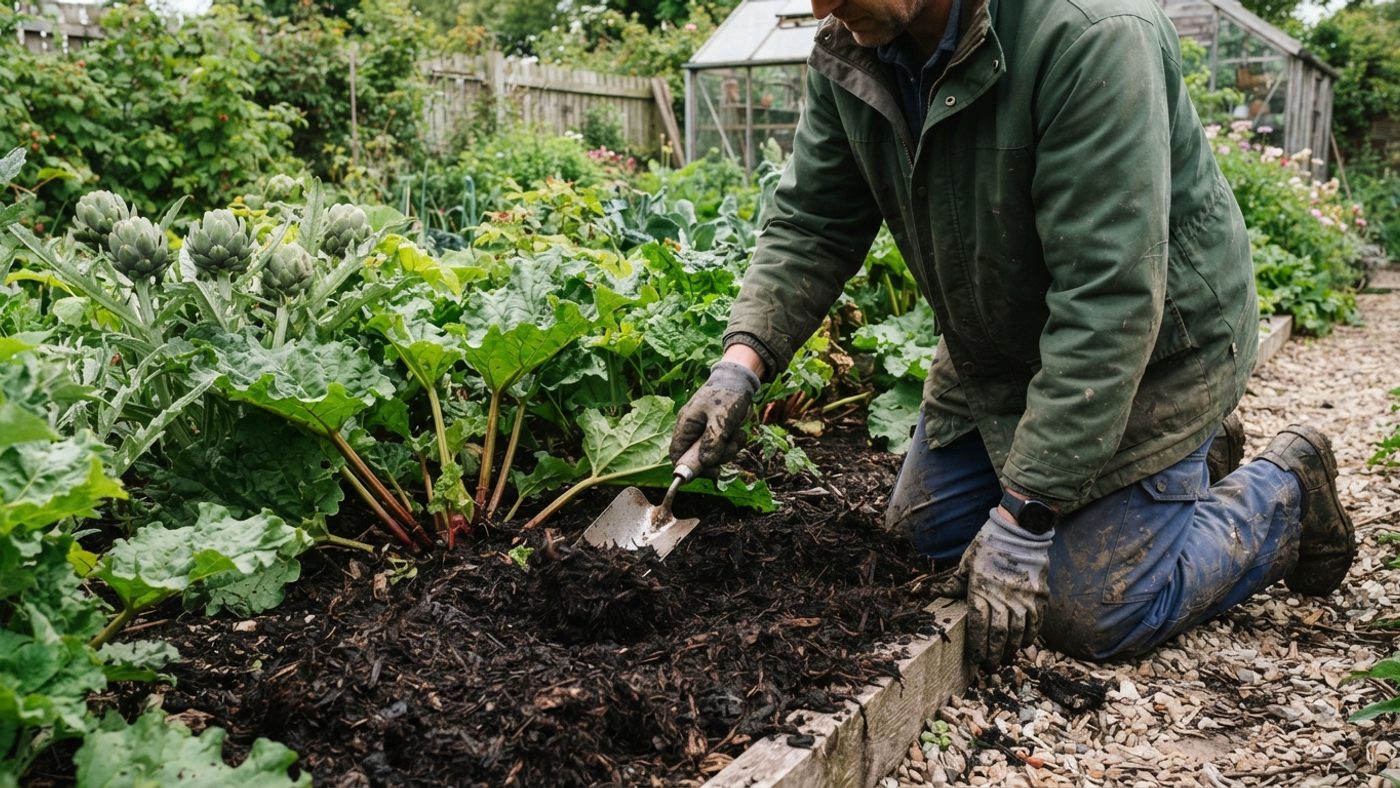
Prepare the soil as if you won't touch it again for a decade, because you largely won't. An annual bed gets manure or compost worked in every year and any perennial weed roots get forked out at the same time. A perennial vegetable bed doesn't get that annual reset, so weed clearance has to be thorough before planting, not gradual afterwards: couch grass, bindweed, and ground elder roots left in the soil will grow up through and around a rhubarb crown or an asparagus crown for years, and by the time they're a problem you can't dig the bed over to get at them without disturbing or losing the crop itself. Dig in as much well-rotted manure or garden compost as the crop calls for at planting time, because top-dressingAdding fresh compost, feed or grit to the soil surface around an established plant, rather than digging it in. Full definition → and mulching afterwards can maintain fertility but won't undo poor initial preparation the way a fresh dig-over would on an annual plot.
Drainage is worth checking before anything else goes in, and it matters more here than on ground you dig over annually: the RHS is explicit that damp, poorly drained soil causes asparagus crowns to rot, and recommends a raised bed on heavy ground for exactly that reason. Scottish soils vary hugely, from free-drainingSoil that lets water pass through quickly rather than pooling, so roots aren't sitting in wet ground after rain. Full definition → sandy machair to heavy clay to peaty upland loam, so this is worth checking on your own plot rather than assuming either way, it's a decision to make once, at planting, not something correctable later without lifting an established crown.
Slugs and asparagus beetle are both worth planning for from the outset rather than treating as an afterthought. Young shoots on sea kale, perennial kale, and Good King Henry are all vulnerable to slug damage, and a damp climate generally favours slugs, so a wet Scottish spring is no easier on these crops than anywhere else with similar rainfall. Asparagus beetle adults and larvae feed on stems and foliage through summer. Neither risk is unique to a permanent bed, but a permanent planting means the same pest pressure returns to the same spot every year rather than moving with a rotation, a raised bed, besides solving drainage, also keeps shoots a little further from ground-level slugs.
Space for the plant's ultimate size, not its first-year size. This is where perennial vegetable beds go wrong most often, plants that look sparse for the first year or two get crowded once they reach the spread they'll actually hold for the rest of their life. Nine-star broccoli needs 90cm between plants because it becomes a genuinely large plant. Globe artichoke can spread to a metre wide. Welsh onion and Good King Henry are more modest, but a walking onion clump actively migrates over years as its bulbils root where they fall, so it needs room to wander into rather than a tight slot.
The table below sets out the comparison that matters most when planning where things go and how long you'll wait: establishment time to a worthwhile harvest, mature size, and the part you actually eat.
| Crop | Time to first worthwhile harvest | Mature size (H × S) | Edible part |
|---|---|---|---|
| Asparagus | 2 years unharvested, then annual | 1–1.5m fern height | Young spears |
| Globe artichoke | 1 year to first buds, full productivity in 3–5 years | Up to 1.5m × 1m | Immature flower buds |
| Sea kale | 1–2 years before regular cutting | 45–60cm × 60cm | Blanched young shoots |
| Rhubarb | No harvest year 1, light year 2, full year 3 | 1m × 1m+ | Leaf stalks (not the leaf) |
| Perennial kale (Daubenton's) | Light picking within year 1 | 0.5–1m × 0.5–1m | Leaves |
| Good King Henry | Light picking year 1, established by year 2 | 0.5–1m × 0.1–0.5m | Young leaves |
| Welsh onion | 2–5 years to full clump | 0.5–1m × 0.1–0.5m | Leaves, shoots |
| Egyptian walking onion | Usable greens/bulbs year 1 | 0.3–0.6m, spreads over years | Greens, small bulbs |
| Chinese artichoke | 1–2 years to worthwhile tubers | 0.5–1m × 0.1–0.5m | Tubers |
Does Scotland change the maths?
There are two plausible ways a shorter Scottish growing season could change this trade-off, and they pull in opposite directions.
The case for the wait feeling worse: Scotland's growing season is generally shorter than southern England's, though this varies a great deal by region and altitude, a coastal Ayrshire garden and a Speyside one aren't the same proposition. Where the season genuinely is shorter, and if a two- or three-year establishment period is measured in growing seasons rather than calendar years, each of those seasons delivers less growing time, so the same number of years to wait contains less actual growth before the first harvest arrives.
The case for perenniality paying off more: an annual vegetable has to complete its entire life cycle inside that same short window, every single year, with no head start. A perennial crop only builds its root system once. In every subsequent year it starts already-rooted and puts its energy straight into growth. In a shorter season, skipping that rebuild in years two through ten, or twenty for asparagus, arguably matters more, not less, because there's less spare season to lose to it.
Neither argument settles the question on its own. What does decide the outcome for a specific garden is hardiness, which varies sharply between the crops on this list. Chinese artichoke (RHS H7, hardy below -20°C) and Good King Henry (RHS H5, hardy to -15°C) will survive a Scottish winter anywhere without protection. Welsh onion is rated only RHS H3, hardy to about -5°C and "in coastal and relatively mild UK areas," a plant that copes with a sheltered, low-lying garden but is a genuine risk in an exposed or high inland site, whatever the establishment-time argument says. Checking each species' hardiness rating before committing a decade of a permanent bed to it matters more than resolving the general theory.
The verdict: who this actually suits
Perennial vegetables suit a gardener with a permanent plot they aren't going to give up in the next few years, room to dedicate a bed that won't be touched for a decade, and the patience to wait two or three seasons before the payoff arrives. If you own your garden, or have a long-term allotment tenancy, and you're building the garden for the long term rather than for this year's harvest, the case is strong: once established, the crops on this list ask for very little, crop hard in the hungry gap, and don't need reordering, resowing, or replanting.
It suits this less well if you're renting, on a plot with an uncertain tenure, or gardening somewhere you might move from in the next two or three years, because you may do all the establishment work and hand the harvest to whoever comes after you, in the case of the slower crops especially. It's also a poor fit for a small garden with limited bed space, since a permanent bed for six or eight of these plants is space that can't grow a fast-turnaround annual crop like lettuce or radish in the meantime, and some of these plants, globe artichoke, nine-star broccoli, take up a genuinely large footprint for what they return. And it doesn't suit anyone who wants to see quick results from a new plot: if the appeal of growing your own is the fast feedback loop of sowing and harvesting inside a single season, waiting two years for the first asparagus spear will be a frustrating start.
A workable middle path many gardeners take is to start with the fast payers, perennial kale, Good King Henry, Chinese artichoke, or an Egyptian walking onion, which all give something useful within the first year, while giving a longer-term corner of the plot over to asparagus or globe artichoke for the years-out payoff. That way the permanent bed is doing something for you from year one, even while the slowest crops are still building their root systems underground.
Common questions
Do perennial vegetables need feeding every year, or only when planted?
They still need feeding. Because the same ground and the same plant aren’t renewed annually the way an annual crop is, most perennial vegetables are fed with an annual mulch of well-rotted manure or garden compost, typically in autumn or spring, to replace the nutrients removed by cropping and to keep the soil from becoming exhausted.
Can I grow perennial vegetables in containers if I’m renting?
Some of the smaller, faster ones can — Welsh onion, Chinese artichoke, and Good King Henry are all realistic in a large container, and a container also solves the "leaving it behind for the next tenant" problem, since you take it with you. Asparagus, globe artichoke, and rhubarb generally do badly long-term in containers because their root systems want more room than a pot gives them over a decade.
Is rhubarb really a vegetable?
Botanically, yes — it’s the leaf stalk of the plant that’s eaten, and a 1947 US customs ruling specifically classified rhubarb as a fruit for tariff purposes precisely because it’s almost always used like one in cooking. In the kitchen and on a plate, it behaves entirely as a fruit; botanically, it’s a vegetable.
How much space do I need for a permanent perennial vegetable bed?
It depends heavily on which crops you choose. A bed built around the smaller crops (Good King Henry, Welsh onion, Chinese artichoke, perennial kale) can fit a reasonable range into a few square metres. Add globe artichoke or nine-star broccoli, which need roughly a metre of clearance each way, or asparagus, which is usually grown in dedicated rows, and the space requirement grows quickly.
What happens if I have to dig up an established perennial vegetable bed?
Some crops divide and relocate well — globe artichoke is routinely lifted and divided every four to six years anyway, and Chinese artichoke tubers can simply be lifted and replanted elsewhere. Others resent disturbance: asparagus crowns and established rhubarb clumps can take a year or more to recover from being moved, effectively restarting part of the establishment clock.
Sources
11 sources, recorded with what each was used for
- RHS: How to grow Asparagus: The 2-year (3 from seed) wait before cutting spears, and the ~20-year productive crown lifespan
- RHS: How to grow Globe Artichokes: Time to full productivity, the 4–6 year lift-and-divide cycle, and winter protection guidance (no H-number is given for this crop)
- RHS: How to grow Rhubarb: The year-1/year-2/year-3 harvest schedule
- RHS: Crop rotation: Treating perennial vegetables as a separate section outside the annual rotation
- RHS: Kale, the wonder vegetable: Perennial kale (Daubenton's) propagation by cuttings and multi-year cropping life
- RHS: Brassica oleracea 'Nine Star Perennial': The 90cm spacing requirement
- RHS: Chenopodium bonus-henricus (Good King Henry): The H5 hardiness rating and growing conditions
- RHS: Allium fistulosum (Welsh onion): The H3 hardiness rating
- RHS: Stachys affinis (Chinese artichoke): The H7 hardiness rating and time to first harvest
- Gardeners' World: Perennial veg to grow: The "hungry gap" and late-autumn cropping benefit of perennial vegetables
- Garden Organic: Perennial vegetables: The resource-saving case for perennials, and the caution against relying on them for a whole vegetable rotation