
Every weed on a Scottish plot is doing the same thing: storing energy underground so that whatever happens above ground, it can come back. Understanding that single fact is the difference between a weed-control method that actually works and one that just looks like it worked for a fortnight.
Why weeds keep coming back
Annual weeds, groundsel, chickweed, annual meadow-grass, live fast and die once. Kill the top growth before they set seed and, bar whatever's already banked in the soil seed bank, that plant is finished. This is why scorching leaves is often good enough for annuals.
Perennial weeds are a different problem entirely. Docks, dandelions and thistles hold a taprootA single, thick, dominant root growing straight down from a plant, storing energy and anchoring it, as opposed to a spreading mass of fine roots. Full definition → that resprouts from below any point you damage it. Couch grass and ground elder spread by rhizomes, underground stems that travel outward and can regenerate from a fragment a few centimetres long. Horsetail's storage structures go down over a metre. All of these are, in effect, energy stores buried below the reach of a hoe, a flame, or a splash of vinegar. Damage the leaves and the plant simply draws on the reserve and pushes up new growth. The reserve itself is what has to be dealt with, either killed in place, physically removed, or starved of light for long enough that it exhausts itself trying to regrow.
That gives a clear bar to judge every method against: does it kill leaf tissue, or does it reach the root and the storage organ underneath it? Those are not the same question, and most "it didn't work" complaints trace back to conflating the two.
The verdict
| Method | Kills leaf tissue | Kills root / stops perennial regrowth | Verdict |
|---|---|---|---|
| Glyphosate (systemic, legally available) | Yes | Yes, moves from the leaf down into the root | Effective on perennials; usually needs repeat applications |
| Vinegar / acetic acid (horticultural strength) | Yes, fast | No | Good for annual seedlings and hard-surface weeds; perennials regrow |
| Salt | Yes | Only with heavy, repeated application that also sterilises the soil | Works, but the collateral damage is the whole point to avoid |
| Boiling water | Yes | No, for established perennials | Reliable for annuals and cracks in paving; perennials outlast it |
| Flame weeding | Yes | No | Excellent on annual seedlings; perennial storage organs resprout |
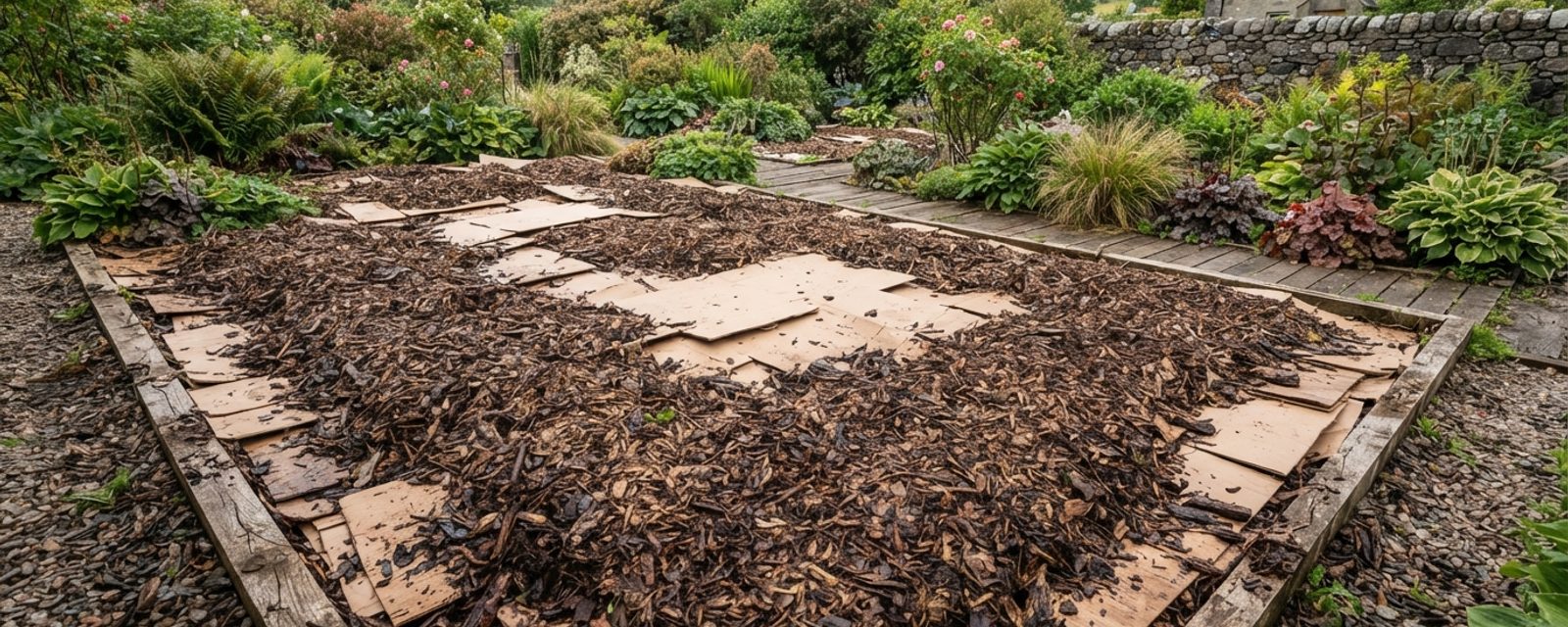
| Smothering / mulchingA layer of material spread over the soil around plants to suppress weeds, retain moisture, and improve soil structure as it breaks down. Full definition → | Starves via light exclusion | Yes, for most perennials, with sufficient depth and duration | The most reliable non-chemical route for perennial weeds; not an instant fix |
| Hand removal (digging out roots) | N/A | Yes, if the whole root/rhizome system is extracted | Effective but labour-intensive and easy to do incompletely |
Glyphosate: the current legal position in Great Britain
Glyphosate is legally approved for use in Great Britain, including by amateur gardeners, and remains on sale through ordinary garden retailers. HSE extended that approval in March 2025 by roughly a year from where it was previously due to expire, and it is currently approved for use in GB until 15 December 2026 while a full renewal assessment is carried out. Northern Ireland sits under a separate regulatory arrangement not covered here. That renewal process includes evaluation of the current scientific evidence, review of the 2023 EU risk assessment, a public consultation expected to open in summer 2026, and a final decision due by the end of 2026, which could extend approval for up to 15 years or introduce new restrictions.
There is no separate rule for domestic garden use: glyphosate products are authorised for a wide range of agricultural, horticultural and amenity uses, and the register of pesticide products with GB and Northern Ireland authorisation for use in the garden lists glyphosate-based weedkillers as approved for home garden use, searchable by active substance. The regulatory debate that periodically makes headlines is about agricultural pre-harvest spraying, not garden weedkilling, and it hasn't changed what's on sale at a garden centre.
The pesticides approvals register is a single GB-wide list rather than a separate Scottish system, so gardeners in Scotland are working from the same approval status as everywhere else in Great Britain. As a systemic herbicide, glyphosate is applied to actively growing leaves and moves down into the root system from there, which is why timing matters as much as the product itself: applied to a dying or dormant plant late in the season, there's little green leaf left to absorb it and carry it down, so it's most effective on perennials while they're still actively growing and putting on leaf, typically through the summer months. In practice that means spraying (or wiping onto leaves with a gel or roller applicator, for precision around plants you want to keep) on a calm, dry day so it isn't blown onto other plants or washed off before it's absorbed, and wearing the gloves and eye protection the product label specifies, a genuinely dry, calm spell can take longer to arrive further west or at altitude, the same rainfall pattern behind the flame-weeding limitation below, so it's worth checking a short-range forecast rather than the calendar before spraying. Every glyphosate product sold for garden use carries its own label instructions on dilution, application method and any keep-off period for children and pets until the spray has dried, follow the specific product's label rather than a general rule, since these vary between brands. Labels also carry their own buffer-zone conditions around watercourses, ditches and ponds, the same underlying concern as the salt-and-water problem covered below, check the specific product label before spraying near any of them. Storage matters as much as application: keep any concentrate or made-up spray in its original, clearly labelled container, never decanted into an unmarked bottle, and stored somewhere locked or otherwise out of reach of children and pets between uses.
Two other things worth flagging for anyone gardening on an allotment: many allotment sites impose their own tenancy-agreement bans on glyphosate regardless of its legal status, worth checking with a site's committee before relying on it; and invasive species like Japanese knotweed and giant hogweed carry their own separate legal obligations around control and disposal on top of ordinary weedkiller rules, which the step-by-step guide to clearing an overgrown allotment plot covers in full alongside the practical clearance routine.
Why "natural" doesn't mean "kills the root"
Vinegar, salt and boiling water are grouped together in most home-remedy advice, and all three share the same limitation: none travels down into a root system, they only reach what the liquid or heat actually touches.
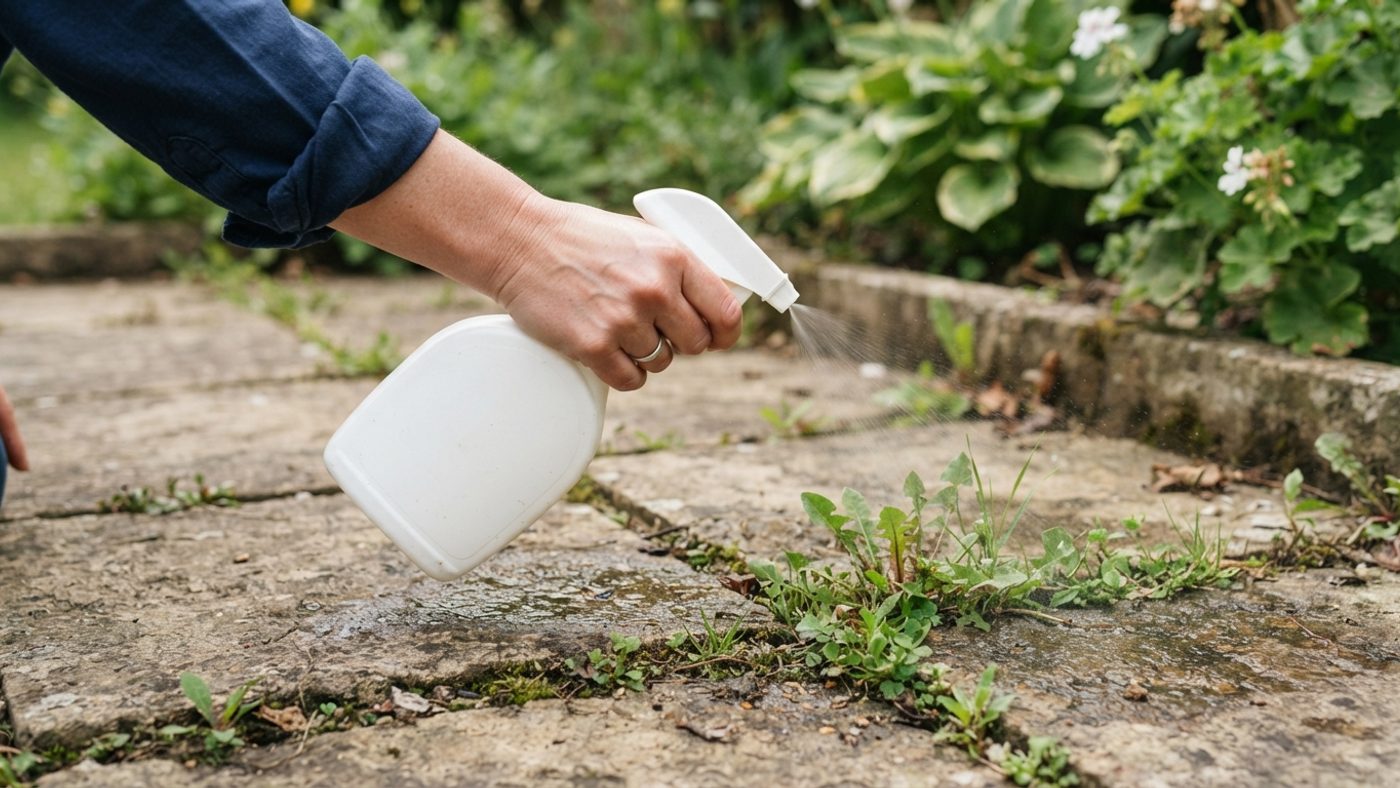
Vinegar / acetic acid. Household vinegar and horticultural "organic" weedkillers based on acetic acid (or, in some products, pelargonic acid, a related fatty acid with the same contact-only action) work by killing the plant tissue the spray droplets actually land on, the same mechanism as any other contact herbicide, just from a different active ingredient. That makes them genuinely useful against annual seedlings and moss on hard surfaces, where there's no perennial root to survive underneath. Against a dock or a patch of couch grass, the top growth blackens and the root sends up new shoots within weeks. Ordinary household vinegar is also explicitly advised against as a homemade pesticide, alongside bleach and washing-up liquid, on the grounds that DIY solutions from household products can damage plants, soil organisms and the wider environment beyond the weed being targeted.
Boiling water. The mechanism is heat denaturing leaf tissue on contact, with the same ceiling as vinegar. It's a legitimate, zero-residue option for weeds in paving cracks and gravel, and it needs no shopping list beyond a kettle. It will not reach a rhizome sitting centimetres below the surface.
Salt. Salt does scorch and desiccate leaf tissue on contact, and applied heavily and repeatedly enough it can eventually exhaust even a perennial root, but that's also exactly the problem with it. Salt does not break down and disperse the way an approved herbicide is designed to; it persists in the soil, and enough of it will sterilise ground against anything trying to grow there, weed or otherwise, for a long time afterwards. It doesn't stay where it's put, either: as a highly soluble mineral, salt applied to a path or bed moves with rainfall. Any of it that washes into a garden border can damage or kill neighbouring plants that were never the target, and any of it that reaches a ditch, burn or drain becomes a water-pollution problem rather than a weed-control one. Scotland's own rules on pesticide use near water set a 10-metre buffer around watercourses, lochs and wetlands, and require that pesticides (and the other chemicals mixed into some products, such as wetting agents) not enter the water environment at all. Salt isn't a pesticide, so that specific rule doesn't apply to it directly, but the underlying problem it exists to prevent, a substance that shouldn't be there ending up in a watercourse via runoff, is exactly the same one salt creates, and salt's very solubility means it travels further and faster than most.
Flame weeding: a real technique, with a real ceiling
Flame weeding scorches leaf tissue in seconds and is a legitimate tool against annual weed seedlings, the flame doesn't need to burn the plant to ash, just rupture the cell walls, which kills the top growth without reaching anything underground. Against established perennials, the storage organ below ground is out of reach and resprouts regardless.
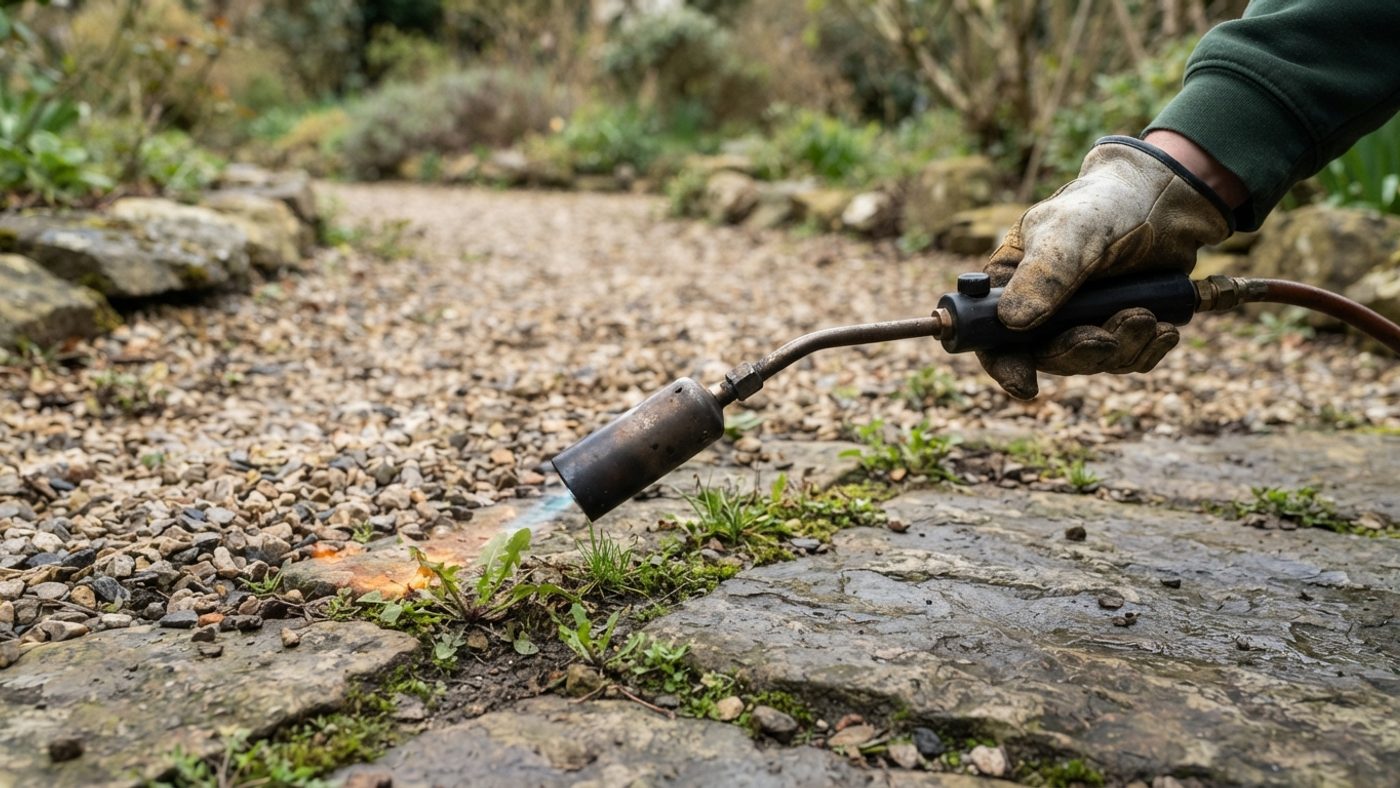
A flame weeder is an open flame, so it carries the basics that come with any open flame in a garden: clear dry leaves, mulch or other combustible material away from the area first, keep the flame moving rather than lingering over one spot near a fence, shed or hedge, and have water or a means to douse a stray spark close to hand. None of that is unique to flame weeding, but it's worth taking as seriously as any other outdoor burning.
The other honest limitation is Scotland's weather. Flame weeding needs the target foliage reasonably dry to scorch effectively, not because rain makes the flame itself dangerous, but because reliably finding a dry window to do it in is harder here than it sounds. At Edinburgh (Gogarbank), one of Scotland's drier, more easterly locations, long-term averages show measurable rain on roughly one day in three across summer (June-August). No comparable figure is cited here for the west coast or upland areas, but Scotland's rainfall is well established as running considerably wetter in those parts of the country than in the east, so treat the Edinburgh figure as a best case rather than a national one: a gardener further west or higher up should expect fewer reliably dry days to work with, not more, and flame weeding stays a job for whenever a dry spell turns up rather than a fixed weekly routine.
Smothering: the reliable non-chemical route, done properly
Of every non-chemical method covered here, sustained smothering is the one that actually starves the root rather than just scorching what's above it: deprived of light for long enough, a perennial weed keeps drawing on the reserves in its root or rhizome trying to push through, and eventually exhausts them rather than regrowing.
The caveat is "long enough" and "sufficient depth." A thin scatter of mulch will stop annual weed seeds germinatingA seed sprouting: breaking dormancy and putting out its first root and shoot, given the right warmth and moisture. Full definition → but won't touch an established perennial underneath it, a compost layer only a few centimetres deep is enough to prevent annual weed emergence, which is a different job entirely from starving out a rhizome. For perennials, the standard organic recommendation is overlapping cardboard weighted down, topped with an organic mulch 10-20cm deep, left in place for months rather than weeks; tougher spreaders like bindweed, couch grass or horsetail need a doubled cardboard layer and a longer smothering period, and mulches are ineffective against already-established perennial weeds where the coverage or duration is inadequate, smothering only works as well as its depth and patience allow it to. Root barriers (fabric or paving edging set at least 7.5cm proud of the soil) stop rhizomes spreading sideways but don't kill what's already inside the barrier, worth pairing with smothering rather than relying on alone against a spreader as vigorous as ground elder or horsetail. None of this is instant, and none of it is a substitute for actually removing the bulk of the root system by hand first where that's feasible.
Hand removal
Digging out the entire root or rhizome system removes the storage organ directly, rather than waiting for it to exhaust itself. It clears the job completely when done thoroughly, which is exactly the difficulty: leaving even a short rhizome fragment behind, which is easy to do with couch grass or ground elder, gives that fragment everything it needs to become a new plant. It's also the most labour-intensive option here by a wide margin, which is why it tends to be paired with smothering or, for genuinely established infestations, glyphosate, rather than used alone on a large scale. The full species-by-species root-removal technique for bramble, ground elder, couch grass, nettle and horsetail, along with a realistic staged timeline for a genuinely overgrown plot, is in the allotment clearance guide.
Whatever comes out of the ground, dug-out perennial roots and rhizomes don't belong on a home compost heap. A domestic heap rarely holds enough sustained heat to actually kill a fragment of couch grass or ground elder rhizome, and every fragment that survives the compost is then spread wherever that compost eventually gets used, turning a contained weed problem into one distributed across every bed it's dug into. Bin or burn what's dug out instead.
A related option that doesn't involve digging at all: repeatedly cutting a perennial weed's top growth back to the ground, over and over through a growing season, forces the same root-exhaustion effect as smothering, without needing cover material. It's slower and needs more consistency than a single clearance session, but it's a realistic option on ground that's mown, strimmed or hoed regularly anyway.
Matching the method to the job, not ranking them
There's no single "best" method, the right choice depends on what's being cleared, how established it is, and what's growing nearby. Vinegar, boiling water and flame weeding are genuinely useful for annual weeds and paving cracks, not failed alternatives to glyphosate; judging them against a job they were never suited to is the wrong comparison. How many repeat treatments a given perennial needs also varies hugely by species, root depth and how established the infestation already is, a first-year dandelion taproot and a decade-old bed of horsetail are not the same job.
Common questions
What happens to glyphosate’s legal status after December 2026?
That’s when the current renewal decision is due, and the outcome isn’t settled yet: it could extend approval for up to a further 15 years, or come with new restrictions attached. There’s no indication a straightforward ban is likely, but a gardener relying on it for an ongoing project is worth keeping an eye on the review rather than assuming today’s status is permanent.
Will vinegar or boiling water kill bindweed or ground elder for good?
No. Both scorch the leaves on contact but don’t reach the rhizome underground, so the plant resprouts. They’re genuinely effective on annual seedlings and weeds in paving, just not on established perennials.
Why is salt worse than vinegar or boiling water, if it also kills weeds?
Salt persists in soil rather than breaking down, so heavy or repeated use can leave ground unable to support any plants, not just the targeted weed, for a long time afterwards. It’s also highly soluble, so rain readily carries it into neighbouring beds or, worst case, a nearby watercourse.
Is flame weeding safe to use on a lawn, near a hedge, or on a windy day?
Not on a lawn, it’ll scorch the grass along with any weeds. Keep well clear of hedges, dry mulch or anything else combustible while the flame is moving, and avoid it on a windy day, since wind blows the flame off target and can carry sparks further than intended. It’s better suited to gravel, paving cracks and bare cultivated ground than anywhere with dry vegetation nearby.
What’s the most reliable non-chemical way to kill an established perennial weed?
Sustained smothering, cardboard plus a thick organic mulch, or a heavy-grade biodegradable film, left in place for months rather than weeks, doubled up for tough spreaders like couch grass or horsetail. Thin or short-term coverage only stops weed seeds germinating; it won’t exhaust an established root system.
Sources
10 sources, recorded with what each was used for
- HSE: Active substance renewal: glyphosate: Current GB approval status, extension to 15 December 2026, renewal assessment timeline
- HSE: Pesticides: HSE’s role as GB pesticide regulator, amateur vs professional product categories
- HSE: Pesticide Products with Great Britain and Northern Ireland Authorisation for use in the Garden: Register confirming glyphosate products with amateur garden-use authorisation
- RHS: Non-chemical weed control: Hand removal, repeated cutting, mulch depths (10-20cm), biodegradable film, root barriers, effectiveness limitations
- RHS: Weedkiller damage: recognise, fix and prevent: Glyphosate’s systemic translocation mechanism vs contact weedkillers (acetic acid/pelargonic acid) killing only where spray lands; effective application timing
- RHS: Understanding and avoiding chemical use: Advice against DIY household-product pesticides (vinegar, bleach, washing-up liquid)
- Garden Organic: Direct weed controls: Mulch effectiveness against annual vs established perennial weeds, cardboard smothering for tough perennials
- Soil Association: No-dig gardening: Soil health framing for why light-exclusion smothering works as a root-starving mechanism
- SEPA: Pesticide application near water (EASR-SC-041): 10-metre watercourse buffer rules and the principle that chemicals must not enter the water environment
- Met Office: Edinburgh, Gogarbank location-specific long-term averages: 1991-2020 rainfall and rain-day averages, summer (June-August) breakdown