
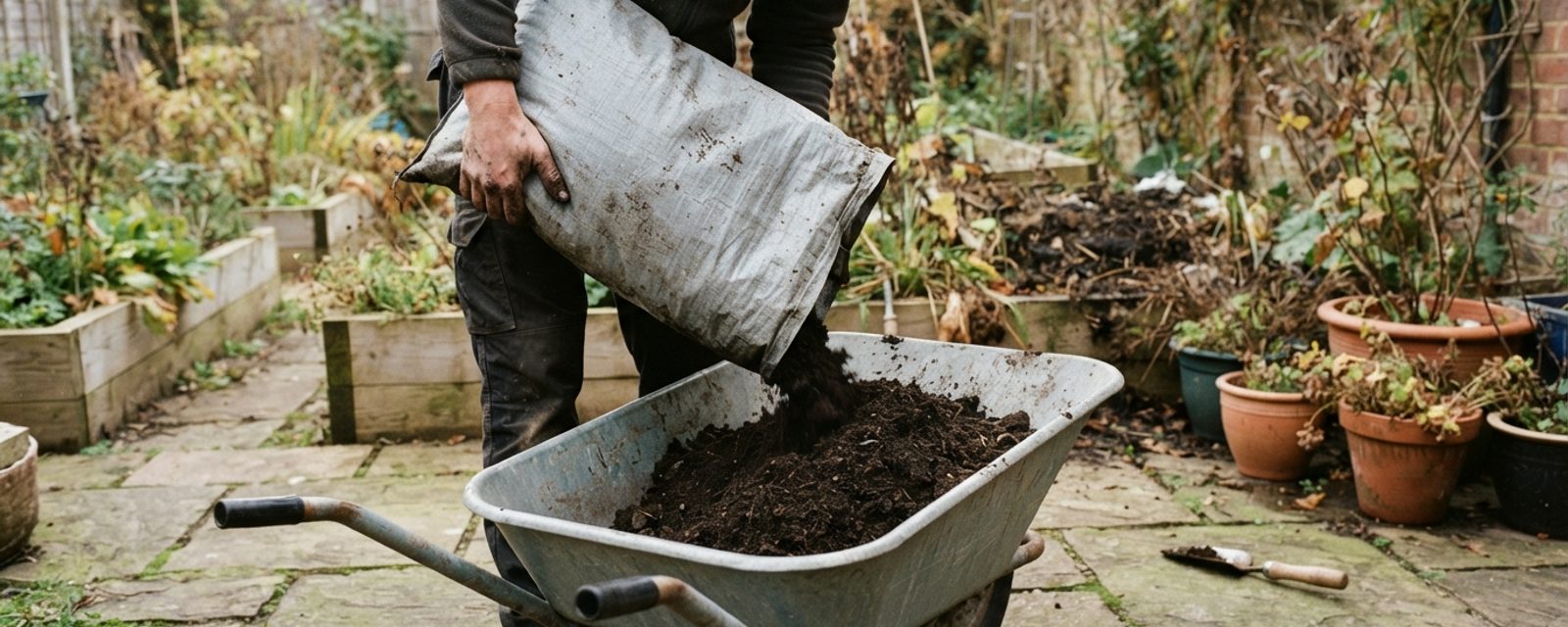
By late summer or early autumn, the tomatoes are stripped, the grow-bags have gone slack and grey, and every pot onMoving a plant into a larger pot as its roots fill the current one, giving it more room and fresh compost before it becomes pot-bound. Full definition → the patio holds a root-bound tangle sitting in compost that's a season past its best. This is the moment the decision actually gets made, not in the abstract, but standing over a wheelbarrow or a stack of emptied bags, deciding whether this compost goes back into something, onto the heap, or into the green bin. It's worth pausing before any of those, because spent compost isn't finished, it's just changed.
What a season of growing actually does to compost
Fresh multi-purpose or grow-bag compost starts out with a structure designed to hold air, drain freely and release nutrients steadily over several weeks. Roots, watering and feeding change all three of those things. The structure collapses as fine root hairs break down the larger particles and repeated watering compacts what's left, so the compost holds less air and drains more slowly than it did in spring. If the compost was originally peat-freeCompost made without peat, which is harvested from a slow-forming, carbon-storing wetland habitat that peat extraction damages. Full definition →, increasingly the default now, and covered in more detail in the peat-free compost article, that structural collapse tends to happen a little faster, since peat-free mixes built from bark, coir or wood fibre generally hold their structure for a shorter working life than peat did.
The nutrients are the other casualty. Whatever base feed the compost was sold with has been drawn down by a full season of growth, and container feeding schedules are built to top up a depleting reserve, not to leave a surplus behind. By the end of the season there's little left for the next crop to draw on.
Plants grown in containers are unlikely to have suffered soil-borne disease, so compost from a normal, healthy pot is generally safe to reuse. The exception worth checking for is vine weevil, its C-shaped white grubs overwinterKeeping a plant alive and intact through the cold months, whether left outdoors, moved under cover, or stored dormant. Full definition → in compost and will happily move into the next plant you pot up in the same material. Cool, damp conditions between autumn and spring are exactly when vine weevil grubs are active in the compost, doing root damage that often isn't obvious until a plant collapses the following season, so this is one pest worth checking for on any pot that sat outside over a Scottish winter. If you find grubs while emptying a pot, spread the compost thinly on a hard surface (wear gloves) so birds can pick them off before you reuse it. A biological nematode drench is the standard active treatment rather than just relying on birds, applied when the compost is warm enough for the nematodes to work, Steinernema species tolerate compost temperatures down to 5°C, which gives a wider practical window in a Scottish autumn or spring than the 12°C+ that Heterorhabditis species need.
Slugs and snails also turn up in old pot compost, but they aren't a reuse hazard the way vine weevil is, they're a normal, largely beneficial part of how organic matter breaks down, and any eggs present are usually eaten by other compost-dwelling organisms or simply decompose rather than surviving into the next pot.
Weed seed is a smaller but real risk too, if anything in or around the pot set seed before you emptied it, that seed goes wherever the compost goes next. A quick check for obvious seed heads before reuse is worth the ten seconds it takes.
Ranking the realistic reuse options
Not every use is equally safe or equally rewarding. Ranked from lowest-risk and most realistic down to the ones that need real caution, here's where spent compost from pots and grow-bags is worth putting:
| Reuse option | Risk level | Why |
|---|---|---|
| Mixed into garden borders/beds as a soil conditioner | Low | Diluted into a large volume of existing soil, so any residual nutrient shortfall or minor pest issue is absorbed rather than concentrated |
| Used for less-hungry crops or ornamental bedding | Low-moderate | Doesn’t need the fertility hit that a hungry vegetable crop demands, so depleted nutrients matter less |
| Composted properly (added to a compost bin/heap) | Low | Breaks the material down further and mixes it with fresh green and brown waste rather than reusing it as-is |
| Reused for the same crop family two years running | Moderate-high | Repeats the exact conditions that let a soil-borne problem specific to that plant family build up |
| Used unamended for a new season’s hungry crop (tomatoes, courgettes, chillies) | High (of disappointment) | Not dangerous, but nutritionally short, a hungry crop grown in unamended spent compost will underperform |
The two "risky" rows aren't the same kind of risk: reusing for the same crop family risks an active disease or pest problem taking hold, where using unamended compost for a hungry crop just risks a disappointing harvest. Treat the crop-family rule as the firm one, and the "unamended" row as a quality trade-off you can fix with amendment.
Mixing into borders and beds, the safest option
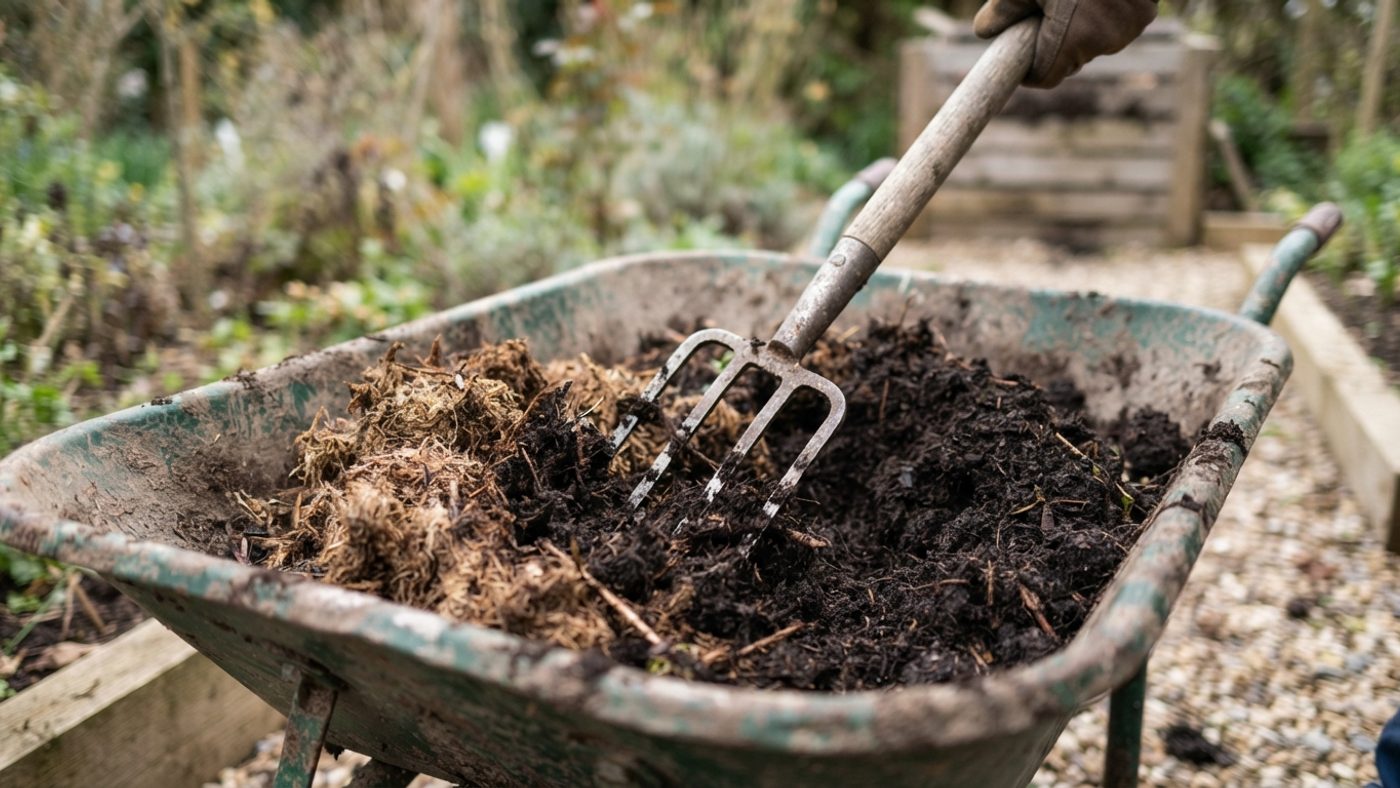
This is the option with the least that can go wrong. Digging spent compost into an existing bed or border adds it to a much larger body of soil, so any depleted nutrients are a rounding error against what's already there, and any minor pest or disease presence is diluted rather than concentrated in one pot. It's also exactly the same soil-conditioning role that mulches and compost play in improving structure on heavy or clay ground, the no-dig gardening on heavy clay article covers the mechanism of using organic matter to open up compacted clay soil, and spent compost works the same way, forked or dug in as a bulky conditioner rather than a source of fertility. The same applies to a raised bed's existing soil, not just open ground, spent compost tops it up as bulk and structure, same as it would in a border. It also has a second life as a winter mulchA layer of material spread over the soil around plants to suppress weeds, retain moisture, and improve soil structure as it breaks down. Full definition →, spread a few centimetres thick over bare soil or around the base of tender perennials, where it buffers the ground against hard frost even though it's past its best as a growing medium.
Less-hungry crops and ornamental bedding
Where spent compost goes back into a container rather than the ground, matching it to a less demanding plant makes the nutrient shortfall irrelevant. Bedding plants, most hardy annuals, and crops that aren't heavy feeders, salad leaves, radishes, herbs, will generally get by on what's left in reused compost, especially with a light top-up of general fertiliser at the rate given on the packet. Reserving fresh compost for the plants that actually need the fertility it provides, and routing spent compost to the plants that don't, is the most efficient way to use both.
Not for the same crop family, two years running
The one firm rule: don't reuse a pot's worth of spent compost to grow the same crop family again the following year, especially tomatoes, potatoes and other nightshades, or anything from the brassicaThe cabbage family: cabbage, kale, broccoli, cauliflower, Brussels sprouts, kohlrabi, swede, turnip and more, sharing the same pests, diseases and rotation rules. Full definition → family. This is the same logic behind crop rotationMoving each crop family to different ground each year, on a multi-year cycle, so pests and diseases that build up in soil don't get a repeat host. Full definition → in open ground, just compressed into a single container, a soil-borne pathogen or pest that favours one plant family can persist in the growing medium, and growing that family in the same material again gives it a second run at a susceptible host. The 3-year crop rotation planning article covers the disease-carryover mechanism behind this in more depth; the same reasoning applies whether the "ground" in question is a border or a pot of reused compost.
Brassicas need particular care here. ClubrootA soil-borne fungal disease of the brassica family that swells and distorts roots, and survives in soil for years. Full definition → spores can survive in soil or growing medium for many years, and an ordinary home compost heap rarely runs hot enough for long enough to kill them off, so compost from a pot that grew brassicas showing clubroot symptoms shouldn't go back into brassicas, and arguably shouldn't go into the compost bin either, since the spores can simply be reintroduced wherever that finished compost eventually lands. Bin it, or keep it strictly away from future brassica growing, rather than composting it and assuming the problem is dealt with. A cooler, damper growing medium generally takes longer to reach the sustained heat that breaks pathogens like clubroot down, so a Scottish garden's typically cool, wet conditions make the "assume it's dealt with" mistake a slightly easier one to fall into than it would be in a warmer, drier climate.
Whatever the crop, reusing the pot or grow-bag itself matters as much as the compost inside it. A quick scrub with hot water, and a wipe with garden disinfectant if the previous plant showed any disease symptoms, removes pathogens clinging to the container's surface that fresh compost alone won't fix. Spent compost isn't recommended for starting seed on its own, even for a different crop family, fresh, sterile, fine-structured compost gives seedlings the most even, disease-free start, and reused material's coarser, uneven structure and residual pests work against that. Making spent compost safe for seed-starting means heat-treating it first, a distinct process from simply digging it into a border.
Composting it properly
Where compost has clearly seen better days, waterlogged, compacted solid, or from a plant that did show signs of disease (setting aside clubroot, covered above), the better home for it is the compost bin rather than another pot. Spent compost still carries a working population of soil organisms, and adding it to a compost heap or bin helps kick-start the breakdown of other green and brown waste rather than sitting inert in a pot doing nothing for the next plant. Home compost typically takes anywhere from four months to over a year to mature into usable, crumbly compost, depending on the mix of materials and how often it's turned, worth knowing before assuming a heap started in autumn will be ready in spring. A roughly equal mix of nitrogen-rich "green" material and carbon-rich "brown" material, turned every few months, is the standard formula for getting there.
What spent compost can't do
Without amendment, spent compost on its own isn't a substitute for a fresh bag, and that's a quality gap, not a hazard to guard against the way disease carryover is. One more distinction worth keeping straight: a plant that had a foliar or stem disease like tomato or potato blight (Phytophthora infestans) doesn't leave the same soil-borne legacy clubroot does, blight needs living plant tissue to survive and generally doesn't persist in compost once that tissue has broken down, so it's a narrower caution than the clubroot rule above, not the same one applied to a different crop.
Storing spent compost between uses: does Scotland's rain change anything?
It's a reasonable question for anyone gardening here: given how much rainfall varies across Scotland itself, does that change how spent compost should be stored between one season and the next, in an open heap versus something covered?
General composting guidance already covers this ground: covering a compost heap with a tarp, cardboard or old carpet, specifically to stop it getting too wet, is standard advice, because a heap that becomes waterlogged tends to go anaerobic, it starts to smell, and the composting process slows rather than speeds up.
Rainfall itself varies sharply by region in Scotland:
| Region | Typical annual rainfall |
|---|---|
| Eastern Scotland (East Lothian, Fife, Moray Firth) | Under 700mm |
| Northern Scotland, western half | At least 1,700mm |
| Near Fort William (wettest ground) | Over 4,000mm |
That range means the standard "keep it covered" advice carries more weight for a gardener storing spent compost outdoors on the west coast than for one on the drier eastern side. If you're storing spent compost outdoors over winter anywhere with regularly heavy rainfall, keeping it under cover rather than in an open, unprotected pile is the sensible precaution.
Common questions
Can I reuse compost from a pot that had a diseased plant in it?
Not for the same purpose. If a plant showed clear signs of disease, wilting, rot, foliar disease, the safer option is to route that compost to the compost bin rather than reuse it directly in another pot, since heat and time in an active compost heap will do more to break down a pathogen than simply reusing the material as-is. Clubroot is the one exception: home compost heaps generally don’t get hot enough for long enough to kill clubroot spores, so compost from clubroot-affected brassicas is better binned or kept well away from future brassica beds rather than added to the heap.
Do I need to add fertiliser to reused compost, or is mixing in garden compost enough?
Either works, but they do different jobs. Fresh organic matter, garden compost or well-rotted manure, mixed in at roughly 70% spent compost to 30% organic matter, mainly restores structure and adds some fertility back gradually. For a hungry plant going straight back into reused compost, a general fertiliser on top of that organic matter addition gets closer to matching what fresh compost would provide.
Is grow-bag compost different from pot compost for reuse purposes?
Not fundamentally, both have been through a season of watering, feeding and root growth, and both lose structure and nutrients in the same way. Grow-bag compost is often a slightly lower grade to begin with, so amending it before reuse matters just as much, if not more.
How long can I store spent compost before it’s unusable?
There’s no fixed expiry point, it’s more about condition than time. Compost that’s kept reasonably dry and isn’t waterlogged or compacted solid can sit through winter and still be usable as a soil conditioner or mulch in spring. If it’s gone anaerobic (visibly slimy, foul-smelling) from prolonged waterlogging, it’s better composted properly than dug straight into a bed.
Can spent compost go in a food waste or green waste bin?
Rules vary by council, so check what your own council’s collection service actually accepts before assuming it’s treated the same as ordinary garden waste, some don’t take compost at all.
Starting seed and wondering whether reused compost is safe for that too? See sterilising compost for seed starting.
Sources
6 sources, recorded with what each was used for
- RHS: How to reuse spent compost: Nutrient depletion framing, the 70:30 compost-to-organic-matter reuse ratio, the "unlikely to suffer soil-borne diseases" reassurance, the vine weevil carryover warning, gloves as recommended equipment, and the five reuse methods
- RHS: Potato blight and how to beat it: Blight needing living plant tissue to survive and not persisting in soil or compost the way clubroot does, distinguishing the two diseases' carryover risk
- RHS: Vine weevil: Nematode treatment timing and the Steinernema (5-20°C) vs Heterorhabditis (12-20°C) temperature thresholds
- RHS: Slugs and snails: Slug/snail eggs and compost-dwelling role not being treated as a reuse hazard
- Soil Association: How to make your own compost: The 4-months-to-over-a-year composting timeline, the green/brown material ratio, turning frequency, and the advice to cover a heap to stop it getting too wet
- Met Office: UK regional climates: Eastern Scotland (under 700mm/year) and Northern Scotland (at least 1700mm/year, exceeding 4000mm/year near Fort William) regional rainfall figures underpinning the storage discussion