
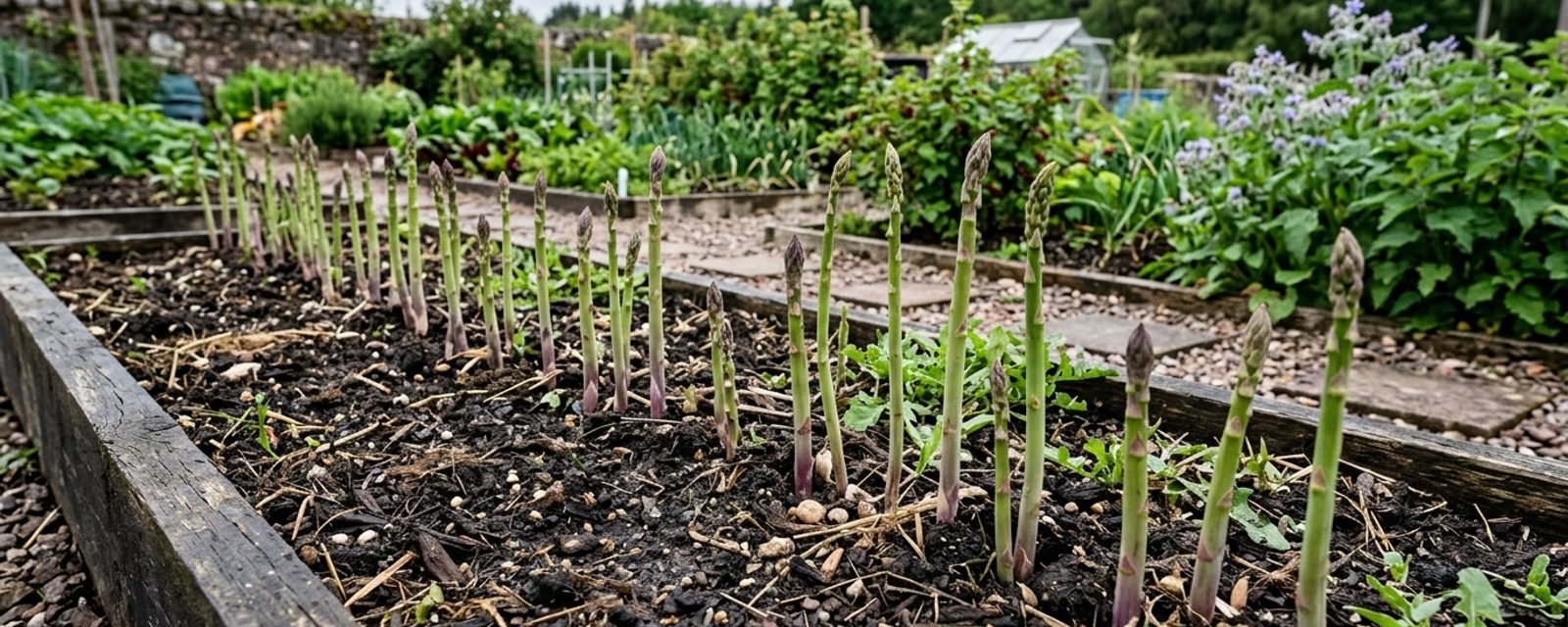
Asparagus officinalis
An asparagus bed occupies permanent ground for up to two decades once it's productive. Unlike most vegetables, which get replanted or rotated within a few years, the site you choose and the variety you plant are decisions you live with for fifteen to twenty years, which makes them worth getting right before a single crownThe base of a perennial plant where roots and shoots meet, often sold and planted as a ready-made dormant plant rather than grown from seed. Full definition → goes in the ground.
Perennial Vegetables Worth Growing in Scotland → compares asparagus against the other permanent-bed crops worth the same long-term commitment.
Crowns or seed
Plant one-year-old dormant crowns rather than sowing from seed: crowns settle in more successfully and reach harvest after two years, against three years (Gardener's World says at least five) from seed. Seed is cheaper, but on a crop where the first harvest is already years away, the extra wait is a real cost rather than a minor one.
If you do want to raise plants from seed, sow indoors in February at 13-16°C, transplanting outdoors in early June after hardening offGradually getting young plants raised indoors used to outdoor conditions over 7–14 days before planting out, so cold, wind and direct sun don't shock or damage them. Full definition →, or sow outdoors March to April in drills 2.5cm deep, thinning seedlings to 15cm apart before moving them to their final spacing the following March.
Choosing a site
Choose an open, sunny spot with free-drainingSoil that lets water pass through quickly rather than pooling, so roots aren't sitting in wet ground after rain. Full definition → soil; avoid heavy clay unless you're prepared to raise the bed. Never plant asparagus where it, or potatoes, have grown before. Weed the bed thoroughly before planting, and dig in at least a bucketful of garden compost or well-rotted manure per square metre.
Planting
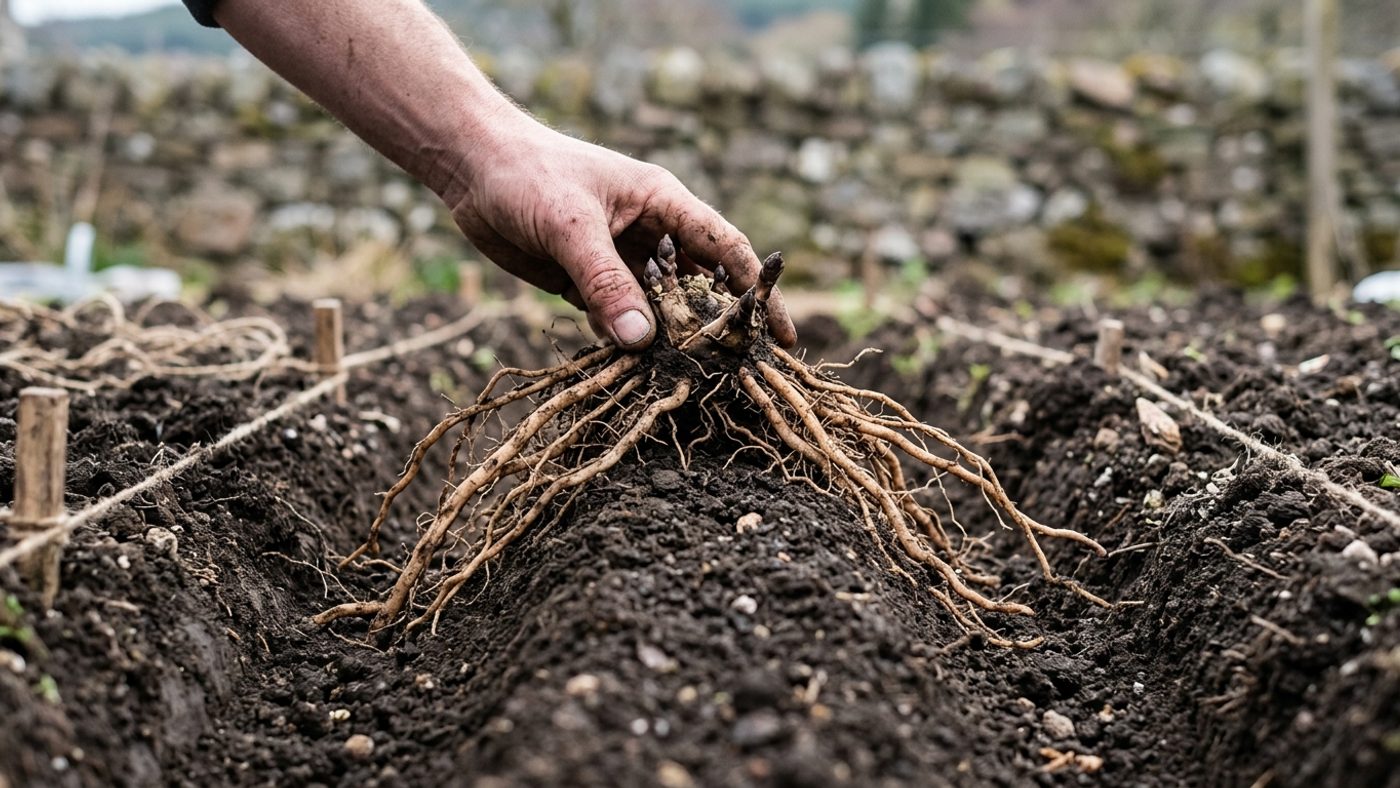
Plant crowns in March. Dig a hole or trench about 30cm wide and 20cm deep, build a 10cm mound in the centre, and set the crown on top with its growing points uppermost, spreading the roots evenly down the sides. Cover so that just the bud tips remain visible. Space plants 30-45cm apart, in rows 45cm apart, staggering plants between adjacent rows.
Varieties
All three varieties below carry the RHS Award of Garden Merit, a UK-wide award rather than a Scottish one.
RHS also lists 'Backlim' (AGMThe RHS's Award of Garden Merit: a UK-wide trials award for reliable performance, not a Scotland-specific recommendation. Full definition →, all-male, but genuinely adds nothing beyond Gijnlim once checked). 'Pacific 2000' carries no AGM, but its own individual plant page states it is all-male and H5The RHS's H1a–H7 scale for how much cold a plant can survive outdoors, H1a being tender indoor-only and H7 hardy anywhere in the UK. Full definition → hardy, contradicting the general page's 'can be either male or female' description. 'Mondeo' also carries no AGM and isn't on the general list at all, but its own page states it's highly disease-resistant and H5 hardy. 'Vittorio' and 'Jersey Knight' have no meaningful RHS cultivation data.
★ Our pick for Scotland
GijnlimAGM
All-male, early-season, prolific, medium-thick spears with closed purple tips
All-male productivity, plus an early start.
Why this one: Combines the two traits that matter most here: all-male, so no energy goes into the berries and volunteer seedlings a mixed bed produces, and early-season, which matters directly on a crop whose harvest window is short and fixed regardless of variety.
Also worth considering
Guelph MillenniumAGM
All-male, very vigorousHow much a fruit tree's rootstock limits or allows its eventual size, from extremely dwarfing (smallest) through to very vigorous (largest). Full definition →, abundant harvests
A second all-male, high-vigour pick for maximum yield: on a crop that stays in the ground for decades, vigour and productivity are worth weighing heavily.
Connover's ColossalAGM
Heritage variety, exceptionally large crop, green spears with deep purple tip
Independently named by both RHS and Gardener's World, a genuinely well-corroborated traditional option for anyone who'd rather grow a heritage variety than an all-male hybrid, understanding it will set seed and needs its volunteer seedlings weeded out.
Best Asparagus Varieties for Scotland → compares all named asparagus varieties head-to-head, with the practical detail that doesn't fit in a summary card.
Care
Water new plants regularly through their first summer; once established, asparagus is drought tolerant and only needs watering in long dry spells. In most soils, established plants crop reliably without extra feeding, especially where the bed is mulchedA layer of material spread over the soil around plants to suppress weeds, retain moisture, and improve soil structure as it breaks down. Full definition → with organic matter each year. Apply a thick mulch every late winter to suppress weeds and hold moisture. Hand-weed rather than hoeing, since the roots sit shallow and are easily damaged, and remove any seedlings from female or mixed plants before they compete with the crowns you actually want cropping.
Support the tall, ferny summer growth with stakes and twine either side of the row, forming a kind of fence, or with netting about 50cm above the ground, so wind doesn't rock the crowns loose.
Harvesting
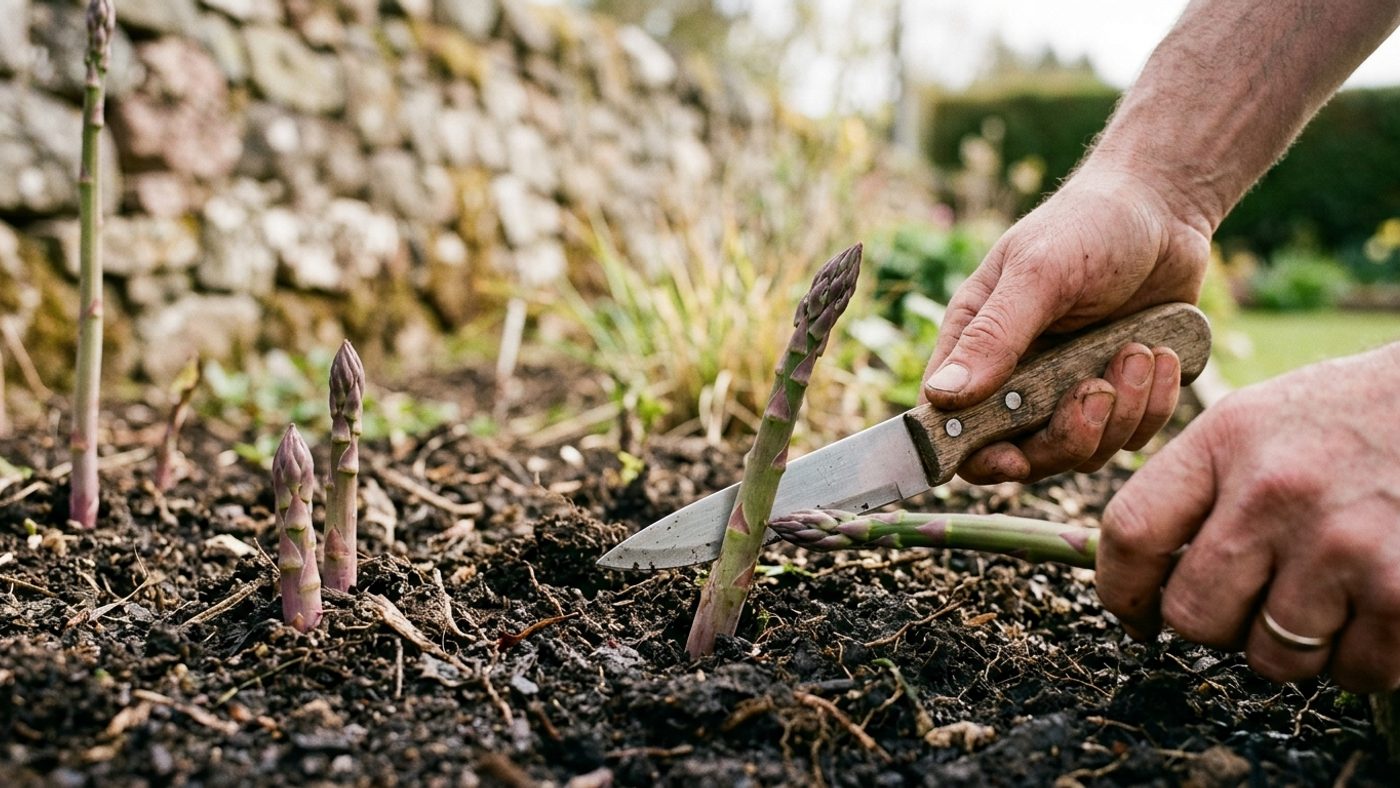
Cut spears with a sharp knife about 2.5cm below the soil surface once they reach finger thickness and no more than 18cm tall. In year three, harvest for six weeks from mid-April; from the fourth year onwards, harvest for eight weeks. In warm weather, cut every two to three days for the best-quality spears, and expect around 10 spears per plant over the season. Stop cutting by the date your routine calls for, not when spears stop appearing, so the plant can rebuild its reserves: cutting too much, for too long, costs you next year's crop rather than this year's.
Common problems
- Slugs and snails target young spears and seedlings.
- Asparagus beetle adults and larvae feed on stems and foliage through summer, and can weaken plants badly if left unchecked.
- Frost damage is particularly harmful to tender new spring growth.
See more problems
- Root rot follows damp, poorly drained soil, which is exactly why site choice matters so much before planting a bed you can't easily move.
Common questions
How long before I can harvest asparagus after planting?
Two years from crowns, three from seed: crowns settle in faster, so start from one-year-old dormant crowns unless the lower cost of seed is worth a much longer wait. Full sourced breakdown: <a href='/tools/garden-myths/asparagus/'>Asparagus Myths →</a>
Does the variety I choose actually matter for productivity?
Yes, more than most crops: all-male varieties such as Gijnlim and Guelph Millennium put all their energy into spears, while mixed or female-setting varieties spend some of it on berries and volunteer seedlings that then need weeding out. Full sourced breakdown: <a href='/tools/garden-myths/asparagus/'>Asparagus Myths →</a>
When should I stop cutting spears each year?
By a fixed date, six to eight weeks after harvest starts (or around mid-June), regardless of whether spears are still coming: cutting past that point weakens the reserves the plant needs to crop well next year. Full sourced breakdown: <a href='/tools/garden-myths/asparagus/'>Asparagus Myths →</a>
How long does an asparagus bed actually last?
A long time: up to 20 years for a well-maintained bed, so choose the site carefully and never plant a new bed where asparagus has grown before. Full sourced breakdown: <a href='/tools/garden-myths/asparagus/'>Asparagus Myths →</a>
Sources
3 sources, and what each was used for
- RHS: the crowns-vs-seed choice and the two-vs-three-year establishment difference, planting method and depth, spacing, soil prep and the permanent-bed warning, watering (drought-tolerant once established), feeding, weeding and female-plant seedling removal, mulching, support, harvesting method and the six/eight-week duration by year, five named varieties (four AGM), the 20-year productive lifespan, asparagus beetle, slugs, frost damage, root rot
- Garden Organic: independently corroborates crown spacing (30cm) and the second-year harvest start for crowns; gives a genuinely different productive lifespan (15 years) against RHS's 20, shown as a real disagreement; gives a slightly different spear-cutting length (15-20cm) than RHS's 18cm maximum
- gardenersworld.com: independently corroborates 20cm depth-adjacent spacing and the 20-year productive lifespan (matching RHS against Garden Organic's 15); gives a more cautious third-year harvest start for crowns against RHS's two years, and a shorter 4-week harvest duration against RHS/Garden Organic's 6-8 weeks, both shown as genuine disagreements; names a specific disease, violet crown rot, requiring plant destruction and site relocation, that RHS's more generic 'root rot' doesn't name; advises against planting where potatoes previously grew