
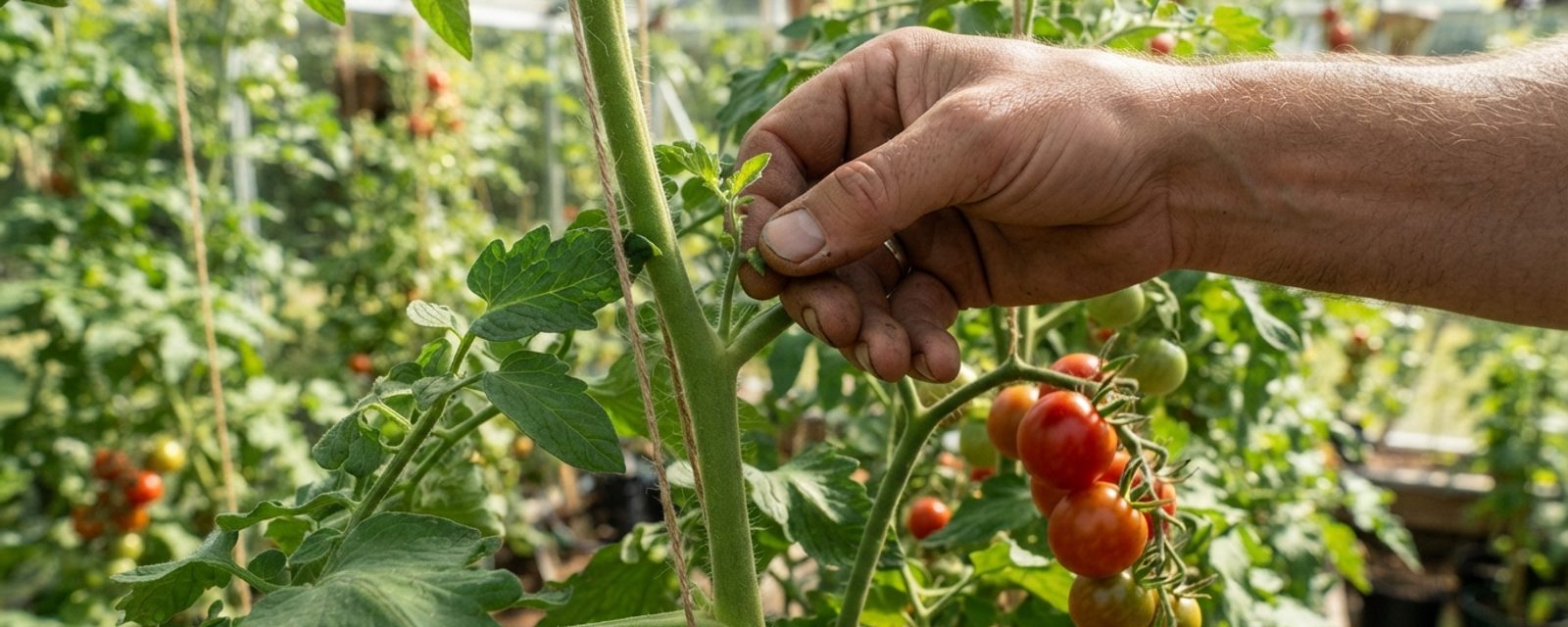
By late July, a lot of first-time tomato growers end up with the same plant: a dense, tangled bush of stems and leaves, two metres of foliage, and a handful of green fruit buried somewhere inside it. Sometimes the opposite mistake happens too, a grower spots what they're sure is a sideshoot, pinches it out to keep the plant tidy, and only weeks later realises they removed a flower trussThe flowering, then fruiting, stem cluster on a tomato plant; each truss ripens its fruit together. Full definition → and took a whole cluster of future tomatoes with it.
Both mistakes trace back to the same piece of technique: pinching outRemoving the soft growing tip of a stem to stop upward growth and make the plant branch out sideways instead. Full definition → sideshoots on cordonA fruit tree or bush trained as a single main stem with short fruiting side-spurs, usually grown at an angle against a wall, fence or wire. Full definition → tomatoes. Done correctly and consistently, it's what turns a sprawling tomato plant into a productive one. Done wrongly, or not at all, it's the difference between a plant that ripens a good crop before autumn and one that's still mostly leaf when the frost arrives.
Why sideshoots matter: the plant only has so much energy
A tomato plant makes its own food through photosynthesis in its leaves, then spends that energy on growth, new stems, new leaves, new roots, and fruit. It doesn't prioritise fruit automatically. Left alone, a cordon tomato will happily put out a sideshoot at every leaf joint, and each of those sideshoots will grow its own leaves, its own flowers, and eventually its own sideshoots, branching over and over through the season.
Every one of those extra growing points is competing for the same pool of water, nutrients and sugars as the fruit trusses already forming lower down the plant. More foliage also means a denser canopy, which shades the leaves and trusses underneath, slows air movement around the plant, and makes conditions damper and more favourable to fungal problems like blight, a real risk in a damp Scottish summer generally, where anything that keeps leaves drier and air moving through the plant is doing double duty. None of this stops the plant producing fruit entirely, a completely unpruned cordon tomato will still ripen some tomatoes, but it spreads the same finite energy budget across far more competing demands, so what does ripen tends to arrive later and in smaller amounts than a pinched, single-stemmed plant growing in the same conditions.
Removing sideshoots while they're still small redirects that energy toward the main stem and the trusses it's already carrying, and it keeps the plant to a single stem that's actually manageable on a support. It's also worth pinching with clean hands, or wiping secateurs between plants when cutting rather than snapping, tomatoes can carry viruses that spread on sap-covered fingers and blades from one plant to the next.
Cordon or bush? This decision comes first
Before pinching anything out, it matters which type of tomato is actually growing, because the two types are grown in opposite ways.
Cordon (indeterminateA tomato's growth habit: determinate (bush) varieties stop at a set height; indeterminate (cordon) varieties keep growing until stopped or frosted. Full definition →) tomatoes keep growing upward from a single main stem for as long as the growing season allows, producing new leaves, sideshoots and flower trusses continuously. Most tomatoes sold as young plants or seeds for greenhouse and outdoor cultivation in the UK are cordon types, and they're the ones this whole technique applies to. A cordon left unpruned is exactly the sprawling, low-yielding plant described above.
Bush (determinate) tomatoes stop growing upward once they've set a certain number of trusses, branching naturally into a compact, self-limiting shape. Their sideshoots aren't a drain to be removed, they're part of how the plant is meant to grow, and many of those sideshoots will themselves carry flower trusses. Pinching out a bush variety's sideshoots the way a cordon is pinched doesn't tidy the plant; it removes fruiting stems the variety was bred to produce, and can noticeably cut the crop. This is one of the more common beginner mistakes with tomatoes, treating every tomato plant as if it needs the same pruning, when the two habits are opposites.
Seed packets and plant labels normally say which type is which, usually as "cordon," "indeterminate," "vine," "bush," or "determinate." If that information isn't to hand, the plant's own growth habitA plant's characteristic shape and manner of growth, such as upright, spreading, creeping or bushy. Full definition → after a few weeks is the tell: a cordon keeps extending a single obvious main stem past its first few trusses, while a bush variety branches into several roughly equal stems and stops getting taller. For a full comparison of which Scottish-suited varieties fall into each category, see best tomato varieties for Scotland.
Telling a sideshoot from a flower truss
This is the identification step that trips up more first-time growers than anything else about tomato pruning, and it's worth slowing down for, because both a sideshoot and a flower truss emerge from the same general area of the plant, the point where a leaf meets the main stem, and at a very early stage they can look similar enough to confuse.
A sideshoot grows from the leaf axil, the V-shaped notch formed exactly where a leaf stalk joins the main stem, and emerges at roughly a 45-degree angle, splitting the angle between the stem and the leaf almost evenly, so it looks like a smaller third branch sitting in the fork. At the stage it should be removed, it's small: a short stub a couple of centimetres long, carrying nothing but a tiny fan of embryonic leaflets, usually a lighter, fresher green than the mature foliage around it. It has no visible flower buds and no thickening at its tip. If left to grow, it develops its own stem, its own leaves, and eventually its own sideshoots and trusses, in effect becoming a second, competing "main stem."
A flower truss emerges directly from the main stem itself, not from a leaf axil, and not necessarily at a leaf joint at all, trusses form along the length of the stem between leaves, in a pattern that's fairly regular for the variety. At an early stage a truss looks like a small, slightly knobbly cluster on a short stalk, without individual leaflets fanning out from it. As it develops over the following days it thickens and starts showing the tight cluster of tiny yellow flower buds that gives it away unmistakably, something a sideshoot never produces.
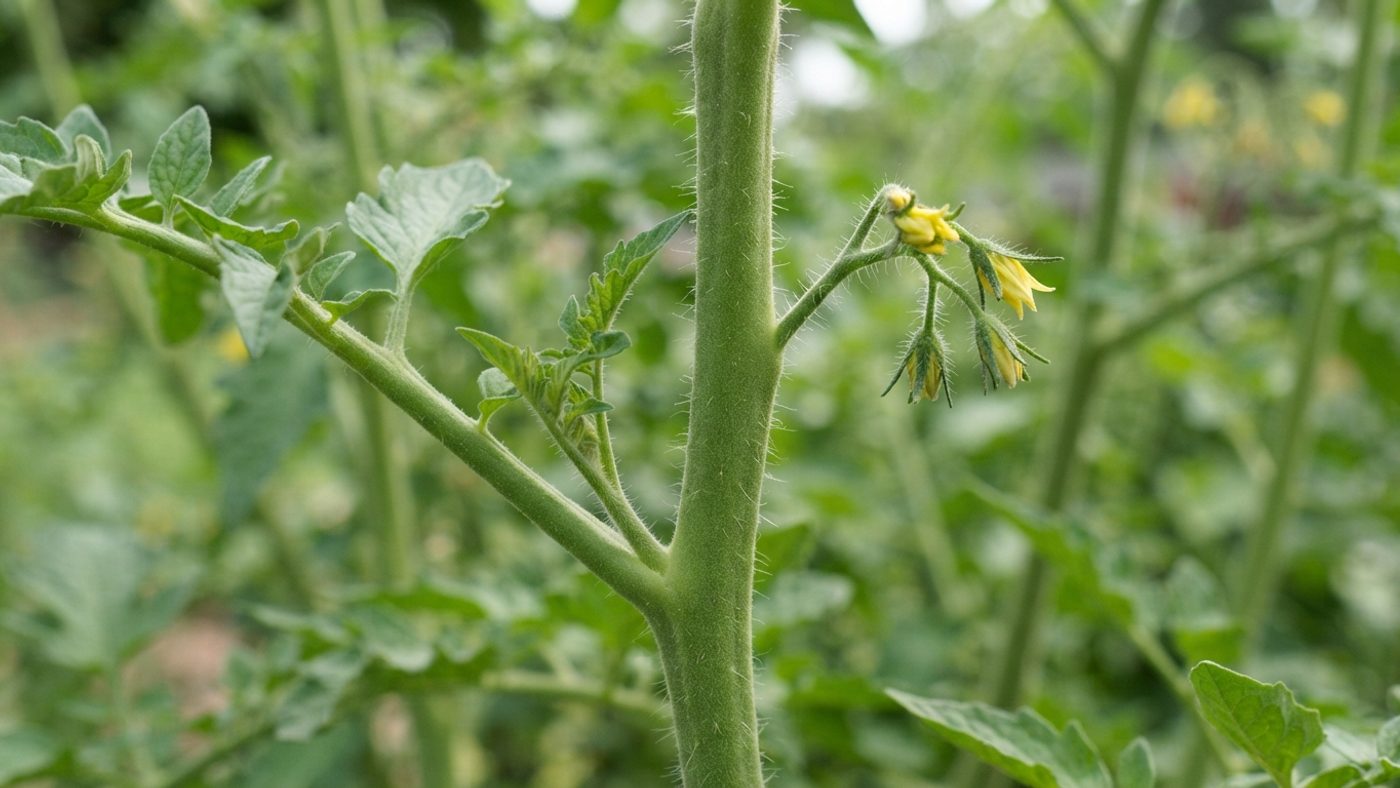
The practical check, when in doubt: look at exactly where the growth is coming from. If it's rising out of the crook between a leaf and the stem, at an angle splitting that crook, it's a sideshoot. If it's coming from the stem on its own, independent of any leaf junction, and shows no leaflet fan, leave it, it's very likely a truss. Waiting two or three days rarely costs anything; a sideshoot left an extra few days is still easy to snap out, while a truss mistaken for a sideshoot and removed is fruit that plant will never produce.
When and how often to pinch out
Sideshoots are easiest to remove while they're still small, an established habit of checking plants roughly once a week works better than trying to catch up on a plant that's got away. At around 2-3cm, a sideshoot snaps off cleanly between finger and thumb with a light sideways bend, leaving barely a mark on the main stem. Left for a few more weeks, the same shoot thickens, and removing it means cutting rather than snapping, which leaves a larger wound and a more obvious entry point for disease.
"Little and often" also means checking behind the leaves and lower down the stem, not just the shoots most visible from the front of the plant, sideshoots that get missed at 3cm are usually the ones found weeks later as thick, semi-woody stems that have to be cut with secateurs rather than pinched by hand. A pinched-out joint often throws up a new sideshoot from the same spot within a week or two, so the same leaf axils are worth rechecking on the next pass rather than assuming a joint is done once it's been pinched. In periods of strong growth, typically once plants are established outdoors or in a greenhouse through midsummer, a weekly check is often not quite enough, and it's worth a quicker look every few days.
Pinch on a dry day if possible, or at least once the foliage itself has dried off. A fresh pinch wound on wet leaves is an easier entry point for grey mould (botrytis) and other fungal problems than the same wound in dry conditions, botrytis thrives in still, humid air just as readily under glass as blight does outdoors, so a greenhouse's own poorer natural ventilation is exactly where that difference matters most.
One genuinely useful thing to do with the sideshoots that come off, rather than composting them: a healthy sideshoot pinched at 8-10cm or so, with its lower leaves stripped and the cut end stood in water or damp compost, will root within one to two weeks and grow into a new tomato plant, genetically identical to the parent. It's a free way to raise a late-season plant, a spare in case of losses, or extra stock to give away, a small side benefit of a task that has to be done anyway.
Stopping the plant: how many trusses is realistic in Scotland
Sideshoot removal isn't the only pruning cut a cordon tomato needs. At some point the growing tip itself has to be removed too, a step usually called "stopping" or "topping": pinching out the growing point two leaves above the top truss you want the plant to keep, so it stops putting on new growth and puts its remaining energy into the fruit already set.
Deciding when to make that cut is a truss-counting question. RHS advice counts trusses, stop at 7 under glass, 4 outdoors. Teagasc, the Irish national agriculture advisory body and a genuine maritime- climate comparison for western Scotland, works to a date instead: stopping outdoor plants in August so the fruit already set has time to ripen before autumn closes in. The tomato growing guide covers that comparison in full.
Scotland's own season is measurably tighter than either reference point on its own. Scotland averages around six days of air frost in April against England's under four, so tender plants like tomatoes typically go outside later relative to the calendar than a UK-wide or Irish timeline assumes, even before Ireland's own generally milder Atlantic-influenced summer is factored in. A later start, without a correspondingly later autumn frost at the end of the season, adds up to a shorter ripening window for an outdoor cordon in most of Scotland than either figure below accounts for on its own, which is why the safer choice, outdoors, is to treat the lower end of each range as the working number rather than the upper one.
| Growing situation | Trusses to keep | Stop by |
|---|---|---|
| Under glass or polytunnel | Up to 7 | Once the top truss you want is set |
| Outdoors, coastal / central belt | 4, treated as a ceiling | Late July to early August |
| Outdoors, cooler inland / upland* | 3 | Mid-to-late July |
The under-glass figure of 7 needs no downward adjustment for Scotland the way the outdoor figures do, a greenhouse or polytunnel is protected from the frost timing that shortens an outdoor season, so the structure itself is already doing the work of extending the growing window. *The inland/upland row is a starting estimate, not a fixed number, check it against the local last frost date on Scotland's frost dates for a specific plot.
For the full tomato-growing process, sowing dates, feeding, staking and the complete side-shoot-and-stopping schedule, see the tomato growing guide. For getting fruit to set in the first place, see hand-pollinating tomatoes and squash.
Common questions
Do I need to pinch out sideshoots on every tomato variety?
No, only cordon (indeterminate) varieties. Check the seed packet or plant label first: it will usually say "cordon," "indeterminate," "vine," "bush" or "determinate" outright, which settles the question before the plant’s even in the ground.
A truss has set more fruit than looks likely to ripen in time, is there anything I can do?
Thinning the truss itself, pinching out the smallest or latest-set fruit within it and leaving the rest, puts the plant’s remaining energy behind fewer, larger tomatoes that stand a better chance of ripening before the season ends. It’s the same logic as stopping the plant, applied one truss at a time rather than to the whole thing.
How big should a sideshoot be before I remove it?
Around 2–3cm is the point it snaps off cleanly by hand with minimal damage to the main stem. Left longer, it thickens and has to be cut rather than snapped, leaving a bigger wound.
Can I grow a new tomato plant from the sideshoots I remove?
Yes. A sideshoot pinched at around 8–10cm, with its lower leaves stripped and the cut end kept in water or damp compost, will typically root within one to two weeks and grow into a plant identical to the parent, a useful way to get a free spare or late-season plant from material that would otherwise be composted.
How many trusses should I let a plant keep before stopping it in Scotland?
There’s no single number that fits everywhere in Scotland, but treating four trusses outdoors as a ceiling rather than a target is a reasonable starting point, and growers in cooler or later-frost inland and upland areas may do better capping at three and topping the plant in mid-to-late July rather than waiting until August.
Sources
3 sources, recorded with what each was used for
- RHS: How to grow tomatoes: Cordon vs bush pruning distinction, sideshoot removal method, stopping/topping technique (two leaves above top truss), and the 7 trusses under glass / 4 outdoors stopping thresholds
- Teagasc: Tomato growing guide: Sideshoot removal at approximately 3cm, stopping plants by date in August rather than by truss count, used as a maritime-climate comparison point for Scotland
- Met Office: 5 gardening tips for April: Average air frost days in Scotland in April compared with England, supporting the point that Scotland's growing season starts later relative to the calendar than a generic UK or Irish timeline assumes