
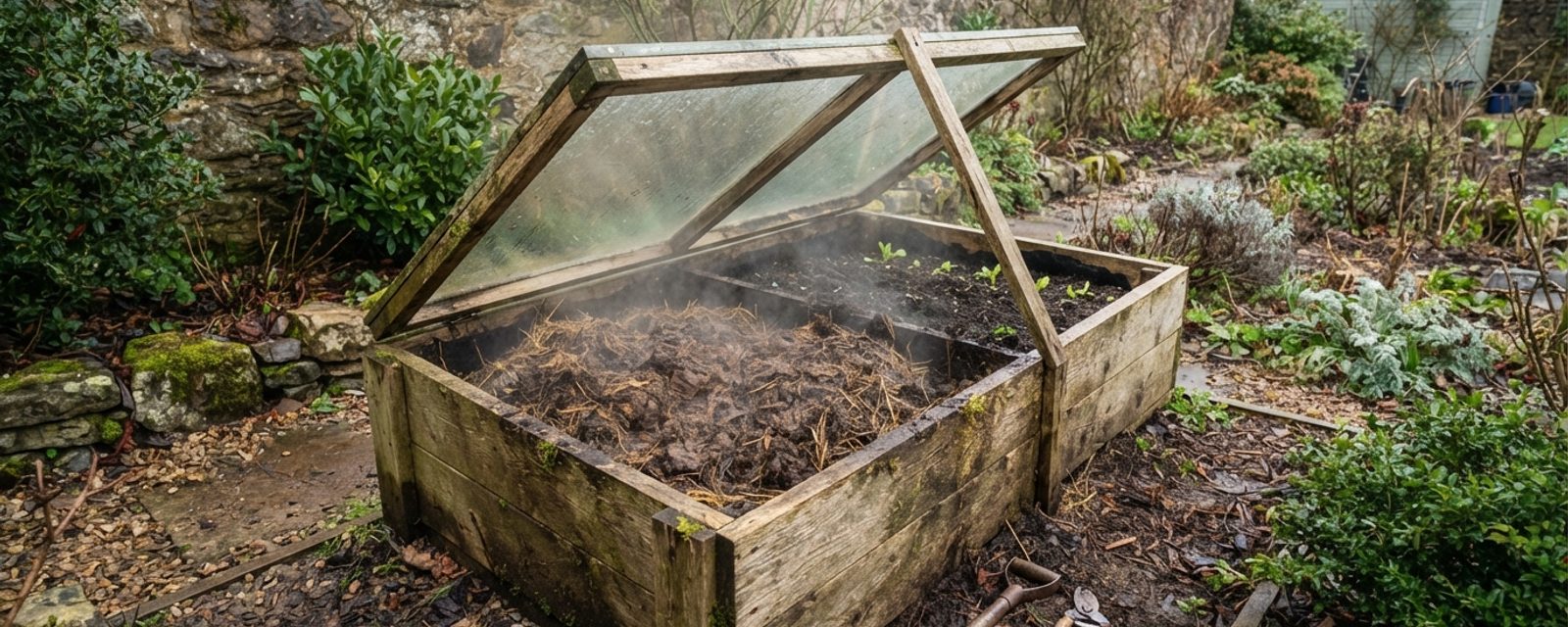
A hotbed isn't warmed by the sun, by stored daytime heat, or by any fuel. It's warmed by digestion. Fresh manure mixed with straw is packed full of readily available carbon and nitrogen, and as soon as it's piled up, heaped, and given air and moisture, aerobic bacteria move in and start breaking it down. That breakdown is exothermic, the microbes releasing energy as they metabolise the material is what generates the heat, in exactly the same reaction that makes a garden compost heap warm to the touch within days.
An ordinary garden compost heap of kitchen and garden waste reaches around 60°C at its centre 24 to 48 hours after filling, then cools as the material is used up. A hotbed is the same biology run at much greater scale and much greater fuel density: a far larger mass of fresh, nitrogen-rich manure and carbon-rich straw, built specifically to hold that heat rather than let it escape, with a layer of soil or growing medium on top to carry the warmth up to plant roots instead of losing it to the air.
Horse manure mixed with straw bedding is the traditional choice, mainly because the straw bedding already supplies the carbon-rich material the reaction needs, but any fresh manure mixed with enough dry, carbon-rich bulking material, straw, or dry leaves as a substitute, can be built into a working hotbed on the same principle. Poultry manure is the one to be more cautious with: it's considerably higher in nitrogen than horse or cattle manure, runs hotter for it, and is more likely to scorch roots even after the settling period below, so it needs a longer settle, or a smaller proportion mixed with more straw, rather than being used at the same ratio as horse manure.
What makes the reaction take off, or fail
Three things decide whether the reaction takes off and how long it lasts. The carbon-to-nitrogen ratio has to be in the range the bacteria can actually use, too much straw (carbon) and the pile heats sluggishly; too much manure (nitrogen) and it can turn anaerobic and slimy instead of hot. Moisture matters just as much: the material needs to be damp enough for microbial activity but not sodden, since waterlogging excludes the oxygen the aerobic bacteria depend on. And mass matters more than almost anything else, a small heap loses heat to the surrounding soil and air about as fast as it generates it, the same reason a single log doesn't hold a fire the way a full stack does.
That's why traditional hotbeds were built at real scale, roughly a cubic metre or more of manure, rather than as a token layer under a growing bed: below that rough threshold, too much of the heat generated escapes at the pile's surface before it can build up in the core. Undersize the pile and the reaction still happens, it just never gets hot enough, or for long enough, to matter. If the pile turns slimy, wet, and smells sour rather than earthy, a sign it's gone anaerobic, forking it through to let air back in and mixing in more dry straw is the fix.
How much heat, and for how long
That heat holds for substantially longer in a hotbed than in an open compost heap, but the exact peak temperature and the exact number of weeks of useful bottom heat depend heavily on the freshness of the manure, the manure-to-straw ratio, pile size, and outside temperature. The heat is front-loaded and declines steadily rather than staying level: a hotbed gives seedlings and early sowings a hot start in the coldest weeks, not a constant heat source for an entire winter.
Composting also slows sharply in cold weather, and heap temperatures run lower in winter than the 24-to-48-hour figure suggests, because the microbes doing the work are themselves temperature-sensitive. That matters more here than it would somewhere milder: a Scottish garden's coldest weeks, the ones a hotbed is usually built to beat, are exactly when the pile itself is working hardest against the weather. A full-size, properly insulated, capped pile is built to keep generating usable heat in cold weather by holding onto more of what it produces than a small or exposed one can; a smaller or thinner pile, or one exposed to wind that strips heat off its sides, asks more of the reaction than it can deliver and underperforms accordingly. Siting a hotbed in the most sheltered, sunniest spot available, ideally against a wall with some southerly aspect, does more to protect it through the coldest weeks than any change to the manure recipe, the same siting logic behind why altitude and exposure matter more than latitude for frost risk generally: a low, sheltered corner of the garden is likely to give a hotbed an easier winter than an exposed or elevated one.
Building the bed
There are two common approaches: dig a pit roughly a metre square and a metre deep straight into the ground, or build an above-ground frame to the same rough dimensions from scaffold boards, breeze blocks, or an existing raised bed's sides. In practice, an above-ground frame is the more workable choice for a hotbed built in midwinter, since ground that's frozen or waterlogged, a real possibility in a Scottish garden in January or February, is hard to dig into at all, and a below-ground pit is more exposed to rainwater draining in and waterlogging the pile from below than a raised frame is.
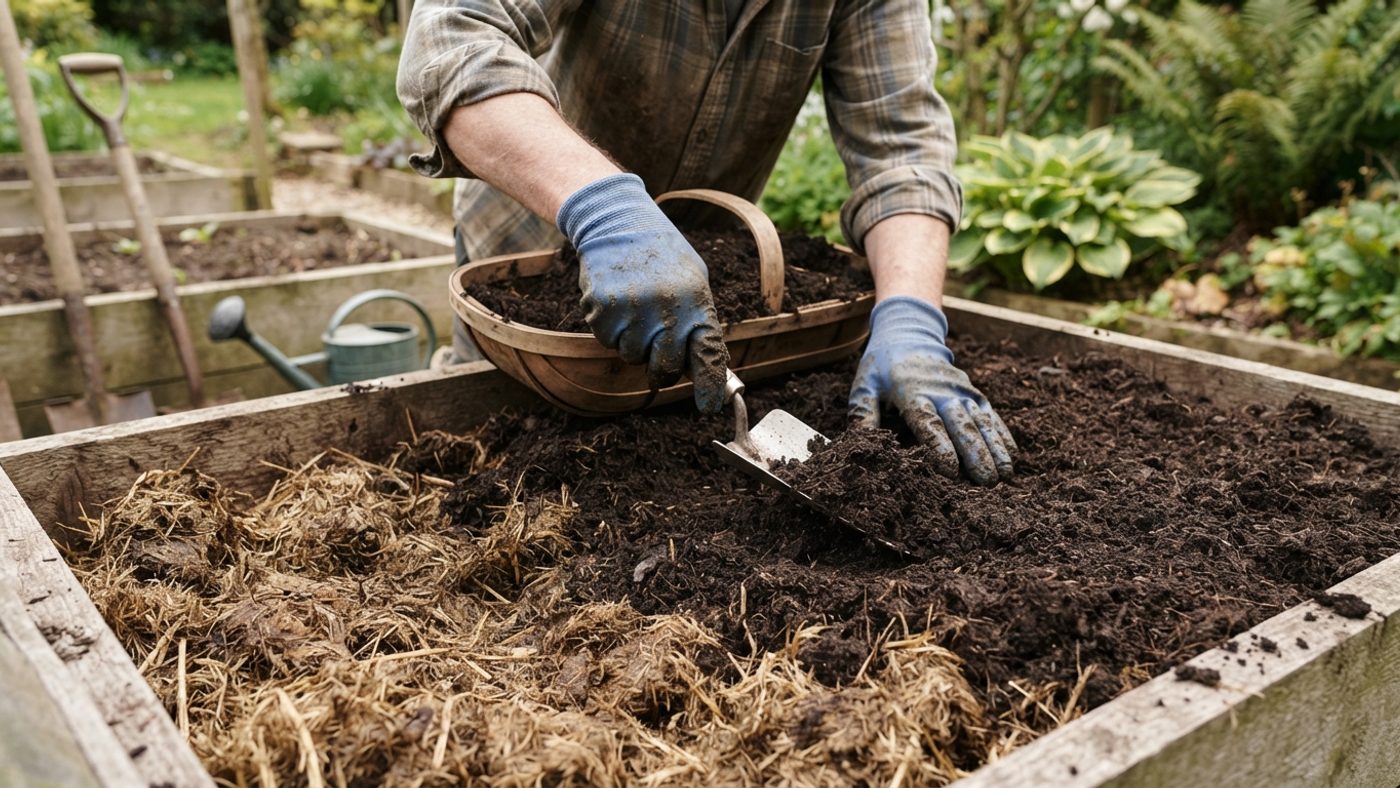
Either way, fill it with fresh manure mixed with straw bedding, treading or tamping it down in layers as you go to remove large air pockets without compacting it so hard the pile can't breathe, then cap it with 15-25cm of soil or potting compost, deep enough for roots to establish without reaching the hot layer underneath, but no deeper than it needs to be, since a thicker cap slows how much of that rising warmth actually reaches the plants. An existing cold frame lid, an old window frame, or a clocheA small, portable clear cover placed over an individual plant or short row to trap warmth and keep off wind, rain and pests. Full definition → over the top holds the rising warmth in; without one, most of the benefit is lost to the open air. A roughly metre-square pile built this way gives about a square metre of heated growing space under the lid, enough for a tray or two of forcedCovering plants to exclude light and speed early, tender growth in the dark, most associated with rhubarb and sea kale in late winter. Full definition → early sowings, not a full bed of crops; a bigger growing area means a proportionally bigger pile and more manure to source.
Because ammonia given off by fresh manure can scorch roots, most guidance recommends leaving the finished bed to settle for a week to ten days before sowing or planting into the cap, or checking with a compost thermometer that surface temperature has dropped out of the danger zone first. Don't be alarmed by visible steam rising off a working hotbed in cold air, it's a sign the reaction is running well, not a problem. Under a closed lid that heat and moisture has nowhere to go, so the lid needs to be propped open or vented on mild days and through that first week or two while the pile is at its hottest, the same way an overheating cold frame needs venting in summer sun, just for a different reason. Skipping this risks cooking tender seedlings from below rather than gently warming them.
Hotbeds are traditionally built in mid to late winter, so the pile is fully hot by the time early sowings would normally go in, checking the region's actual last-frost timing is the best guide to how many weeks of head start a hotbed is realistically worth building for.
| Figure | Rough guide |
|---|---|
| Manure/straw pile size | A cubic metre or more |
| Soil/compost cap depth | 15-25cm |
| Settling time before planting | 7-10 days |
| Venting needed | First 1-2 weeks, on mild days |
| Composting to make manure safe for direct soil use elsewhere | ~3 months aerobic, or ~6 months stockpiled |
Sourcing fresh manure in a modern Scottish garden
A hotbed of any useful size needs a real volume of fresh manure and straw, not a bucketful, but closer to a cubic metre, and, unlike in the nineteenth century, when a horse-drawn city ran on stables and every gardener had a nearby source, that volume has to be actively sourced today. A gardener without a stable, livery yard, or riding school within reasonable reach is starting from a genuine barrier, not a minor inconvenience, before any other part of the technique comes into play.
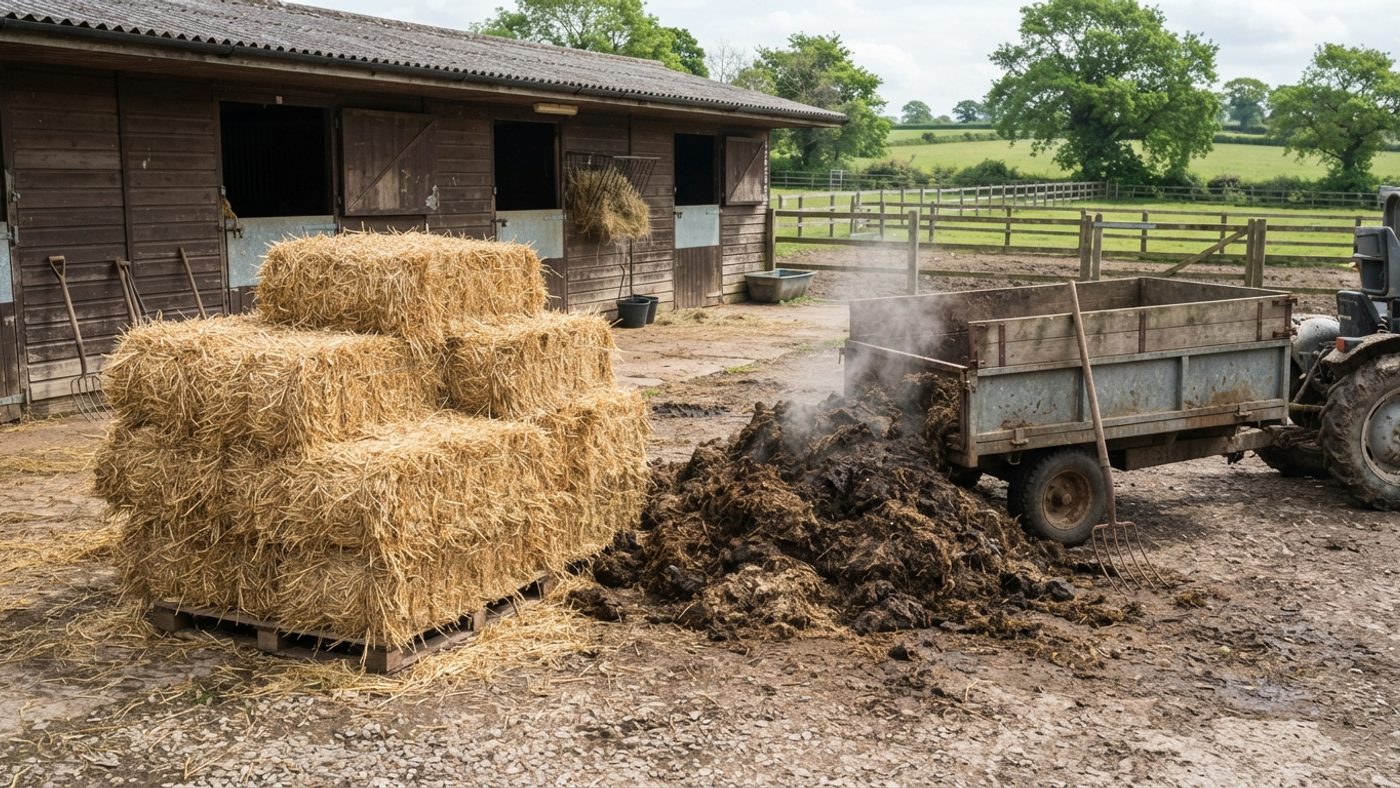
The realistic sources for an ordinary gardener are livery yards, riding schools, and stables, many of which produce more muck than they know what to do with and are glad to have it taken away, sometimes free, sometimes for a small charge covering loading and delivery. Allotment associations in areas with active equestrian businesses nearby are often the easiest route in, since someone on the site has usually already made the connection. Smallholdings keeping a few sheep, pigs, or cattle are a second possibility, though volumes tend to be smaller and less reliable. Straw is worth sourcing at the same time as the manure where possible, a farm shop, feed merchant, or the stable itself is a more reliable route than a garden centre, which typically sells small bagged quantities at a price that doesn't scale to a cubic metre of hotbed.
A working hotbed smells while it's decomposing and can attract rats and other vermin if it isn't properly contained, worth mentioning to whoever's next door before a cubic metre of fresh manure turns up, in a back garden as much as on an allotment. On an allotment specifically, also check the site's own rules first: some associations restrict or ban stockpiling raw manure on-site for exactly those reasons.
Handling fresh manure safely
Fresh manure carries a real hygiene risk. Livestock manure can carry pathogens including E. coli, and handling it fresh, lifting it, barrowing it, tamping it into a bed, means direct contact with material that hasn't yet gone through the composting process that destroys most of that risk. Handling manure and muck-heap material with a cut or graze also carries a risk of tetanus and of leptospirosis (Weil's disease), which is spread through contact with animal urine and can enter through broken skin. Basic precautions are simple but genuinely matter: wear gloves throughout, wash hands and forearms thoroughly afterwards, keep fresh manure and the tools used to handle it away from anything that touches food directly, cover any cuts or grazes before starting, and make sure tetanus vaccination is up to date.
Composting reduces or destroys pathogens and weed seeds and makes manure easier and safer to handle, which is why guidance for using manure as a soil improver calls for it to be aged well before it goes anywhere near ground that will grow food, non-organic farmyard and horse manure is generally recommended to be aerobically composted for around three months, or stockpiled under cover for around six, before it's used as a general soil conditioner.
A hotbed sits in a slightly different position: the manure is the heat source, not a soil amendment spread directly onto a bed of salad leaves, and it's capped with a separate layer of soil or compost that crops actually root into. That reduces direct contact between fresh manure and edible plant tissue, but it doesn't remove the hygiene risk to the person building and maintaining the bed, and it doesn't remove the ammonia-scorch risk to roots in the early days, which is the practical reason for the settling period before planting. Horse manure in particular is also likely to carry residues of the wormers routinely given to horses, which break down during proper composting but are still present in genuinely fresh material.
Once a hotbed's heat is spent, usually after the seedlings it was built for have gone out and the reaction has run its course, the material underneath isn't waste. By that point it's had months to break down and is well on its way to becoming ordinary garden compost, dig it in, or move it to a compost heap to finish rotting down fully, rather than starting over with a fresh pile each time.
The herbicide risk almost nobody checks
One risk is specific to manure and doesn't apply to compost made from garden and kitchen waste: contamination from aminopyralid-family herbicides. These are sometimes used on pasture and hay fields to control broadleaf weeds, and they can pass essentially unbroken through a grazing animal's digestive system and straight into its manure, then persist in soil long after that manure is applied. Contaminated manure can badly stunt or twist susceptible plants, tomatoes, potatoes, beans, and other broadleaf vegetables are particularly sensitive, and there's no way to tell by looking at the manure whether it's affected. If sourcing manure from a stable or livery yard, it's worth asking what the horses are fed and where their hay and grazing comes from, and running a simple germinationA seed sprouting: breaking dormancy and putting out its first root and shoot, given the right warmth and moisture. Full definition → or growth test with a fast broadleaf plant like beans before committing a full hotbed's worth of manure to a bed intended for food.
Is a domestic-scale manure heap even something to worry about legally?
Scotland's General Binding Rules for handling livestock manure and slurry, enforced by the Scottish Environment Protection Agency (SEPA), which require, among other things, that a temporary field heap of farmyard manure be kept at least 10 metres from any watercourse or field drain and at least 50 metres from any spring, well, or borehole, are written for commercial agricultural operations, not domestic gardens, and don't have anything to say about a back-garden or allotment-scale hotbed. That said, the underlying logic still applies at small scale: siting a manure pile well away from any drain, ditch, or watercourse, and off a slope that runs toward one, is just sensible practice regardless of size or legal threshold.
Hotbed vs. the insulation-based methods
A cold frame, fleeceA lightweight, breathable fabric laid or draped over plants to trap a little warmth and keep off frost, wind and some flying pests. Full definition →, and a polytunnel all trap or reflect heat that's already there. Delivering heat none of them can generate is what a hotbed costs real labour, materials, and manure to buy.
| Method | Heat source | Typical effort | Ongoing cost | Reliability |
|---|---|---|---|---|
| Hotbed | Microbial decomposition of fresh manure and straw | High -- sourcing, building, tamping, capping, monitoring | Free to low if manure is locally available; otherwise a real logistics job | Variable -- depends on manure freshness, pile size, and build quality |
| Cold frame (unheated) | Trapped solar heat only | Low to moderate -- one-off build or purchase | Low | Consistent, but limited to what sunlight provides |
| Fleece | Trapped ambient/ground heat, wind and frost barrier | Low | Low, replace periodically | Consistent, well understood |
| Polytunnel | Trapped solar heat, wind and frost barrier | Moderate to high -- structure and siting | Moderate | Consistent, largest protected area |
If fleece, a cold frame, or a polytunnel is already part of the garden, see the guides on fleece grades and timing, insulating a greenhouse for winter, and protecting plants from frost for how to get the most from them. A hotbed isn't a replacement for any of those; it's a genuinely different tool, giving seedlings bottom heat none of the insulation-based methods can provide, at the cost of far more manual effort and a manure supply most modern gardeners simply don't have on tap.
The verdict
A hotbed's real value is giving a crop a start several weeks ahead of when it could normally go in, worth checking against the region's actual last-frost timing to see how much of a head start is realistically on offer before committing the effort. For most Scottish gardeners today, a hotbed is a rewarding project for someone who already has ready access to fresh manure, an allotment near a livery yard, a smallholding, a good relationship with a local stable, and who wants an early, heated start for the crops hotbeds have traditionally been used to force, chillies, aubergines, cucumbers, melons, early potatoes, French beans, and salad leaves through winter, without running a propagator or heated greenhouse.
For someone without a nearby manure source, the sourcing problem alone usually makes a cold frame, fleece, or a small heated propagator the more realistic route to the same early-season goal, with a fraction of the labour and none of the hygiene handling. The two aren't really in competition for most gardens; a hotbed is what's worth building once the more ordinary methods already in place aren't giving quite enough heat for what's being started.
Common questions
Can I use a hotbed built with fresh manure to grow salad leaves I'll eat raw?
Not directly in the manure itself -- fresh manure carries a real pathogen risk and shouldn't go anywhere near crops that will be eaten raw and unwashed. In a hotbed, the manure is the heat source underneath a separate cap of soil or growing compost that plants actually root into, which reduces direct contact, but good hygiene when handling the manure and a proper settling period before planting still matter.
How long does a hotbed stay warm?
The heat is front-loaded: strongest in the first weeks after building, driven by the readily available material in the fresh manure and straw, then declining steadily as that material is used up. Build size, manure freshness, and outside temperature all affect exactly how long useful warmth lasts, which is why it's worth checking pile temperature directly with a compost thermometer rather than relying on a fixed timescale.
Where can I actually get fresh manure in Scotland if I don't have a stable nearby?
Livery yards and riding schools are the most realistic source for most gardeners, and many are glad to have manure taken away. Allotment associations in areas with equestrian businesses nearby are often the easiest way in. Without one of these reasonably close by, sourcing enough manure for a proper hotbed is a genuine practical barrier.
Is it worth building a hotbed instead of just using a cold frame?
Only if biologically generated bottom heat is actually needed, for forcing very early sowings or tender crops like chillies and aubergines well ahead of the normal season. For general frost protection and season extension, a cold frame, fleece, or polytunnel does the job with far less labour and no manure sourcing or handling involved.
Do I need to worry about herbicide contamination in manure for a hotbed?
Yes, if the manure comes from horses or livestock grazing pasture or fed hay that may have been treated with aminopyralid-family herbicides. These can pass through the animal and remain active in the manure, potentially stunting sensitive crops like tomatoes and beans. Asking about feed and grazing sources, and running a simple growth test before committing manure to a food-growing bed, are worthwhile precautions.
Weighing up other alternative growing systems for a Scottish garden? See square foot gardening: a Scottish verdict, hugelkultur: where it actually works and fails, hydroponics for beginners, and chaos gardening: what it does to yield.
Sources
7 sources, recorded with what each was used for
- RHS: Composting through the winter: The ~60°C peak compost heap temperature within 24-48 hours of filling, and the note that winter cold reduces heap temperatures
- RHS: Organic matter, how to use in the garden: Fresh manure risks, the not-for-raw-eaten-crops caution, and the herbicide contamination and germination-test warning
- RHS: Coldframes and mini-greenhouses: General cold frame context in the comparison section
- Garden Organic: Frequently asked questions: The three-month aerobic composting / six-month stockpiling guidance, pathogen and weed-seed destruction through composting, and wormer-residue breakdown in horse manure
- Garden Organic: Different composting methods: How quickly a hot heap heats up and what hot composting destroys
- Soil Association: How to make your own compost: The green:brown ratio and typical composting timescale, and the point that overheating without turning can kill the aerobic bacteria doing the work
- gov.scot: Prevention of environmental pollution from agricultural activity: guidance (Section 4): The 10m/50m watercourse and water-source distance rules for temporary farmyard manure heaps, and confirming this guidance is scoped to commercial agricultural operations rather than domestic gardens