
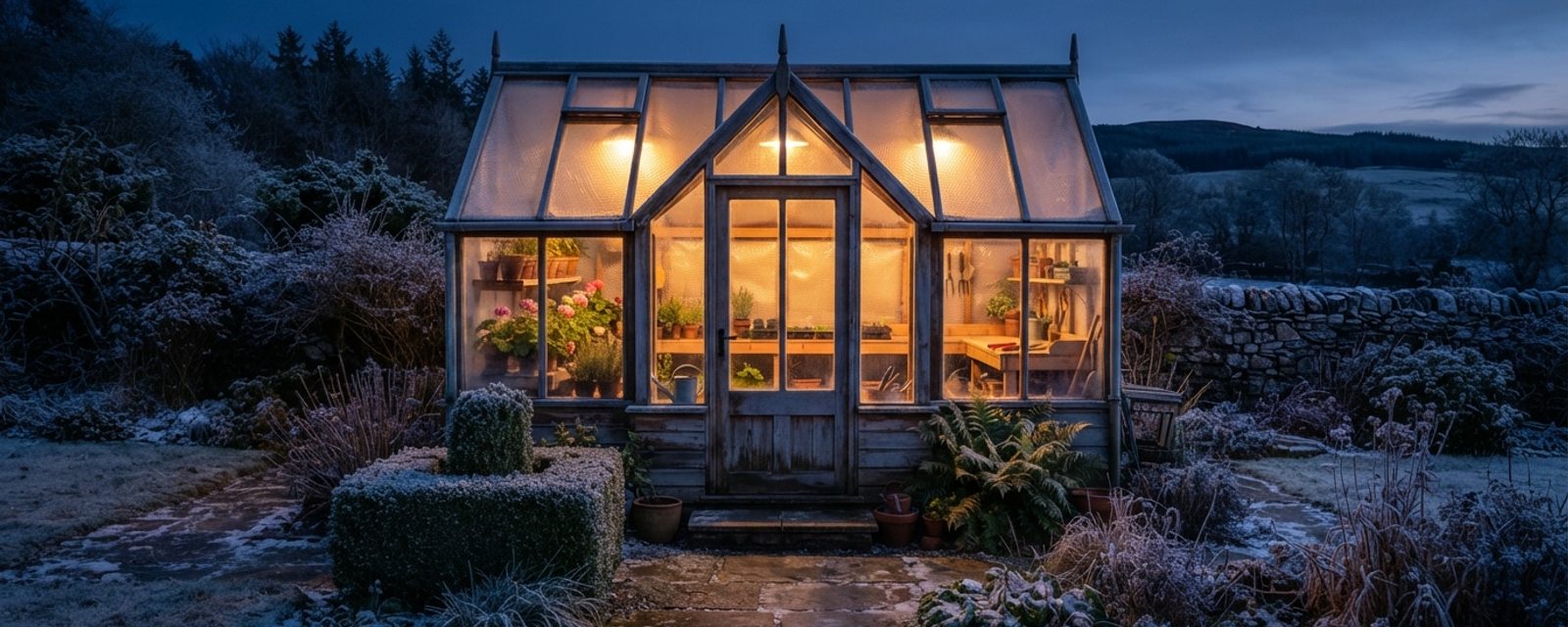
A greenhouse keeps rain and wind off, but glass does almost nothing to stop heat escaping. During the day, short-wave sunlight passes straight through the glass and warms the soil, the pots, and the structure inside. Those warmed surfaces then re-radiate that energy back out as long-wave infrared heat, and ordinary horticultural glass is far more transparent to outgoing long-wave radiation than it is opaque to it, so the heat a greenhouse gained for free all day leaks straight back out through the same panes after dark. Single glazing also conducts heat directly through the glass to the cold air outside, and any gaps around vents, doors or overlapping panes lose more again through simple air exchange.
The net effect: on a still, clear winter night, exactly the nights with the sharpest radiative losses, an unheated single-glazed greenhouse can end up barely warmer than the garden outside it, sometimes only a degree or two different from the open air. That gap between "keeps rain off" and "keeps cold out" is the entire reason insulation, thermal mass and heating exist as a separate category of greenhouse management from the structure itself.
That physics is the same everywhere in the UK. What differs in Scotland is simply how often, and how hard, the outside air actually gets cold enough for it to matter.
How much colder is a Scottish winter, really?
Met Office 1991-2020 station normals show every mainland Scottish lowland location logging several times more annual air-frost days than a mild English comparator. Camborne in Cornwall, one of the mildest stations in mainland Britain, averages only 7.38 air-frost days a year and a yearly minimum temperature of 8.61C. Compare that with Scotland's own stations:
| Station | Annual air-frost days (1991-2020) | Coldest night recorded |
|---|---|---|
| Camborne, Cornwall (England comparator) | 7.38 | - |
| Inverness | 38.35 | around -15 to -16C |
| Dumfries | 42.56 | -18.3C (nearby Glenlee, 1940) |
| Edinburgh (Royal Botanic Garden) | 42.68 | around -15 to -16C |
| Charterhall, Borders | ~48 | - |
| Dyce, Aberdeen | ~49 | - |
| Braemar (upland, 339m) | ~51 in Dec-Feb alone | -27.2C (1982), UK record shared with Altnaharra |
For all eight Scottish regions, not just the ones picked out above, see Scottish frost dates by region, and for the full H1aThe RHS's H1a–H7 scale for how much cold a plant can survive outdoors, H1a being tender indoor-only and H7 hardy anywhere in the UK. Full definition →-H7 hardiness framework these figures map onto, RHS hardiness zones for Scotland breaks it down station by station.
Even Scotland's mildest mainland station, Inverness, sees more than five times as many frost days a year as Camborne, and Glasgow Airport (-20C) and Carnwath in South Lanarkshire (-24.8C, one night after Braemar's record) show that a hard extreme isn't confined to the Highlands. Read across the table and most of lowland, inhabited Scotland, Edinburgh, Dumfries, Dyce, Charterhall, Inverness, sits in a fairly tight band, roughly 38-49 air-frost days annually, all clearly colder than England's mild extreme but broadly comparable to each other. Braemar stands apart, not just in frost-day count but in how much colder its worst nights actually get.
These are regional averages, not a prediction for one specific plot. A greenhouse sited in a dip or hollow where cold air can drain and pool, or in an open spot with no wall or hedge for shelter, will run colder on a still night than its region's station figures suggest, sometimes by several degrees. A greenhouse tucked against a south-facing house wall, by contrast, picks up stored heat from the brickwork and is milder than the open-ground figures imply. Where the structure actually sits matters as much as which region it's in.
Does that actually change what insulation is worth doing?
Yes, but not uniformly, and not in the direction of "just insulate harder everywhere." The data splits Scotland into two genuinely different cost-benefit cases.
For most lowland Scottish gardens, Edinburgh, Dumfries, Dyce, Charterhall, Inverness, and anywhere with a broadly similar climate, the frost-day count (upper 30s to upper 40s annually) and extreme minimums (roughly -15C to -20C in the coldest recorded events, not the typical winter night) mean the standard bubble- wrap-plus-thermometer approach most UK greenhouse advice describes remains proportionate. These gardens see harder and more frequent frost than England-wide advice assumes, so insulation and vigilance genuinely matter more here than a Cornwall-written guide implies, but the gap between a cold Scottish lowland winter and a cold English winter is a matter of degree, not of category. A well-fitted double layer of bubble wrap, sensible plant siting, and a min/max thermometer to catch the exceptional cold snap covers the realistic range of conditions for the vast majority of Scottish gardeners.
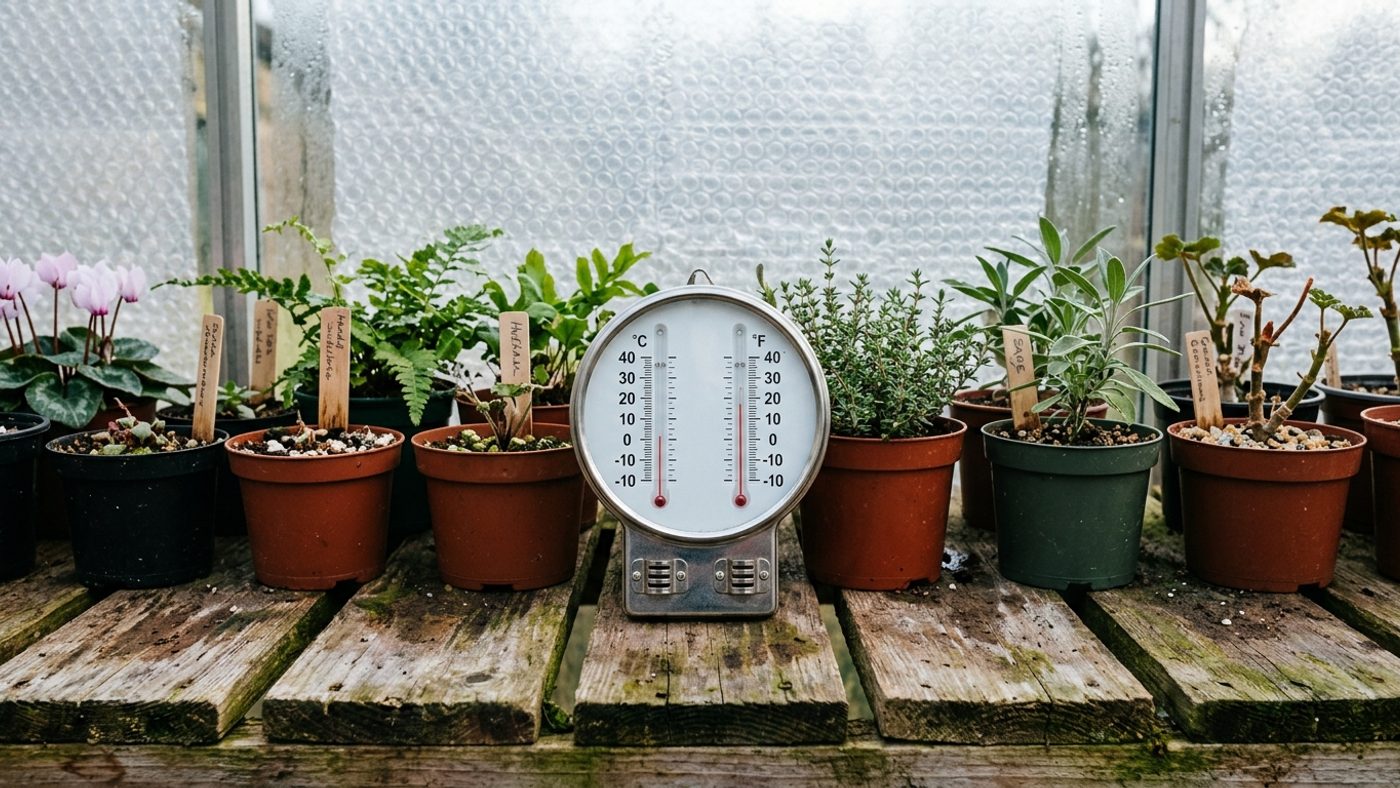
For upland and Highland-glen gardens, Braemar-like conditions, frost recorded most months of the year, extreme minimums in the -20C to -27C range, the case changes. Bubble wrap buys a genuine but modest few degrees of protection by trapping an insulating air layer against the glass and cutting radiative and convective losses; it does not create heat, it only slows its escape. Against a typical lowland frost of -2C to -5C, that few degrees is often enough to keep an unheated space above freezing. Against Braemar's recorded extremes, or even its routine mid-winter nights, a few degrees of buffer on top of an already deeply sub-zero outside temperature will not keep a genuinely tender (RHS H2 or tenderer) plant alive, pelargoniums, citrus, tree ferns and young alpine seedlings overwinteredKeeping a plant alive and intact through the cold months, whether left outdoors, moved under cover, or stored dormant. Full definition → under glass are all typical examples. In that setting, the proportionate response for anything not fully hardy is to budget for frost-free minimum heat, a thermostatically controlled heater holding the space at 4C (the RHS's definition of frost-free, sufficient for H2-rated plants), and to treat bubble wrap as a way of reducing how much that heater has to work, not as a substitute for it. It's also worth planning for the mains going out on the coldest night of the year, which is exactly when an upland or Highland-glen power cut is most likely: a paraffin heater kept as backup, or at minimum a maximum/minimum thermometer with an alarm, is cheap insurance against losing tender stock to an outage rather than to the cold itself.
Most Scottish gardeners are not gardening in Braemar, and the real dividingPropagating a clump-forming perennial by digging it up and splitting it into several smaller pieces, each with roots and shoots attached. Full definition → line for what's worth doing is lowland versus upland/ Highland-glen, not Scotland versus England as a whole.
Insulation methods compared
| Method | Typical cost | Effort | Temperature gained | Best suited to |
|---|---|---|---|---|
| Bubble wrap glazing (large-bubble, double layer) | Low, one-off, reusable for several seasons | Moderate, fitting takes an afternoon | A few degrees; reduces radiative and convective loss | Most lowland Scottish gardens; hardy-to-borderline plants |
| Horticultural fleeceA lightweight, breathable fabric laid or draped over plants to trap a little warmth and keep off frost, wind and some flying pests. Full definition → (inside, over plants) | Low | Low | A few degrees directly at plant level | LayeringPropagating a new plant by pinning a low, flexible stem into the soil while still attached to the parent, so it roots before being cut free. Full definition → inside bubble wrap for individual tender specimens; frost-only cold snaps |
| Thermal mass (water butts, dark-painted containers) | Low-moderate | Low, fill and position, no fitting | Buffers swings rather than raising the average; can add a degree or two overnight | Any greenhouse as a supplementary measure, especially with reliable daytime sun |
| Electric fan heater with thermostat | Moderate purchase + ongoing running cost | Low | Can hold any set minimum, including frost-free (4C) or warmer | Upland/Highland-glen gardens; anything genuinely tender anywhere |
| Electric tube heater with thermostat | Moderate purchase + lower running cost than fan | Low | Reliable frost-free background heat, less air movement than fan | Frost-free minimum heat without needing strong air circulation |
| Paraffin or gas heater | Low purchase, ongoing fuel cost | Moderate, needs monitoring, ventilation | Can reach frost-free or warmer | Only where mains electricity isn't available; least suited to airtight winter greenhouses |
For fitting: buy large-bubble horticultural bubble wrap (the bubbles roughly 25mm across, not the small-bubble packaging kind, which insulates less well) and fix it to the frame with proprietary plastic clips pushed into the glazing bars, or drawing pins on a wooden frame, both quicker and less fiddly than tape, which tends to fail once it's damp.
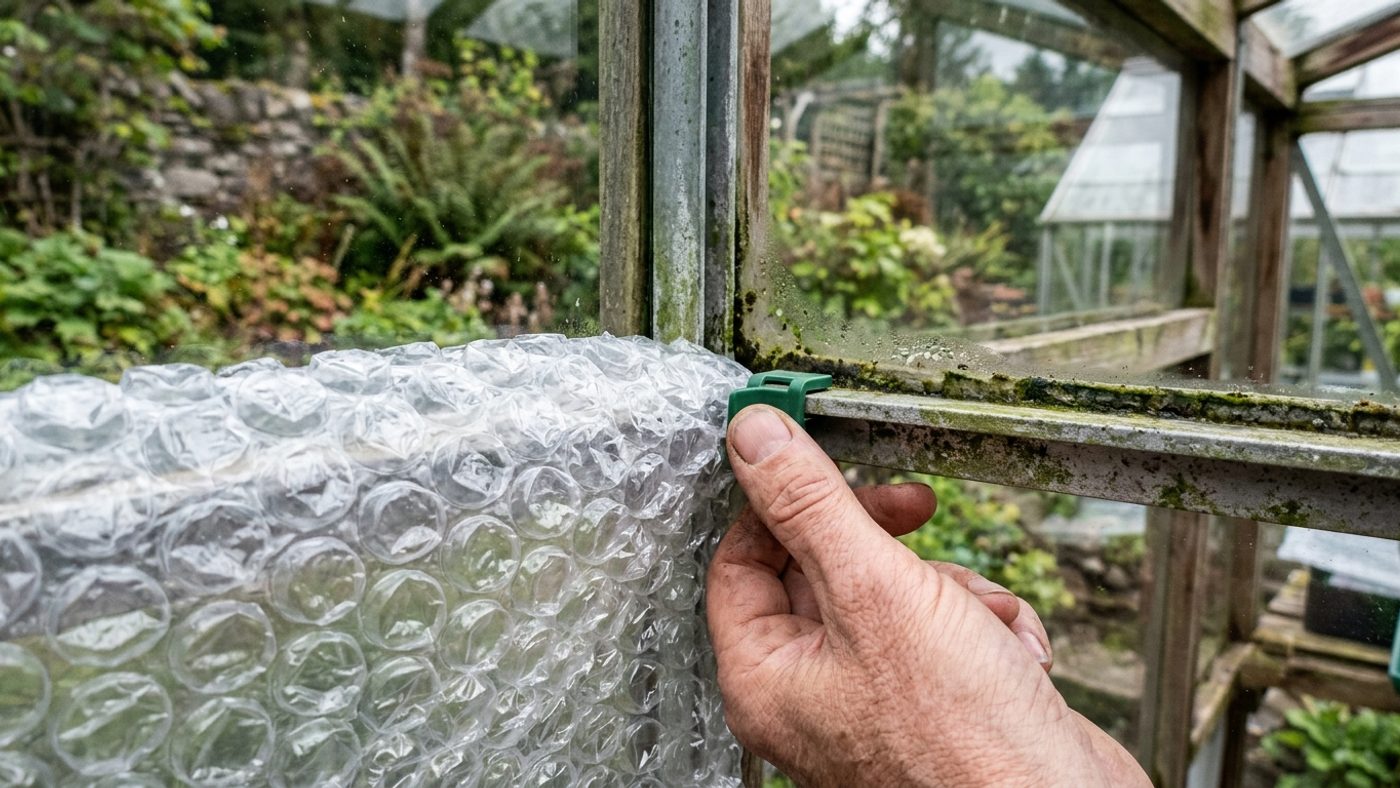
Put it up as the first hard frosts start, typically October in most of lowland Scotland, and take it down again by April or May once night frosts are behind you, since it also blocks light your plants need once the growing season restarts. A heater's running cost depends on its wattage, the greenhouse's size and insulation, and the electricity tariff, so check the wattage against your own tariff before buying rather than rely on a generic figure; an off-peak tariff (Economy 7 and similar) is worth checking too, since a thermostat-controlled heater does most of its work overnight, exactly when off-peak rates apply.
A few points worth knowing before choosing between these. Bubble wrap and fleece are not either/or: fleece, hessian, straw or bracken are recommended as direct plant-level protection, and there's no reason that has to stop at the greenhouse door; fleece over an individual tender plant, inside a bubble-wrapped structure, adds a genuinely separate layer of protection rather than duplicating the same one. Thermal mass is a multiplier, not a primary strategy on its own; four 25-litre containers of water in a modest greenhouse are commonly cited as adding roughly 1-2C to the overnight minimum by absorbing daytime solar heat and releasing it slowly after dark, useful on top of bubble wrap but won't rescue a night that bubble wrap alone can't cover.
Paraffin and gas heaters both produce water vapour, ethylene and carbon monoxide as combustion by-products, which means the greenhouse needs ventilation that partly undermines the heat being generated. Given how many more frost days a Scottish winter greenhouse has to get through than the England-wide comparison above, that ventilation penalty costs more heat here over the course of a winter than it would further south, which is why electric heating on a reasonable tariff is the more practical and less environmentally costly everyday option. That's a case for electric as the primary heater, not against keeping paraffin as backup: the earlier advice to keep a paraffin heater in reserve for an upland power cut is about outage cover for the rare worst night, not a recommendation to run paraffin day to day.
Bubble wrap and fleece both cut light as well as heat loss, which matters more in Scotland than the temperature figures alone suggest: short, low-angle winter daylight this far north means anything grown on through winter is already working with less light than an equivalent English greenhouse, so a second or third layer piled on for extra warmth is trading light a plant may already be short of. Fit enough to do the job, not more; many gardeners insulate only the north-facing wall and roof, where little useful winter light comes from anyway, and leave the south-facing glazing clear to keep as much daylight in as possible.
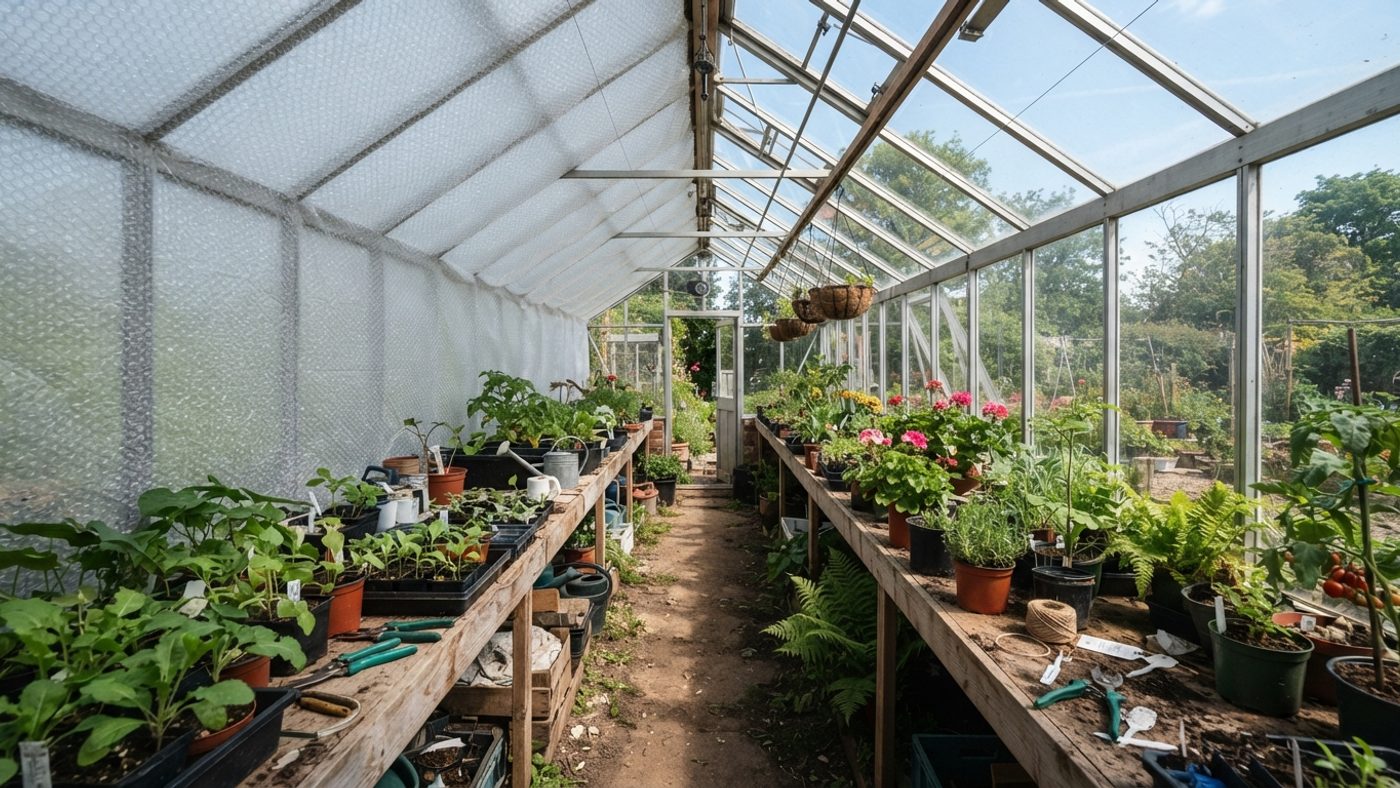
For a more exposed or west-coast site, rigid insulation panels (cellular polycarbonate or Correx, cut to fit the frame) are a sturdier alternative to bubble wrap on the north wall specifically; they survive wind and repeated seasons better, at a higher one-off cost, though they're more fiddly to fit and remove than bubble wrap. And if the job at hand is raising seedlings rather than just keeping mature plants alive, a soil-warming cable or heated propagator mat warms the compost directly, a far more efficient way to get seeds germinatingA seed sprouting: breaking dormancy and putting out its first root and shoot, given the right warmth and moisture. Full definition → in a cold, dark Scottish February than heating the whole greenhouse's air.
Getting the ventilation-versus-heat-loss balance right
The instinct in a cold Scottish winter is to seal everything up. That's a mistake for a different reason than heat loss: condensation and mould. Ventilation remains essential through winter, not just in growing season, specifically to prevent damp and mould building up and to keep a healthy balance of oxygen and carbon dioxide around the plants. A tightly sealed, bubble-wrapped, unventilated greenhouse traps the moisture that plants transpire and that evaporates from compost, and that moisture condenses on the coldest surfaces overnight, which, in an insulated greenhouse, is often the plants themselves. Grey mould (botrytis) thrives in exactly those still, humid, poorly ventilated conditions.
The practical balance:
- Vent briefly on frost-free or milder winter days, even for twenty minutes around midday, to exchange stale humid air for drier outside air, then close up again before the temperature drops in the afternoon.
- Space plants apart rather than letting foliage touch: stand pots on wood or slate to lift them off cold, damp staging and keep air moving around leaves.
- Cut back watering through the darkest, coldest months; overwatering in winter adds humidity the greenhouse can't easily lose and cold, wet roots are more vulnerable to rot than to the cold itself.
- Keep bubble wrap and fleece separated from foliage where possible, since damp trapped between plastic and leaf tissue is a common site for rot and mould to start.
Getting this balance wrong in either direction costs plants: too much ventilation on a hard frost night undoes the insulation you've just fitted; too little ventilation, ever, breeds the mould and rot that kill overwintering plants just as reliably as frost does.
Islands and exposed coasts: wind, not cold, is the bigger problem
Everything above assumes cold is the main threat, which holds for most of mainland Scotland but not for the islands and exposed coasts. Stornoway's own Met Office station records among the lowest air-frost counts anywhere in Scotland, around 4.7 to 5.5 air-frost days a month even at the depths of winter, milder than any mainland station in this article. On ground that mild, insulating against cold matters far less than keeping the structure itself standing through a winter gale, and a west-coast or island gardener planning for winter is better off starting with securing the structure rather than warming it. Heavy or wet snow is worth a line too, especially on the Grampian and Highland sides of the country: clear it off a polytunnel or greenhouse roof before its weight cracks glazing bars or collapses the frame, the same way you'd clear a conservatory roof.
Common questions
Is bubble wrap actually worth it in a cold Scottish garden, or is it just an England-oriented tip that does not really apply here?
It's worth it for most gardens. If you're not sure which camp yours falls into, the quickest check is a maximum/minimum thermometer left in the greenhouse over a cold snap: a recorded low within a few degrees of freezing means bubble wrap alone is doing its job; a low well into double-digit negatives is your sign to budget for a heater instead of piling on more bubble wrap, which won't close a gap that size.
What temperature should I aim to keep my greenhouse at over winter?
It depends what's inside. RHS guidance defines frost-free as around 4C, which is enough to keep H2-rated tender plants alive through winter; a cool greenhouse for borderline-hardy plants is usually kept around a 5C minimum night temperature; genuinely tender or warm-temperate plants need 10C or higher. Fully hardy plants and dormant stock need no artificial heat at all, check the plant's RHS hardiness rating before deciding what level of heating it actually needs.
Should I trust the thermostat dial on my heater?
Not on its own. Thermostat dials, mounted close to the heater itself, can misread the actual air temperature by several degrees, and several degrees is the entire margin between frost-free and a dead tender plant in an upland garden. A separate maximum/minimum thermometer positioned near the plants, not near the heater, gives a far more reliable picture of what they're actually experiencing overnight, and it's the only way to know whether a heater set to 4C is actually holding 4C where it matters.
Does thermal mass, like water butts, really make a difference, or is it a marginal gimmick?
It's a real but modest effect, and it works best as a supplement to bubble wrap rather than a replacement for it. Large containers of water absorb solar heat during the day and release it slowly overnight, commonly cited as adding roughly 1-2C to the overnight minimum for a modest domestic greenhouse. That's a meaningful buffer against a borderline frost, but it won't turn an unheated upland greenhouse into a frost-free one on a genuinely cold Scottish night.
Do I need to ventilate a bubble-wrapped greenhouse in winter, or does that defeat the point of insulating it?
Yes, you still need to ventilate, briefly and on the milder days. Ventilation prevents the mould and dampness that build up in a sealed, humid space, and that risk is higher, not lower, once a greenhouse is insulated and holding in the moisture plants transpire. A short vent on a frost-free afternoon, followed by closing back up before the evening cold sets in, protects against damp without giving away the heat gains from the insulation.
Sources
6 sources, recorded with what each was used for
- RHS: Greenhouses - Heating Efficiently: Bubble wrap light-loss figure, heater types (electric fan/tube vs paraffin/gas), thermostat accuracy caveat, 4C frost-free/H2 definition
- RHS: Greenhouse - Ventilation and Shading Tips: General ventilation and cold-night blind/netting use
- RHS: How to make the most of your greenhouse in winter: Winter ventilation necessity, condensation/mould prevention, plant spacing, glass-vs-polytunnel heat retention, hardiness-rating heating guidance
- RHS: Overwintering tender plants - wrapping: Fleece/hessian/straw as direct plant-level winter protection materials, timing, and rot risk from trapped moisture
- Met Office: Location-specific long-term averages, Camborne, Cornwall (1991-2020): Camborne annual air-frost days (7.38) and yearly minimum temperature (8.61C), used as the England comparator figure
- Met Office: Location-specific long-term averages (Scottish station network): Regional Scottish air-frost-day figures underlying this site's own frost-dates data