
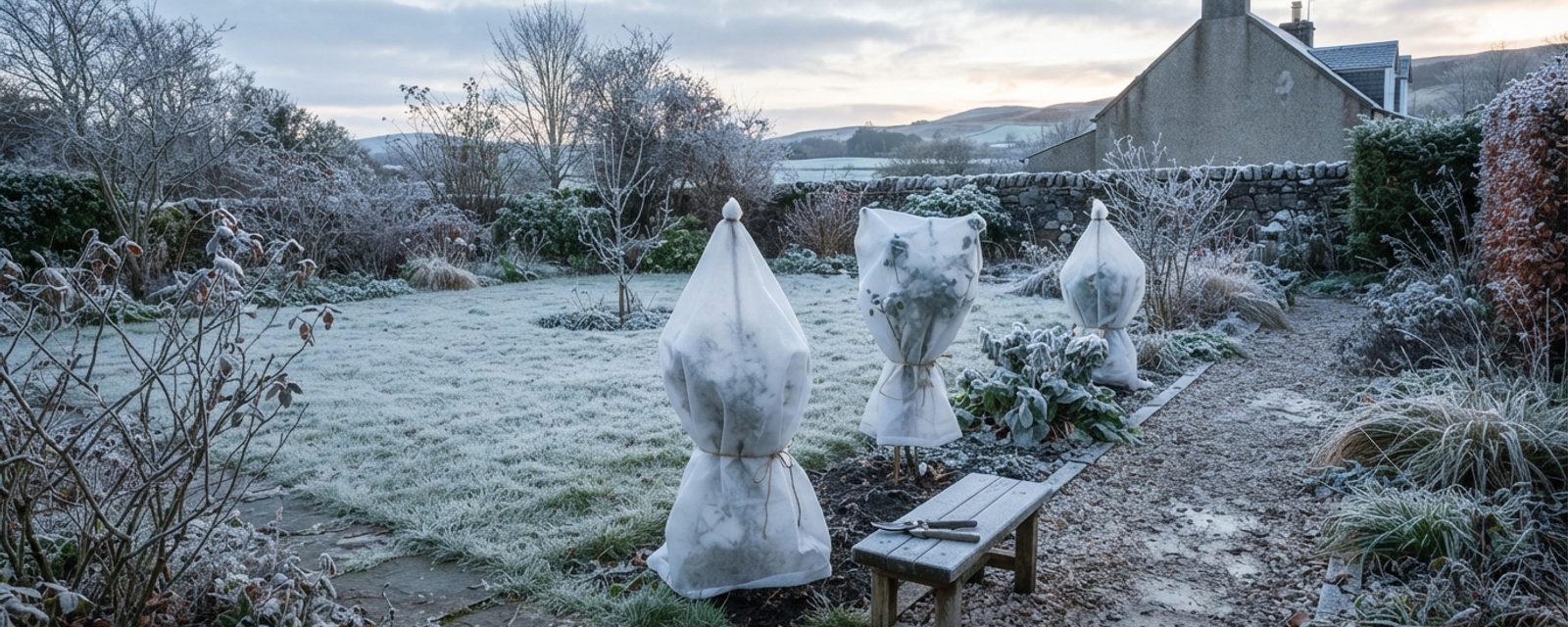
If you're out in the garden this morning looking at dahlia foliage gone black and collapsed overnight, or a fuchsia's soft new tips hanging limp and water-soaked, that's frost damage. Ice has formed inside or between the plant's cells. As water freezes it expands, and in soft, non-hardy tissue that rupture kills the cell walls outright, which is why the damage often doesn't show as "frozen" but as blackened, mushy, or scorched growth, sometimes not fully visible until the tissue thaws and the cell contents leak out. Frost-scorched evergreen leaves can look bleached or bronzed for a similar reason: the plant loses moisture from its foliage faster than its (possibly frozen) roots can replace it, especially in wind, worth knowing on an exposed Scottish plot, where wind is a genuine part of the damage, not just the cold on its own.
None of that necessarily means the plant is dead. Established, correctly-hardy plants often recover from the growing point even when top growth is destroyed, but most of this damage was genuinely preventable, and knowing why it happened is what makes the difference next time a cold night is forecast.
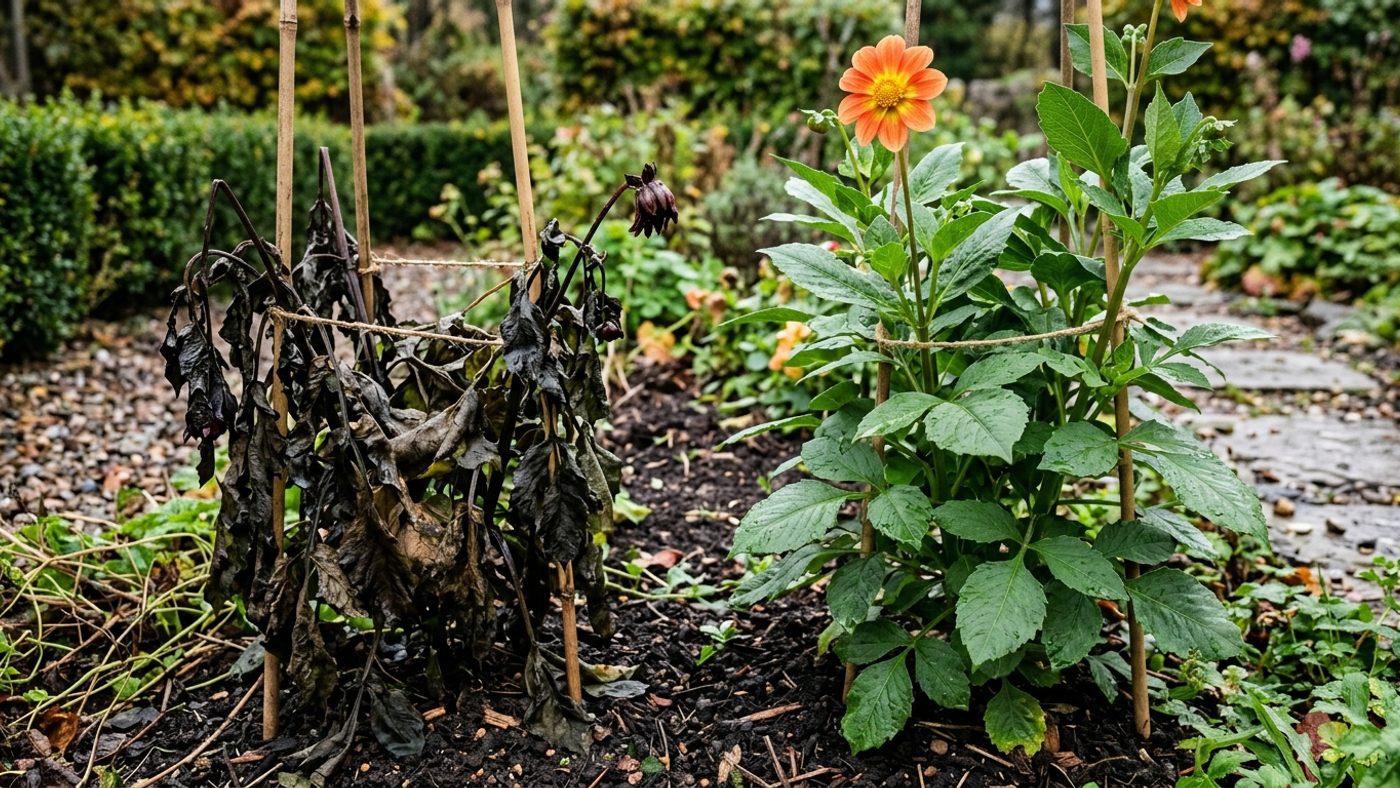
If it's dahlias or cannas that took the hit, the real fix happens before the frost, not after: lift and store the tubersA swollen underground stem or root a plant uses to store energy, which can also grow into a new plant, the classic example being a potato. Full definition → once the first frost has blackened the foliage back, rather than leaving them in the ground to face a second, harder frost that can damage the tuber itself and not just the leaves.
Two kinds of frost, and why the distinction matters
Not all frost forms the same way, and the difference changes what actually protects a plant.
Radiative frost (the ordinary "clear night, frosty morning" kind) happens on clear, still nights. With no cloud cover to trap it, heat radiates straight up from the soil and plant surfaces into open sky, and temperatures at ground level can drop several degrees below the air temperature reported for the wider area. It's the type most protection advice is built around: a physical cover, fleeceA lightweight, breathable fabric laid or draped over plants to trap a little warmth and keep off frost, wind and some flying pests. Full definition →, a clocheA small, portable clear cover placed over an individual plant or short row to trap warmth and keep off wind, rain and pests. Full definition →, even an old sheet, traps the heat radiating up from the ground underneath it, creating a noticeably warmer pocket of air around the plant.
Advective frost (a genuinely cold spell blowing in, not just a still cold night), by contrast, is carried in on the wind as a cold air mass moves through, regardless of cloud cover. Because the cold isn't being generated by heat loss to a clear sky but is simply there, in moving air, a light cover traps far less benefit; the cold air displaces whatever warmth was underneath rather than being kept out by it. Wind-driven cold spells generally call for more solid, insulating protection (or moving container plants to full shelter) rather than a single layer of fleece and hoping for the best.
Knowing which is forecast is worth five minutes of checking, because "just throw a fleece on it" is a reasonable response to one and only a partial one to the other. It matters more on an exposed or coastal Scottish site, where a windy cold snap off the Atlantic is a realistic way for a hard frost to arrive, not just the still, clear nights the "cover it and forget it" advice usually assumes, a real reason to check the forecast's wind and cloud, not just its temperature, before deciding a single fleece layer will do the job.
Why frost pools in some parts of a garden and not others
Cold air is denser than warm air, so it behaves like water: it sinks and flows downhill, and it pools wherever it can't drain away (hollows, the base of slopes, and anywhere a solid barrier, a wall, a dense hedge, a fence with no gaps, blocks it from continuing to flow). These low, trapped spots are frost pocketsA low-lying spot where cold air drains and pools on still nights, making it noticeably more frost-prone than the surrounding area. Full definition →, and they can be measurably colder than a slope twenty metres away on the same night, simply because that ground never lets its cold air leave. A gap in a hedge, a sloped bed, or open fencing instead of a solid wall at the low point of a garden all give cold air somewhere to keep draining rather than sitting on the plants. For a full diagnostic checklist to find your own garden's frost pocket, and the suntrap on the other end of the same effect, see frost pockets vs suntraps.
This is the single most useful piece of siting knowledge for frost-prone gardens: two beds a few metres apart, one at the bottom of a dip and one on a gentle slope, can have meaningfully different frost risk on the same night for no reason other than where the cold air is settling.
What to do on the night of a frost warning
- Cover before dusk, while the ground still holds the day's warmth: that trapped daytime heat is exactly what a cover is meant to hold onto overnight, so covering after the temperature has already dropped gives up most of the benefit.
- Water the soil beforehand if it's dry. Moist soil holds more heat than dry soil and releases it more slowly overnight, which measurably raises the air temperature immediately around the plant. This costs nothing and is one of the most under-used steps in frost protection.
- Remove covers again once temperatures rise the next day. Leaving fleece or cloches on too long smothers growth and starves it of light; a cover is a night-time tool, not a season-long fix.

Protection methods, and what each one is actually for
- Fleece or cloches over tender bedding, vegetables, and blossom: effective against radiative frost, less reliable in a genuinely cold, windy air mass (see above).
- MulchA layer of material spread over the soil around plants to suppress weeds, retain moisture, and improve soil structure as it breaks down. Full definition → over the root zone of borderline-hardy shrubs and perennials, insulating the roots even if top growth is lost.
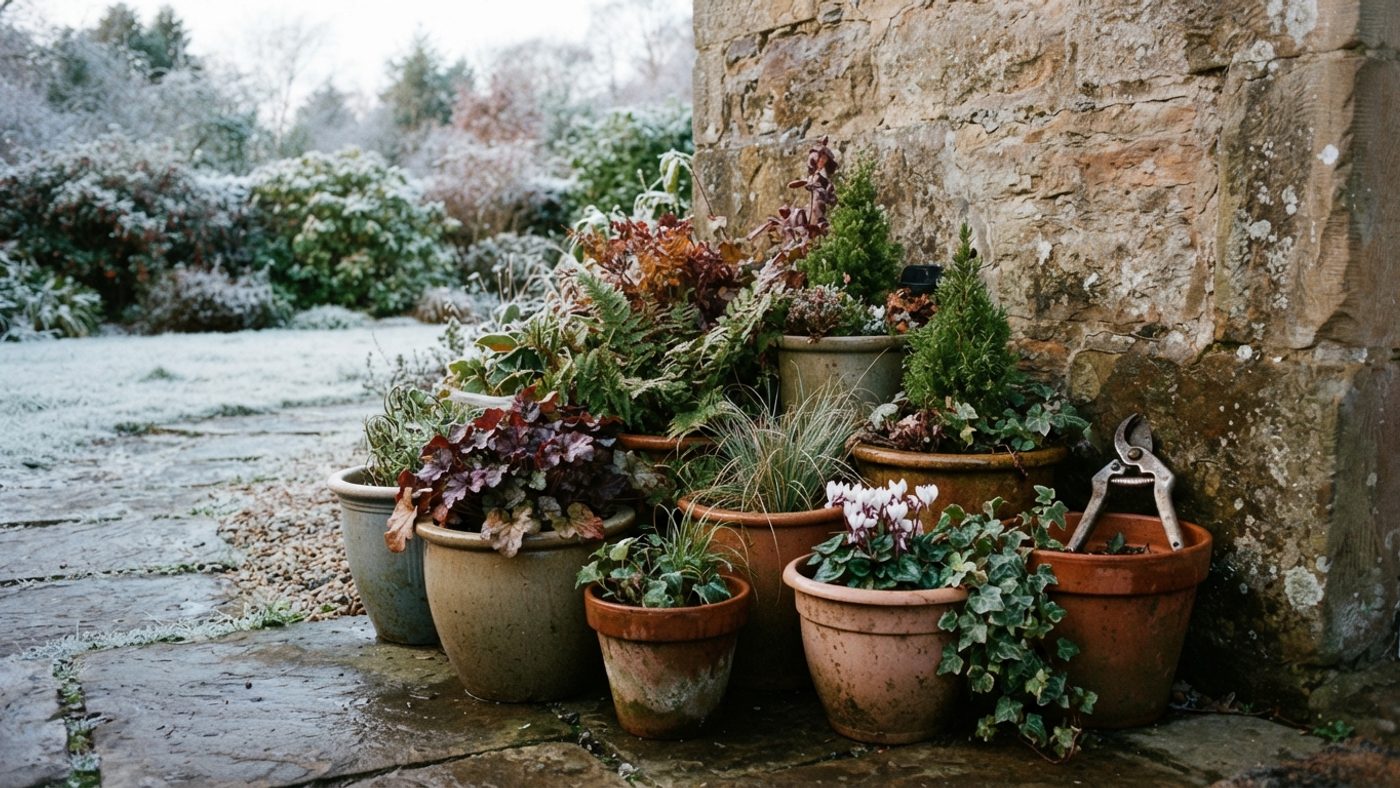
- Moving containers to a sheltered spot, against a house wall, or into an unheated porch: walls that have absorbed daytime sun release some of that heat overnight, giving pots pushed against them a slightly milder microclimateThe local growing conditions in one specific spot that differ, sometimes substantially, from the wider area's average climate. Full definition →.
- Clustering pots together so they shelter each other and reduce the exposed surface area losing heat.
- Wrapping trunks or crownsThe base of a perennial plant where roots and shoots meet, often sold and planted as a ready-made dormant plant rather than grown from seed. Full definition → of specimens with real cold sensitivity: this is the one most relevant to tree ferns, cordylines and other borderline-exotic specimens that a mild west-coast Scottish garden can otherwise get away with growing outdoors year-round, provided the crown itself is protected through the hardest weeks.
Fleece grades vary in weight and warmth, and it's usually worth layeringPropagating a new plant by pinning a low, flexible stem into the soil while still attached to the parent, so it roots before being cut free. Full definition → a heavier grade over anything genuinely tender rather than relying on the lightest option in the shed; our guide to garden fleece covers which weight suits which job.
Which plants actually need protection
Fully hardy plants that are dormant and established don't need intervention for an ordinary frost, that's what "hardy" means in this context, and the RHS's H1a-H7 hardiness ratingThe RHS's H1a–H7 scale for how much cold a plant can survive outdoors, H1a being tender indoor-only and H7 hardy anywhere in the UK. Full definition → on a plant's label or catalogue entry is the quickest way to check where a specific plant sits, rather than guessing (see our RHS hardiness zones for Scotland for how those ratings map onto Scottish conditions). Protection is worth the effort for:
- Tender and half-hardy plants not adapted to freezing at all (dahlias, cannas, pelargoniums, tender bedding)
- New, soft spring growth on plants that are otherwise hardy once mature, frost-tender at the shoot-tip stage even on a tough shrub
- Blossom on fruit trees and other spring-flowering plants, where a late frost can wipe out the fruit set for the year even though the tree itself is unharmed
- Marginally hardy shrubs recently planted, before their root systems are established enough to support strong regrowth
The last two matter more in Scotland than the calendar suggests: with lowland last spring frost typically not clearing until April to early May (see below), new growth and blossom are still exposed well after many England-facing guides assume the risk has passed.
Scotland's frost picture: altitude beats latitude
It's tempting to assume "further north in Scotland" simply means "more frost," but the more reliable predictor is altitude and exposure, not compass position. The clearest evidence: Inverness, on the coast, actually averages fewer air-frost days a year than Edinburgh, further south. Cold air draining off the surrounding hills doesn't settle there, and the Moray Firth's sea temperature changes far more slowly than the land around it, moderating the coldest nights the way any large body of water does. Meanwhile upland stations well away from any coast see far harsher frost regardless of which broad region they sit in. ("Air-frost days" below counts days the air temperature itself, not just the ground, fell below freezing, the standard Met Office measure.)
| Station | Altitude / setting | Frost profile |
|---|---|---|
| Edinburgh | Lowland | ~43 average annual air-frost days |
| Inverness | Lowland, coastal | ~38 average annual air-frost days (milder than Edinburgh) |
| Braemar | 339m, upland | Frost recorded in nearly every month; extreme minimum -27.2C |
That's the same frost-pocket logic covered above, just at landscape scale, and it means your own site's altitude, exposure, and whether cold air can drain away from it matters more for a garden-scale decision, is tonight a night to cover the dahlias, than which part of Scotland you're in. In most of lowland, inhabited Scotland, last spring frost typically falls somewhere in April to early May and first autumn frost in October, though the exact window shifts by region and altitude, worth checking against your own area rather than assuming one national date. For the full region-by-region and lowland/upland breakdown, including where your own postcode falls, see Scottish frost dates by region.
Common questions
Should I water plants before a frost?
Yes, if the soil is dry. Moist soil holds and releases more heat overnight than dry soil, which raises the temperature immediately around the plant's roots and lower stem. Water in the morning or early afternoon rather than right at dusk, so the foliage itself has time to dry before nightfall: wet leaves going into a freeze are more vulnerable, not less.
Why is one part of my garden always frostier than the rest?
Because cold air sinks and pools wherever it can't drain away, the same logic covered above under frost pockets. If you know a corner of the garden is a frost trap, it's worth reserving it for the hardiest plants and keeping anything tender or newly planted elsewhere.
Does frost only harm plants, or does it ever help?
Both. It's genuinely bad news for tender and half-hardy plants, but it isn't universally bad: parsnips, for instance, are traditionally left in the ground until after the first heavy frost, which intensifies their sweetness and flavour, so not every plant on the plot needs protecting even when a frost is forecast. Also worth avoiding: walking on frosted grass, which bruises the frozen blades and can leave dead footprint-shaped patches once it thaws.
Do frost pockets matter more in some parts of Scotland than others?
The mechanism is the same everywhere, but it matters most in Scotland's many valley, glen and inland sites, where cold air draining off higher ground has to settle somewhere. It's also why two gardens on the same street can differ: a garden at the low point of a sloping street can trap cold air that a neighbour's, on flatter ground with a gap for it to drain through, doesn't.
When should I take covers off after a frosty night?
Once temperatures have risen the next day. Leaving fleece or cloches on into full daylight smothers growth and cuts off light, so treat covers as an overnight measure rather than a standing fixture.
Sources
4 sources, recorded with what each was used for
- RHS: Frost damage: The mechanism of frost injury to plant cells, ground vs air frost, wind's role in desiccation, named tender plants, standard protection methods (fleece, mulch, container moves, wrapping), and lifting tender tubers such as dahlias and cannas before frost
- Met Office: Location-specific long-term averages (1991-2020 station normals): The underlying Edinburgh, Inverness and Braemar air-frost-day figures behind the Inverness-milder-than-Edinburgh comparison and the lowland/upland contrast
- RHS: Parsnips - How to grow: The fact that frost intensifies parsnip sweetness and flavour
- RHS: Monthly gardening tips and advice - January - lawns: The advice to avoid walking on a frosted lawn, which can damage the grass blades and leave brown footprints