
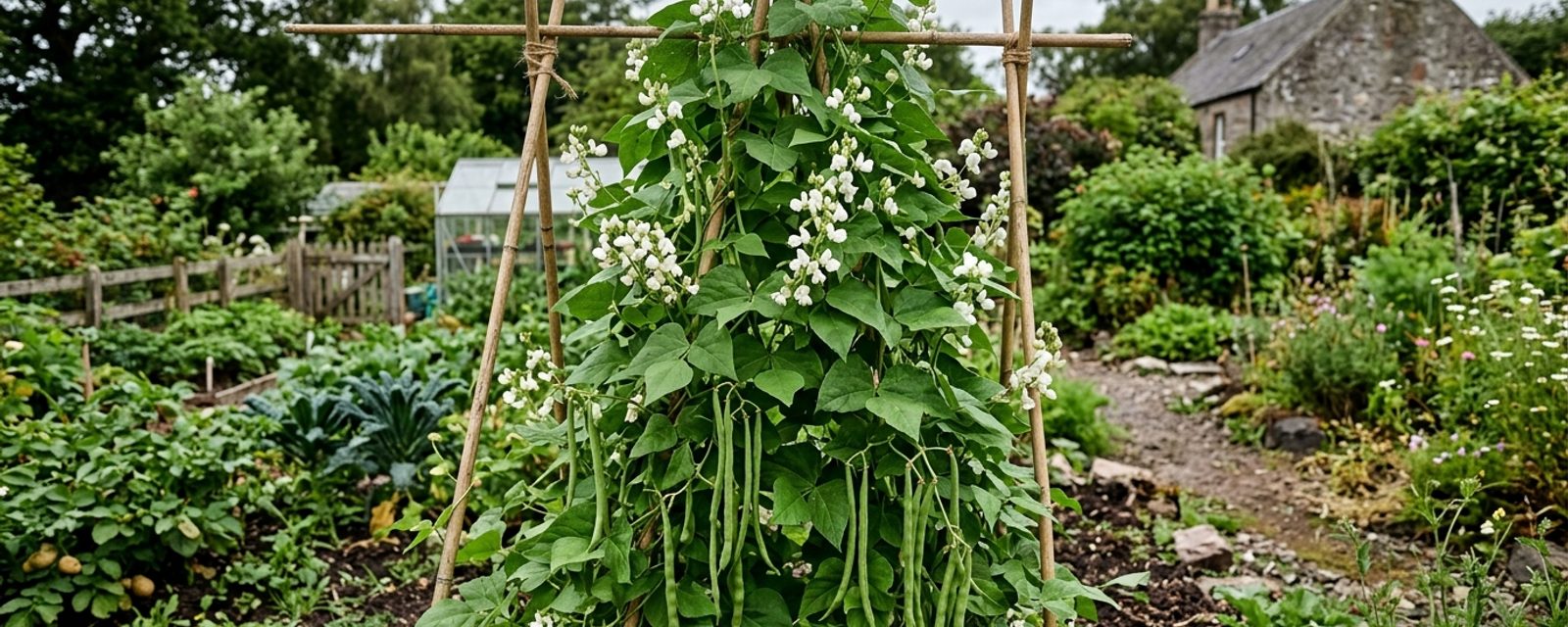
A runner bean plant can flower for weeks without setting a single pod, and the reason usually isn't the variety, it's the weather at flowering time. Runner bean flowers need insects to move pollen between them, and there are two separate ways that fails: extreme heat that stops pollen germinatingA seed sprouting: breaking dormancy and putting out its first root and shoot, given the right warmth and moisture. Full definition → (worse at night), and cold, wet or windy conditions that simply keep pollinators away. Most award-winning breeding effort has gone into solving the first problem, the more commonly reported complaint UK-wide. A Scottish summer is more often cool, damp and breezy than dangerously hot, which puts the weight on the second failure mode far more than the first, and that shapes which variety actually earns its place here.
Quick answer
Stardust is the strongest choice for most Scottish gardens: it's self-fertileA plant that can set fruit using its own pollen, without needing a second, different variety nearby to cross-pollinate it. Full definition → (it doesn't need bees or other insects to set pods), which sidesteps the cold/wet/windy pod-set problem directly, and it's described as a heavy cropper "whatever the weather." For a smaller or more exposed plot, White Lady or Liberty's more compact habit is easier to support in wind; for showing or the longest pods, Enorma (Elite) is worth the trade-off of a slightly less cold-hardy rating at a sheltered site.
Why pod-set fails, and why that matters more here than the variety name does
The fix for the pollinator-shortage problem is a sheltered site, which encourages bees to visit and pollinate; keeping plants out of strong winds is a pollination measure, not just a structural one, and having other bee-friendly planting nearby helps draw pollinators in, a real reason to give some weight to a variety's own pollinator appeal, not just its flower colour.
None of this is about picking the "toughest-looking" variety. A self-fertile variety doesn't need insect visits at all, so it sidesteps a poor summer for pollinators regardless of how sheltered the site is, a meaningfully different lever from simply choosing a shorter plant or a tighter support structure.
The same damp conditions that keep bees grounded also suit fungal disease: rust, named on several of the varieties below, spreads more readily in humid, still air than in a dry summer. A sheltered, wind-broken site helps pollination, but good airflow between plants still matters for keeping rust down, the two aren't quite the same thing, and neither should be sacrificed entirely for the other.
Dry roots at flowering time is the third lever, and the most direct to fix: water at 5-11 litres per square metre, twice a week, once flowering and podding begin. Low soil pH also contributes to poor pod-set, lime the soil before planting if it runs below pH 6.5.
Wind, height and support — the same mechanism, from a different angle
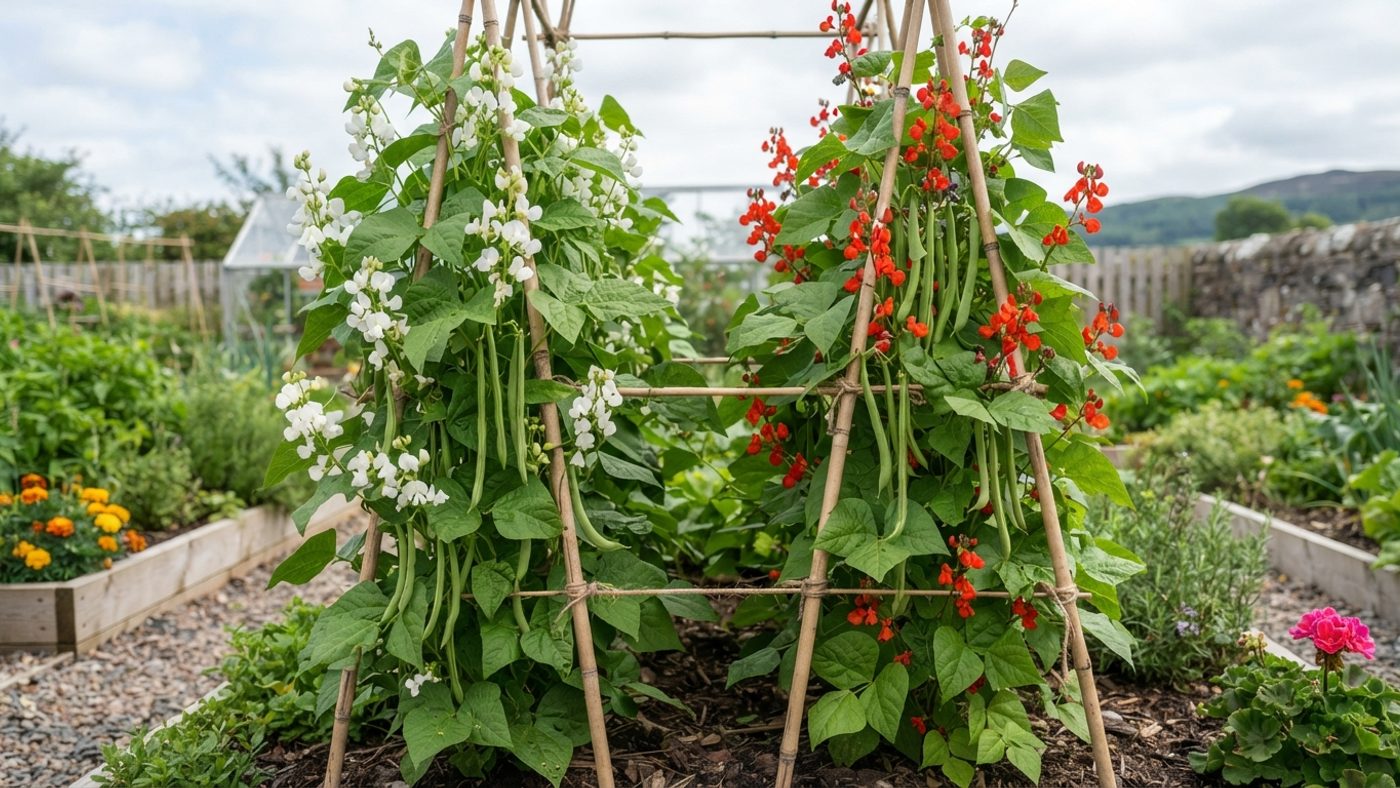
Runner beans are naturally tall, twining climbers, unfussy about what they climb: wires, trellis, bamboo canes or steel mesh will all do. Exact spacings for A-frame, X-frame and wigwam supports are covered in the full growing guide; what matters for variety choice specifically is that a taller plant carries more leaf and pod weight into more exposed air. The heights vary genuinely by variety (see the table below), on an exposed or smaller plot, a shorter one is genuinely easier to keep upright and pollinated, whatever support structure it's tied to. Liberty and Enorma are both on the shorter end and carry the "Plants for pollinators" badge, a useful pairing where a compact, insect-friendly habit is the priority.
A damp Scottish summer that keeps pollinators grounded also tends to favour slugs, a genuine risk to young bean seedlings before the plants get tall enough to shrug it off. It's a separate problem from pod-set, but the same weather pattern makes both more likely in the same season.
None of the six varieties compared below is bred as a true dwarf. Hestia is the named dwarf runner bean, better suited to containers or the most wind-exposed spots.
The six varieties compared
AGMThe RHS's Award of Garden Merit: a UK-wide trials award for reliable performance, not a Scotland-specific recommendation. Full definition → (Award of Garden Merit) marks trial performance; the hardiness ratingThe RHS's H1a–H7 scale for how much cold a plant can survive outdoors, H1a being tender indoor-only and H7 hardy anywhere in the UK. Full definition → (H2 or H3 on the standard scale) describes how much cold and exposure a variety tolerates, with H2 the hardier of the two ratings used here.
| Variety | AGM | Hardiness | Height / spread | Flowers | Named disease risk |
|---|---|---|---|---|---|
| Moonlight | Yes | H2 | 2.5–4m / 1–1.5m | White | Runner and French bean rust |
| Stardust | See note below | H2 | 2.5–4m / 1–1.5m | White | Runner and French bean rust |
| White Lady | Yes | H2 | 1.5–2.5m / 0.5–1m | White | Chocolate spot, downy mildews, foot and root rot, powdery mildews |
| Liberty | Yes | H2 | 2.5–4m / 0.1–0.5m | Red | Foot rot |
| Enorma (Elite) | Yes | H3 | 1.5–2.5m / 0.1–0.5m | Scarlet | Runner and French bean rust |
| Firelight | No | H3 | 1.5–2.5m / 0.1–0.5m | Scarlet | Rust, slugs and snails, blackfly |
Stardust is named an AGM winner on the general runner bean summary page, but its own individual plant page carries no AGM badge and no awards section at all. The self-fertility and "heavy crop whatever the weather" claims for Stardust also sit only on that general summary page; its own individual page doesn't repeat them.
H3 hardiness (hardy in coastal and relatively mild parts of the UK, -5 to 1°C) is a step down from the H2 rating carried by the other four AGM varieties. Much of Scotland's growing ground is inland or upland rather than mild coastal, so that gap is worth weighing against Enorma's showing-length pods and Firelight's heat-tolerant pod-set before choosing either.
On eating quality: Moonlight, Stardust and White Lady are all specifically described as stringless pods; Liberty and Enorma don't make that claim either way, so don't assume it applies there.
Which variety for your situation
Best overall for Scotland: Stardust. Every other variety in this comparison still depends on bees showing up in whatever weather a given week brings; Stardust is the one exception. The AGM-badge discrepancy above is worth knowing, but it doesn't change that cultivation case.
Smaller or more wind-exposed plot: White Lady or Liberty. Both are meaningfully shorter and narrower than Moonlight or Stardust, easier to keep upright and pollinated without a heavier support structure. Liberty also carries the "Plants for pollinators" badge, worth pairing with other bee-friendly planting nearby. One caveat on White Lady: Gardener's World describes it as more tolerant of dry, hot conditions than some other varieties, a genuine strength but one that cuts the other way from what matters most for a typical Scottish growing season, not a reason to rule it out, just not the lead argument for choosing it here.
Showing or exhibition-length pods, sheltered site available: Enorma (Elite). Capable of winning local shows with fine-textured beans, and it carries the pollinator badge too. The trade-off is its H3 hardiness rating, worth accepting only where the site is genuinely sheltered.
Avoid for Scotland: Firelight. It carries no AGM award, has an H3 hardiness rating, and is named susceptible to rust, slugs, snails and blackfly directly. More specifically, its defining trait, virtually self-fertile with improved pod-set even in hot dry summers, solves the opposite problem from the one a Scottish garden usually has. It's bred to keep setting pods when heat kills pollen; Scotland's more common failure is too few pollinators in cool, damp, breezy weather, a mechanism Firelight's own selling point doesn't address.
Rust turns up as a named risk on Moonlight, Stardust and Enorma: the runner bean rust page covers identification and management. Firelight separately carries slugs and black bean aphid (blackfly). White Lady carries a genuinely different, longer list instead: chocolate spot, downy mildew, foot and root rot, and powdery mildew.
Which variety to grow is only half the decision; how to grow it, exact indoor and outdoor sowing dates and support-structure spacings, is covered in full on the runner beans growing guide, and the planting calendar can time it precisely for your part of Scotland.
Common questions
Is Moonlight or Stardust better for Scotland?
Both share the same hardiness, height and disease profile, and both are described as reliable even in poorer weather. The real difference is self-fertility: Stardust doesn't need insects to set pods, the more directly useful trait against a cool, damp, windy pollination risk. Moonlight remains a solid, fully AGM-confirmed alternative if Stardust's badge discrepancy is a concern.
Why isn't Firelight a good choice here?
It's bred to solve hot, dry-summer pod-set failure specifically, the opposite of Scotland's more typical cool, damp, windy pod-set problem, and it carries no AGM award and a less cold-hardy H3 rating.
Do I need an AGM variety at all?
No — AGM marks trial performance, not a Scotland-specific guarantee. Stardust makes the case directly: it's the strongest pick on cultivation grounds here, yet its own individual plant page doesn't carry the badge at all, only the general summary page does.
What about Red Rum — why isn't it in this comparison?
Its own individual plant page carries no AGM badge or awards section, the same way Stardust's doesn't — but a separate RHS advice feature lists Red Rum among "award-winning cultivarsA plant variety that arose or was bred under cultivation and is kept true by deliberate propagation, rather than a naturally occurring wild species. Full definition →" without naming the award, an inconsistency distinct from Stardust's. Gardener's World also credits it with self-fertility and pod-set "even in poor weather," a claim Red Rum's own page doesn't make; that page only claims heat-tolerant pod-set. With its status this unsettled, it doesn't belong alongside the six confirmed varieties above.
Is there a dwarf runner bean option?
Yes — Hestia is the named dwarf variety suited to containers and small or wind-exposed spots, growing to only 45cm rather than the 1.5-4m of the climbing varieties above.
Sources
11 sources, recorded with what each was used for
- Moonlight: AGM status, hardiness, height/spread, flower/pod description, disease susceptibility
- Stardust: Hardiness, height/spread, flower/pod description, disease susceptibility; confirmed absence of AGM badge on this individual page
- White Lady: AGM status, hardiness, height/spread, flower/pod description, disease susceptibility
- Liberty: AGM status, hardiness, height/spread, flower/pod description, disease susceptibility, pollinator badge
- Enorma (Elite): AGM status, hardiness, height/spread, flower/pod description, disease susceptibility, pollinator badge
- Firelight: Confirmed absence of AGM badge, hardiness, height/spread, flower description, disease and pest susceptibility, self-fertile/hot-dry pod-set claim
- Red Rum: Confirmed absence of AGM badge, cultivation detail used for the FAQ footnote
- Runner beans: failure to set pods: Pod-set failure mechanisms (heat vs. cold/wet/windy/lack of pollinators), shelter recommendation, liming guidance below pH 6.5
- Growing runner beans: secrets of success: Wind shelter tied to pollination, support-material framing, pollinator-friendly planting advice, Red Rum "award-winning" mention, dwarf variety Hestia
- Runner beans: grow your own: General summary listing used for Stardust's AGM/self-fertility/heavy-crop claims
- Five of the Best Runner Beans to Grow: Red Rum's self-fertile/poor-weather claim, White Lady's dry/hot-tolerance claim