
Rosemary Beetle is a minor pest that affects rosemary, lavender and sage in Scotland. Here is what it looks like, how to spot the damage, and which controls have been tested.
What does it look like?
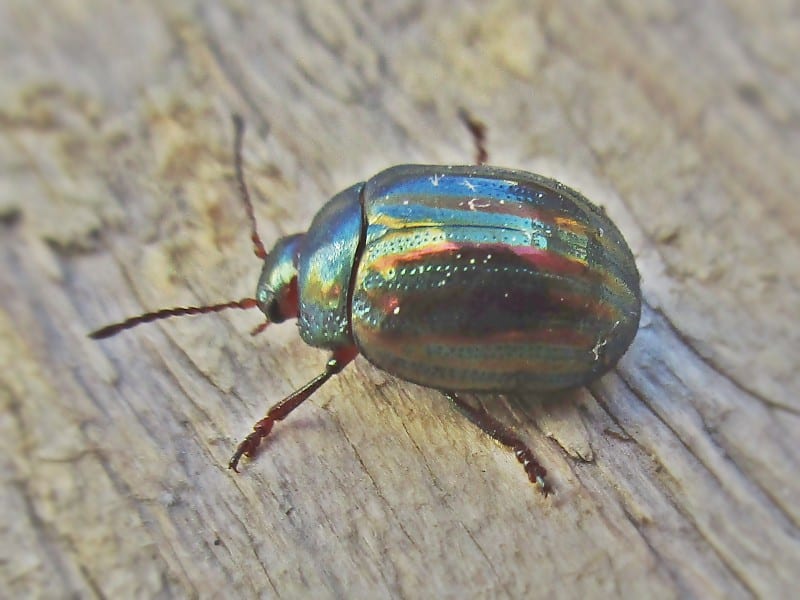
Adults are shiny, 6-8mm long, with metallic purple and green stripes running along the wing cases and thorax, easy to spot once you know to look. Larvae are greyish-white with darker stripes along the body, growing up to 8mm when fully grown. Eggs are small and elongated, laid in groups on the undersides of leaves.
The metallic sheen is the reliable field mark: searching after dark with a torch is a genuine trick worth knowing, since the beetles' shine reflects the light back at you. A metallic green beetle on mint rather than rosemary, lavender, sage or thyme is more likely to be a related but different species, the mint leaf beetle, which lacks the purple stripes and stays on mint.
What causes it
This beetle doesn't have a true off-season the way a lot of insects do. Feeding and egg-laying are driven by temperature rather than by month, so any mild spell between late summer and spring can trigger activity, while the settled warmth of high summer is actually when adults feed least.
Is this pest active now?
August to April is the practical window to start checking plants. Adults are the easiest sighting, since they're present in some numbers almost year-round, but they aren't the only thing doing the damage: each mild spell that triggers egg-laying produces larvae within one to two weeks, and it's the larvae feeding alongside the adults that does most of the real harm. Spotting an adult is the cue to check the undersides of leaves for the greyish, dark-striped larvae too, not a reason to assume that's the whole picture. How steady that checking needs to be depends on where in Scotland the plant is: a mild, Gulf Stream-moderated west coast garden can see mild spells right through winter with barely a pause, while an inland or upland garden with sharper, more reliable cold snaps gets more of a genuine off period between them.
Symptoms
Foliage can be reduced to short, greyish-brown stumps where feeding has dried out the damaged tissue, and holes appear in leaves. Flowers can be eaten too. In most cases the plant's overall health isn't affected.
Life cycle
One generation a year, but adults are long-lived enough that old and new generations overlap, so adult beetles can turn up at almost any time of year rather than in one clear window.
Why this matters in Scotland
A recent arrival with a fast spread, and Scotland was reached quickly.
First found breeding in central London in the late 1990s, the beetle has spread quickly and is now established in Scotland, not just present in England and Wales. Rosemary, lavender and thyme are all grown here mainly on the strength of good drainage rather than genuine warmth, so this is one of the few pests that doesn't get any easier just for being grown in a cooler climate. Established here changes the odds of finding it in your garden, not the extent of the damage described above once it turns up.
Controls: what actually works
Not every method here works equally well: some are backed by real evidence, others are simply traditional and untested.
Hand-picking: pick off adults and larvae, and shake or tap branches over paper to collect them
This is the main practical control, and it's a monthly task through the active season: check plants regularly from August into fine mild days through winter, removing and destroying anything found.
Check container-grown rosemary, lavender, sage or thyme on a patio or balcony exactly as closely as anything in a border, not as an afterthought. New plants are worth a proper look too before they go near anything else: a beetle that's spread across most of Britain within a few decades has to be moving somehow, and plants changing gardens between growers is a plausible route.
A torch after dark makes this easier, since the beetles' metallic shine catches the light.
Encourage natural predators: birds, frogs and predatory ground beetles
Birds, frogs and predatory ground beetles will all eat the larvae, and sometimes the adults too.
Tolerate the beetle as part of garden biodiversity
The default recommended position: accept the beetle as part of the garden rather than working to remove it.
Chemical: insecticide spray
Thiocloprid, a neonicotinoid, can be used from late summer to spring, but never spray while plants are in flower: this chemical class is particularly harmful to bees and other pollinators.
Check the current HSE amateur pesticides register before buying anything, since active ingredient approvals change over time and can be withdrawn. Hand-picking works and needs no such check.
Frequently asked questions
What should I do first if I find rosemary beetle in my garden?
Start with hand-picking. After that, encourage natural predators. Work through the rest in order of how well-evidenced they are if the first two aren’t enough on their own.
Will rosemary beetle kill my plants?
They rarely kill established plants. The damage is usually cosmetic on outer leaves, and natural predators often bring numbers under control without you doing anything.
When are rosemary beetle most active in Scotland?
Check the seasonal activity section above. Scottish timings can run a few weeks behind the UK-generic figures.
Should I just leave rosemary beetle alone?
In most gardens, yes. rosemary beetle are food for birds, wasps and predatory insects, and a healthy garden carries some without trouble. Tolerance is also RHS's official position now, for that same reason.
Sources
3 sources, recorded with what each was used for
- RHS1: adult and larva identification, symptoms and damage, host plants, tolerance as the recommended default, one generation a year with long-lived overlapping adults, egg-to-pupa life cycle, established-in-Scotland distribution, natural predators, absence of a pesticide recommendation
- Gardener's World12: corroborating identification and damage independently, egg-laying and pupation timing detail, hand-picking, thiocloprid as an unverified chemical option with a bee-safety caution
- Garden Organic8: hand-picking as a monthly task through the active season from August