
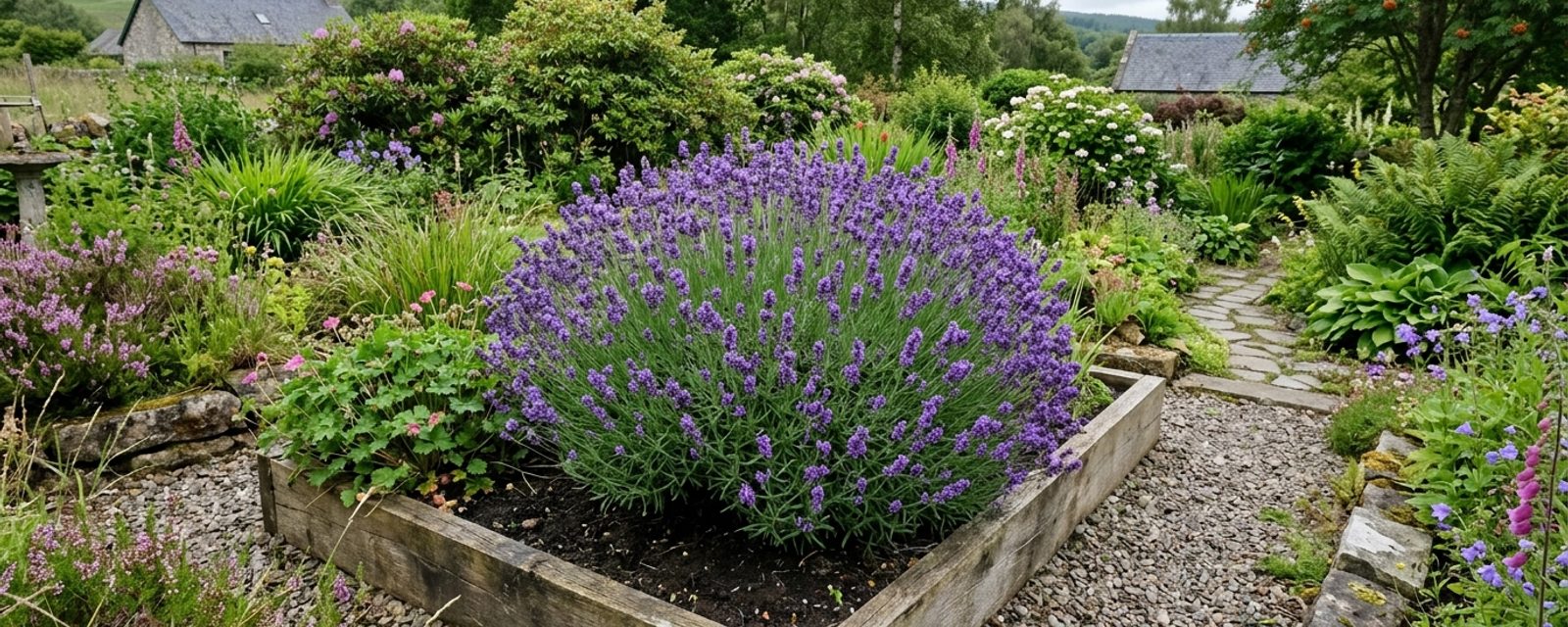
Lavender sold as a "hybrid" sounds like a step down from the straightforward English kind, softer, less proven, the sort of plant added once the reliable stuff is already established. RHS's own hardiness ratings tell a different story. Of the ten lavenders carrying the Award of Garden Merit (AGMThe RHS's Award of Garden Merit: a UK-wide trials award for reliable performance, not a Scotland-specific recommendation. Full definition →), two sold as lavandin, a genuine cross between English and Portuguese lavender, carry exactly the same H5The RHS's H1a–H7 scale for how much cold a plant can survive outdoors, H1a being tender indoor-only and H7 hardy anywhere in the UK. Full definition → rating as the four English cultivarsA plant variety that arose or was bred under cultivation and is kept true by deliberate propagation, rather than a naturally occurring wild species. Full definition → on the same list. The real dividingPropagating a clump-forming perennial by digging it up and splitting it into several smaller pieces, each with roots and shoots attached. Full definition → line across these ten varieties isn't the type name on the plant label, it's the species behind it, and getting that right decides whether a lavender copes with an open Scottish border or needs a pot and a sheltered wall over winter. Planting, spacing and pruning are the same across all ten and covered in the full growing guide.
Quick answer
For an open, unprotected Scottish border, the safest choices are any of the four English cultivars (Hidcote, Imperial Gem, Miss Katherine, Beechwood Blue) or either of the two lavandins (Alba, Sussex), all six are H5, hardy to about -15°C. The remaining four AGM varieties are a real step down: Ballerina and Sawyers (H4) tolerate cold but not reliably through a hard winter, and Willow Vale and Royal CrownThe base of a perennial plant where roots and shoots meet, often sold and planted as a ready-made dormant plant rather than grown from seed. Full definition → (H3) genuinely need a container that can be moved somewhere sheltered or frost-free, not open ground. Hidcote remains the most widely available single pick if only one plant is wanted; Alba or Sussex are worth choosing over a second English cultivar for a taller, later-flowering hedge with the same hardiness.
The ten AGM varieties, and why "hybrid" doesn't mean less hardy
RHS names ten lavenders with the Award of Garden Merit (AGM), its trials panel's mark of reliable garden performance across the UK. Every one of the ten badges holds up on the variety's own individual plant page as well as the general award list, a clean result, with no gap between the two pages for any of the ten. That's worth stating plainly because it isn't guaranteed: the AGM says nothing about Scottish performance specifically, so a confirmed badge is a starting point for comparison, not a guarantee of how a plant will do here. Hardiness is rated separately on RHS's own H1-H7 scale, H7 being fully hardy anywhere in the UK and H1 needing a heated greenhouse. This list spans three ratings: H3 ("half hardy," roughly -5 to 1°C), H4 ("hardy through most of the UK," -10 to -5°C) and H5 ("hardy in most places throughout the UK even in severe winters," -15 to -10°C). Imperial Gem's own page also carries RHS's "Plants for pollinators" symbol alongside its AGM badge; none of the ten pages singles out one variety as more attractive to bees than the rest, so any of the ten is a reasonable pollinator-friendly choice.
| Variety | Species / type | Hardiness | Scotland use |
|---|---|---|---|
| Hidcote | English (L. angustifolia) | H5 (-15 to -10°C) | Open border |
| Imperial Gem | English (L. angustifolia) | H5 | Open border |
| Miss Katherine | English (L. angustifolia) | H5 | Open border |
| Beechwood Blue | English (L. angustifolia) | H5 | Open border |
| Alba | Lavandin (L. × intermedia) | H5 | Open border |
| Sussex | Lavandin (L. × intermedia) | H5 | Open border |
| Ballerina | Hybrid (L. stoechas parentage) | H4 (-10 to -5°C) | Sheltered wall or pot |
| Sawyers | Hybrid (L. angustifolia × L. lanata) | H4 | Sheltered wall or pot |
| Willow Vale | French (L. stoechas subsp. pedunculata) | H3 (-5 to 1°C) | Pot, frost-free winter |
| Royal Crown | French (L. dentata) | H3 | Pot, frost-free winter |
One naming trap worth knowing before buying: RHS's own award list calls Royal Crown (L. dentata) "Spanish lavender," but Royal Crown's own plant page calls it "French lavender" instead, and Gardener's World agrees with the individual page, not the award list. The common "type" name a seller uses isn't reliable; the botanical name on the label (angustifolia, × intermedia, stoechas, dentata) is.
The real hardiness split, by species, not by the type name on the label
Gardener's World independently confirms the same grouping the RHS ratings show: English lavender and L. × intermedia together "can cope with temperatures down to about -15°C" and "can therefore be left in the garden all year round," while L. stoechas "may not survive winter" and needs moving to "a light, airy, frost-free spot," and L. dentata is flagged as the most tender of the three groups. That's a three-tier split, not two: English and lavandin together as the hardy group, then a real step down to the true hybrids (Ballerina, Sawyers) at H4, then a further step down to the stoechas- and dentata-type French/Spanish lavenders at H3.
For a Scottish border, that means Alba and Sussex belong on the same shortlist as Hidcote and Imperial Gem, not filed under "marginal" alongside Willow Vale and Royal Crown just because none of the four carry the plain "English lavender" name. Lavandin plants also grow taller and bushier than English lavender, Alba and Sussex both reach around a metre, useful where a hedge or screen is wanted rather than a compact edging plant, without giving up any hardiness to get it.
The four English lavenders compared
Hidcote, Imperial Gem, Miss Katherine and Beechwood Blue share H5 hardiness and full AGM confirmation (see the table above), so the choice between them comes down to size, colour and availability rather than winter survival. All four are aromatic on both leaf and flower, the standard lavender scent; none of their RHS pages claims a stronger fragrance than another.
Hidcote is the most widely stocked of the four, useful when sourcing plants locally rather than by mail order, and slightly larger and more vigorous than Imperial Gem, with deep violet-purple flowers on a bushy dwarf shrub to around 40cm. Imperial Gem is more compact at the same 40cm height but a narrower 90cm spread, with dark violet flowers, a tidier choice for a smaller border or tight edging run. Miss Katherine is the outlier of the four on colour: light pink flowers with a silvery ring of small leaves (calyces) cupping each bloom, described on its own RHS page as "highly fragrant" and "prodigious" in flower production, a genuine alternative for anyone who finds the usual violet-blue lavender palette repetitive. Beechwood Blue is the smallest of the group, a low-growing 30cm dome with violet-blue spikes, the pick for the very front of a border or a container where the taller three would look out of scale.
None of the four is sourced as more disease-resistant or longer-lived than the others; RHS's shared disease list, grey mould, and rarely honey fungus, a soil-borne fungus that attacks roots and can kill a shrub outright, applies across all four equally, the same soil-borne route as the root rot risk covered later in this article, on top of the pests also covered there.
The two lavandins: a taller, equally hardy alternative the standard picks skip past
Alba and Sussex are both L. × intermedia, the cross between English lavender and Portuguese lavender (L. latifolia) that produces a larger plant with a longer, later flowering spike. Alba is the paler of the two, "long spikes of fragrant, pure white flowers," reaching a metre or more, a genuinely different look from the violet-blue lavender most gardens already have. Sussex flowers "dark blue-purple" on spikes to 20cm long, in mid and late summer, later than the English cultivars typically finish, which extends the flowering season into a period when most other lavender is already spent.
Because lavandin flowers later and grows larger, it suits a different role than the English four: a low hedge or screen rather than edging, and a genuine option where the goal is height or a later flowering window rather than a compact specimen. Both plants share the same drainage and pruning needs as English lavender, no extra winter protection required in free-drainingSoil that lets water pass through quickly rather than pooling, so roots aren't sitting in wet ground after rain. Full definition → soil.
Ballerina and Sawyers: H4 hybrids, best against a wall or in a pot
Ballerina and Sawyers both carry the AGM and both sit at H4, tolerant of an ordinary UK winter but not dependably through a hard or prolonged frost, a real five-degree step down from the H5 varieties above.
Ballerina is "a vigorous hybrid lavender with L. stoechas in its parentage," purple flower spikes topped by white leaf-like flaps (bracts) that flush pink-purple with age, flowering over a long period from late spring through summer, on a compact 60cm shrub. Sawyers crosses hardy L. angustifolia with the tender, woolly-leaved L. lanata, producing silvery-grey foliage with, RHS's own listing states, "a rich lavender perfume" from the leaves themselves, not just the flowers, and light purple spikes in midsummer on a 60cm bush.
Neither variety's own page recommends open-ground planting without qualification the way the English and lavandin varieties above do. A sheltered spot against a south- or west-facing wall, or a container that can be moved somewhere more protected in a hard frost, is the safer route for either in most of Scotland, rather than an exposed open border.
Willow Vale and Royal Crown: H3, pot-grown with frost-free winter shelter
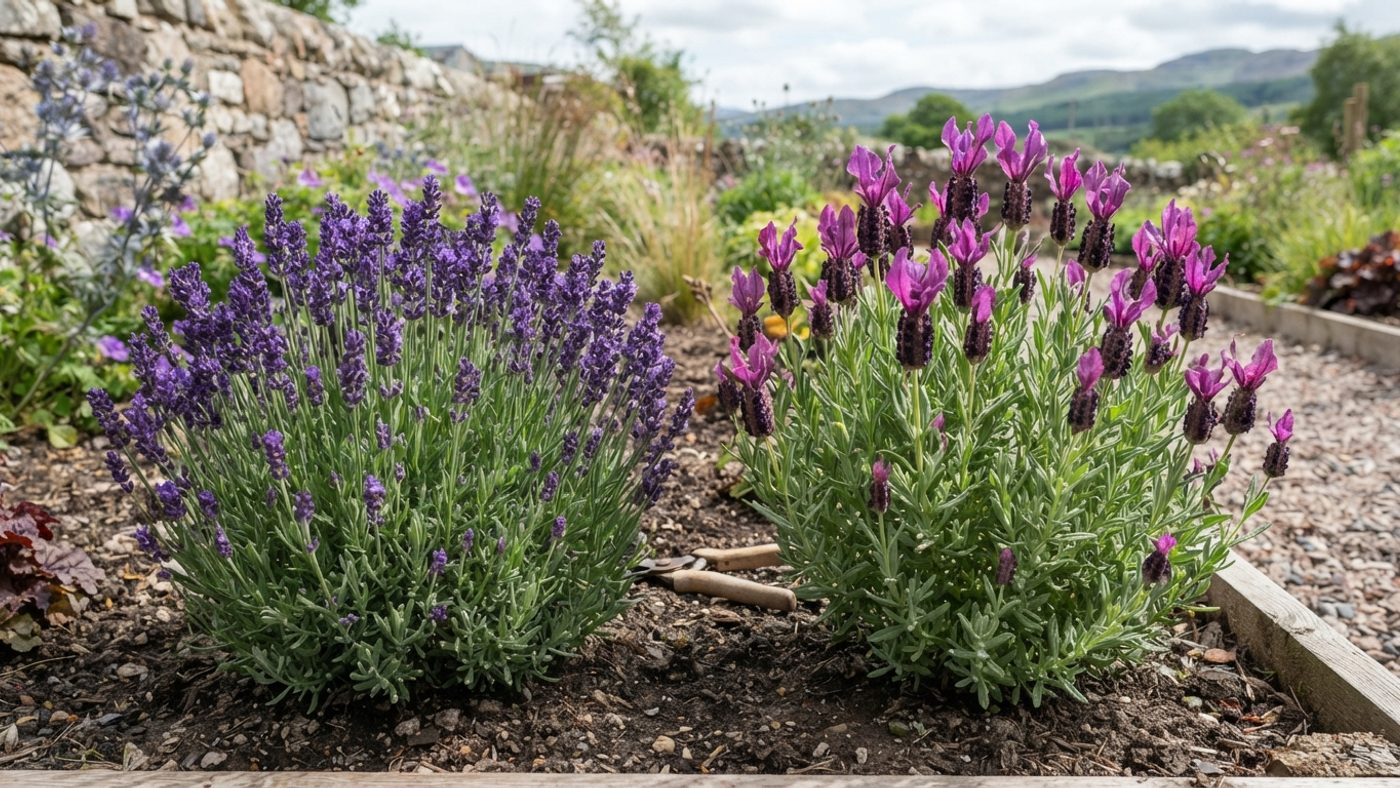
Willow Vale and Royal Crown sit at the bottom of the hardiness list, H3, the same range Gardener's World separately describes for L. stoechas as "may not survive winter." Willow Vale is L. stoechas subsp. pedunculata, deep violet flower spikes topped by conspicuous reddish-purple leaf-like tufts, the classic "rabbit-ears" lavender look, on a 75cm shrub; its own RHS page notes that in colder areas it "may need protection from very low temperatures and excess winter wet," and names container growing with overwinteringKeeping a plant alive and intact through the cold months, whether left outdoors, moved under cover, or stored dormant. Full definition → in an unheated greenhouse as the reliable route. Royal Crown is L. dentata, "a compact, rather tender evergreen shrub," toothed grey-green leaves and violet-blue tufted flower spikes, its own page stating plainly that in areas prone to frost it "should be grown in containers and overwintered in a greenhouse or conservatory."
Both are worth growing in Scotland specifically as container plants, not border shrubs: the distinctive rabbit-ears flower shape neither the English nor lavandin varieties offer, moved under cover from autumn to late spring. RHS's own H3 rating already covers ordinary UK winters, not just an exceptionally harsh one, so open ground is a real gamble for either variety here, not only in a hard-frost year; the container route removes the guesswork.
Soil pH: no numeric figure published
Neither RHS nor Gardener's World publishes a numeric pH range for lavender. Both state a direction instead: RHS's growing guide says lavender "prefers poor, dry or moderately fertile soil, including chalky and alkaline soils," and Gardener's World recommends "neutral to alkaline soil," naming French lavender (L. stoechas, the same species as Willow Vale) as the better option specifically on acid soil. That's a genuine trade-off worth weighing rather than treating as free advice: French lavender is also the least hardy species on this list at H3, so choosing it to suit acid soil means growing it in a container that can be moved to frost-free shelter over winter, not planting it straight into an open acid bed. Individual variety pages for Miss Katherine, Beechwood Blue, Alba, Sussex, Sawyers and Royal Crown each repeat the same direction, "well-drained neutral to alkaline soil but tolerates acidic conditions," without ever giving an exact number. "Neutral to alkaline, well short of acid" is the honest working target for any of these ten varieties.
Drainage, wind, and pruning: the conditions that matter more than variety choice
Every one of the ten varieties shares the same real risk, and it isn't cold. RHS states plainly that lavender "will not thrive in heavy clay soil or any soil that becomes waterlogged over winter," and having roots sit in damp compost "makes the plants more susceptible to root rots." Gardener's World independently confirms the same failure mode: lavender "will suffer in wet, heavy soils, particularly over winter," and recommends adding horticultural grit to the planting hole and planting on a slight mound to keep roots clear of standing water. Where a garden's soil runs heavier or damper than the free-draining, chalky or sandy ground lavender actually wants, a raised bed, a mounded planting spot, or a gritty container is worth treating as standard practice rather than an optional extra.
Coastal and windy gardens are a genuine strength for this crop, not a weakness: RHS's own coastal-planting advice names Lavandula angustifolia 'Hidcote' specifically as suitable for open, exposed sites slightly back from the sea, and lavender's narrow, silvery-grey leaves are exactly the leaf type RHS flags as coping well with salt-laden wind generally. A windbreak (hedge or netting) close to the sea widens which lavenders can be grown; further inland from direct salt spray, the hardiness rating by species above matters more than wind exposure does.
Pruning is the one piece of care that decides whether any of these ten varieties stays compact for years or turns straggly and short-lived, and it's the same routine across all ten: prune annually, once flowering finishes (typically late summer), removing spent flower stalks and a couple of centimetres of soft leaf growth, but never cutting into the old woody stems below, lavender doesn't reliably resprout from bare wood, so a plant already gone woody is usually better replaced than rescued, taken as a softwood or semi-ripe cutting from a healthy plant in early to midsummer. See the full growing guide for the complete site/soil, planting, pruning, propagation and harvest routine.
Pests, and the real risk in Scotland
Lavender carries a short pest list compared with most herbs, and on the damp, heavy ground common in Scottish gardens the bigger risk is cultural rather than a named insect: root rot, not any of the pests below, is the one worth taking seriously. No variety in this list is sourced as more pest-resistant than another; the same list applies across all ten.
| Problem | What it looks like | What to do |
|---|---|---|
| Root rot | Wilting, blackened base, plant collapsing | Sharp drainage is the defence, not a spray; improve the site rather than treat the plant |
| Rosemary beetle | Leaves and flowers chewed to greyish stumps | Rarely threatens plant health; hand-pick beetles and larvae |
| Sage and Ligurian leafhopper | Pale mottling on leaves | Usually cosmetic, no treatment needed |
| Cuckoo spit | Frothy white spit on stems | Cosmetic only, no treatment needed |
| Xylella fastidiosa | Notifiable bacterial disease, not currently found in the UK | Favour UK-grown plants over recent imports; report a suspected case rather than treating it |
Which one for your situation
Best overall for an open Scottish border: Hidcote or Alba. If space is tight or a specimen is going in a small bed, Hidcote; if there's room for a metre-wide shrub used as a low hedge or screen, Alba, flowering later in the season once Hidcote is largely spent.
- Want the most widely available plant, sourced locally rather than by mail order: Hidcote.
- Want height, a later flowering window, or a low hedge rather than edging: Alba (white) or Sussex (dark blue-purple), both H5, both taller than any English cultivar here.
- Want a compact plant for a small border or tight edging: Imperial Gem or Beechwood Blue, the two smallest of the English four.
- Want a genuinely different flower colour: Miss Katherine, light pink rather than the usual violet-blue.
- Growing on acid soil: French lavender (L. stoechas, Willow Vale) is the named alternative, though it's also H3, the least hardy on this list, so a movable container is the safer route on acid soil rather than open ground.
- Want the distinctive rabbit-ears flower shape and can offer a container and frost-free winter shelter: Willow Vale or Royal Crown, H3, not for open ground in most of Scotland.
- Want a plant against a sheltered south- or west-facing wall, one step hardier than the pot-only pair: Ballerina or Sawyers, H4.
Common questions
Is lavender too tender to grow in Scotland?
Not the H5 varieties. Six of the ten AGM cultivars, the four English (Hidcote, Imperial Gem, Miss Katherine, Beechwood Blue) and the two lavandins (Alba, Sussex), are hardy to about -15°C and can stay outdoors in free-draining soil all winter without protection. The other four, rated H3-H4, genuinely do need a pot or a sheltered spot.
Is lavandin the same as hybrid lavender?
Not quite the same group. Lavandin (L. x intermedia, Alba and Sussex on this list) is specifically a cross between English lavender and Portuguese lavender, and carries the same H5 hardiness as English lavender. Ballerina and Sawyers are also hybrids, but with tender L. stoechas or L. lanata in their parentage instead, which is why they only reach H4. 'Hybrid' on a label doesn't tell you which parentage, or which hardiness, is behind it.
Why does RHS call the same lavender both "French" and "Spanish" in different places?
Its own pages aren't fully consistent. The general award-winners list calls L. dentata (Royal Crown) 'Spanish lavender,' while Royal Crown's own individual plant page, and Willow Vale's (L. stoechas), both use 'French lavender' instead. Gardener's World uses 'French lavender' for L. stoechas only. Checking the botanical name on the label is more reliable than the common 'type' name, since it isn't used consistently across sources.
What actually kills lavender in Scotland, cold or wet?
Wet, heavy soil, not cold, according to both RHS and Gardener's World, and this holds for every variety on this list, not just the H5 ones. Free-draining soil, a raised bed or mound, or a gritty container matters more than which variety is chosen.
Sources
15 sources, recorded with what each was used for
- 10 award-winning lavenders: The full list of ten AGM varieties with type and hardiness rating
- How to grow lavender (growing guide): Soil/drainage guidance, winter protection for containers, pest/disease list, root rot risk
- French, Spanish and hybrid lavender: Winter protection and cold-sensitivity framing for the non-English/lavandin types
- Lavandula angustifolia 'Hidcote': AGM confirmed, H5, size and description
- Lavandula angustifolia 'Imperial Gem': AGM confirmed, H5, size and description, RHS 'Plants for pollinators' symbol
- Lavandula angustifolia 'Miss Katherine': AGM confirmed, H5, pink flower colour, soil guidance
- Lavandula angustifolia 'Beechwood Blue': AGM confirmed, H5, size and description
- Lavandula x intermedia 'Alba': AGM confirmed, H5, size, white flower colour, soil guidance
- Lavandula x intermedia 'Sussex': AGM confirmed, H5, size, flowering period, soil guidance
- Lavandula 'Ballerina': AGM confirmed, H4, parentage, size and description
- Lavandula 'Willow Vale': AGM confirmed, H3, 'French lavender' naming, winter protection guidance, container recommendation
- Lavandula x chaytoriae 'Sawyers': AGM confirmed, H4, parentage, soil guidance
- Lavandula dentata var. dentata 'Royal Crown': AGM confirmed, H3, 'French lavender' naming, container/frost-free winter guidance — independently confirmed by the hub via direct WebFetch
- How to grow lavender: pH direction, hardy/half-hardy/tender grouping by species with named cultivars, -15°C figure for the hardy group, drainage and planting-on-a-mound advice
- Plants for coastal areas: Hidcote named for exposed coastal planting, windbreak guidance, silvery-leaved plants coping well with salt-laden wind