
Petroselinum crispum
Parsley rewards patience: it germinatesA seed sprouting: breaking dormancy and putting out its first root and shoot, given the right warmth and moisture. Full definition → slowly, a month or more, and a Scottish April isn't warm enough to hurry it along, but a row by the kitchen door gives you fresh green leaves for nine months of the year.
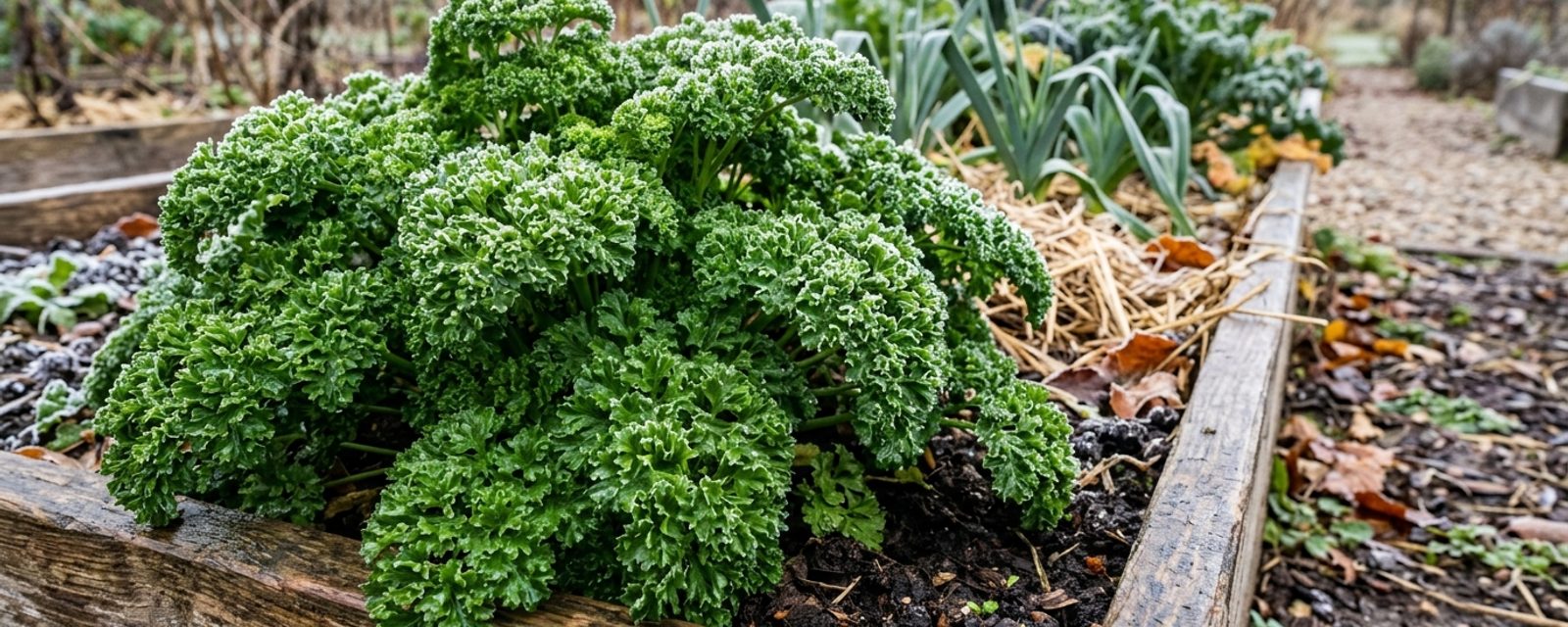
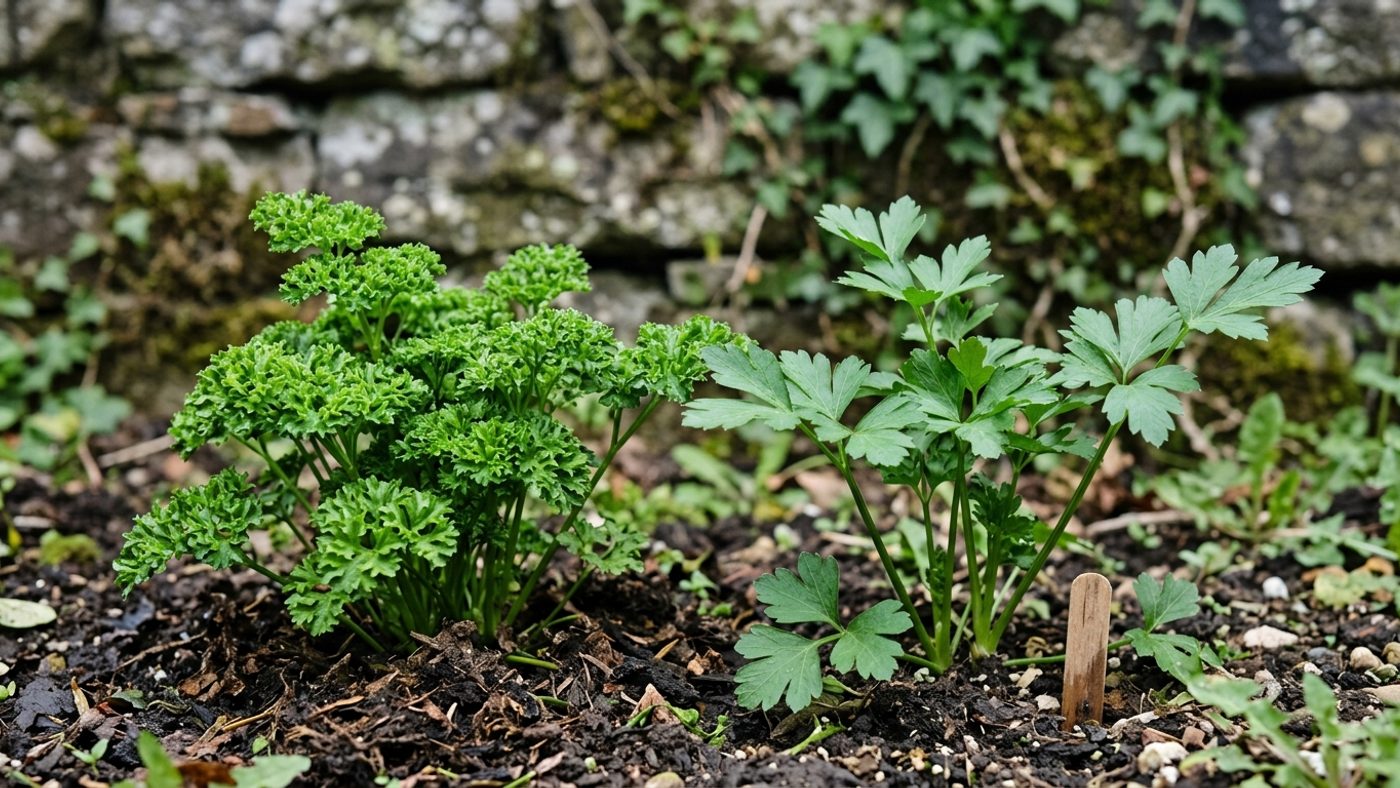
Flat-leaf parsley has the deeper flavour that earns its place in cooking. Curly parsley is the classic garnish. Both are the same plant, grown the same way, so the choice comes down entirely to what you'll use it for.
Why parsley suits Scotland
Parsley is a cool-weather crop. It grows best in spring and autumn, and a Scottish summer without extreme heat produces lush leafy plants rather than stressed ones that bolt to seed. The real Scottish advantage is winter. An autumn sowing, protected by a clocheA small, portable clear cover placed over an individual plant or short row to trap warmth and keep off wind, rain and pests. Full definition → or fleeceA lightweight, breathable fabric laid or draped over plants to trap a little warmth and keep off frost, wind and some flying pests. Full definition →, will stand through the cold and give you fresh leaves in March and April when little else is producing. Parsley is a biennialA plant that completes its life cycle over two years: growth in year one, then flowering, seeding and dying in year two. Full definition →. It produces leaves in its first year, flowers and dies in its second. Treat it as an annual and sow fresh every spring, with a late summer sowing to carry you through winter.
Varieties
Flat-leaf parsley has no AGMThe RHS's Award of Garden Merit: a UK-wide trials award for reliable performance, not a Scotland-specific recommendation. Full definition → and is still the standard cooking type: stronger flavour, easier to handle. Moss Curled and Bravour carry the AGM on RHS's general list, a UK-wide award, not a Scottish one — though Bravour's own individual plant page shows no AGM badge, an unresolved discrepancy between two RHS-published pages. RHS also lists 'Titan' (the only flat-leaf AGM cultivarA plant variety that arose or was bred under cultivation and is kept true by deliberate propagation, rather than a naturally occurring wild species. Full definition →) and 'Envy' (curly, good in containers), both H4The RHS's H1a–H7 scale for how much cold a plant can survive outdoors, H1a being tender indoor-only and H7 hardy anywhere in the UK. Full definition → hardy and carrying the same cross-page AGM discrepancy.
★ Our pick for Scotland
Flat-leaf parsley
Petroselinum crispum var. neapolitanum
Also called Italian parsley. The one chefs reach for. Stronger flavour than curly types, easier to chop, and stands up better in cooking.
Why this one: Flat-leaf parsley has the deeper flavour that makes it the cooking parsley rather than the garnish. It stands up to heat without disintegrating, and the large flat leaves are easier to pick, wash and chop than curly types.
Also worth considering
Moss CurledAGM
Curly
The classic curly parsley. Tightly ruffled leaves. Good for garnishes and sauces.
BravourAGM
Curly
A vigourous curly type.
Best Parsley Varieties for Scotland → compares all named parsley varieties head-to-head, with the practical detail that doesn't fit in a summary card.
Site and planting
Parsley wants full sun or light shade and rich, moisture-retentive soil. It is one of the few kitchen herbs that genuinely does not mind partial shade, which makes it the sensible choice for the bed that only catches sun for half the day. Dig in some garden compost before sowing. The germination is the hard part. Start seeds indoors in early spring, or sow outdoors from mid-spring through late summer. Sow in small pots or modulesA tray divided into small individual cells, each sown with its own seed or seedling, so each plant grows undisturbed roots until it's ready to plant out. Full definition → indoors, or make a drillA shallow, straight groove made in prepared soil for sowing seed into, at a set depth so germination and rows are even. Full definition → 1cm deep outdoors. Parsley seed benefits from warm water poured along the drill before sowing. Sow thinly and cover lightly with soil. Keep the soil moist. Seedlings appear slowly.
Thin or transplant seedlings to 15 to 30cm apart. Sowing a new short row every few weeks through the season gives you a continuous supply. Plants will eventually bolt to flower in their second year. When they do, pull them out and sow fresh.
Care through the season
Water during dry spells. Parsley in dry soil boltsA plant switching early into flowering and seed production, usually triggered by stress, after which leaves, roots or bulbs turn bitter or unusable. Full page → prematurely. A mulchA layer of material spread over the soil around plants to suppress weeds, retain moisture, and improve soil structure as it breaks down. Full definition → of garden compost around the plants holds moisture and feeds the soil. Weed regularly while the plants are young. Once the leaves fill out, parsley shades out most competition.
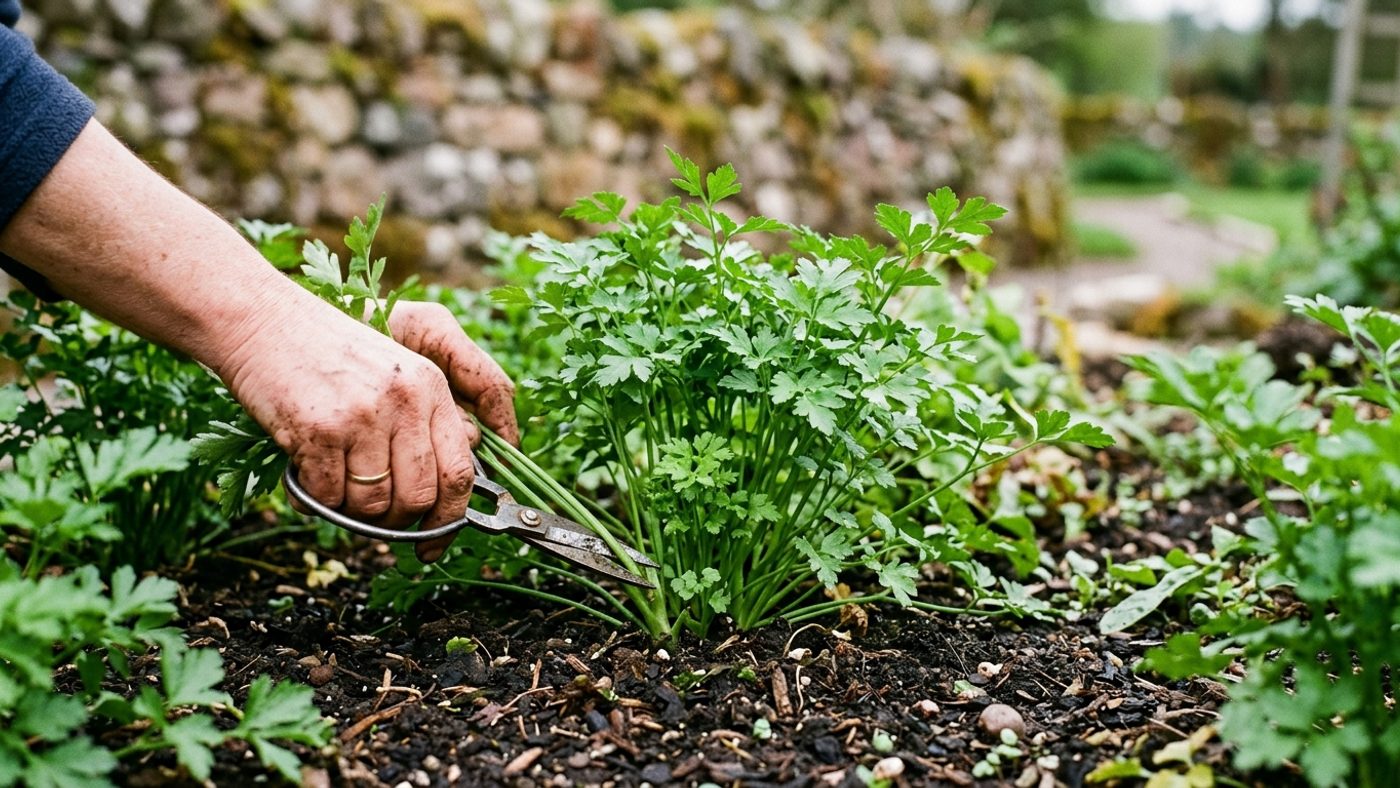
Harvesting: cut the outer leaves close to the base, leaving the centre of the plant intact. Harvest regularly. The more you pick, the more the plant produces. Do not strip a plant bare. In a mild Scottish winter, parsley under a cloche will keep producing. In spring, the plant will send up a flower stalk. At that point, pull it and sow fresh. The leaves turn bitter once flowering begins.
Common problems
- Slow or failed germination is the most common parsley problem. The seed coat is hard. Warm water along the drill, or soaking seeds overnight, helps. Sowing indoors on a warm windowsill removes the cold-soil variable entirely.
- Bolting means the plant is running to seed in its second year, or responding to stress. Once a parsley plant sends up a flower stalk, the leaves turn bitter. Pull it and sow fresh.
- Celery leaf mining fly tunnels pale blotches into the leaves. Usually just tolerable on an established plant, though the first generation in spring can check young seedlings; pick off affected leaves.
See more problems
- Carrot fly can affect parsley, which is in the same family as carrots. Fine mesh is the defence if you have carrot fly in your area. In practice, parsley in a border or pot is rarely troubled.
Common questions
Why does parsley take so long to germinate?
Parsley seed has a hard coating and germinates slowly. It can take a month or more. Six weeks is a reasonable expectation if the soil is cool. Pouring warm water along the drill before sowing, or soaking the seeds overnight, can speed it up. Do not sow parsley in cold wet Scottish spring soil and walk away. Start it indoors on a warm windowsill where you can see it every day. Transplant when the seedlings are large enough to handle.
Does parsley survive a Scottish winter?
Partly. Parsley is a biennial, giving leaves in year one and flowers and seeds in year two. It is hardy enough to stand through a Scottish winter, especially if covered with a cloche or fleece, and will give you fresh leaves in mild spells. In spring it will send up a flower stalk, after which the leaves turn bitter. Most growers treat parsley as an annual and sow fresh each year. A late summer sowing overwinteredKeeping a plant alive and intact through the cold months, whether left outdoors, moved under cover, or stored dormant. Full definition → under cover gives you fresh parsley in March and April when little else is growing.
How do I harvest parsley to keep it producing?
Cut the outer leaves first, close to the base, leaving the inner leaves to keep growing. Harvest regularly. The more you pick, the more the plant produces. Do not strip a plant bare. Always leave the central growing point intact.
Curly or flat-leaf parsley: which should I grow?
Flat-leaf genuinely has the stronger flavour and is what most cooks reach for, though curly is hardier through a Scottish winter and holds its shape better as a garnish: grow both if you have room. Full sourced breakdown: <a href="/tools/garden-myths/parsley/">Parsley Myths →</a>
Sources
3 sources, and what each was used for
- RHS: biennial habit grown as annual, sowing windows and succession, month-plus germination, 1cm depth, 15-30cm spacing, 20-30cm rows, harvest window, flat vs curly leaf types, AGM varieties
- Garden Organic: 14-28 day germination, sowing at 0.1cm in pots and transplanting at 5-10cm tall, 15cm final spacing, tolerance of partial shade, removing flower heads to hold leaf production, and extending the autumn harvest under fleece
- Teagasc: corroborates the biennial habit and the bolt-in-May-or-June limit; gives a June/July sowing for winter and spring use, and wider 45cm rows thinned to 10cm