
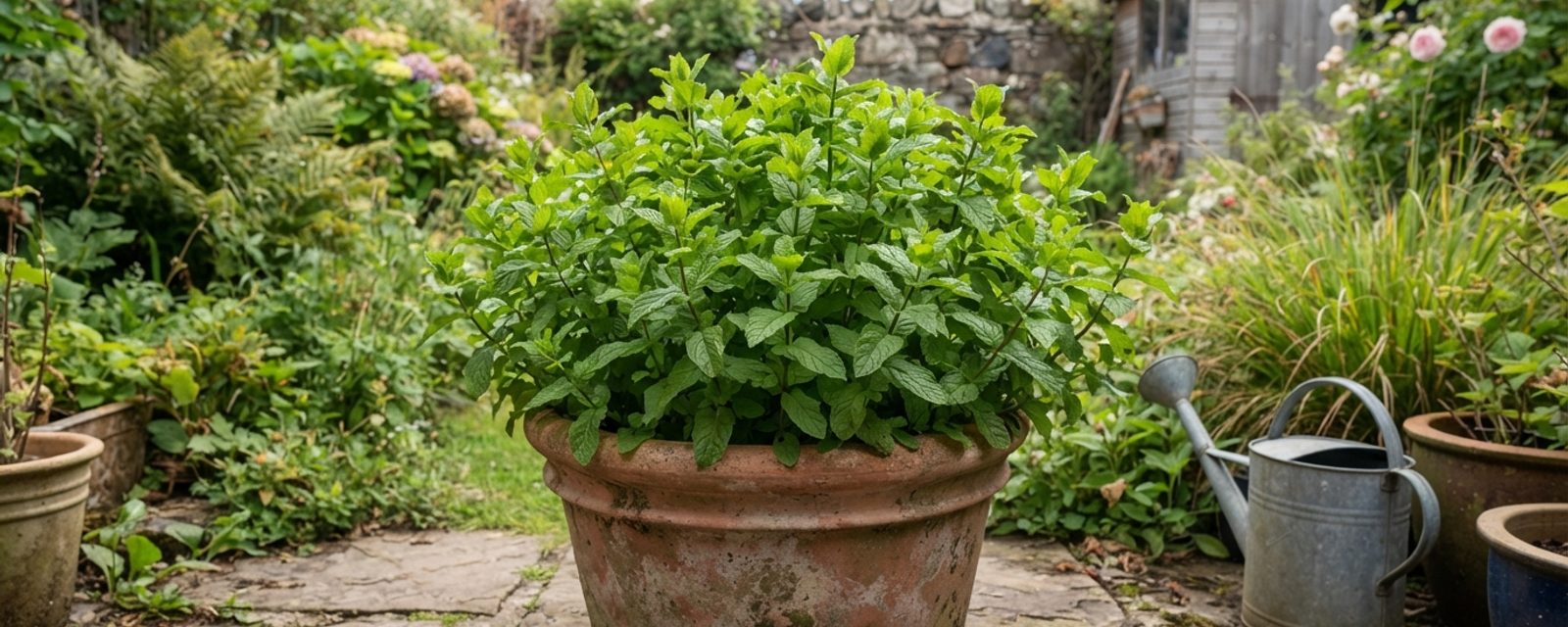
Mint is the one herb on this site where the variety question isn't really the point: every named type spreads by the same underground rhizomes, and every one of them is fully hardy enough to survive a Scottish winter without a second thought. Pick spearmint for cooking, chocolate mint for dessert, or pineapple mint for the fruit bowl, and the plant still needs the same answer to the same question first, pot, or bed?
Quick answer
Spearmint is the best all-round pick for a Scottish kitchen garden: classic flavour, fully hardy, and widely available. Choose apple mint if you want a milder leaf for mint jelly and sauce, chocolate mint for a genuinely dessert-flavoured leaf, or pineapple mint for the mildest, most fruit-forward flavour and its cream-edged leaves as a garnish. Whichever type you choose, grow it in a container, mint's spreading rhizomes matter more to the outcome than the variety does, and Gardener's World singles out chocolate, lime and pineapple mint as the calmer spreaders of the group if containment is the main worry.
Why "variety" means something different for mint
Most herbs and vegetables worth comparing have RHS Award of Garden Merit cultivarsA plant variety that arose or was bred under cultivation and is kept true by deliberate propagation, rather than a naturally occurring wild species. Full definition → to weigh against each other, proven, judged performers competing on cropping, disease resistance or garden merit. Mint doesn't fit that shape. RHS names spearmint, Moroccan mint, apple mint, pineapple mint, lime mint and chocolate mint on its mint growing page, but describes them as flavour types rather than judged cultivars, and none carries an AGMThe RHS's Award of Garden Merit: a UK-wide trials award for reliable performance, not a Scotland-specific recommendation. Full definition →. There's no equivalent of comparing two AGM apple varieties on cropping and disease resistance here, mint's "best variety" question is a flavour and vigour decision, not a merit-award one. Sage, savory and oregano share the same shape: named types or species rather than an AGM shortlist.
Peppermint (Mentha × piperita) is a genuinely popular mint too, and a fine plant in its own right, but RHS's own mint growing page names six other types by name, pineapple, Moroccan, lime, spearmint, apple and chocolate mint, without including peppermint among them, so it isn't part of the six-way comparison below.
That doesn't mean there's nothing to compare. The six RHS-named types differ in real, checkable ways once you look at each one's own plant page rather than the general mint summary: hardiness ratingThe RHS's H1a–H7 scale for how much cold a plant can survive outdoors, H1a being tender indoor-only and H7 hardy anywhere in the UK. Full definition →, height and spread, and, the one that actually matters most for a Scottish garden, how much room each one wants to take up.
The mint types compared
Hardiness ratings on the UK's standard scale run from H1 (needs a heated greenhouse) to H7 (survives the coldest European winters); the six mint types below sit at the hardy end, rated either H5 or H7.
| Type | Latin name | Hardiness | Height / spread | Flavour |
|---|---|---|---|---|
| Spearmint | Mentha spicata | H7 (below -20°C) | 0.5-1m / 1-1.5m | Classic sweet mint, the cooking standard |
| Moroccan mint | M. spicata var. crispa 'Moroccan' | H7 | 0.5-1m / 0.5-1m | Clear, sweet mint flavour, crinkled leaves |
| Apple mint | Mentha suaveolens | H5 (-15 to -10°C) | 0.5-1m / 1-1.5m | Milder, apple-scented, used for mint sauce and jelly |
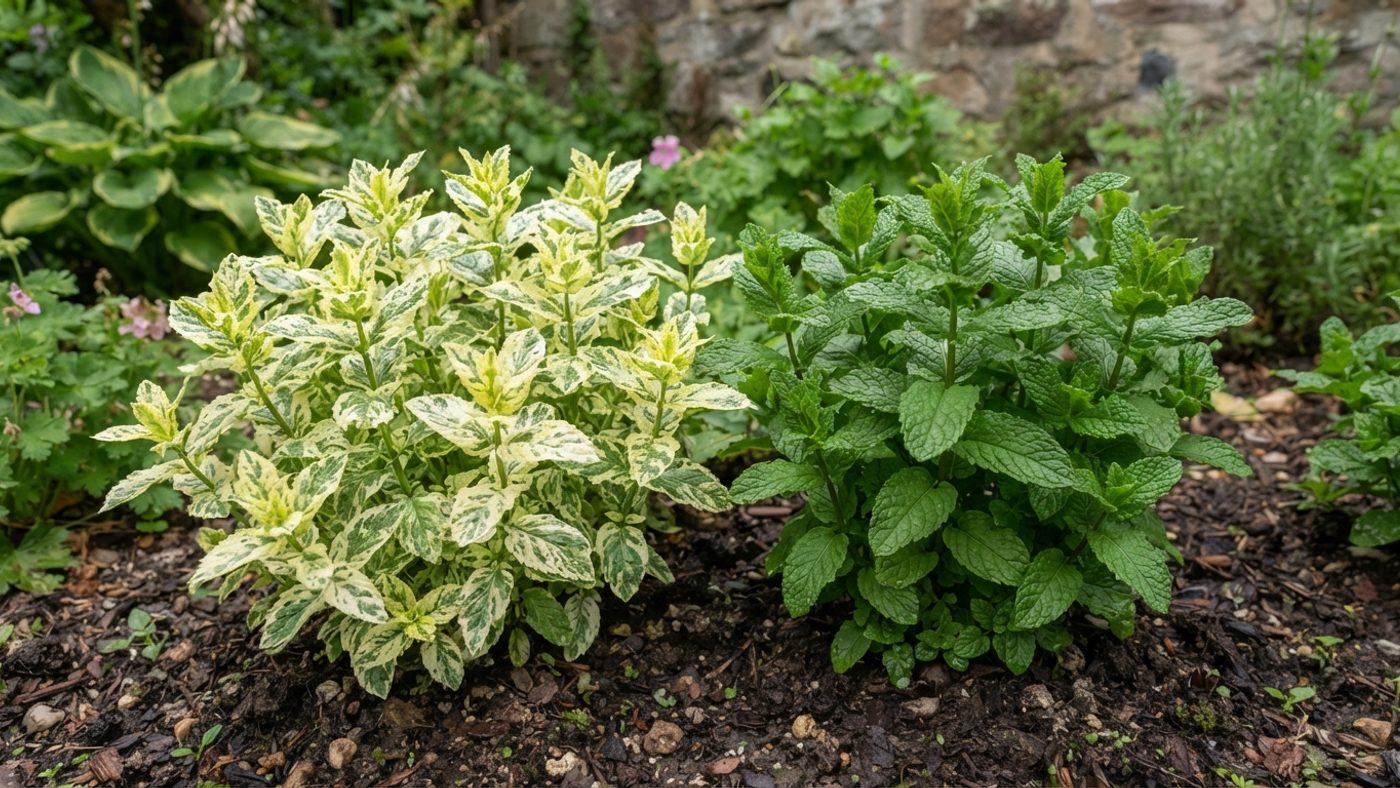
| Pineapple mint | M. suaveolens 'Variegata' | H5 | 0.1-0.5m / 1-1.5m | Mild, fruity, pineapple-scented; cream-variegated leaves |
| Chocolate mint | M. × piperita f. citrata 'Chocolate' | H7 | 0.1-0.5m / 0.5-1m | Minty-chocolate scent, leaves tinge reddish-purple in sun |
| Lime mint | M. × piperita f. citrata 'Lime' | H7 | 0.1-0.5m / 1-1.5m | Lime-scented leaves flushed bronze |
In practice, H5 versus H7 is close to academic here: mint dies back to the roots regardless of type and regrows once the ground warms in spring, so both bands comfortably cover a Scottish winter. Spread is the figure worth actually reading the table for, every one of the six reaches at least 0.5m, and four of the six reach 1-1.5m if left unchecked, which is most of a small raised bed on its own.
Which one actually spreads more
This is the genuinely useful comparison a flavour list alone doesn't give you. Every one of the six carries the same "may become a nuisance, restrict the root run" caution on its own individual plant page without exception, on paper, mint is mint, and containment advice doesn't vary by type.
Gardener's World draws a real distinction RHS doesn't: its how-to-grow page names chocolate mint, lime mint and pineapple mint ('Variegata') specifically as non-invasive, a claim it doesn't extend to spearmint or apple mint. That's a genuine discrepancy between two authorities rather than a settled fact, RHS's own pages for chocolate and lime mint still carry the standard nuisance warning, so "non-invasive" is Gardener's World's practical field judgement, not an RHS-confirmed rating. Worth knowing either way, here's where each type actually falls, combining both sources with RHS's own spread figures:
- Calmer spread — chocolate mint, lime mint, pineapple mint (all named "non-invasive" by Gardener's World, though RHS's own pages still carry the standard nuisance caution), plus Moroccan mint (not named by either source, but its own RHS spread figure of 0.5-1m is the smallest of the six)
- Most vigorous spread — spearmint and apple mint (1-1.5m maximum spread, RHS's largest figures on this list, and not named as calmer by Gardener's World either)
None of the six is exempt from container growing regardless of which group it falls in.
Pineapple mint's cream variegation carries one containment-adjacent quirk worth flagging: RHS's general guidance on plant reversion notes that variegated cultivars can throw all-green shoots, which grow more vigorously than the variegated growth and should be pruned out completely as soon as they appear, or they gradually take the plant back to plain green. Left unchecked, that's a second, separate way pineapple mint can end up more vigorous than expected, on top of the usual rhizome spread.
Lime mint carries one more real point of difference: RHS lists it as generally pest-free, while spearmint, apple mint and pineapple mint are each named as vulnerable to sage and Ligurian leafhoppers, mint beetles and caterpillars, and pineapple mint's own page adds mint moth to that list. Every type remains susceptible to mint rust and powdery mildew regardless of pest pressure, rust doesn't discriminate by flavour type the way the pest list above does.
Containing mint, whichever type you grow
A pot at least 20cm wide, sunk into a bed with its rim left 4cm proud of the soil if you want the look of a border, stops the rhizomes escaping, a rim flush with the soil surface is no barrier at all, since runnersLong, trailing stems a plant sends out that root where they touch soil, producing a genetically identical new plant for free. Full definition → simply climb over it.
Any of the six types is best bought as a young plant rather than raised from seed, mint is so easy to divide or take a cutting from that seed is rarely worth the wait, and a named type like chocolate or Moroccan mint won't come true from seed reliably in any case. Plant in spring or autumn; a young plant put in during a Scottish spring establishes over that first growing season and is ready to divide by its second or third spring. The full planting method, including root-cutting propagation and how often to divide an established clump, is covered in the mint growing guide.
A potted mint left outdoors over winter is more exposed to frost at the roots than the same plant would be in open ground, since a pot has no surrounding soil mass to buffer the cold, pushing the pot against a sheltered wall, wrapping it in fleeceA lightweight, breathable fabric laid or draped over plants to trap a little warmth and keep off frost, wind and some flying pests. Full definition → or horticultural bubble wrap, or standing it on feet to stop the base sitting in freezing standing water all reduce that risk through a hard Scottish frost. None of the six types needs this in a mild winter, since all are hardy enough to take a UK winter regardless, but it's worth doing in an exposed or upland garden rather than assuming a pot behaves the same as a bed.
One additional point on rust worth adding to the growing guide's own "cut affected growth to the ground" advice: Gardener's World recommends leaving the ground where an infected plant grew unplanted with mint for three years afterwards, on top of removing and binning the affected stems, a more specific figure than either RHS or the existing guide gives, worth following if mint rust has been a repeat problem in the same pot or bed.
Garden mint isn't the only mint growing in Scotland: water mint and corn mint turn up wild in damp ground and by burns and ponds. That's one more reason a bed rather than a pot is the wrong call near a pond or a wet corner of a plot, an escaped rhizome from any of the six garden types has a route to keep spreading into damp ground that a contained pot never gives it.
Soil: what's actually known
No numeric pH range for mint specifically appears in the sources checked. The closest figure comes from Utah State University Extension, which describes mint as preferring "rich, moist and slightly acidic soils", useful as a general lean toward acid-to-neutral ground, not a precise target, and an easy match on ground that already runs acidic without any amendment needed. Sun or partial shade suits every one of the six types; none needs full sun specifically.
Which type for which situation
Classic cooking, mint sauce, new potatoes, mojitos. Spearmint is the reference flavour most recipes assume. Its H7 hardiness and 1-1.5m maximum spread make it one of the most vigorous types on this list, so it's also the type where container growing matters most.
- Mint sauce and jelly specifically: apple mint's milder flavour is the traditional choice for sauce and jelly rather than fresh use, where spearmint's stronger flavour can dominate.
- Tea: Moroccan mint is the type most commonly recommended for mint tea, and its tighter 0.5-1m spread (against spearmint's 1-1.5m) makes it a slightly smaller pot commitment for the same hardiness.
- Dessert and garnish: chocolate mint's minty-chocolate flavour and lime mint's citrus note both suit puddings and drinks rather than savoury cooking, and both are named among the calmer spreaders above if a smaller pot is the goal.
- Ornamental edge, fruit bowl garnish: pineapple mint's cream-variegated leaves do decorative duty as well as flavouring a fruit salad, and it's the shortest of the six at 0.1-0.5m tall, though its spread still reaches 1-1.5m like spearmint's.
- A shadier spot: every type tolerates partial shade as well as full sun, so a lack of a sunny spot isn't a reason to rule mint out, pick on flavour rather than ruling anything out for light levels.
- Feeding pollinators alongside the kitchen: all six flower in summer if a few stems are left unpinched, and RHS names mint among the plants that benefit bees and other pollinating insects, worth leaving one uncut stem to flower on whichever type is grown, since regular harvesting for the kitchen otherwise removes the flower buds before they open.
Common questions
Is any mint type actually less invasive than the others?
Sources disagree rather than agree on this one. RHS's own individual pages carry the standard nuisance caution on all six types without exception, but Gardener's World's how-to-grow page names chocolate, lime and pineapple mint specifically as non-invasive. Container growing is the safe default regardless of which of the calmer options is picked.
Do any mint types carry an RHS Award of Garden Merit?
No, not one of the six. RHS treats mint as named flavour types on its mint growing page rather than as judged cultivars, so choosing a mint really is a flavour, hardiness and spread decision rather than a merit-award one, closer to choosing a species of savory or oregano than picking between AGM cultivars of thyme or rosemary.
Is one mint type hardier than the others in a Scottish winter?
Apple mint and pineapple mint are rated H5 (-15 to -10C); spearmint, Moroccan mint, chocolate mint and lime mint are rated H7 (below -20C). In practice this rarely matters for the plant itself: mint dies back to the roots and regrows from below ground every year regardless of type, so H5 is already well below anything a Scottish winter typically produces at ground level.
Does mint get any pests or diseases that vary by type?
Mint rust and powdery mildew affect every type. Lime mint is the exception on general pests, generally pest-free according to its own plant page, while spearmint, apple mint and pineapple mint are each vulnerable to sage and Ligurian leafhoppers and caterpillars, with pineapple mint adding mint moth specifically.
Sources
10 sources, recorded with what each was used for
- How to grow Mint: General mint habit, the six named types, containment advice, propagation
- Mentha spicata (spearmint): Hardiness (H7), height/spread, pest/disease susceptibility
- Mentha spicata var. crispa 'Moroccan' (Moroccan mint): Hardiness (H7), height/spread, flavour, pest/disease susceptibility
- Mentha suaveolens (apple mint): Hardiness (H5), height/spread, pest/disease susceptibility
- Mentha suaveolens 'Variegata' (pineapple mint): Hardiness (H5), height/spread, pest/disease susceptibility including mint moth
- Mentha x piperita f. citrata 'Chocolate' (chocolate mint): Hardiness (H7), height/spread, flavour, pest/disease susceptibility
- Mentha x piperita f. citrata 'Lime' (lime mint): Hardiness (H7), height/spread, flavour, pest-free note — independently confirmed by the hub via direct WebFetch
- How to Grow Mint: Chocolate, lime and pineapple mint named non-invasive (independently confirmed by the hub via direct WebFetch), container growing method, mint rust removal and three-year replant gap
- Mint in the Garden: Soil pH preference ("rich, moist and slightly acidic soils")
- Reversion in Plants: General guidance on variegated plants throwing more vigorous plain-green shoots, applied here to pineapple mint