
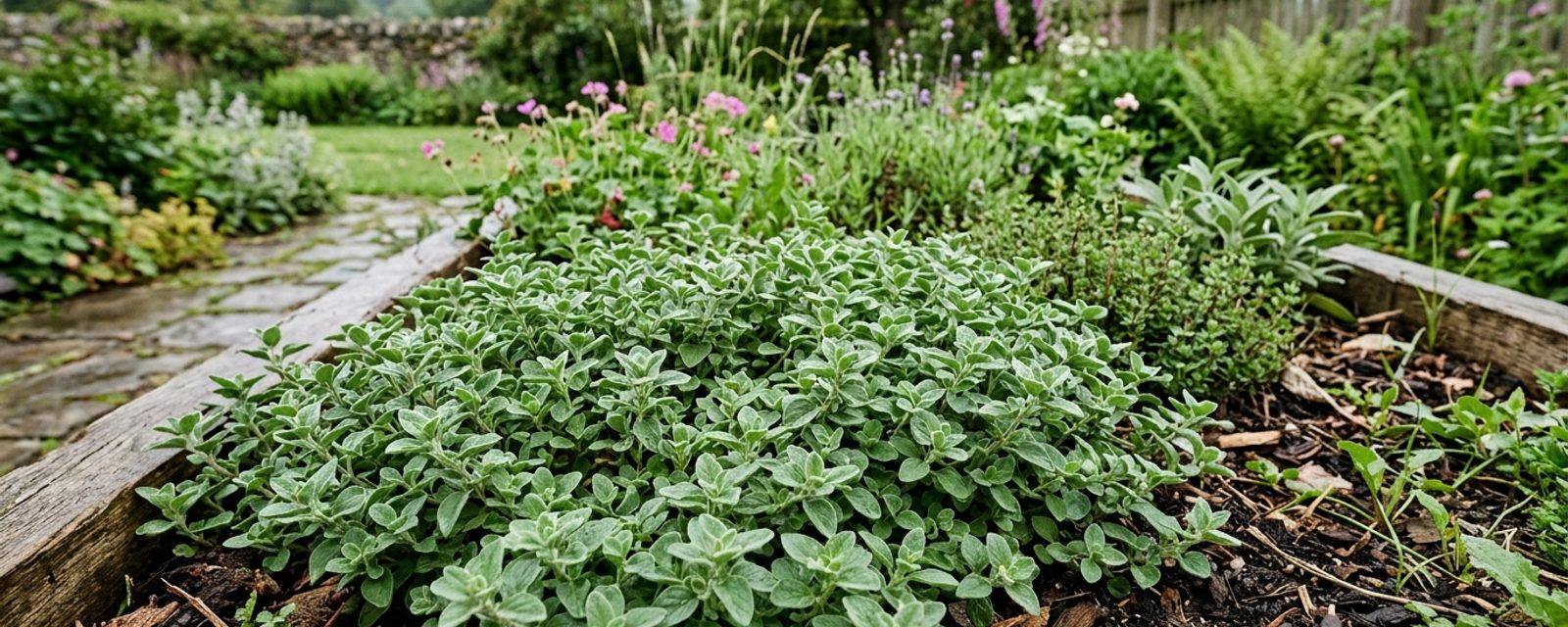
Oregano's flavour comes from oil glands on the leaf surface, and light is what drives them: a plant grown hard in full sun generally produces smaller, more intensely flavoured leaves than the same plant in shade, which tends to grow larger, softer leaves with a milder taste. That trade-off runs through most of the real differences between oregano cultivarsA plant variety that arose or was bred under cultivation and is kept true by deliberate propagation, rather than a naturally occurring wild species. Full definition →, a golden-leaved plant grown mainly for colour sits in strong sun differently to a green one grown for the kitchen, and a low, mat-forming habit holds more moisture at soil level than an upright one. Variety choice for a Scottish garden comes down to which of those trade-offs actually suits your plot.
Quick answer
For most Scottish gardens, 'Hot and Spicy' is the best all-round pick: full culinary strength, a robust habit, and it takes to container growing if drainage on your plot is poor. If you specifically want the most compact, driest-summer-proof container plant, choose 'Compactum' instead. If you're growing for looks rather than the kitchen, ground cover, a rock garden edge, or a hanging container, 'Kent Beauty' or 'Rosenkuppel' are the better picks, but neither is worth cooking with.
The varieties compared
Seven Origanum cultivars come up repeatedly for UK gardens: four hold the RHS Award of Garden Merit (Hot and Spicy, Compactum, Gold Nugget, Aureum), and three don't but are still widely sold and relevant to a variety-choice decision (Kent Beauty, Rosenkuppel, and Greek oregano). For planting, feeding and pruning technique, see the full growing guide.
| Variety | AGMThe RHS's Award of Garden Merit: a UK-wide trials award for reliable performance, not a Scotland-specific recommendation. Full definition → | Hardiness | Habit / siting | Strongest differentiator |
|---|---|---|---|---|
| Hot and Spicy | Yes | H5The RHS's H1a–H7 scale for how much cold a plant can survive outdoors, H1a being tender indoor-only and H7 hardy anywhere in the UK. Full definition → (to -10°C) | Mound-forming, full sun; suited to containers | Distinct heat alongside the usual pungency |
| Compactum | Yes | H5 (to -10°C) | Low mound to 15cm, full sun or part shade | Most compact of the culinary AGM varieties, best for small pots |
| Gold Nugget | Yes | H5 (to -10°C) | Spreading clump to ~30cm, full sun | Sweet flavour with gold foliage that pales as the season goes on |
| Aureum (golden oregano) | Yes | H6 (to -15°C) | Spreading clump to ~30cm, full sun or part shade | Hardiest of the golden-leaved forms, warm flavour |
| Kent Beauty | Yes | H4 (to -5°C) | Trailing, to 10cm, full sun | Ornamental hop-like pink bracts; not a cooking herb |
| Rosenkuppel | No | H7 (below -20°C) | Upright to 0.5-1m, full sun or part shade | Toughest of the seven for cold, but purely ornamental |
| Greek oregano (subsp. hirtum) | Not stated | H4 (to -5°C) | Upright to 0.5-1m, full sun or part shade | The "true Greek oregano" of Mediterranean cooking, good for drying |
These hardiness figures are the standard H-ratings; the straight species' rating (H6) sits above every named culinary cultivar here except Aureum and Rosenkuppel. Waterlogged soil, not cold, is the main winter risk for oregano in a wet UK garden, so drainage at planting time is worth more than chasing the hardiest cultivar on this list.
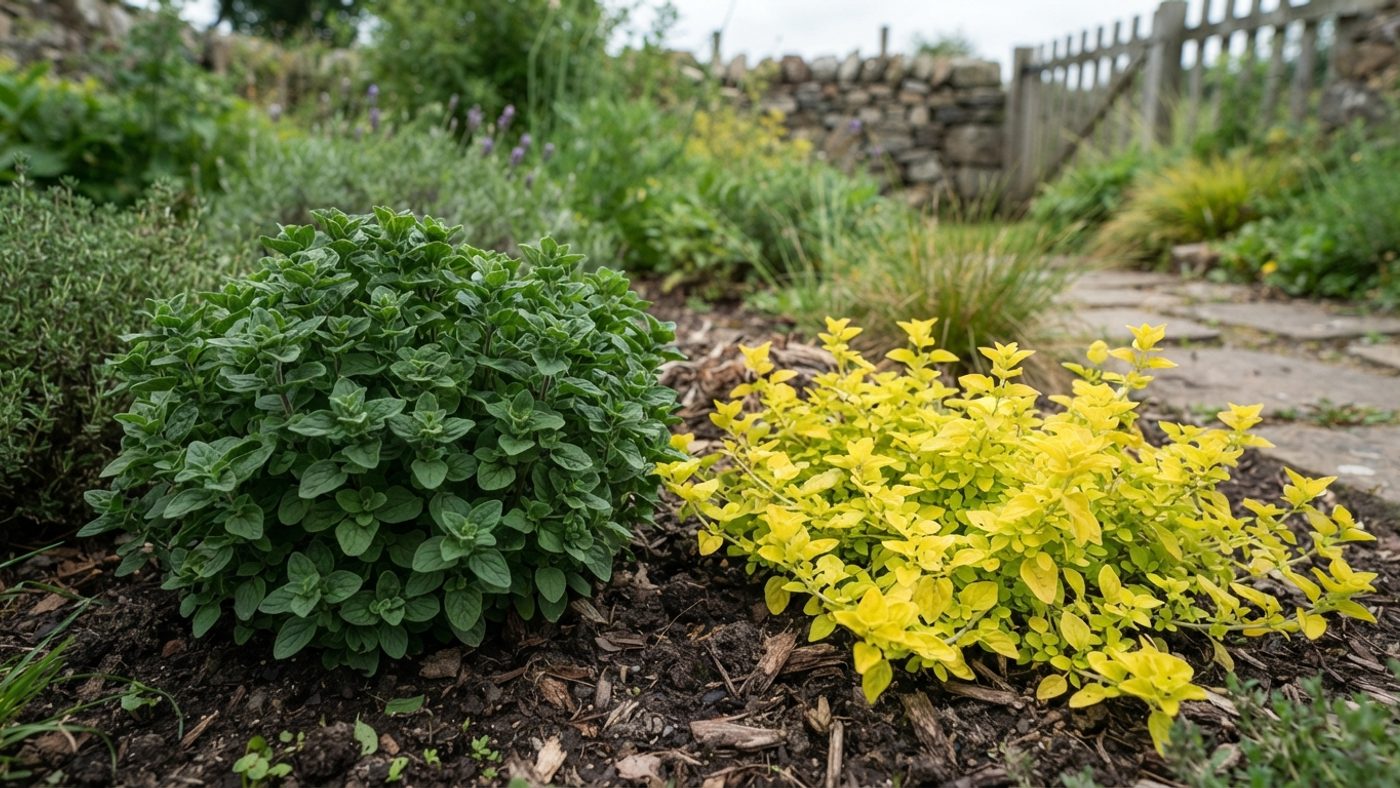
Best overall: Hot and Spicy
'Hot and Spicy' combines real culinary usefulness with a habit that's forgiving of a Scottish plot: its grey-green leaves carry a distinct heat on top of oregano's usual pungency, it's rated hardy to -10°C, and it's suited to container growing, useful if you need to move it under cover for a wet winter rather than trust it to open ground. It also attracted strong pollinator numbers in trials, so it isn't a compromise plant for the border either.
Which one for your situation
Most compact / smallest container: 'Compactum' tops out at around 15cm, lower than any other AGM culinary form here, and its small, densely packed leaves are strongly aromatic despite the plant's size, the better choice if space, not flavour range, is the constraint.
Full sun and want colour as well as flavour: 'Gold Nugget' and 'Aureum' both carry the AGM and a genuine culinary flavour, but their gold foliage is the point of growing them, and gold Origanum foliage generally holds its brightest colour in full sun, part shade tends to green the leaves back down, which 'Aureum' itself demonstrates as its yellow spring growth fades greener through the season regardless of siting. Aureum's H6 rating gives it a cold-tolerance edge over Gold Nugget's H5.
Most intense, most traditionally "Greek" flavour: Greek oregano (Origanum vulgare subsp. hirtum) is the culinary reference point most recipes actually mean by "oregano", highly aromatic, upright, and specifically good for drying. It's rated H4, a step down in cold tolerance from the AGM cultivars above, so it benefits more than most from a sheltered, sharply drained spot.
Ground cover, rock garden, or ornamental container, not for the kitchen: 'Kent Beauty' trails to just 10cm with showy, hop-like pink bracts, and 'Rosenkuppel' grows taller and more upright with purple-flushed foliage and the best cold tolerance of any cultivar here (H7). Both are sold and grown for looks; neither is bred or recommended for cooking.
Soil pH: no number to give you
No specific pH figure is published for oregano; the guidance is a general preference for alkaline soil, though several cultivars are documented as tolerating a wider acid-to-alkaline range. If you're testing your plot, don't chase a precise number; aim for free-drainingSoil that lets water pass through quickly rather than pooling, so roots aren't sitting in wet ground after rain. Full definition → ground on the neutral-to-alkaline side and treat drainage, not pH precision, as the factor that actually decides whether oregano thrives.
Feeding, pruning and wind: the other siting factors
Lean, unfed soil tends to hold flavour better than rich ground: extra fertiliser pushes oregano into soft, leafy growth rather than the smaller, oilier leaves that carry the strongest taste. No feeding is needed in the ground at all; an occasional general-purpose feed only suits container plants over a year old. Cut plants back hard in late spring to stop the woodier upright forms (Rosenkuppel, Greek oregano) becoming leggyDescribes a plant that's grown tall, thin and sparse rather than bushy, usually from too little light or not being pinched out. Full definition →, and on an exposed plot, those same taller, upright cultivars are the ones worth siting out of the worst of the wind, the low, mat-forming cultivars (Compactum, Kent Beauty) aren't at meaningful risk of wind rock at 10-15cm.
Pest and disease notes relevant to variety choice
No cultivar-specific pest or disease difference is documented, the risks that matter for oregano generally, root rot from waterlogging, and pressure from mint rust, mint moth, and sage and Ligurian leafhoppers, apply across the genus rather than to one cultivar over another. The clearest habit-linked consideration is airflow: the low, dense mounds of 'Compactum' and the trailing mat of 'Kent Beauty' sit closer to damp soil than the upright growth of Greek oregano or 'Rosenkuppel', so sharp drainage matters more, not less, if you choose one of the low-growing forms.
Common questions
Is golden oregano ('Aureum' or 'Gold Nugget') less hardy than green oregano?
Slightly, and it depends which one — see the comparison table above for the exact ratings. Both are hardy through most UK winters; the difference between them is one step on the hardiness scale, not a reason to rule either out.
Can I grow true Greek oregano in Scotland?
Yes. Origanum vulgare subsp. hirtum is rated H4, meaning it needs a more sheltered, well-drained spot than the AGM cultivars bred specifically for UK gardens, but it isn't excluded by climate — it just has less margin for a cold, wet site.
Do I need more than one variety?
Only if you want different things from the plant. Growing one culinary AGM variety (Hot and Spicy or Compactum) plus, separately, an ornamental one (Kent Beauty or Rosenkuppel) for ground cover or a rock garden covers both uses — there's no flavour benefit to growing multiple culinary cultivars side by side.
Is "Greek oregano" the same plant as ordinary oregano?
It's the same species, Origanum vulgare, but a specific subspecies (hirtum) rather than a separate plant. It's worth distinguishing from non-Origanum plants that also get called "oregano" in seed catalogues, such as Mexican oregano or Cuban oregano, which belong to entirely different plant families and aren't covered by this guide.
Will a golden-leaved variety scorch in full sun?
No scorch risk is noted for either. Gold Nugget and Aureum are both specified for full sun (Aureum tolerates partial shade too), and the main colour effect through the season runs the other way: leaves tend to green up rather than burn as the year goes on.
Sources
10 sources, recorded with what each was used for
- How to grow oregano: General cultivation guidance, list of AGM culinary varieties, ornamental-vs-culinary distinction for Kent Beauty/Rosenkuppel
- Origanum vulgare (species page): Species hardiness (H6), mature size, flowering time, soil/pH range
- Origanum vulgare 'Hot and Spicy': AGM status, hardiness (H5), habit, container suitability, trial pollinator note
- Origanum vulgare 'Compactum': AGM status, hardiness (H5), mature height, siting
- Origanum vulgare 'Gold Nugget': AGM status, hardiness (H5), foliage colour behaviour, container/rock garden use
- Origanum vulgare 'Aureum': AGM status, hardiness (H6), foliage colour behaviour, siting
- Origanum 'Kent Beauty': AGM status, hardiness (H4), habit, ornamental bract description
- Origanum 'Rosenkuppel': Hardiness (H7), habit, ornamental-only status, no AGM
- Origanum vulgare subsp. hirtum: Hardiness (H4), habit, drying suitability note
- How to grow oregano: Confirms Kent Beauty and Rosenkuppel are not suitable for cooking