
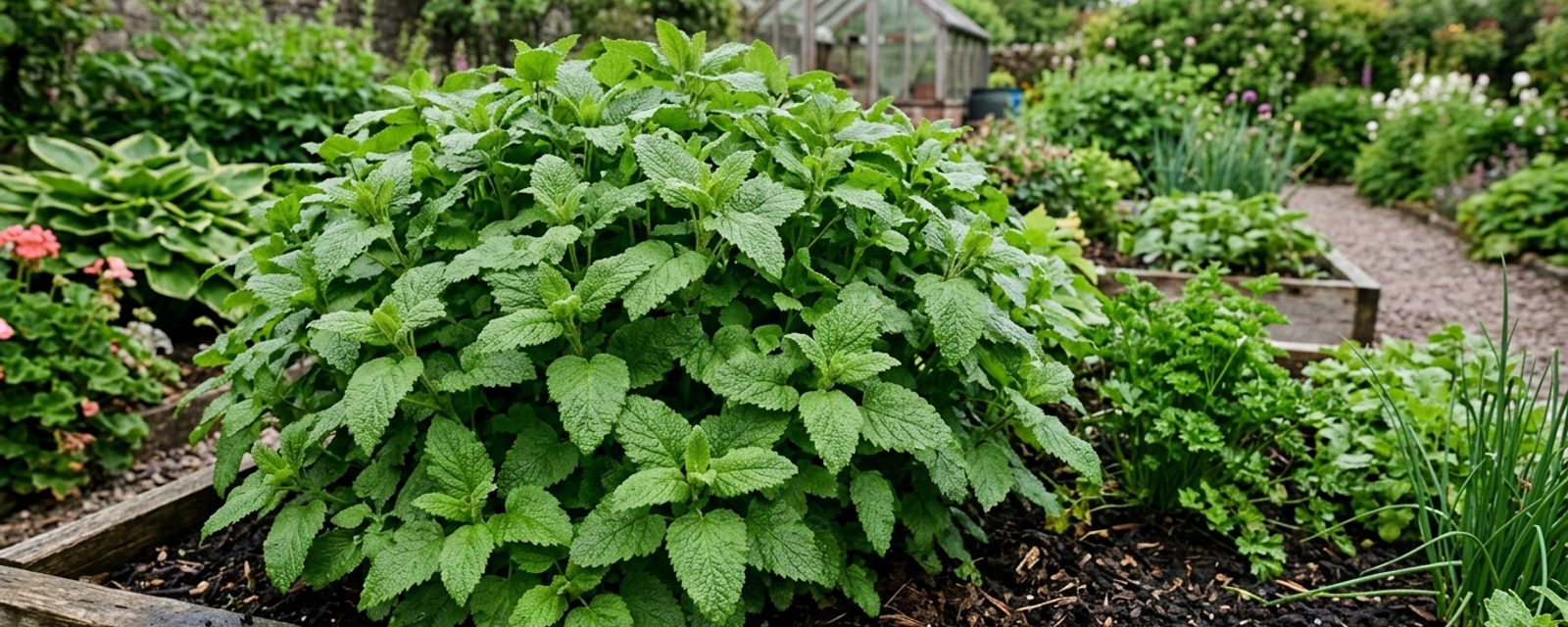
Lemon balm doesn't stay where you put it. Left to its own devices, a single plant of Melissa officinalis builds outward into a dense, woody-based clump while simultaneously scattering seed freely around itself, so a patch that starts as one small pot-bought plant can become several unplanned ones within a couple of seasons, which is exactly why the variety you choose, and where you put it, matters more with this herb than with most others in the mint family.
Quick answer
For most gardens, standard lemon balm (Melissa officinalis) is the best overall pick: it has the strongest lemon scent and is what most recipes and remedies assume. Choose All Gold instead for a small patio pot or tight border edge where a genuinely compact, decorative plant matters more than maximum leaf yield, and choose Aurea for a larger ornamental planting, a border edge, bank or slope, where you want more visual colour spread while keeping the full lemon scent.
All three varieties share the same H7 hardiness ratingThe RHS's H1a–H7 scale for how much cold a plant can survive outdoors, H1a being tender indoor-only and H7 hardy anywhere in the UK. Full definition →, hardy down to below -20°C, well beyond anything a Scottish winter typically produces, and the same rough tolerance for ordinary garden soil, so the real choice between them comes down to size, position and what you want the plant to look like, not toughness. None of the three currently holds an RHS Award of Garden Merit. For sowing, planting and containment technique, see the full growing guide.
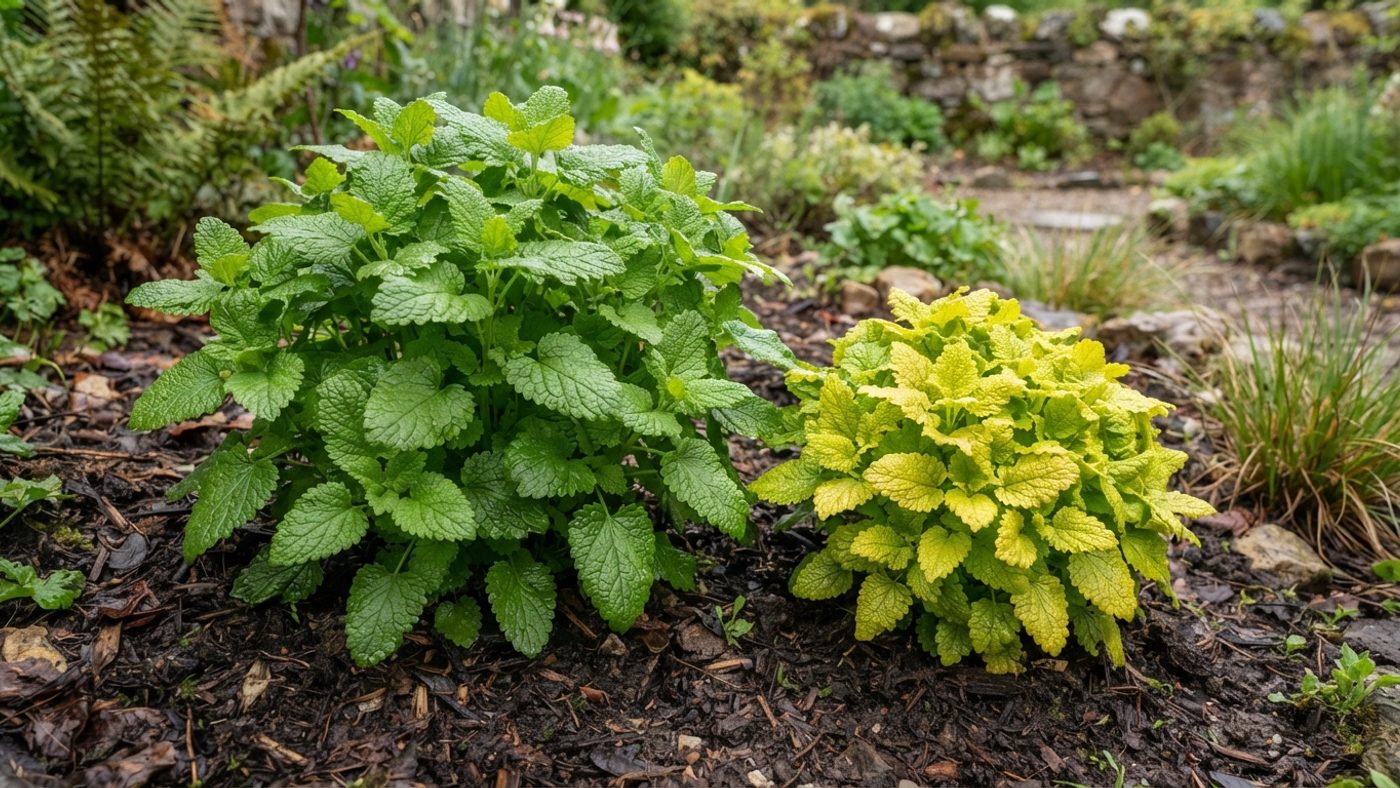
Size and habit: the differences the label won't tell you
Standard lemon balm is the biggest of the three by some distance, grows happily in full sun or partial shade, and tolerates chalk, clay, loam and sandy soils. It's also the variety documented as self-seeding readily, so an established clump left to flower will keep producing seedlings around itself unless you deadheadRemoving spent flowers before they set seed, which redirects a plant's energy into further flowering rather than seed production. Full definition → or contain it.
All Gold is genuinely dwarf, roughly a third the height of the species (see the table below for exact figures). Its position is full sun, on a south- or west-facing, sheltered site with well-drained, relatively poor soil; once established it copes well with drought. Leaves are golden-yellow, toothed and wrinkled, with pale lilac-tinted white flowers.
Aurea sits closer to the species in size, but its leaves are the real distinguishing feature: dark green, heavily splashed with yellow at the margins, giving a variegated look rather than All Gold's solid gold. Aurea's position is also full sun, and it's flagged as well suited to cottage gardens, wildlife gardens, and banks or slopes. Like All Gold, it's drought-resistant once established.
Worth noting plainly: both golden-leaved cultivarsA plant variety that arose or was bred under cultivation and is kept true by deliberate propagation, rather than a naturally occurring wild species. Full definition → want full sun, not the partial shade the plain green species tolerates, easy to assume otherwise, since variegated and gold foliage often signals a shade-loving plant. Both also want a sheltered spot, which is worth taking seriously in an exposed Scottish garden: wind as much as cold is what damages soft-leaved herbs like this over the growing season, so a spot with a wall, hedge or fence to break the worst of the wind suits either cultivar better than fully open ground.
Both cultivars can also revert: shoots that come up plain green rather than gold or variegated should be cut out as soon as you spot them, or they'll eventually out-compete the coloured growth and the plant will drift back toward the species' appearance.
| Variety | Height | Spread | Position | Leaf | Best for |
|---|---|---|---|---|---|
| Standard (M. officinalis) | 0.5–1m | 0.1–0.5m | Full sun or partial shade | Plain green | Strongest flavour, general use |
| All Gold | 0.1–0.3m | 0.1–0.5m | Full sun, sheltered | Solid golden-yellow, wrinkled | Small pots, patios, tight spots |
| Aurea (v) | 0.1–0.5m | 0.1–0.5m | Full sun | Dark green, yellow-splashed margins | Border edges, banks, cottage/wildlife planting |
No specific soil pH preference is published for lemon balm; ordinary, reasonably drained garden soil is sufficient across all three varieties.
Choosing where to grow it: containment vs. decoration
For the standard species, self-seeding is the bigger long-term risk: even if you keep the clump itself in check, flowered stems will drop seed into surrounding beds. Deadheading before seed sets, or growing it in a container standing on paving rather than open soil, deals with this directly. All Gold and Aurea aren't documented as self-seeding as readily, so their smaller natural spread, not self-seeding, is the main thing to plan for with either cultivar, and since named cultivars are propagated by divisionPropagating a clump-forming perennial by digging it up and splitting it into several smaller pieces, each with roots and shoots attached. Full definition → rather than reliably true from seed, an established plant that does self-seed is likely to throw up plain green seedlings rather than gold or variegated ones, another reason to remove stray seedlings early if you want to keep a bed looking uniform.
That smaller size is what makes All Gold and Aurea the more forgiving choices for a container or a modest raised bed, a pot that would feel crowded by a full-size lemon balm within a season or two suits either cultivar comfortably for longer. For open ground, the standard species wants real room: treat it as needing significantly more space than either cultivar, and site it where a metre-wide clump won't crowd neighbours. A practical rule of thumb: if you're planting into a border you can't easily police for seedlings, favour a cultivar or commit to deadheading; if you're planting into a contained pot or a bed you check regularly, the standard species is easy to manage and gives the strongest flavour for the effort. A spacing of around 45cm between plants, with pinching outRemoving the soft growing tip of a stem to stop upward growth and make the plant branch out sideways instead. Full definition → to encourage bushiness, applies across all three and is a reasonable starting point regardless of which one you choose.
All three establish the same way, whether bought as a young plant or started at home: spring is the main planting window, an established clump can be lifted and divided in spring or autumn to make new plants (and to keep a spreading clump in check at the same time). Feeding isn't necessary once a plant is established in reasonable soil.
Pests, disease and pet safety
All three share the same disease risks. Powdery mildew shows as a white, dusty coating on the leaves, usually in dry spells with poor airflow around the plant; root rot follows waterlogged soil rather than cold, and is mostly a container risk over a wet winter, so a sheltered spot for pots matters as much for drainage as for wind; sage and Ligurian leafhoppers cause coarse pale mottling on the leaves but rarely serious damage. All three are covered in more depth in the full growing guide. Verticillium wilt is also an occasional problem, seen as wilting foliage; it's uncommon enough in garden-grown lemon balm that it's worth knowing rather than worrying over. Young growth in spring is also worth checking for slugs and snails, a routine risk in Scotland's damp climate on any soft new shoots, lemon balm included.
The flowers are genuinely good for pollinators, Melissa, the genus name, comes from the Greek for "bee", and bees are drawn to all three varieties in flower, Aurea especially given its wildlife-garden recommendation.
On safety, lemon balm has a clean record: no toxic effects have been reported in birds, cats, dogs, horses, livestock or people, which makes it a reasonably relaxed choice for allotments with hens or gardens shared with pets.
Using the harvest
None of the three varieties needs different treatment once cut, and leaves are at their best picked before the plant flowers, when the scent is strongest. For a simple tea, a small handful of fresh leaves steeped and strained works hot or iced. Lemon balm's scent fades quickly once the leaves are cut or dried; freezing chopped leaves in ice-cube trays with a little water holds the aroma noticeably better than air-drying, which still works for storage but gives a much milder result than the fresh leaf.
Cutting the whole plant back hard once it's finished flowering does double duty: it triggers a fresh flush of more flavourful young growth for a second late-season harvest, and tidies the clump going into a Scottish winter, when the top growth dies back regardless.
Common questions
Which lemon balm variety has the strongest scent?
The standard species, Melissa officinalis, is generally considered to have the strongest lemon scent of the three, which is part of why it remains the default choice for cooking and tea.
Can I grow All Gold or Aurea in a small pot?
Yes, and either suits a pot better than the species does long-term. In a container over winter, drainage matters as much as size: raise the pot off the ground on feet so it doesn't sit in standing water, since cold, waterlogged compost is what causes root rot, not the cold itself.
Do the golden and variegated varieties need shade to keep their colour?
No. Both are listed on their own individual plant pages as wanting full sun, not the partial shade the green species tolerates, though both also want shelter from wind rather than fully open ground.
Is lemon balm safe to grow around pets or hens?
Yes. No toxic effects have been reported in cats, dogs, horses, birds, or livestock, making it a low-risk herb for shared gardens and allotments.
Do All Gold and Aurea self-seed as much as standard lemon balm?
Not necessarily. The species is documented as self-seeding readily; All Gold and Aurea's own listings don't make the same claim, and since seedlings from either cultivar tend to come up plain green rather than true to the golden or variegated parent, any self-seeding is easy to spot and remove early.
Sources
6 sources, recorded with what each was used for
- Melissa officinalis (species) plant page: Height, spread, position, soil tolerance, self-seeding, hardiness
- Melissa officinalis 'All Gold' plant page: Dwarf size, position, leaf and flower detail
- Melissa officinalis 'Aurea' (v) plant page: Size, position, leaf detail, recommended uses
- Lemon balm grow-your-own guide: General growing context
- Melissa officinalis plant page: Pet/livestock safety, tea preparation method
- Lemon balm: Spacing and pinching-out guidance