
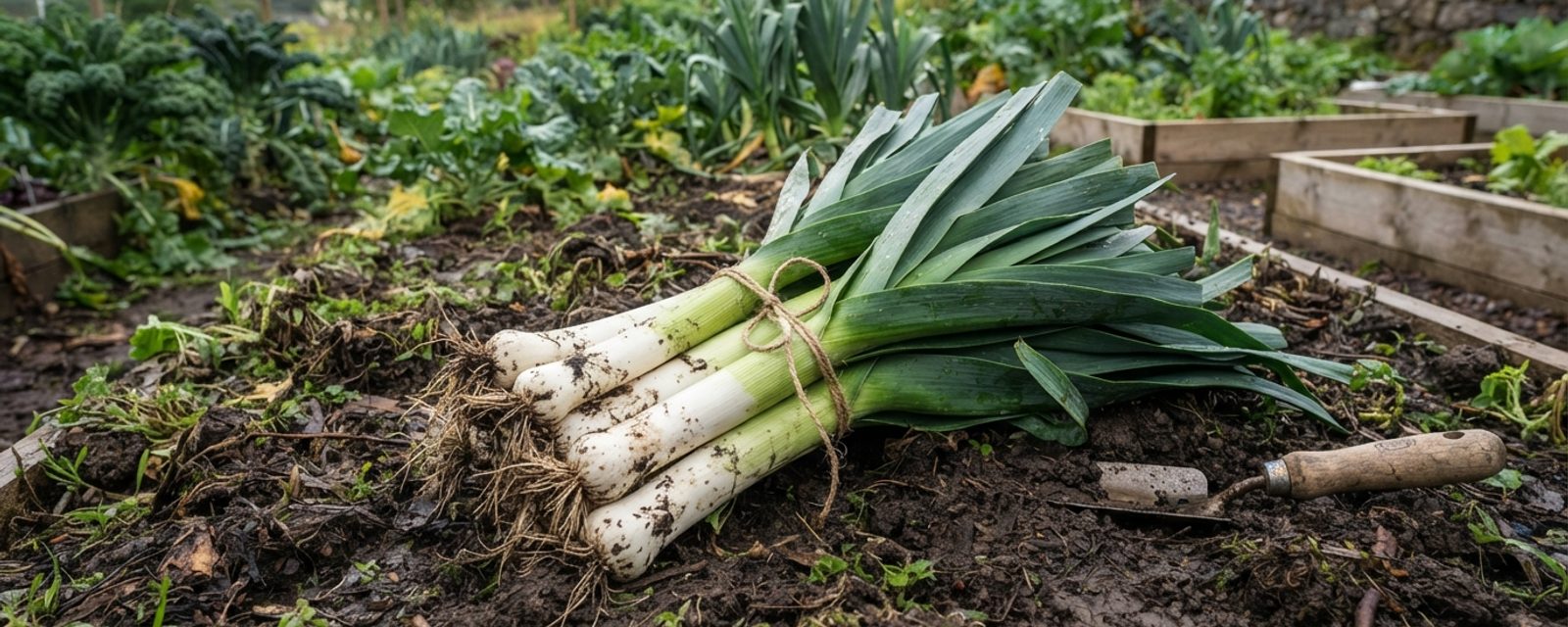
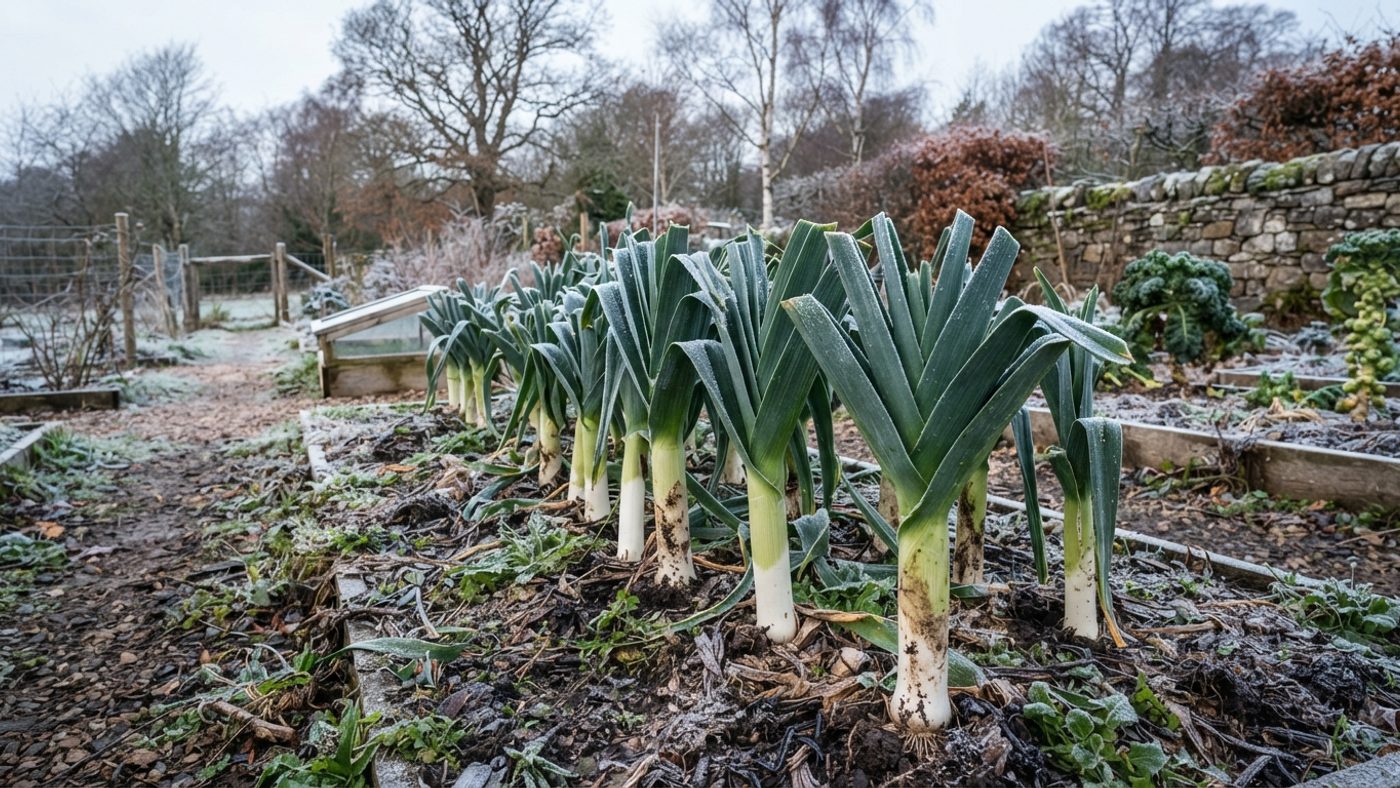
A leek is a biennialA plant that completes its life cycle over two years: growth in year one, then flowering, seeding and dying in year two. Full definition →. Left alone, it spends its first year building the thick white stem gardeners actually want, then in its second spring it boltsA plant switching early into flowering and seed production, usually triggered by stress, after which leaves, roots or bulbs turn bitter or unusable. Full page → skyward to flower and set seed. That first-year pause is what makes leeks so well suited to a Scottish growing calendar: the plant has evolved to sit through a full winter doing nothing but waiting for spring, and it does that by staying dormant in the ground rather than trying to keep growing through the cold. Frozen soil doesn't kill a leek the way it would a soft-leaved crop, the plant simply stops, insulated by its own tightly wrapped leaves and the earth around it, and resumes when temperatures allow. That's what "standing crop" means in practice: leeks left in the ground rather than lifted and stored, harvested a few at a time right through autumn, winter, and into spring.
Quick answer
For most Scottish gardens, Oarsman is the safest all-round choice: it carries the higher H5 hardiness ratingThe RHS's H1a–H7 scale for how much cold a plant can survive outdoors, H1a being tender indoor-only and H7 hardy anywhere in the UK. Full definition → and holds the RHS Award of Garden Merit (AGMThe RHS's Award of Garden Merit: a UK-wide trials award for reliable performance, not a Scotland-specific recommendation. Full definition →), giving it the widest margin against a hard winter of any variety here. Gardeners on the coldest, most exposed, or northerly plots should lean toward Bandit, also H5 and the latest-maturing of the group; those wanting an earlier crop, or gardening somewhere sheltered where full winter hardiness matters less, can do well with an H4 variety like Stamford.
Not every named leek variety is bred for the same job, though, and the differences that matter for a Scottish winter aren't always the ones seed catalogues lead with.
The six RHS-recommended varieties compared
| Variety | Hardiness | AGM | Harvest window | Notable resistance |
|---|---|---|---|---|
| Stamford | H4 | Yes | From October ("second early") | — |
| Porvite | H4 | No | Autumn to early winter | Good bolting resistance |
| Krypton | H4 | Yes | From December | Good general disease resistance; compact, upright habitA plant's characteristic shape and manner of growth, such as upright, spreading, creeping or bushy. Full definition → |
| Porbella | H4 | Yes | Mid-autumn to late winter | Stands well for several months |
| Oarsman | H5 | Yes | From October, keeps well in the ground | None specifically claimed; may be susceptible to rust like the others |
| Bandit | H5 | Yes | From January (latest of the six) | Thick, pure-white stems |
Why hardiness rating and harvest date are two different things
Two of the six, Oarsman and Bandit, are rated H5. The other four, Stamford, Porvite, Krypton, and Porbella, are rated H4. Oarsman is H5, yet its own plant page states harvest from October, the same starting month given for the H4-rated Stamford. Krypton and Porbella, both only H4, mature later than Oarsman: Krypton from December onwards, Porbella from mid-autumn through to late winter. Bandit, H5, genuinely is the latest-maturing of the six, ready from January. Hardiness rating tells you how much cold the plant is built to shrug off; maturity date tells you when it's ready to eat. Choose on both, not one as a stand-in for the other.
The standard hardiness definitions explain why the H4/H5 split matters here specifically. H4 covers -10°C to -5°C and is described as hardy through most of the UK "apart from inland valleys, at altitude and central / northerly locations." H5 covers -15°C to -10°C and is hardy through most of the UK "even in severe winters," though it may still struggle on "open or exposed sites or central / northerly locations." Inland, elevated, and northerly gardens are common across Scotland, which is a concrete reason to favour Oarsman or Bandit on a colder or more exposed plot. That doesn't make the H4 varieties unsuitable for Scotland generally; it just means the extra margin an H5 rating provides is more likely to be tested here than in a sheltered southern garden.
A Scottish heritage option: Musselburgh
Musselburgh is a heritage leek historically associated with the East Lothian town of the same name, just outside Edinburgh. Gardener's World describes it as very hardy with rust resistance. Its own plant page, though, rates it H4, the same as Stamford, Porvite, Krypton, and Porbella, and it doesn't carry the AGM. The heritage story is real and worth naming for anyone gardening near where the variety originated, but its own rating puts it alongside the H4 group rather than the higher-rated Oarsman and Bandit.
Best overall pick, and situational picks
Best overall: Oarsman. If you only grow one variety, this is it, the H5 rating means it's carrying the extra margin most Scottish sites can use, and it also holds the AGM. Worth being precise about what it doesn't offer: its own plant page names no specific rust or bolting resistance, it's listed as possibly susceptible to rust like the others, so the recommendation rests on hardiness and general merit, not disease resistance.
Most exposed or coldest sites: Bandit. Same H5 rating as Oarsman, but the latest-maturing of the six from January, so it's still standing, and still worth lifting, deep into the part of winter that does the most damage to a less hardy crop.
Earliest crop: Stamford. An H4 "second early," ready from October, for gardeners on a sheltered plot who'd rather start lifting sooner than wait out the full winter.
Sheltered gardens wanting a local story: Musselburgh. Heritage and named rust resistance, on the understanding that its rating sits with the H4 group, not the higher-rated Oarsman and Bandit.
Whichever variety you choose, allium leaf miner, onion fly, and leek moth are worth watching for alongside rust, the longer a leek stands in the ground over a Scottish winter, the longer it's exposed to all four. A very hard cold snap is still worth covering an H5 crop with fleeceA lightweight, breathable fabric laid or draped over plants to trap a little warmth and keep off frost, wind and some flying pests. Full definition → even though the rating is built for exactly that weather. Soil pH around 6.5, and a four-to-five-year gap since the bed last grew onions or leeks (against onion white rot), matter more to a good crop than the variety label does. The full growing guide has the rest of the growing steps and pest management.
Common questions
Does a higher RHS hardiness rating mean a leek matures later?
No. Rating and maturity date are separate. Oarsman is H5 but starts cropping in October, the same month as the H4-rated Stamford; Krypton and Porbella, both H4, mature later than Oarsman does.
Is an AGM the same as a Scotland-specific recommendation?
No, the AGM is a UK-wide award, not a Scotland-specific one, so it's worth checking a variety's individual hardiness rating alongside it rather than relying on the AGM alone.
Can H4-rated leeks still be grown successfully in Scotland?
Yes, on most sites. H4 is described as hardy through most of the UK, with the specific exception of inland valleys, altitude, and central or northerly locations, worth weighing against your own site before ruling an H4 variety out.
Which leek variety copes best with leek rust?
Musselburgh is the one named for rust resistance, per Gardener's World. It's worth knowing that none of the six main RHS-recommended varieties, including Oarsman, are claimed rust-resistant on their own pages; all are listed as possibly susceptible, the same as most leeks. Porvite is the one named for bolting resistance on its own plant page.
Do I need to sow different varieties at different times?
Sowing timing depends on the variety's stated season (early, second early, or late) rather than its hardiness rating, the full growing guide covers sowing dates in detail.
Sources
11 sources, recorded with what each was used for
- Leeks: grow your own: List of six recommended varieties
- Allium porrum 'Stamford': Hardiness rating, AGM, harvest window
- Allium porrum (Autumn Giant 2 Group) 'Porvite': Hardiness rating, harvest window, bolting resistance
- Allium porrum 'Krypton': Hardiness rating, AGM, harvest window, disease resistance
- Allium porrum 'Porbella': Hardiness rating, AGM, harvest window
- Allium porrum 'Oarsman': Hardiness rating, AGM, harvest window, pest/disease susceptibilities
- Allium porrum 'Bandit': Hardiness rating, AGM, harvest window
- Allium porrum 'Musselburgh': Hardiness rating, AGM status
- Hardiness rating definitions: H4 and H5 definitions
- How to grow leeks: Musselburgh hardiness and rust resistance claim
- Leek Technical Note: Soil pH target