
Allium porrum
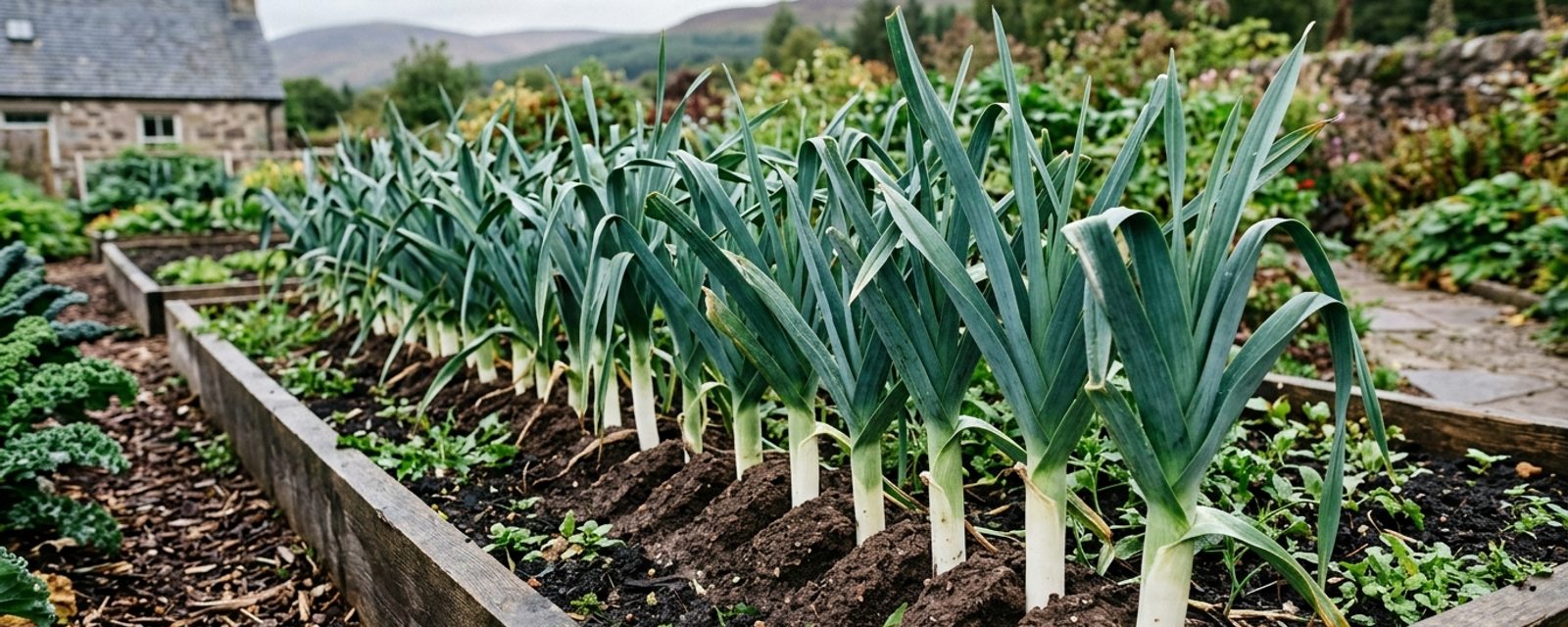
Leeks go into the ground in March and don't leave it until you lift them, sometimes out of frozen soil, the following February.
Leeks are one of the few crops that genuinely suit this climate rather than merely tolerating it. They are hardy, they stand through a Scottish winter without protection, and they crop in the months when almost nothing else does. They are also slow, occupying a bed for the best part of a year, and they have one real enemy here. Almost everything below is about making that trade work in your favour.
Why leeks suit Scotland
Scotland makes most crops harder to grow well. Leeks are the exception, and it is worth understanding why, because it changes what you should worry about.
The insect pests that trouble leek growers further south are largely warm-weather problems. Thrips, the main pest of commercial leek crops, do their worst damage in warm summers and are discouraged by rainfall. Allium leaf miner and leek moth are both far more common in England and Wales than here, and it is genuinely unclear how established either is in Scotland.
What we get instead is rust, because it is driven by leaf wetness and we have plenty of that.
Varieties
Nobody trials leeks for Scottish winters, so the pick below is our judgement, reasoning shown. These carry the RHS Award of Garden Merit, which is UK-wide and not a Scottish recommendation.
★ Our pick for Scotland
PorbellaAGM
Late
Crops October to February, with thick pure-white stems that stand for months in good condition.
Why this one: The whole reason leeks earn a bed in Scotland is that they wait in the ground through winter and get lifted as needed. Standing for months without deteriorating in good condition is precisely that job, and it is the trait that singles Porbella out here.
Also worth considering
BanditAGM
Late
Blauwgroene Winter type. Late maturing, cropping winter through spring.
OarsmanAGM
Winter
Modern British-bred F1The first-generation offspring of two specific, deliberately chosen parent plants, bred for a predictable, uniform result but not worth saving seed from. Full definition → for winter harvest, with rust and boltingA plant switching early into flowering and seed production, usually triggered by stress, after which leaves, roots or bulbs turn bitter or unusable. Full page → resistance.
Show other recommended varieties (2)
KryptonAGM
Late
Matures December onwards. Compact and upright, with good disease resistance.
StamfordAGM
Early
Early-maturing F1 with blue-green foliage.
Best Leek Varieties for Scotland → compares all named leek varieties head-to-head, with the practical detail that doesn't fit in a summary card.
The useful distinction is early against late. Early varieties tend to be taller and paler with a longer white shaft; late varieties are shorter, darker and hardier. For Scotland the late ones are usually the better buy, because standing through winter is the whole point of growing leeks here.
Soil, and the pH question
Leeks want a sunny spot and free-drainingSoil that lets water pass through quickly rather than pooling, so roots aren't sitting in wet ground after rain. Full definition → soil, with a couple of bucketfuls of garden compost or well-rotted manure worked in per square metre. Avoid ground where onions, garlic or shallots grew recently.
They are also fussier about acidity than most vegetables. Leeks prefer soil around pH 6.5, and growth becomes increasingly restricted below 5.8.
Sowing
Sow in March and April, or May and June for later-cropping varieties that stand into spring. You can start indoors from late winter for an earlier crop. Sow about 1.5cm (¾in) deep, either in a seedbed for transplanting later, or straight into the final position.
Most people use a seedbed or modulesA tray divided into small individual cells, each sown with its own seed or seedling, so each plant grows undisturbed roots until it's ready to plant out. Full definition → and move the plants later, which is the traditional approach and works well. Expect roughly eight weeks from sowing to a transplantable plant.
Those are UK-wide months. In colder parts of Scotland the later end of each window is the safer bet, though leeks are forgiving about this in a way that tender crops are not.
Transplanting and puddling in
Move plants when they are about 20cm tall and pencil thick. This is the step that produces the long white shank, and the method is unusual enough to be worth describing properly.
- Make a hole about 15cm (6in) deep and 5cm (2in) across with a dibberA simple pointed hand tool used to make a planting hole in soil, for seedlings, sets or young plants. Full definition →.
- Trim the roots back to about 2.5cm.
- Drop one leek into each hole. Do not backfillThe soil (sometimes improved with grit or compost) used to fill the gap around a plant's roots after it's placed in its planting hole. Full definition → with soil.
- Fill the hole with water. That washes just enough soil down around the roots and leaves the rest of the hole open, which is what blanches the shank.
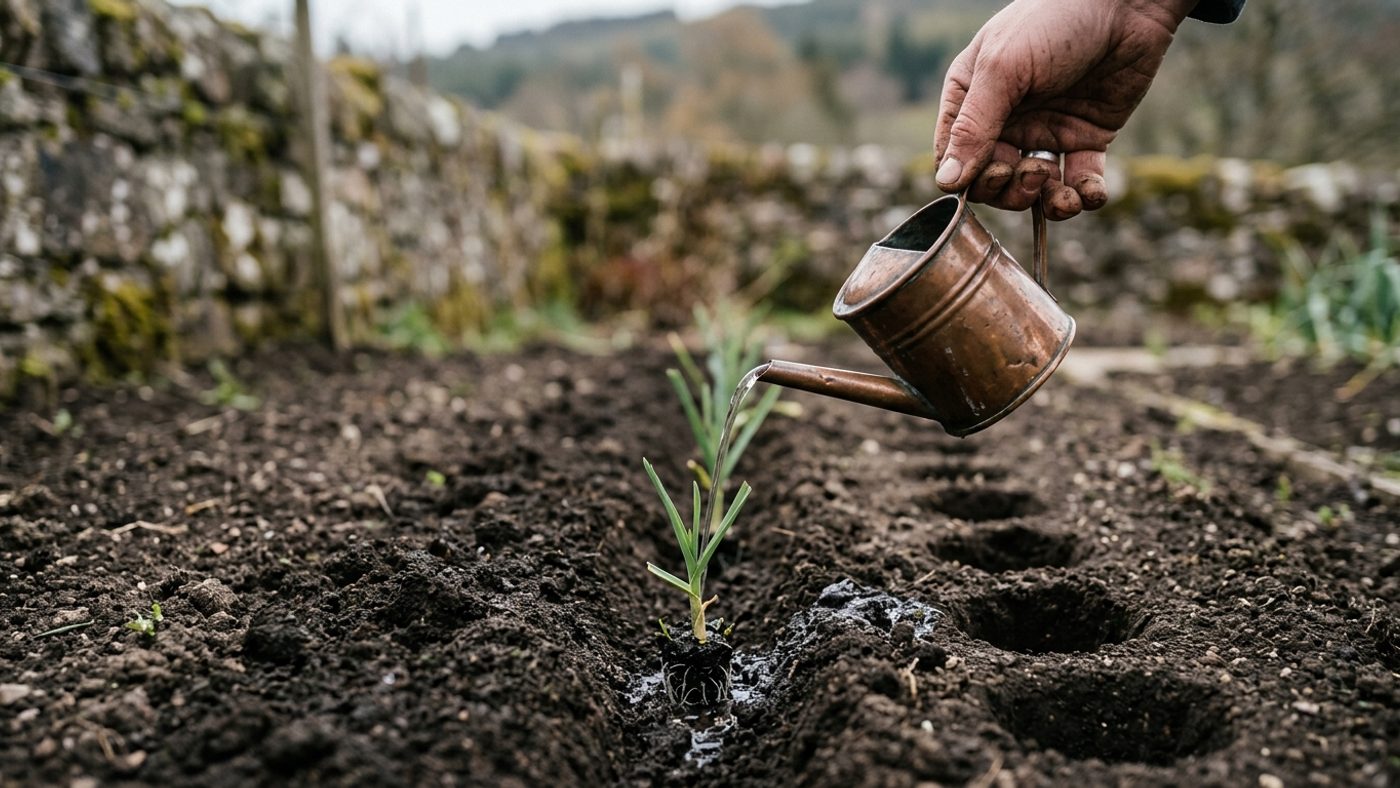
Space plants 15cm to 20cm apart depending on variety, or about 10cm for baby leeks, with rows around30cm apart.
Earthing up
Draw soil up around the stems several times as the plants grow, to keep light off the shank and lengthen the white part. Do it gradually, a little at a time.
The one thing to avoid is letting soil fall down between the leaves, which is gritty and almost impossible to wash out later. Earthing upDrawing soil up around a plant's base as it grows, most often potatoes, to keep light off developing tubers and support tall stems. Full definition → doubles as weed control and loosens the surface, so it is rarely wasted effort.
Watering and weeding
Water seedlings and new transplants until they take hold. After that, leeks only need water during prolonged dry spells, which in most Scottish summers means rarely. Containers are the exception and need watering across the season.
Keep water off the foliage where you can. Wet leaves are what rust needs, and in a climate that supplies plenty of leaf wetness for free, there is no reason to add more.
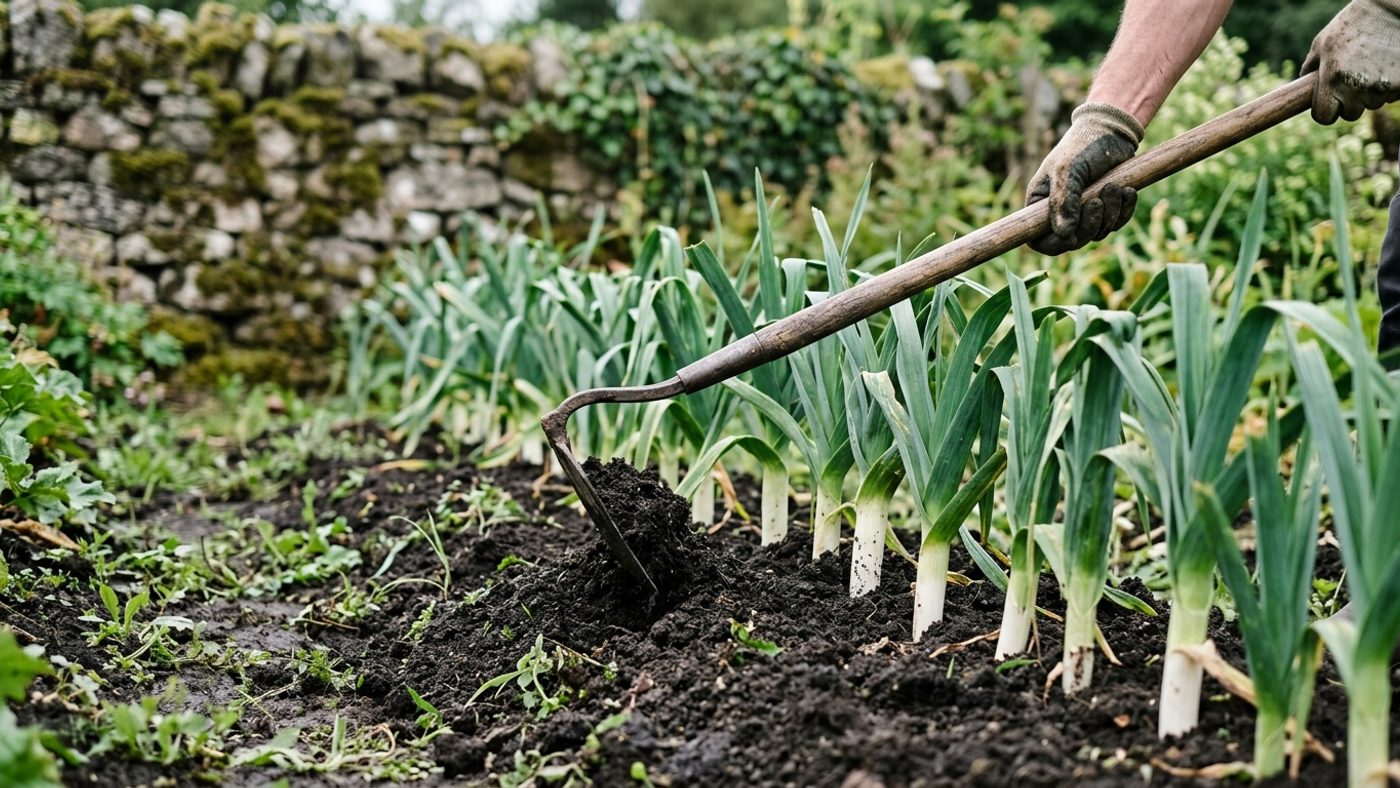
Hoe between the rows, but weed by hand close to the plants. Leek stems bruise easily and damage lets rot in.
Organic and Legal Weedkillers: What Actually Works → weighs up hoeing, mulchingA layer of material spread over the soil around plants to suppress weeds, retain moisture, and improve soil structure as it breaks down. Full definition → and the chemical options against each other for anyone wanting more than hand-weeding between rows.
Leek rust, the one that will find you
Bright orange pustules on the leaves are leek rust. In Scotland you should expect it rather than hope to avoid it, and knowing how it behaves takes most of the sting out.
- It infects best between 10 and 18°C, which is most of a Scottish summer.
- August to October are the worst months, exactly when leeks are bulking up here.
- Frost knocks it back, so winter works in your favour.
- It is not in your soil. It survives only on living green tissue, which means it carries over on standing crops rather than lurking in the ground.
That last point is the useful one. Because leeks are in the ground almost year-round, one season's crop hands the rust straight to the next. Clearing old plants promptly, rather than leaving a few standing out of habit, breaks that chain. Give plants enough room for air to move between them, keep the foliage dry, and remove badly affected leaves.
Rust is usually disfiguring rather than fatal. A rusty leek is still a perfectly good leek once the worst leaves are stripped off.
Rotation
Keep alliums moving around the plot, and allow four to five years before onions, garlic, shallots or leeks return to the same ground. That is a longer gap than the usual four-year convention, and it exists because the diseases that matter here sit in the soil for years once introduced.
Onion white rot is the reason. It persists in soil for a very long time and there is no treatment for it, so keeping it out is the whole game. Leeks are less susceptible to it than onions are, which is a small mercy rather than a reason to relax.
Harvesting
Baby leeks are ready in a couple of months. Full-sized leeks take about six months, and you can start lifting from late summer while they are still small to spread the crop out.
Lift them gently with a fork rather than pulling, because the shank snaps more easily than you would think. Late varieties can be left standing through winter into spring and lifted whenever you want them. There is no need to store leeks: the garden is the store, which in February is worth a great deal.
Garden crops that are toxic to dogs → covers leeks and the rest of the allium family, which stay dangerous to dogs whether raw, cooked or dried, so trimmings are worth keeping out of reach as much as the crop itself.
Common problems
- Leek rust is the main one here, covered above.
- Bolting means the plant runs to flower and the shank goes woody. Usually a response to stress or a cold check after transplanting.
- Onion fly maggots can kill seedlings outright and damage the roots and shank of mature plants. Insect-proof mesh over the row is the real defence.
See more problems
- Onion white rot persists in soil for many years and cannot be treated. Rotation is the only real defence.
- Allium leaf miner and leek moth are serious problems in England and Wales. How far either is established in Scotland is genuinely unclear, so we would not fit mesh against them here without seeing damage first.
Common questions
Why do my leeks get orange spots every year?
That is leek rust, and in Scotland it is close to unavoidable rather than a sign you did anything wrong. It infects best between 10 and 18°C, which describes most of a Scottish summer, and August to October are the worst months for it, which is exactly when leeks are bulking up here. The good news is that it is disfiguring more often than fatal. Keep picking off badly affected leaves, give plants room so air moves between them, and carry on. Frost knocks it back.
Is there a rust-resistant leek variety?
Our sources disagree, which is worth knowing before you spend money on one. RHS lists Oarsman as having rust resistance. Teagasc, whose technical note covers commercial leek growing, says plainly that there are no resistant varieties, only ones that vary in how badly they get it. Both can be true if resistance means "gets it less" rather than "never gets it". Either way, do not expect a variety to solve rust on its own.
Do leeks need a particular soil pH?
They prefer around 6.5, and growth is increasingly restricted below 5.8. This matters more in Scotland than almost anywhere else, because our soils are naturally acidic and a lot of gardens sit below that mark without the owner knowing. Leeks are one of the few crops where a cheap soil test is genuinely worth doing before you plant.
What is puddling inFilling a planting hole with water and letting it drain away before or after planting, to settle soil firmly around the roots and remove air pockets. Full definition →, and do I have to do it?
It is worth doing: dropping seedlings into a dibbed hole and watering them in, rather than earthing up later, blanches the shank just as well without soil getting between the leaves. Full sourced breakdown: <a href="/tools/garden-myths/leeks/">Leek Myths →</a>
How long can I leave leeks in the ground?
As long as you like through autumn and winter: leeks stand in the ground without going woody or splitting, though the last ones should come out by March before they run to seed. Full sourced breakdown: <a href="/tools/garden-myths/leeks/">Leek Myths →</a>
Sources
2 sources, and what each was used for
- RHS: sowing months, 1.5cm depth, transplant trigger and 15cm holes, spacing 15-20cm, rows 30cm, harvest timing, AGMThe RHS's Award of Garden Merit: a UK-wide trials award for reliable performance, not a Scotland-specific recommendation. Full definition → varieties
- Teagasc: soil pH around 6.5 and restricted growth below 5.8, 4-5 year allium rotation, leek rust infection temperature 10-18C and Aug-Oct peak, rust not soil-borne but carried over on standing crops, no fully rust-resistant varieties, thrips worst in warm summers and discouraged by rainfall