
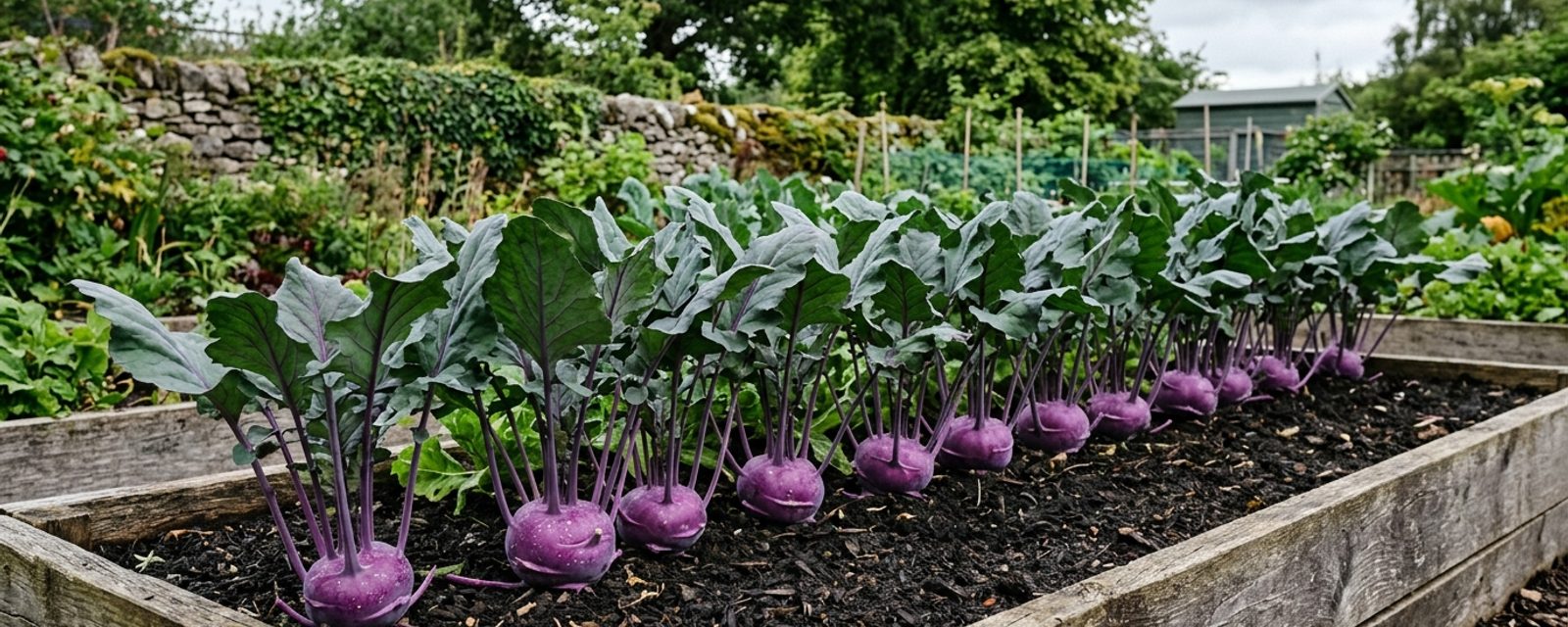
Kohlrabi rewards Scottish growers with one of the fastest turnarounds in the brassicaThe cabbage family: cabbage, kale, broccoli, cauliflower, Brussels sprouts, kohlrabi, swede, turnip and more, sharing the same pests, diseases and rotation rules. Full definition → bed, but the four varieties worth growing here behave differently enough that picking the wrong one costs you a boltedA plant switching early into flowering and seed production, usually triggered by stress, after which leaves, roots or bulbs turn bitter or unusable. Full page → or woody crop. Kolibri, Olivia, Korist and Kossak are the varieties that matter for Scottish gardens, three hold the RHS Award of Garden Merit, one doesn't, and each has a distinct trait that decides when it earns a place in the plot.
Quick answer
For most Scottish gardens, Olivia is the best overall pick, its bolt-resistance and mildew tolerance suit the unpredictable spring swings that trigger premature flowering in this climate. Choose Korist instead if you want the earliest possible sowing with good holding time once mature, or Kossak if you want a genuinely larger kohlrabi and are prepared to sow it later and wait the extra weeks.
Why variety choice matters more for kohlrabi than most brassicas
Kohlrabi is unusual among brassicas in how narrow its harvest window is. Get the timing wrong and you're dealing with one of two failure modes: the plant bolts before the stem swells properly, or the stem swells past its best and turns woody and bitter. Both are timing problems, and both are affected by which variety you're growing, not just by sowing date. The growing guide covers the sowing calendar, spacing and general technique.
The four varieties, head to head
| Variety | AGMThe RHS's Award of Garden Merit: a UK-wide trials award for reliable performance, not a Scotland-specific recommendation. Full definition → | Hardiness | Skin colour | Weeks to maturity | Standout trait |
|---|---|---|---|---|---|
| Kolibri | Yes | H3The RHS's H1a–H7 scale for how much cold a plant can survive outdoors, H1a being tender indoor-only and H7 hardy anywhere in the UK. Full definition → | Purple | ~8 | Fastest to size; bitter if left past maturity |
| Olivia | Yes | H3 | Green | ~8–10 | Slow to bolt; tolerant of mildew and other fungal disease |
| Korist | Yes | H3 | Green | ~8–10 | Long holding ability; resists downy mildew; suited to early sowings |
| Kossak | No | H5 | Pale green | ~12 | Grows notably larger; hardier rating than the other three |
H3 means hardy in coastal and relatively mild parts of the UK, tolerating down to around -5°C. H5 is a step up, hardy through most of the UK even in a severe winter. None of these four is grown as a crop you overwinterKeeping a plant alive and intact through the cold months, whether left outdoors, moved under cover, or stored dormant. Full definition →, so the rating isn't about surviving a hard winter, it's about how well the young plant shrugs off an unexpected cold snap after you've put it out. Kossak is the outlier on that scale, worth knowing if you garden somewhere exposed, an upland plot, an east-coast garden that catches a late cold snap, or anywhere on the west coast or islands where an unseasonal frost can still land after the other three have already gone in.
Kolibri: fastest, but don't leave it
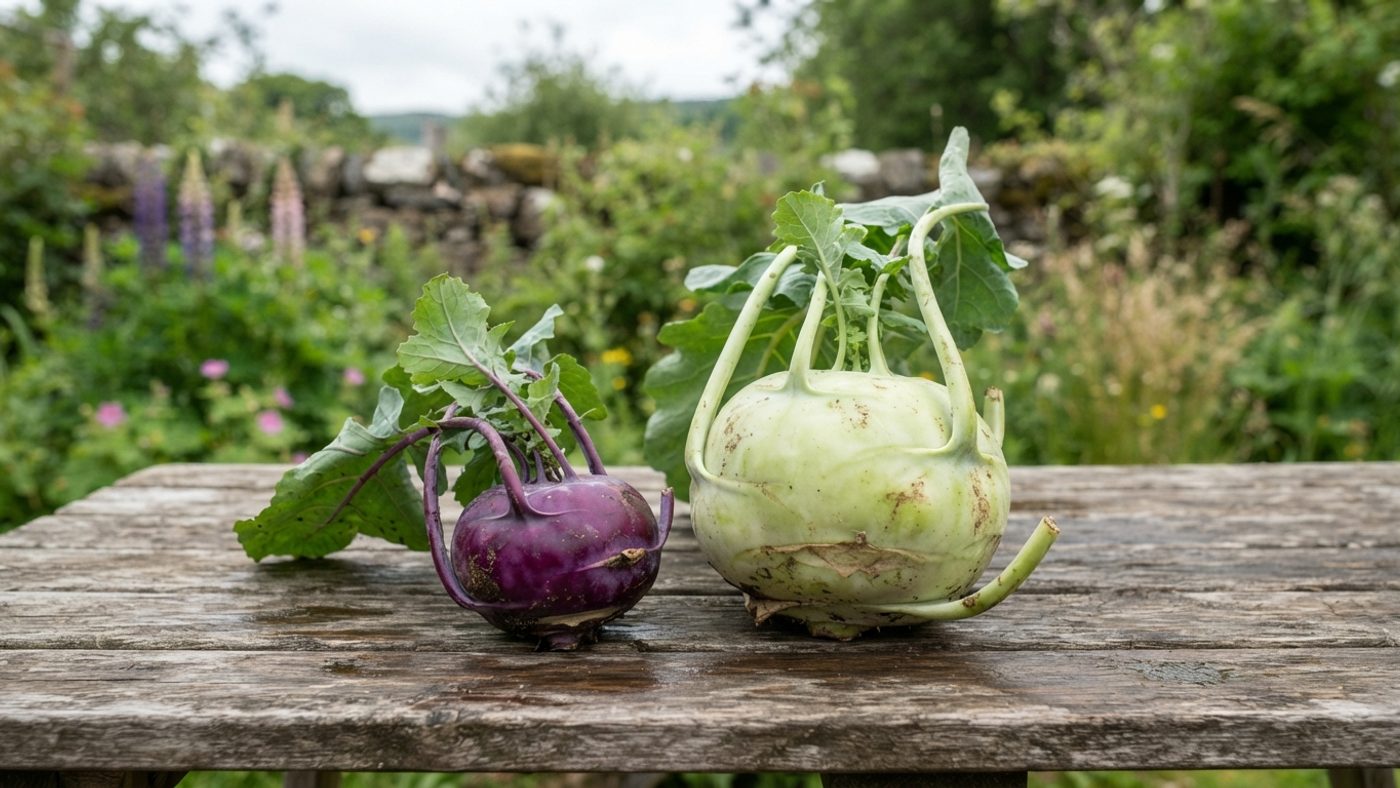
Kolibri is the compact purple-skinned variety with white, succulent flesh, ready in under eight weeks, which makes it the quickest of the four to a usable harvest. The trade-off is that it needs harvesting and eating young: left on the plant past that point, the stem turns bitter, not just woody. That's a sharper failure mode than the usual "goes tough" warning attached to kohlrabi generally, so Kolibri suits gardeners who check the plot regularly and pick promptly rather than those sowing and leaving it.
Olivia: built for unstable spring weather
Olivia carries a green skin, white flesh, and a small globe shape with upright dark-green leaves. Its distinguishing feature is that it's slow to bolt and has strong tolerance of mildew and other fungal diseases, a pairing of two separate traits, not one general "hardy" quality, and a useful one specifically because Scotland's damp growing conditions are what push mildew pressure up in the first place.
That combination matters in Scotland because kohlrabi is a fast, cool-season crop, and the unstable temperature swings common in a Scottish spring, a mild week followed by a cold snap, are exactly the conditions that push brassicas into premature flowering. Olivia's bolt-resistance is a direct answer to that risk, which is why it's the default pick here rather than a niche one. It also suits successional sowingSowing a small batch of seed every couple of weeks, rather than all at once, so crops mature in a staggered sequence instead of a single glut. Full definition → at roughly three-week intervals if you want a continuous supply rather than one glut. See the bolting page for what triggers it and how to reduce the risk further, and downy mildew for the disease side.
Korist: earliest sowings, longest holding
Korist is a green, globe-shaped variety with white flesh described as juicy and mildly sweet. Two things set it apart: it's suited to early sowings, and it has a long holding ability, meaning it stays usable for longer after reaching size, without the rapid decline into woodiness that affects most kohlrabi within days of hitting the golf-to-tennis-ball mark. It also shows good resistance to downy mildew, the fungal disease that mottles and browns brassica leaves in damp weather.
That holding ability is a genuinely useful trait that's easy to undervalue: it buys slack if you can't harvest the moment the crop is ready, which is common when a wet week keeps you out of the garden. Combined with its suitability for early sowing, Korist is the strongest pick if you want to get a crop in the ground as soon as conditions allow and don't want to be racing the calendar to harvest it before it toughens.
Kossak: the one without AGM, and the one that grows biggest
Kossak is a large, fast-growing kohlrabi with pale green skin and a mild taste, taking around three months to mature, noticeably slower than the other three, and worth checking against your own local season length: three months from an early-summer sowing is comfortable in most of lowland Scotland, but leaves less margin further north or at altitude if the sowing gets delayed. It's also rated H5, a full step hardier than Kolibri, Olivia and Korist's shared H3 rating.
Kossak does not currently hold the RHS Award of Garden Merit. The recommended-varieties list tags Kolibri, Korist and Olivia each with "AGM" directly after the name, and lists Kossak with no such tag at all. It's still worth growing for its size and hardiness rating.
Separately, seed catalogues commonly describe Kossak as able to size up without turning woody the way most kohlrabi does at that size, that claim doesn't appear on Kossak's own RHS plant page, so treat it as a widely repeated trade characteristic rather than an RHS-verified one.
Which one for your situation
Sticking with Olivia as the default still leaves real cases where a different variety earns its place:
- Choose Korist if sowing time matters more than speed, its long holding ability means a late harvest doesn't punish you the way it would with Kolibri.
- Choose Kossak if size is the goal and you're gardening somewhere exposed enough that the extra hardiness is worth the wait.
- Choose Kolibri if speed matters more than anything else and you're confident you'll be there to harvest on time, it has the least margin for error of the four.
Seedling stage: the same pest risks across all four
None of these traits change how vulnerable young plants are before they're established. Slugs go for kohlrabi seedlings hard in Scotland's wetter beds, and flea beetle riddles young leaves with small holes in warm, dry spells, both are worth guarding against from sowing regardless of which variety you've chosen. The full growing guide covers mesh and other seedling protection.
Storage and soil pH
None of the four keeps particularly well once pulled, kohlrabi is a fairly short-lived harvest crop rather than a store, and the trimmed leaves in particular should be cooked the same day rather than kept. Korist's long holding ability is about how long the bulb stays good in the ground before it turns woody, not fridge or store life after picking.
On soil, guidance is to lime if pH falls below 6, to deter clubrootA soil-borne fungal disease of the brassica family that swells and distorts roots, and survives in soil for years. Full definition →, the soil-borne disease that swells and distorts brassica roots and has no chemical treatment once established, no exact target pH range is given beyond that threshold. Worth checking rather than assuming: Scotland's naturally higher rainfall and underlying geology leave a lot of garden soil on the acidic side to begin with, so this is one liming check worth actually doing rather than skipping. See the clubroot page for the wider disease picture and liming approach.
If you're short on decent garden soil, all four varieties are compact enough to grow well in a large pot or raised bed, which sidesteps a poor-soil, high-clubroot-risk plot entirely.
Common questions
Which kohlrabi variety is best for a short Scottish growing season?
Kolibri, at under eight weeks to maturity, is the fastest of the four, useful if you're working a short window, but it needs harvesting promptly once ready, as it turns bitter if left.
Does Kossak really not have the RHS Award of Garden Merit?
Correct. Kossak's own RHS plant page doesn't state AGM, and the RHS's recommended-varieties list tags Kolibri, Korist and Olivia with AGM but leaves Kossak untagged. It's still a distinct, useful variety for its size and H5 hardiness rating, it just isn't an AGM holder.
Which variety is least likely to bolt?
Olivia is specifically described as slow to bolt. That doesn't remove the need for consistent watering, though, drought stress triggers bolting in any kohlrabi variety, Olivia included, so bolt-resistance buys margin rather than a guarantee.
What's the difference between purple and green kohlrabi varieties here?
Of the four, Kolibri is purple-skinned and the other three (Olivia, Korist, Kossak) are green or pale green. The purple/green split loosely tracks speed and hardiness in wider kohlrabi breeding, but among these four it's Kossak's H5 rating and Kolibri's speed that matter more than skin colour alone.
Can I sow all four varieties in the same plot?
Yes, since they mature at different rates (Kolibri fastest, Kossak slowest) and Korist tolerates earlier sowing, staggering these four is an effective way to spread harvests rather than getting a single glut.
Sources
6 sources, recorded with what each was used for
- Brassica oleracea (Gongylodes Group) 'Kolibri': Hardiness rating, description, maturity time, bitterness-at-maturity warning
- Brassica oleracea (Gongylodes Group) 'Olivia': Hardiness rating, description, bolt-resistance and mildew/fungal disease tolerance
- Brassica oleracea (Gongylodes Group) 'Korist': Hardiness rating, description, downy mildew resistance, long holding ability
- Brassica oleracea Gongylodes Group 'Kossak': Hardiness rating (H5), description, maturity time; confirms no AGM badge on this specific page
- How to grow Kohl rabi: Recommended-varieties list with AGM tags, confirming Kossak is the one variety left untagged; soil pH/liming guidance for club root
- Fact file: kohlrabi: General growing corroboration (harvest size, maturity window, bolting risk from dry spells)