
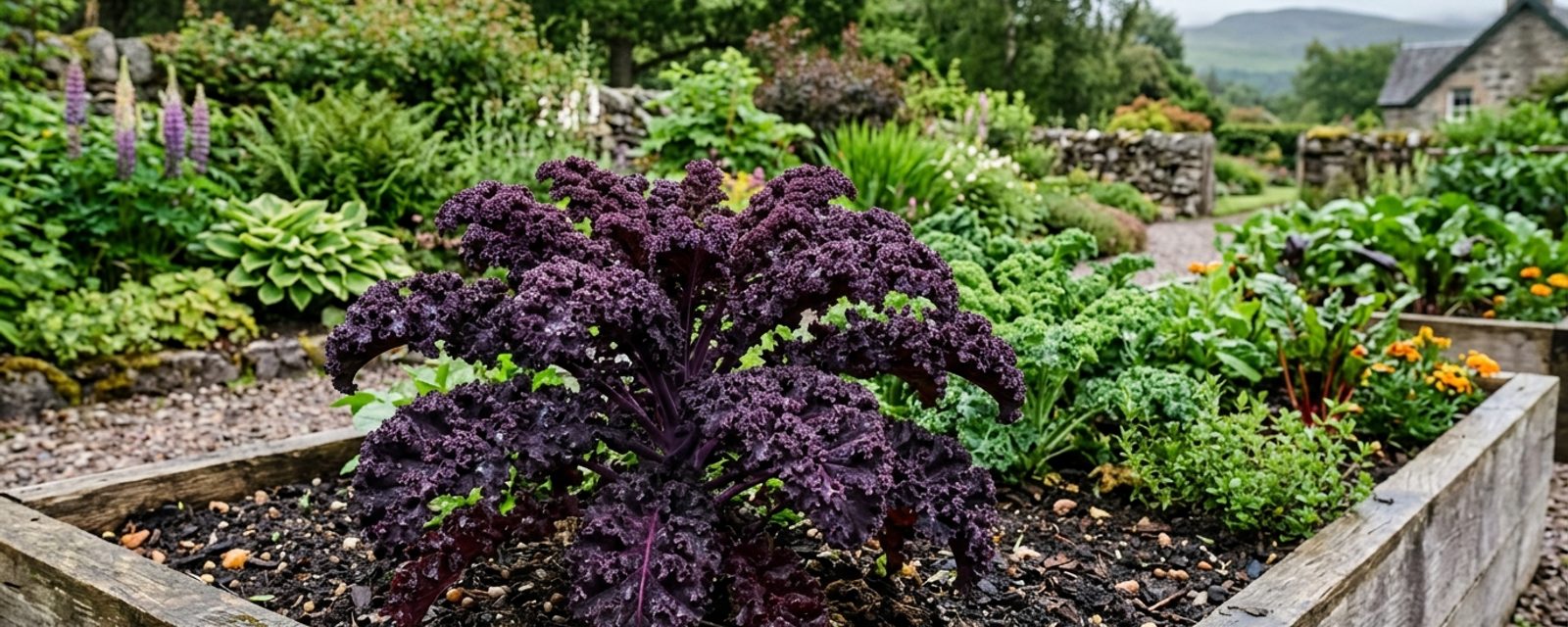
Kale survives what kills most vegetables outright: hard frost, driving sleet, weeks of grey daylight. The reason sits in the leaf itself. As temperatures drop, kale plants convert stored starches into sugars, which lowers the freezing point of the fluid inside their cells and prevents the ice-crystal damage that ruptures cell walls in more tender crops. This is also why kale tastes sweeter after a frost, the same physiological response that keeps it alive concentrates sugars in the leaf. It's a genuinely useful trait on a Scottish plot, where the growing season narrows fast after October and a crop that gets better in the cold, rather than merely tolerating it, is worth planning a bed around. Cold, wet ground in March often makes modulesA tray divided into small individual cells, each sown with its own seed or seedling, so each plant grows undisturbed roots until it's ready to plant out. Full definition → under cover the better start here, ahead of the outdoor sowing window that runs to June; once plants are in the ground, the question that matters most is which variety to buy.
Quick answer
For most Scottish gardens, Starbor is the best all-round choice: its compact 40cm x 45cm habit shrugs off wind that would flatten taller varieties, and it needs no staking. On a sheltered plot with more space, Redbor or Reflex will give a taller, more dramatic crop, but Redbor specifically needs that shelter, it's the one variety with a stated shelter requirement, unlike Reflex. If you want the longest possible picking window, Reflex runs from October through February.
Why "hardiest" isn't the right question
All four kale varieties carrying the RHS Award of Garden Merit (AGMThe RHS's Award of Garden Merit: a UK-wide trials award for reliable performance, not a Scotland-specific recommendation. Full definition →), Redbor, Reflex, Starbor and Yurok, carry the same hardiness ratingThe RHS's H1a–H7 scale for how much cold a plant can survive outdoors, H1a being tender indoor-only and H7 hardy anywhere in the UK. Full definition →: H5, hardy in most places throughout the UK even in severe winters, down to -15°C. None is hardier than the others on paper, so picking between these four on hardiness alone isn't a real decision.
What does separate them is habit and exposure tolerance, and this is where a Scottish plot actually needs to think differently than a sheltered southern English garden. Redbor and Reflex both reach 0.5–1m in height, tall enough to catch serious wind, and Redbor's own listing specifies a sheltered position, a real constraint on an open site. Reflex reaches the same height but carries no such shelter requirement on its own page. Starbor, by contrast, tops out at around 40cm, low enough to avoid wind-rock: the taller stem working loose at the roots and letting rot into the base over a winter of gales, a real risk on exposed sites and one already worth staking against in the full growing guide.
One variety does differ on hardiness, but it isn't among the AGM four. Nero di Toscana (cavolo nero) is rated H4, "hardy through most of the UK (-10 to -5)", a genuine step down from the H5 varieties' -15 to -10°C, and it doesn't carry the AGM at all. Choose it for its flat, dark leaves and flavour, not for winter toughness.
The four AGM varieties compared
| Variety | Height/spread | Hardiness | Needs shelter? | Main pest/disease risks | Best for |
|---|---|---|---|---|---|
| Starbor (AGM) | ~40 x 45cm | H5 | No | Caterpillars, whitefly, flea beetle, no fungal diseases listed | Exposed sites, containers |
| Redbor (AGM) | 0.5–1m tall | H5 | Yes (RHS-specified) | Downy mildew, grey mould, leaf spot, all diseases that need damp to take hold | Sheltered gardens, height and colour |
| Reflex (AGM) | 0.5–1m tall | H5 | No | Wider pest list (incl. swede midge, gall weevil), plus the same damp-favoured diseases as Redbor | Longest picking window, moderate exposure |
| Yurok (AGM) | Short, compact rosettes | H5 | No | Broadest pest and disease list of the four | Small spaces, Sept–Feb harvest |
| Nero di Toscana (cavolo nero) | Upright, not compact | H4, a step down from the others | Not stated | No specific pests/diseases listed | Cooking flavour and texture over habit |
The best overall pick: Starbor
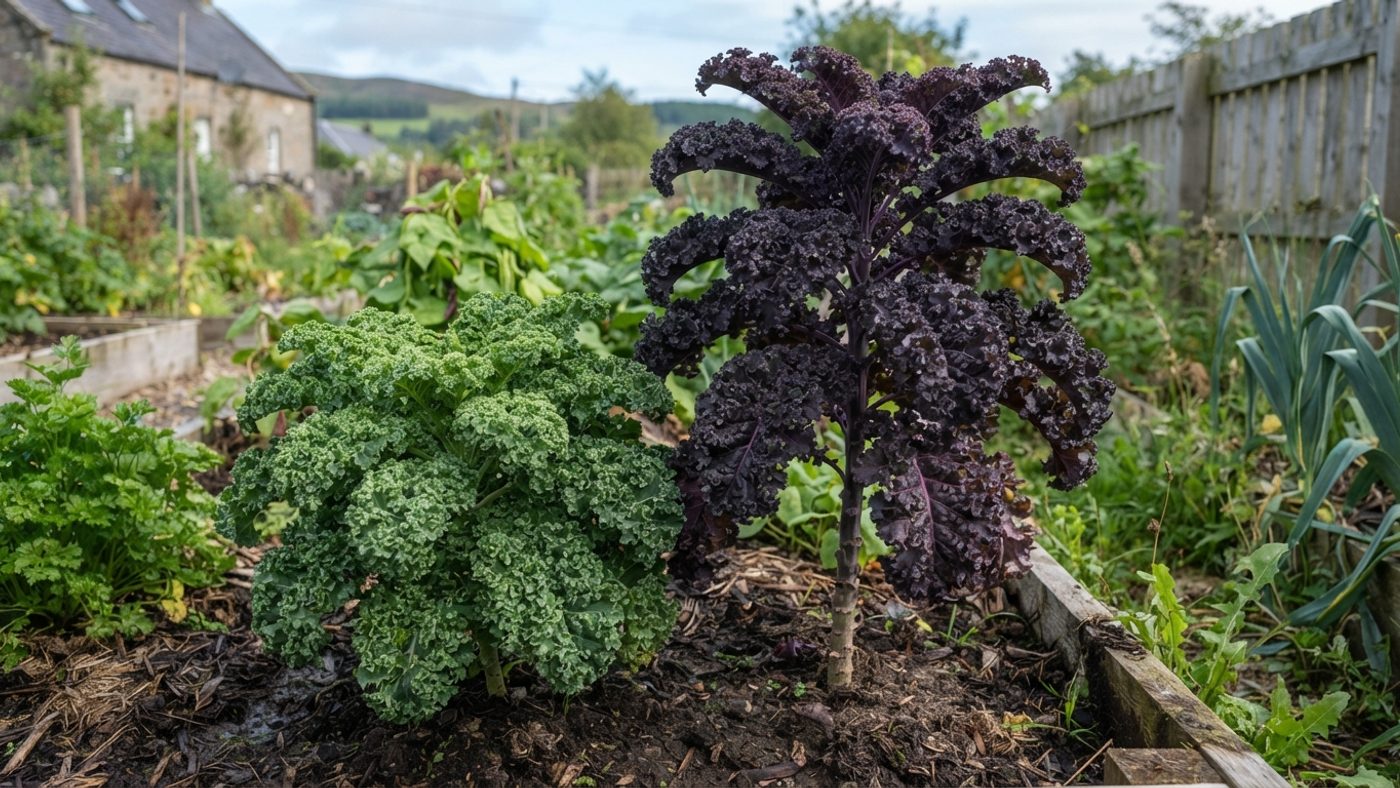
Starbor's biggest advantage isn't wind alone, its susceptibility list is the shortest of the four (no disease list at all, versus six or more entries each for Redbor, Reflex and Yurok), and it's the only one of the four named as suited to container growing, useful if bed space is tight. That combination of a shorter pest list, no staking, and pot suitability makes it the lowest-maintenance option for a typical Scottish garden that isn't fully walled or hedge-sheltered.
When a different variety wins
- Sheltered garden, more space, want height and drama: Redbor's dark red-purple curled leaves and taller habit make sense once its shelter requirement is met, a walled garden, a spot behind a hedge or fence line.
- Want the longest continuous harvest: Reflex is pickable from October to February as baby leaf or mature leaves, the longest stated window of the four, and doesn't carry Redbor's shelter requirement despite similar height.
- Small space, want a tidy curly-leaf plant that isn't Starbor: Yurok gives short, uniform rosettes and a September-to-February harvest window.
- Cooking traditional Tuscan or Italian dishes: Nero di Toscana (cavolo nero) is the standard choice, not AGM, but a genuinely different leaf type worth choosing for flavour and texture rather than hardiness.
- Wanting an ornamental or heirloom leaf outside the AGM four: types such as Ragged Jack (red-tinged, self-seeds) and Scarlet Curled (turns violet-red after frost) aren't AGM holders, so treat any hardiness or disease claims for them as unverified rather than assume they match the four compared here.
Why the harvest window matters as much as the variety
Kale's real job in a Scottish garden is filling the hungry gap: the stretch from late winter into early spring when little else in the plot is ready to pick. Reflex's October-to-February window and Starbor's mid-autumn-to-late-spring side-shoot harvest both extend a plant's useful life deeper into that gap than a single autumn crop would. None of the four runs indefinitely, though, all of them bolt and run to flower as the days lengthen and warm in spring, which is what ends the side-shoot harvest rather than the plant simply stopping.
Exposure is also a site-by-site question, not just a Scotland-wide one: a walled town garden and an open hillside plot need different answers even a few miles apart, so the shelter each variety needs above is worth checking against your own ground rather than assumed from the district.
What Scotland's climate actually changes
Scotland's cooler summers hold down cabbage aphid and cabbage root fly, which the growing guide already flags as harder-hitting further south, and kale here matures more slowly and steadily rather than racing through growth stages. Flea beetle needs warm, dry, still weather to shred seedling leaves, and a wet Scottish spring knocks it back before it gets going, so the real risk is a short dry spell rather than the whole season. That means the pest lists in the table above are a ceiling, not a guarantee: expect lighter pressure in practice than any single variety's own listing suggests on its own. Clubroot is the exception, none of the four AGM varieties is noted as clubrootA soil-borne fungal disease of the brassica family that swells and distorts roots, and survives in soil for years. Full definition →-resistant, so the choice of variety doesn't change that risk; drainage and liming, covered in the full kale growing guide, are what actually help. Slugs and pigeons round out the pests worth planning for regardless of variety, and netting steps for both are in the same guide.
Common questions
What is the hardiest kale variety for Scotland?
Redbor, Reflex, Starbor and Yurok are all rated H5, so none is officially hardier than the rest. Nero di Toscana is the one named exception, at H4.
Does kale need staking in Scotland?
Tall varieties can, in exposed positions. Redbor and Reflex both reach 0.5–1m, and Redbor's own page specifies it needs a sheltered spot. Compact varieties like Starbor, at around 40cm, generally don't need staking.
Can I grow kale in containers in Scotland?
Yes, Starbor is the one specifically named for it, and it can be grown indoors for baby leaves as well as outdoors in a pot.
Which kale variety has the longest harvest season?
Reflex, picked from October through February as either baby leaf or mature leaves. Yurok runs September to February. Starbor can be harvested from mid-autumn through late spring via side shoots after the main crownThe base of a perennial plant where roots and shoots meet, often sold and planted as a ready-made dormant plant rather than grown from seed. Full definition → is cropped.
Is cavolo nero (Nero di Toscana) hardy enough for Scotland?
It's hardy, but genuinely less so than the four AGM varieties: it's rated H4, "hardy through most of the UK (-10 to -5)," against their H5 down to -15°C. It's also not an AGM holder. Grow it for the flat, dark leaves and flavour rather than as a like-for-like swap for winter toughness.
Sources
9 sources, recorded with what each was used for
- Kale: Grow Your Own: List of recommended varieties and confirmation of which carry the AGM
- Brassica oleracea 'Redbor': Hardiness rating, height/spread, position/exposure, disease susceptibility, description
- Brassica oleracea 'Reflex': Hardiness rating, height/spread, position/exposure, pest and disease susceptibility, harvest window
- Brassica oleracea 'Starbor': Hardiness rating, height/spread, pest susceptibility, harvest method
- Brassica oleracea 'Yurok': Hardiness rating, habit description, pest and disease susceptibility, harvest window
- Brassica oleracea 'Nero di Toscana': Hardiness rating (H4), AGM status, description
- How to Grow Kale: Named varieties (Cavolo Nero, Black Tuscany, Ragged Jack, Scarlet Curled, Dwarf Green Curled) as recognised alternative kale types
- Organic Vegetable Production in Scotland (SAC/SRUC Technical Note T488): Lower incidence of cabbage aphid and cabbage root fly, and slower, steadier maturity, in Scotland's cool summers
- Pest management in vegetables and forage brassicas: Flea beetle activity requiring warm, dry, still weather and being knocked back by rain