
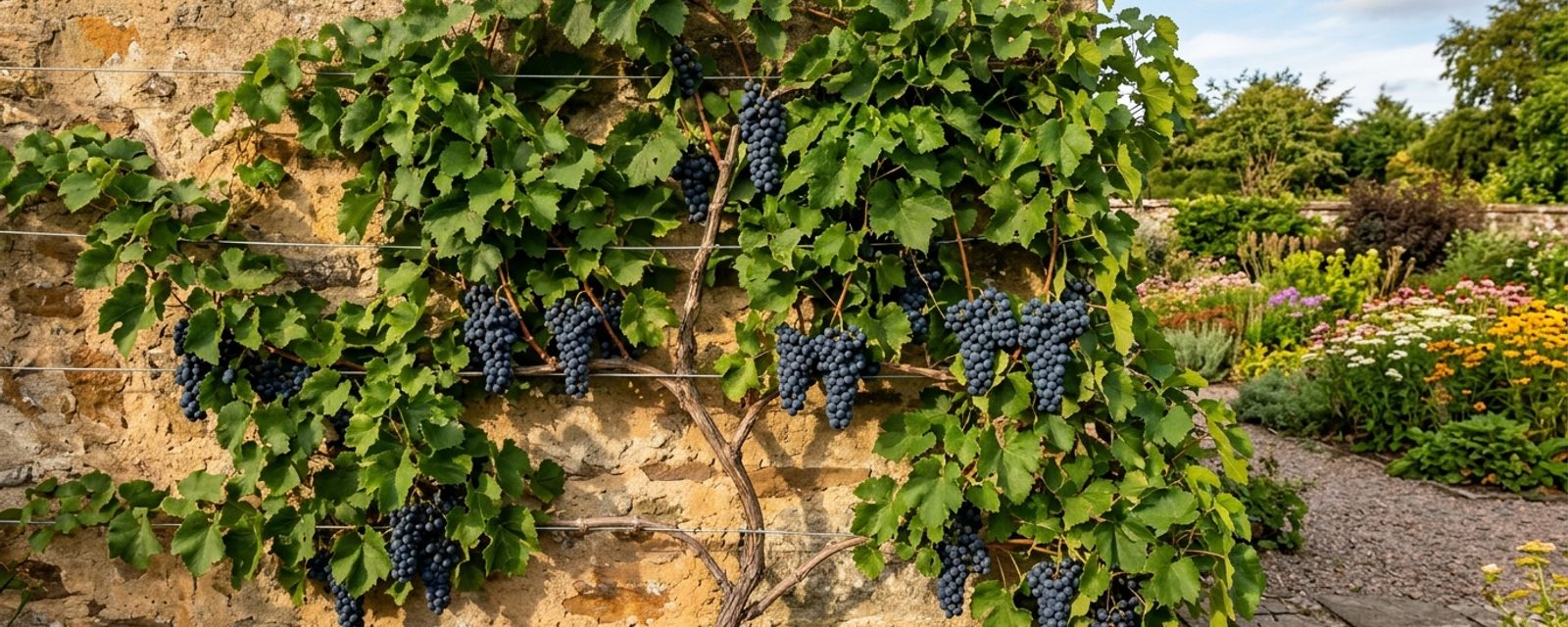
Grapes split into two genuinely different projects depending on what you're planting against. Five Award of Garden Merit (AGMThe RHS's Award of Garden Merit: a UK-wide trials award for reliable performance, not a Scotland-specific recommendation. Full definition →) varieties are named on the main grapes guide, Sovereign Coronation, Reliance, Schuyler, Lakemont and Muscat of Alexandria, and on paper all five sit on the same "greenhouse or a warm wall" page. Look at each variety's own individual plant page, though, and three of the five carry the "suitable for outdoor cultivation" classification, not the greenhouse-only tag the summary page's framing implies. A separate page recommends three more varieties specifically for growing outdoors, Phoenix, Pinot Noir and Siegerrebe, and two further varieties, Rondo and Solaris, don't appear on either summary list page at all, only on their own individual plant pages, where Rondo is called "suited for outdoor cultivation in northerly gardens."
Quick answer
Rondo is the strongest all-round pick for an open, outdoor Scottish site, the only variety named for "northerly gardens" specifically. Solaris and Reliance are close seconds outdoors, both early-finishing enough to beat a short season. Sovereign Coronation and Muscat of Alexandria are the two genuinely greenhouse-committed AGM varieties; grow either only if you have glass or a heated conservatory, not open ground.
A vine's own growing guide covers site, spacing (1.2–1.5m for a single vine against a wall), training and pruning in full, and gives Rondo as its lead pick, expect a first proper crop from year three or four, not sooner, whichever variety is chosen. Below is the full ten-variety comparison behind that pick, plus five further outdoor options named by Gardener's World that RHS doesn't cover at all.
Every variety here shares the same H5 hardiness ratingThe RHS's H1a–H7 scale for how much cold a plant can survive outdoors, H1a being tender indoor-only and H7 hardy anywhere in the UK. Full definition →, the scale for how cold a dormant, leafless vine survives in winter (down to -15°C to -10°C, colder than most of Scotland actually gets). So winter cold isn't really what splits this list. What separates the varieties is a different trait: whether the growing season is long and warm enough to ripen a crop before autumn ends, and that's a genuine Scottish constraint.
No source breaks this down by Scottish region, so none of the calls below claim to know how a Lothians garden compares to an Argyll one specifically, a warmer, more sheltered microclimateThe local growing conditions in one specific spot that differ, sometimes substantially, from the wider area's average climate. Full definition → anywhere in the country tips the odds toward the borderline varieties, wherever it happens to sit.
All ten, side by side
| Variety | Outdoor-hardy? | Ripens | Type | Standout trait |
|---|---|---|---|---|
| Rondo | Yes, named for "northerly gardens" | Late summer | Black, wine | Bred specifically for cold hardiness and disease resistance |
| Solaris | Yes | Early | White, wine | Early-maturing, some fungal disease resistance |
| Phoenix | Yes | Mid autumn | White, wine/dessert | Disease-resistant; ripens yellow for dessert use |
| Reliance | Yes, and AGM | September | Red, dessert (seedless) | Fast-ripening; named "well suited to northern growers" |
| Schuyler | Yes, and AGM | Early autumn | Blue-black, dessert/wine | No warm-wall caveat at all; also sold as Boskoop Glory |
| Siegerrebe | Yes | Early season | White, dessert/wine | Excellent Muscat flavour; needs wasp protection |
| Pinot Noir | Yes, wants shelter | Late summer–early autumn | Black, wine | The classic red wine grape |
| Lakemont | Only in a sheltered, warm spot, and AGM | Late summer onwards | Pale green, dessert (seedless) | Good Muscat flavour, but needs the warmth |
| Sovereign Coronation | No, best against a warm wall, or glass in cold areas, and AGM | Early autumn | Blue-purple, dessert (seedless) | Fast-ripening but wants real wall warmth |
| Muscat of Alexandria | No, needs a greenhouse, and AGM | Late autumn | Golden-green, dessert/wine | Hardy in the ground, but won't crop without glass |
The exact wording behind each "outdoor-hardy" call, and what it actually means for a Scottish garden, follows below.
The outdoor-hardy tier
Rondo carries one of the most direct regional endorsements of any variety here: its own page states outright that it was "bred for its disease-resistance and cold hardiness, so suited for outdoor cultivation in northerly gardens," a specific claim about this variety, not a general description of grapes as a crop. High yields of blue-black grapes for wine, preserves or fresh eating, ripening in late summer.
Solaris is in the same position: absent from both summary pages, but "suitable for outdoor cultivation," early-maturing, with "some resistance to fungal diseases" on its own plant page. Both traits matter here: an early finish beats a short season, and mildew resistance matters in a damp one.
Reliance is the real surprise of this comparison. It's one of the five AGM varieties on the main grow-your-own page, grouped there alongside four others with no obvious outdoor/greenhouse distinction drawn between them. Its own plant page reads differently: "A grape suitable for outdoor cultivation producing sweet, firm fruit. It is early-maturing and makes medium-sized bunches of red dessert grapes in September, making it well suited to northern growers due its speed to maturity." That's close to Rondo's own wording, on a variety the AGM grouping gives no reason to think is any different from its four neighbours.
Schuyler (also sold as Boskoop Glory) carries the same "suitable for outdoor cultivation" tag on its own page, with no warm-wall or greenhouse caveat at all, cultivation instructions simply say "grow outdoors in full sun... and provide support." All ten varieties share the same H5 winter-hardiness rating, so it isn't Schuyler's cold-tolerance alone that sets it apart; it's the absence of any site caveat that the AGM grouping's other members carry. Large bunches of sweet, blue-black grapes, good for eating fresh or wine.
Phoenix, Pinot Noir and Siegerrebe are the three-variety shortlist on the separate outdoor-cultivation page, distinct from the AGM five on the main page (none of the three carries an AGM). Phoenix is disease-resistant with good powdery mildew tolerance, ripening pale greenish-white fruit in mid autumn for wine or, left to ripen further, dessert use. Pinot Noir, the classic red wine grape, is also outdoor-classified on its own page, though its cultivation notes lean more toward a sheltered, south- or west-facing spot than Rondo, Solaris or Schuyler do. Siegerrebe has an excellent Muscat flavour and needs protecting from wasps, which take the ripe fruit readily.
The greenhouse-committed tier
Two of the five AGM varieties genuinely need glass, not just a warm site:
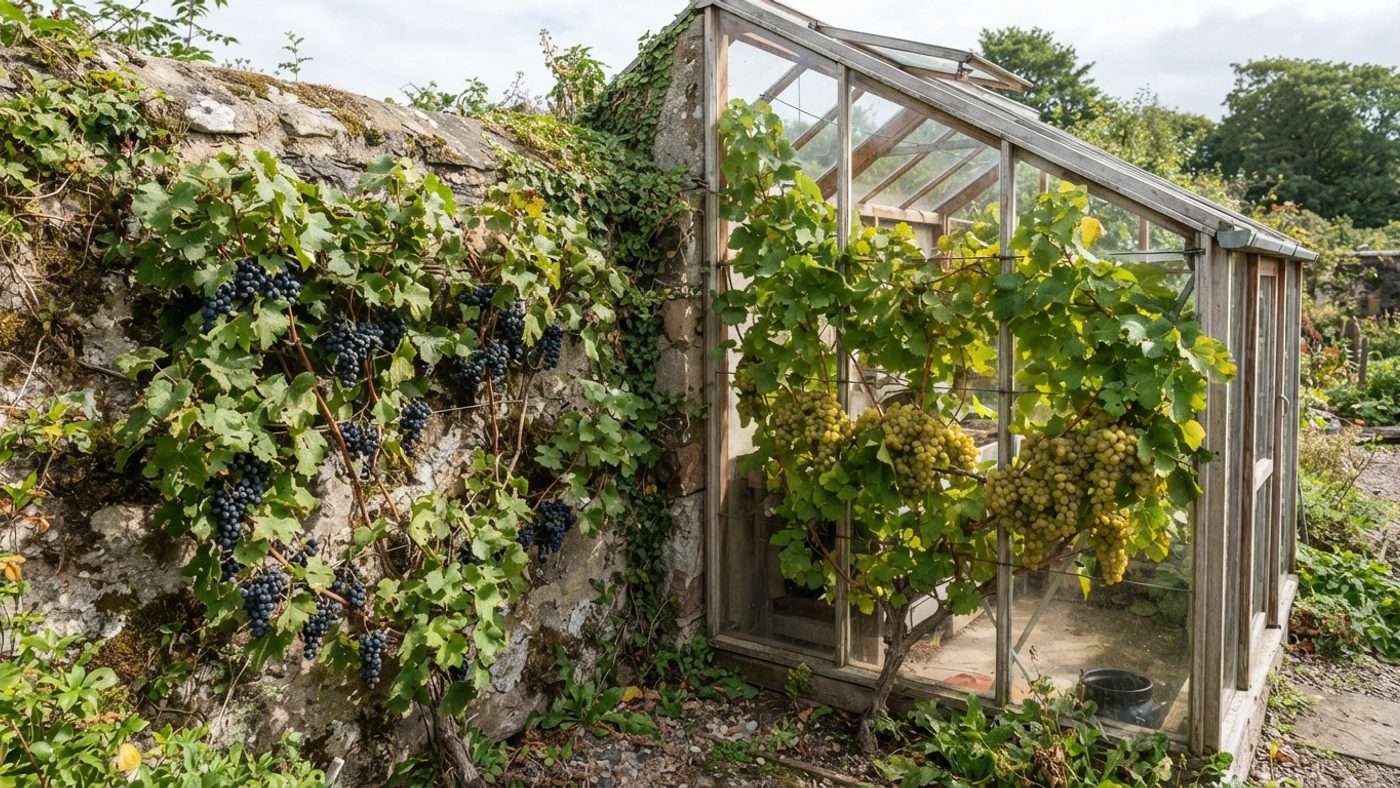
Muscat of Alexandria is the clearest case: its own page is explicit that "although the plants are hardy this cultivarA plant variety that arose or was bred under cultivation and is kept true by deliberate propagation, rather than a naturally occurring wild species. Full definition → needs to be grown in a greenhouse or conservatory, with heat in the autumn, to produce a decent crop." The vine itself survives outdoors; the fruit won't ripen there.
Sovereign Coronation is graded to be grown "outdoors in full sun, best against a sheltered warm wall," real outdoor growing is possible, but the instructions add that in cold areas it should go "indoors in a greenhouse or conservatory to produce a good crop." Fast-ripening, dark blue-purple fruit with a sweet, musky flavour.
Lakemont sits in between: its own plant page carries the same "suitable for outdoor cultivation" tag as Reliance and Schuyler, but qualifies it directly as "suitable for outdoor cultivation in sheltered, warmer parts of the country," the opposite of what a first vine on an open Scottish site needs. Good Muscat flavour on pale green, seedless fruit, but the extra warmth is a real requirement here, not a general caution repeated for every variety. A south-facing brick or stone wall, which stores daytime heat and releases it overnight, is the standard way to manufacture that warmer microclimate without going as far as a polytunnel or greenhouse, worth trying for a variety in this tier before ruling it out.
It's tempting to read "AGM" as "greenhouse" and "no AGM" as "outdoor-hardy" for grapes, since that's roughly how the two summary pages are laid out. Reliance and Schuyler break that pattern. The AGM badge and which summary page a variety happens to sit on both turn out to be the wrong things to check.
A middle ground: polytunnels and pots
Nothing above has to be a straight either/or between open ground and a heated greenhouse. A polytunnel gives a greenhouse-committed variety like Sovereign Coronation or Muscat of Alexandria the extra warmth it needs without the cost of glass, and works for any of the ten varieties above if a wall isn't available. A large container, moved to a more sheltered spot or under cover as the season turns, is the growing guide's own suggested route for a small garden with no bed to spare, and suits a warm-wall variety just as well as an open-ground one.
Every variety on this list is self-fertileA plant that can set fruit using its own pollen, without needing a second, different variety nearby to cross-pollinate it. Full definition → as well: grape flowers carry both male and female parts and pollinate themselves, mostly by wind outdoors, so a single vine of any of the ten crops on its own. Hand-pollinating only comes into play under glass, where still air can leave flowers unpollinated. Winter cold isn't the risk to plan around either, per the H5 hardiness note above; a late spring frost at flowering is the real threat regardless of variety, killing the delicate flowers outright and stopping fruit set for the year. Checking the frost dates page for typical last-frost timing in your area is worth doing before committing to a planting spot.
A genuinely useful second opinion
Gardener's World's own grape-growing guide names five further varieties, none of which overlap the ten above. Two read as directly useful for an open Scottish site: Poloske Muscat, "a green grape plant that can be grown outdoors in most of the UK... mildew resistant and produces lots of fruit with a sweet flavour," and Muscat Bleu, a near-black grape "bred to be very disease-resistant and produce high quality fruit outdoors." Brant is also outdoor-suitable and notably vigorous, though Gardener's World is candid that its fruit isn't premium eating quality, it's grown more for its ornamental vigour and autumn colour than the crop itself. Muscat Saint Vallier is a self-fertile outdoor hybrid better suited to eating than wine. Black Hamburg, by contrast, is Gardener's World's own pick for greenhouse growing, the same greenhouse-only role Muscat of Alexandria plays among the ten.
None of these five has an individual RHS plant page to back them up, so treat them as a second opinion worth having if none of the ten RHS varieties fit a specific site, not as equally well-established as those ten.
Soil pH: two figures, not quite the same
The main grow-your-own page gives a soil pH range of 6.5–7. The separate outdoor-cultivation page states a tighter figure: "a pH of 6.5–6.8 is required." Either way, that's neutral to slightly alkaline, and much of Scotland's ground runs more acidic than that by default, especially in the wetter uplands. Test the soil before planting rather than assume it's ready, and add lime if it needs raising.
Pests and diseases: does variety choice change the risk?
Largely no, with one exception. Powdery mildew, grey mould (botrytis) and downy mildew are the top three named grapevine diseases, and none of the ten varieties above carries a stated resistance to all three, Solaris and Phoenix are both noted for "some" or good resistance specifically to fungal disease/powdery mildew, a real if partial edge over the others. Birds will take a ripening crop regardless of variety; netting or a fruit cage is the working defence either way. Brown rot and spotted wing drosophila affect ripening fruit generally, not one variety over another. Siegerrebe is the one real variety-specific case: its own individual plant page and the outdoor-cultivation page both flag it as needing protection from wasps specifically, which take its ripe fruit readily, worth planning netting around if Siegerrebe is the pick.
Which one for your situation
- Open ground, no wall to spare: Rondo, the only variety with a regional tag naming "northerly gardens" directly.
- Want an AGM-rated pick that still copes outdoors: Reliance or Schuyler, both carry an outdoor classification with no warm-site caveat, unlike the other three AGM varieties.
- Shortest season, want an early finish: Solaris or Reliance, both flagged for fast maturity.
- A warm, sheltered wall to spare, want the best flavour: Siegerrebe (Muscat flavour, needs wasp protection) or Sovereign Coronation (musky dessert flavour, real wall warmth needed).
- A heated greenhouse or conservatory: Muscat of Alexandria, the one variety stated plainly won't crop without it.
- Wine over dessert: Rondo, Solaris, Schuyler, Phoenix or Pinot Noir are all named for wine use; Pinot Noir specifically wants the most sheltered aspect of the outdoor group.
Common questions
Is Rondo really better suited to Scotland than the AGM varieties?
For an open outdoor site, the evidence points that way, though it's worth being precise about the claim: RHS names Rondo for "northerly gardens," not Scotland by name. Nothing published states a firm boundary for where "northerly" starts or stops, so treat it as a strong, reasonable read rather than a guarantee. AGM measures reliable UK garden merit generally, not Scottish suitability specifically, so an AGM variety like Sovereign Coronation can be a genuinely good grape and still need a greenhouse to crop here.
Does every AGM grape variety need a greenhouse in Scotland?
No. Two of the five (Sovereign Coronation, Muscat of Alexandria) genuinely do. The other three, Reliance, Schuyler, Lakemont, are all individually classified for outdoor cultivation, though Lakemont's classification is qualified to "sheltered, warmer parts of the country" while Reliance's and Schuyler's aren't.
What's the difference between the two soil pH figures?
The main growing guide gives 6.5–7; the separate outdoor-cultivation page gives 6.5–6.8. Aim for somewhere in that 6.5–6.8 range as the safer target, and test garden soil directly before planting rather than assume it's already there.
Are there good outdoor varieties beyond the ones named here?
Yes, Gardener's World names five more, none overlapping the ten compared above. Poloske Muscat and Muscat Bleu both read as genuinely outdoor-hardy with real disease resistance, though neither has an individual RHS page to check the claim against, so they carry less weight of confirmation.
Sources
14 sources, recorded with what each was used for
- Grapes: Grow Your Own: The five AGM varieties and their descriptions as grouped on the main growing guide; soil pH figure 6.5-7
- Grapes: Outdoor Cultivation: The reliable outdoor growing line, advice to use later-flowering cultivars further north, the three recommended outdoor varieties (Phoenix, Pinot Noir, Siegerrebe), the tighter soil pH figure 6.5-6.8
- Vitis 'Rondo' (O/B): "Bred for its disease-resistance and cold hardiness, so suited for outdoor cultivation in northerly gardens," H5 hardiness, description
- Vitis 'Solaris' (O/W): Outdoor suitability, early maturity, fungal disease resistance, H5 hardiness
- Vitis vinifera 'Siegerrebe' (O/W/D): Early season, Muscat flavour, outdoor growing, wasp vulnerability
- Vitis 'Reliance' AGM: "Suitable for outdoor cultivation... well suited to northern growers due its speed to maturity," H5 hardiness, September ripening
- Vitis 'Schuyler' AGM: "Suitable for outdoor cultivation," "very cold-tolerant," also sold as Boskoop Glory, H5 hardiness
- Vitis 'Lakemont' AGM: "Suitable for outdoor cultivation in sheltered, warmer parts of the country," H5 hardiness
- Vitis 'Sovereign Coronation' AGM: Outdoor against a sheltered warm wall, or greenhouse in cold areas, H5 hardiness
- Vitis vinifera 'Muscat of Alexandria' (G/W): "Although the plants are hardy this cultivar needs to be grown in a greenhouse or conservatory... to produce a decent crop," H5 hardiness
- Vitis 'Phönix' (O/W): Disease-resistant, outdoor cultivation, mid-autumn ripening, wine or dessert use
- Vitis vinifera 'Pinot Noir' (O/B): Outdoor classification, sheltered south/west-facing aspect preferred, H5 hardiness
- Grapevine Diseases: Powdery mildew, downy mildew and grey mould as grapevines' top three diseases
- Grapes Grow Guide: Five further named varieties not on any RHS page checked, their outdoor/greenhouse framing, general site/soil/watering advice