
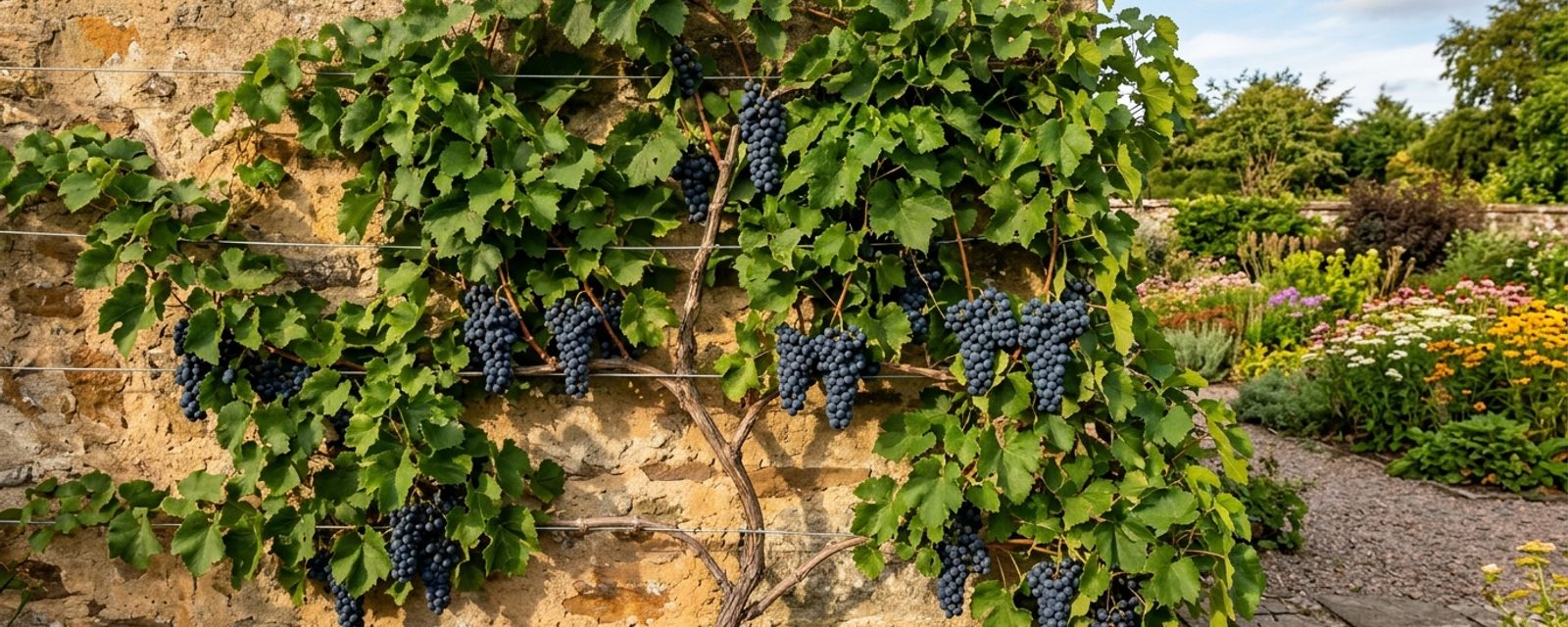
Vitis vinifera (and hybrid cultivars)
Scotland sits outside the reliable outdoor range for grapes by default. A warm wall changes that calculation, and one variety, Rondo, changes it further still.
That's not a reason to skip the crop. A vine planted against the right wall, on the right variety, is a different proposition entirely from one left to fend for itself in the open.
Site and soil
A sheltered, south- or south-west-facing wall or slope is the practical way in, and later-flowering varieties suit a northern garden better than early ones. Frost pocketsA low-lying spot where cold air drains and pools on still nights, making it noticeably more frost-prone than the surrounding area. Full definition → are worth avoiding outright, since late frost damages new shoots in spring. Soil should be free-drainingSoil that lets water pass through quickly rather than pooling, so roots aren't sitting in wet ground after rain. Full definition →, ideally pH 6.5-7; on decent ground no extra preparation is usually needed, but on poor soil or near a wall, dig in a bucketful of organic matter first. That pH sits on the alkaline side of neutral, and a lot of Scottish garden soil runs more acidic than that by default, so a soil test before planting is worth doing rather than assuming the ground is ready. On chalky or otherwise poor ground, choose a vine graftedJoining a chosen fruiting variety onto a separate rootstock, so the tree grows the fruit of one plant on the roots of another. Full definition → onto a rootstockThe root system and lower stem a fruit tree is grafted onto, chosen to control the tree's eventual size rather than for its own fruit. Full definition → suited to it: 5BB and 125AA both cope with shallow, stony or chalky soil, and 5BB also handles heavy clay.
Planting and spacing
Plant a single vine 1.2-1.5m apart from anything else, container-grown at the same depth it was in the pot, bare-root with the first roots just below the surface. Against a wall or fence, keep the base at least 20cm clear of it. A mini-vineyard row of several vines wants more room, 1.5-1.8m apart with rows running north to south; in a greenhouse, space multiple vines at least 1m apart. In a container, use one at least 30cm wide and deep with soil-based, peat-freeCompost made without peat, which is harvested from a slow-forming, carbon-storing wetland habitat that peat extraction damages. Full definition → compost, positioned in the warmest, sunniest spot available.
Care
Water newly planted vines through dry spells in their first growing season. Once established, an outdoor vine rooted in open ground usually needs no further watering, though one trained against a wall or fence in a rain shadow may need topping up. Mulch 5-7.5cm deep in late winter or early spring, kept clear of the stem to avoid rot; a mulchedA layer of material spread over the soil around plants to suppress weeds, retain moisture, and improve soil structure as it breaks down. Full definition → vine generally needs no extra feeding, though a poor harvest is worth following with a granular feed the next spring. Greenhouse and container vines need regular watering through the growing season, plus a high-potassium liquid feed every two to three weeks starting a month after growth begins, stopped once the grapes start to ripen and colour.
No second vine is needed: grape flowers carry both male and female parts and pollinate themselves, mostly by wind outdoors. Under glass, still air can leave flowers unpollinated, so lend a hand at midday on a dry, sunny day, once the vine is well ventilated: shake the stems firmly, or stroke a cupped hand over each bunch of flowers. The hand method is the more reliable of the two for early Muscat-type grapes, whose flowers can be temperamental to pollinate.
Training and pruning
Grapes fruit on the current year's growth, trained onto a permanent framework, usually horizontal wires against a sunny wall or the inside of a greenhouse. Two systems cover most gardens:
- Rod and spur (cordonA fruit tree or bush trained as a single main stem with short fruiting side-spurs, usually grown at an angle against a wall, fence or wire. Full definition →): one main stem, upright or at 45°, with short fruiting side-shoots. Versatile, suits gardens and greenhouses alike.
- Guyot: grown in rows along post-and-wire supports, the vineyard method, used to manage size and increase fruiting outdoors.
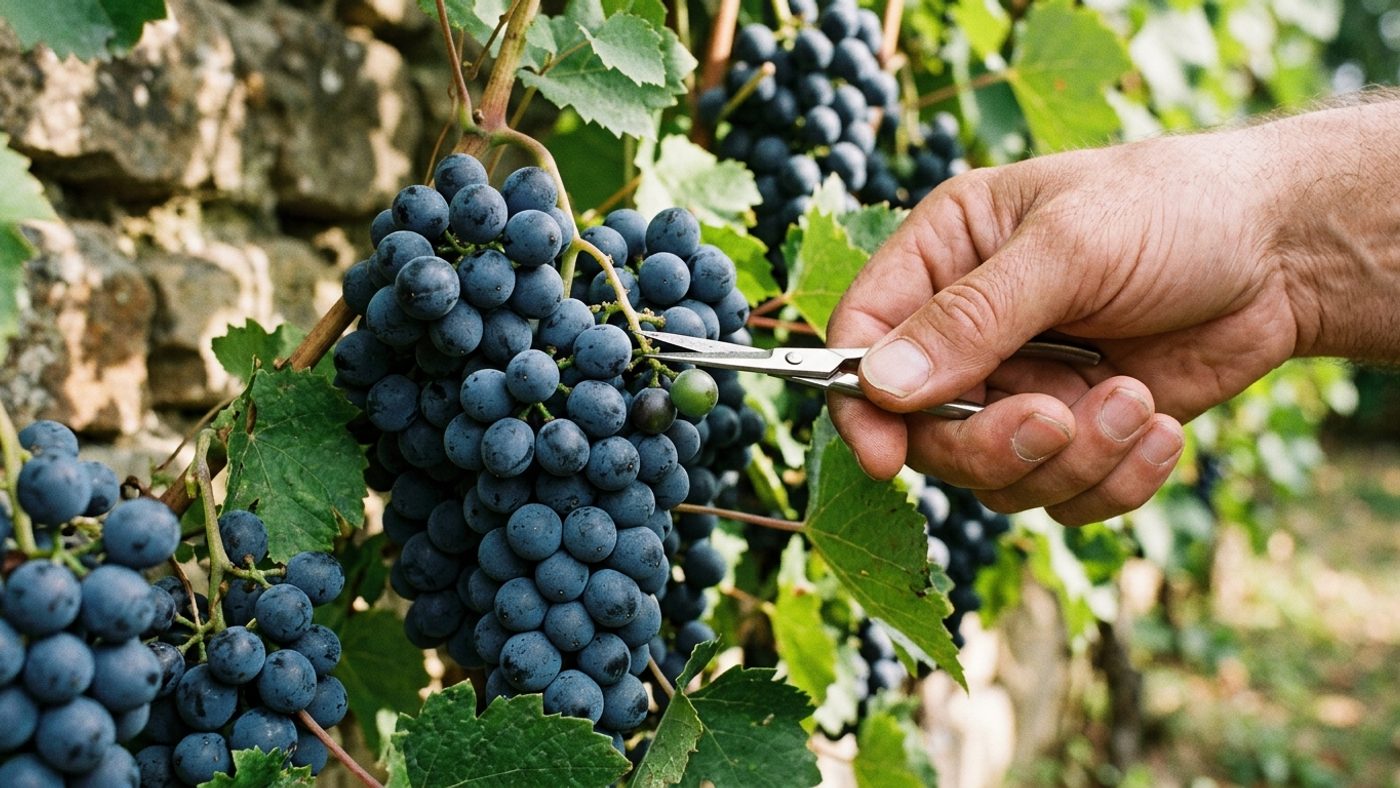
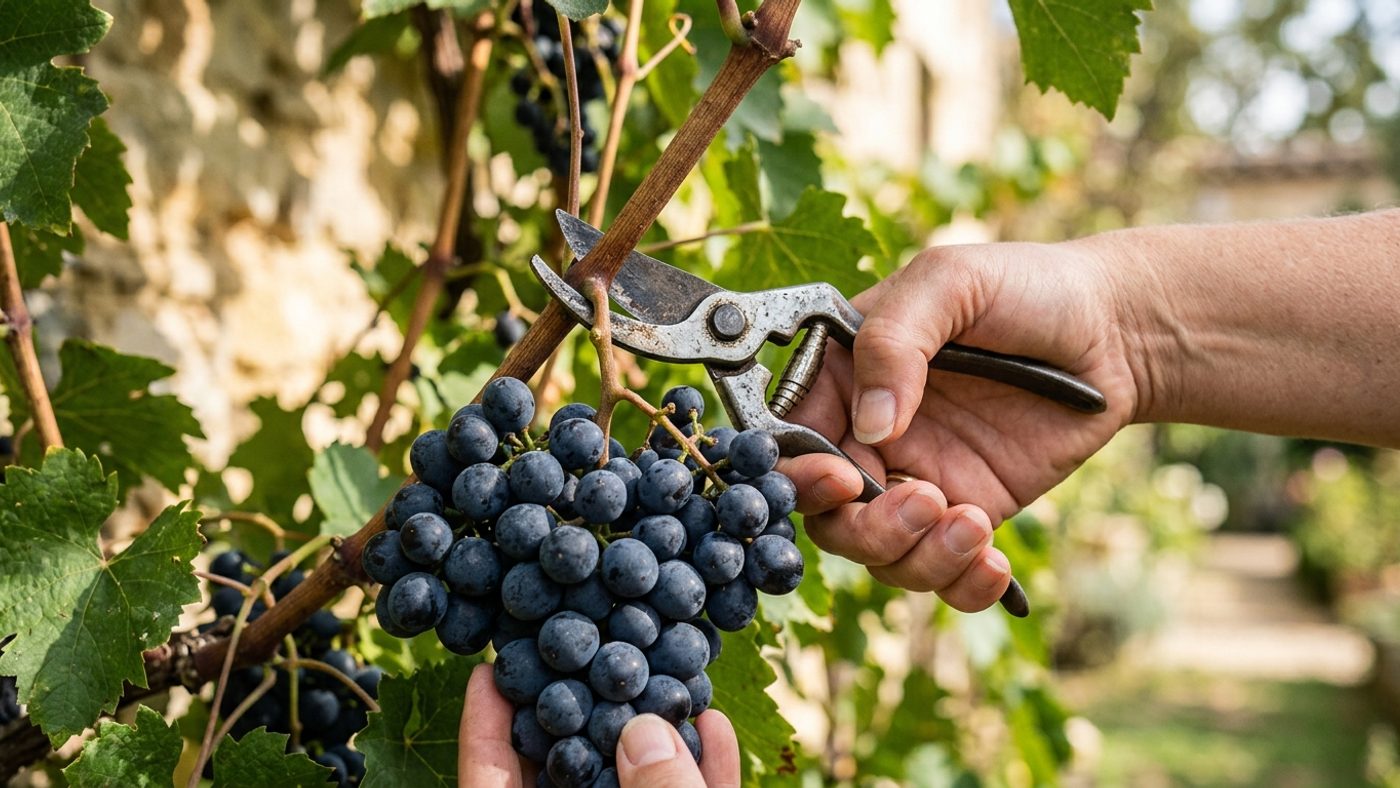
Main pruning happens in early winter, while the vine is dormant. Through the growing season, pinch outRemoving the soft growing tip of a stem to stop upward growth and make the plant branch out sideways instead. Full definition → unwanted shoots, remove leaves shading the fruit, and thin bunches and berries as they develop. A new vine needs several years of restraint before it's allowed to crop properly: remove all flowers in the first two years so the plant puts its energy into getting established, allow only three bunches in year three, and about five from year four onwards. Once bunches are forming, snip off roughly one grape in three per bunch with vine scissors, and check regularly for any diseased or damaged fruit to remove.
Varieties
Rondo, Solaris and Siegerrebe are bred and named specifically for outdoor growing. Five further AGMThe RHS's Award of Garden Merit: a UK-wide trials award for reliable performance, not a Scotland-specific recommendation. Full definition → grapes are reliable, but all bred for the greenhouse.
Reliance and Schuyler are both AGM and carry a genuine 'suitable for outdoor cultivation' tag on their own individual plant pages — Reliance's naming it 'well suited to northern growers'. Sovereign Coronation and Muscat of Alexandria are the two AGM varieties that genuinely need a greenhouse. Phoenix is a further outdoor option: a mildew-resistant white bred for outdoor UK growing.
★ Our pick for Scotland
Rondo
Black wine grape · late summer · H5The RHS's H1a–H7 scale for how much cold a plant can survive outdoors, H1a being tender indoor-only and H7 hardy anywhere in the UK. Full definition →
High yields of blue-black grapes for wine, preserves or eating fresh, ripening in late summer.
Why this one: Rondo was bred specifically for disease-resistance and cold hardiness, and is suited to outdoor cultivation in northerly gardens.
Also worth considering
Solaris
White wine grape · early-maturing · H5
Outdoor-suitable and early-maturing, with some resistance to fungal diseases — less time needed to ripen, and a head start against the damp that favours mildew and grey mould.
Siegerrebe
White dessert or wine grape · early season · excellent Muscat flavour
Bred for outdoor UK growing, with an excellent Muscat flavour worth the wasp-proofing it needs (see Common problems).
Show other recommended varieties (1)
LakemontAGM
Dessert grape, pale green, good Muscat flavour
AGM-rated and reliable, but it needs a warm, sheltered site to do well — better suited to a greenhouse than a first outdoor vine in Scotland.
Best Grape Varieties for Scotland → compares all named grape varieties head-to-head, with the practical detail that doesn't fit in a summary card.
Harvesting
Grapes ripen from August to October, depending on variety and how the season has gone. Dessert grapes are ready when they feel soft and taste sugary; white varieties also turn from deep green to a thinner, translucent yellow. They don't ripen any further once picked, so wait until they're at their sweetest, then cut the whole bunch with its stalk still attached. Wine grapes stay small, fairly acidic and thick-skinned even when ripe, better pulped for wine than eaten fresh. Dessert grapes are a genuinely tricky crop to get right, with a long wait built in: a minimum of 36 months to a first harvest.
Common problems
Most of what troubles a grape vine here is damp rather than cold: two of the three top diseases, grey mould and downy mildew, both take hold in humid, poorly ventilated conditions, which is exactly the trade-off of growing under cover in a wetter climate. Air circulation, not just warmth, is what a wall or greenhouse needs to deliver.
- Powdery mildew is one of grapevines' three top diseases, causing white powdery growth on leaves, stems and fruit; infected fruit can split or drop early. Mulching against drought stress and pruning for airflow both help.
- Grey mould (botrytis) turns fruit soft and brown with a fluffy grey coating, especially as it starts to ripen, and can get in through the splits powdery mildew leaves behind.
- Birds will damage and eat a ripening crop outright. Netting raised clear of the fruit on canes, kept taut and secured, or a fruit cage, are the working defences.
See more problems
- Downy mildew shows as yellowish patches on upper leaf surfaces with a matching whitish mould underneath. Clean up and destroy fallen leaves over winter, and avoid overhead watering, which raises humidity and favours both this and powdery mildew.
- Brown rot affects grapes the same way it does apples, pears and stone fruit, turning fruit soft and brown, usually spreading from a wound or touching fruit.
- Spotted wing drosophila lays eggs in otherwise sound, ripening fruit rather than only fruit that's already damaged. Fine mesh netting and prompt clearing of ripe and fallen fruit are the working defences, not a spray.
- Wasps, including social wasps and hornets, are drawn to ripening grapes and will take fruit outright, not just enlarge existing damage. Siegerrebe specifically needs protecting from them.
- Grapevine blister mite causes small blister-like pimples on leaves; mainly cosmetic on an otherwise healthy vine.
- Grape shanking, where individual berries in a bunch fail to colour properly and eventually shrivel, is a physiological disorder rather than a pest or disease, more common under glass.
Common questions
Can grapes actually be grown outdoors in Scotland?
Only with real help from a wall. A south- or south-west-facing wall traps enough extra warmth over a growing season to make the difference between a vine that ripens and one that doesn't, especially for varieties not specifically bred for cold hardiness. Later-flowering varieties also cope better with a Scottish spring than early ones.
Do I need a greenhouse to grow grapes here?
Not always. Two dessert varieties, Sovereign Coronation and Muscat of Alexandria, genuinely need one to crop reliably here, but Reliance is a dessert grape with a stated outdoor classification, and wine grapes are generally the more realistic outdoor option. Rondo and Solaris are the varieties best placed to crop outdoors without glass.
How long before a new vine actually produces a crop?
Longer than most fruit you'd plant in a garden. Dessert grapes take a minimum of 36 months to first harvest, and the year-by-year thinning routine described above, which restrains the vine until year four, backs that up. Patience in the early years is what a good crop later depends on.
Does every grape variety need a warm site?
Every grape wants a warm, sheltered, sunny spot; that much doesn't change by variety. What changes is whether the variety can still crop reliably given Scotland's shorter, cooler season on top of that. Lakemont, AGM-rated and reliable, is flagged as needing more warmth than a typical outdoor Scottish site can offer, better suited to a greenhouse. Rondo and Solaris are bred specifically to cope without it.
Sources
7 sources, and what each was used for
- RHS: getting started, indoor vs outdoor growing, site and soil, rootstocks for chalky/poor soil, spacing, planting method and timing, container growing, training methods (rod-and-spur, Guyot), pruning timing, watering, feeding, mulching, fruit thinning and the year-by-year bunch allowance for young vines, harvesting method and timing, and named pests and problems
- RHS: the reliable outdoor line for UK grapes ('south of a line between Pembroke and the Wash', cultivation further north 'worth experimenting' with a warm wall or sheltered site), later-flowering cultivarsA plant variety that arose or was bred under cultivation and is kept true by deliberate propagation, rather than a naturally occurring wild species. Full definition → for northern gardens, recommended outdoor varieties Phoenix, Pinot Noir and Siegerrebe, and soil pH
- RHS: Rondo: bred for disease-resistance and cold hardiness, suited to outdoor cultivation in northerly gardens, H5 hardiness, soil and aspect preferences, disease susceptibility
- RHS: Solaris: outdoor suitability, early maturity, some fungal disease resistance, H5 hardiness
- RHS: Siegerrebe: early season, Muscat flavour, outdoor growing, soil and site preferences, wasp vulnerability
- RHS: downy mildew, powdery mildew and grey mould (botrytis) on grapevines: symptoms, causes, non-chemical control advice, and mildew-resistant cultivars (Leon Millot, Orion, Seyval Blanc, Triomphe d'Alsace, Brant)
- Garden Organic: sunny, well-drained site, October-February planting, August-October harvest and picking-by-ripeness, wire-training and pinching/thinning method; the 'Trickier' difficulty rating and 36-month minimum to first harvest