
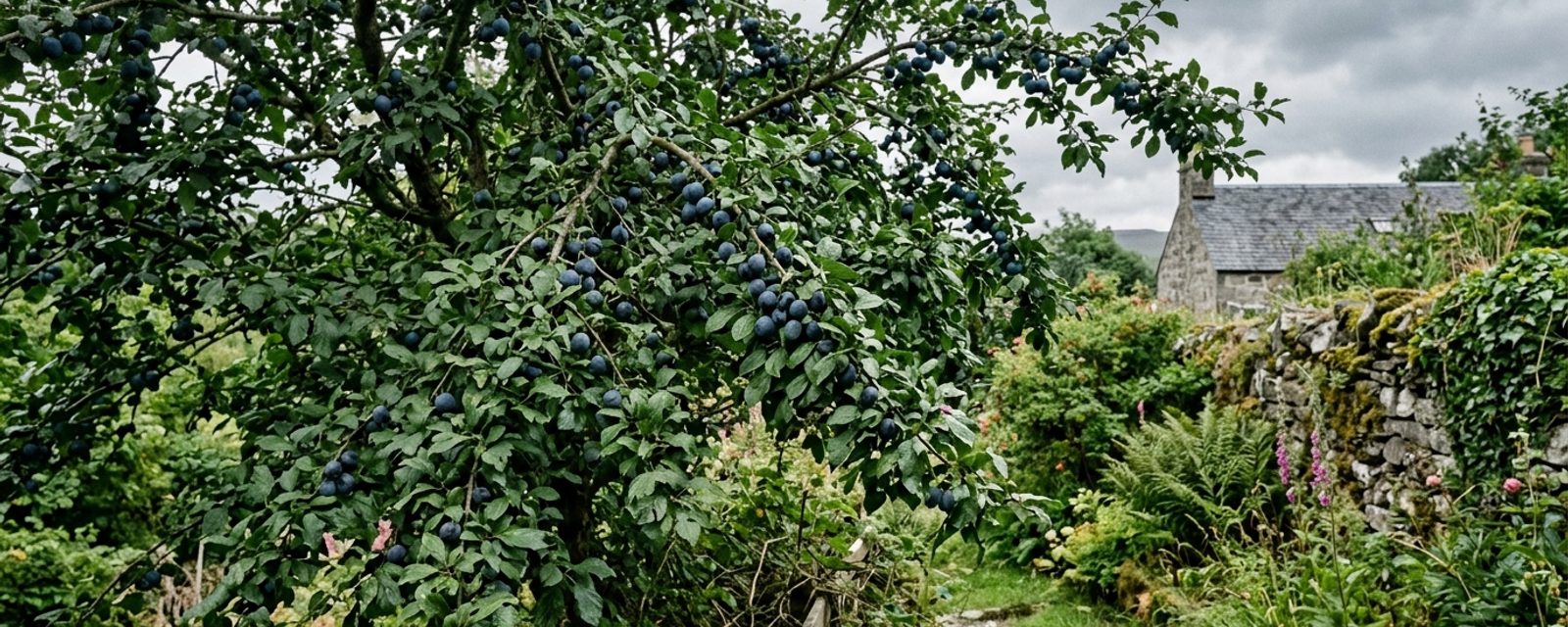
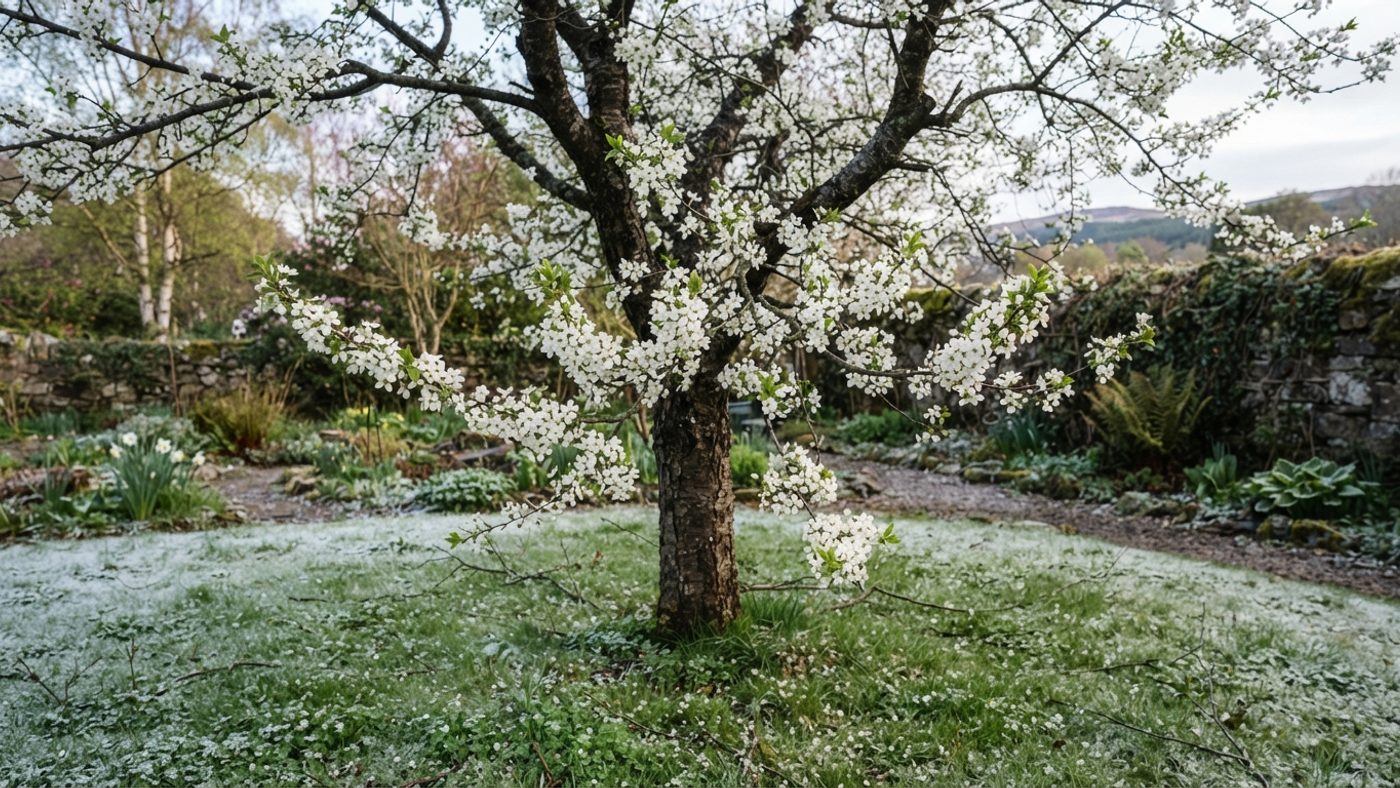
Blossom, not the tree itself, is what a hard spring frost actually kills, and the three fully documented varieties holding the Award of Garden Merit (AGMThe RHS's Award of Garden Merit: a UK-wide trials award for reliable performance, not a Scotland-specific recommendation. Full definition →) flower in a loose sequence rather than all at once: Merryweather Damson first, Farleigh Damson a little after it, and Prune Damson (also sold as Shropshire Damson) last. A tree's hardiness ratingThe RHS's H1a–H7 scale for how much cold a plant can survive outdoors, H1a being tender indoor-only and H7 hardy anywhere in the UK. Full definition → protects the dormant wood down to a stated temperature; it says nothing about the open flower, which is frost-tender at any rating. May frosts are still a genuine risk across much of Scotland (see the regional frost-date reference for how late they typically run near you), which is exactly the window damson blossom opens into, so flowering order is a real part of the decision here, not just a catalogue detail.
Quick answer
Merryweather Damson is the strongest all-round pick: full AGM detail, H6 hardiness, and named resistance to silver leaf, the disease risk this whole fruit family carries from badly timed pruning. Where a late spring frost is the bigger worry than the fruit's size, Prune Damson (Shropshire Damson) flowers latest of the three and dodges more of the frost window as a result. Where space is tight, Farleigh Damson stays compact and is named specifically less prone to frost damage than most damson cultivarsA plant variety that arose or was bred under cultivation and is kept true by deliberate propagation, rather than a naturally occurring wild species. Full definition →. Six further AGM-listed damson varieties exist by RHS's own count, but none of them has enough independently verifiable detail to recommend by name.
Planting, rootstocksThe root system and lower stem a fruit tree is grafted onto, chosen to control the tree's eventual size rather than for its own fruit. Full definition →, pruning and harvest technique are all covered in the damsons growing guide.
Why "best for Scotland" doesn't have a clean answer here
No Scottish trial body publishes damson variety data; the James Hutton Institute, Scotland's main fruit-breeding and trials authority, doesn't breed or trial damsons at all. What exists instead is the UK-wide Award of Garden Merit, which confirms garden-worthiness across the whole of Britain, not a specific finding about Scotland's shorter, cooler, wetter growing season.
The workable substitute, in the absence of Scottish trial data, is comparing hardiness rating, flowering/pollination groupA classification of fruit tree varieties by when they flower each spring, used to check whether two varieties can pollinate each other. Full definition → and named disease resistance per variety. None of that is a Scotland-specific claim on its own, but flowering group has a direct Scotland consequence: later flowering means less of the blossom sits exposed during the likeliest frost window. That's the logic the rest of this article works through.
The three fully documented AGM varieties
Three AGM damson varieties have complete detail on their own individual plant pages, beyond the shorter summary on the general damsons page. A fourth name, Shropshire Damson, isn't a separate variety: it's a synonym of Prune Damson, with identical hardiness, pollination group, ripening date and pest/disease list on its own separate record, the same cultivar catalogued under two page URLs, not a fourth option.
| Variety | Hardiness | Pollination group | Ripens | Height & spread | Named resistance |
|---|---|---|---|---|---|
| Merryweather Damson | H6 (to -20°C) | 3 | Late summer | 2.5–4m | Silver leaf |
| Farleigh Damson | H6 (to -20°C) | 4 | Autumn | 2.5–4m | Less frost-prone than most cultivars |
| Prune Damson (Shropshire Damson) | H6 (to -20°C) | 5, late-flowering | Late August | 2.5–4m | None named |
All three are self-fertileA plant that can set fruit using its own pollen, without needing a second, different variety nearby to cross-pollinate it. Full definition →, AGM-holding, and rated H6, the top hardiness band (hardy throughout the UK and northern Europe, to -20°C). Pollination group is a rough weekly scale assigned by flowering time, not a fixed calendar date; a variety in group 3, 4 or 5 will generally cross-pollinatePollen moving from one plant to a different, compatible variety, needed for fruit to set on any variety that isn't self-fertile. Full definition → well with anything one group either side of it, so any two of these three planted together overlap enough to help each other's fruit set even though all three are self-fertile alone. The differences that actually separate the three, beyond what's in the table, are named disease resistance and cropping behaviour:
- Merryweather Damson is the only one of the three with a named disease resistance rather than only a susceptibility list: it specifically resists silver leaf, the fungal disease that gets into stone fruit through pruning cuts made at the wrong time of year, one of the two reasons damsons and plums are pruned only in spring and summer, never while dormant. Fruit is the largest of the three, blue-black.
- Farleigh Damson is "less susceptible to frost damage than many other cultivars," a genuine named frost claim distinct from the shared H6 rating. It's also the variety called out for reliably heavy cropping on a compact tree, useful where a full-size damson doesn't fit.
- Prune Damson, sold interchangeably as Shropshire Damson, has no disease resistance separately named, unlike the other two, and carries the longest pest list of the three, including bullfinches. Its main advantage is timing: latest flowering, latest ripening, most frost avoided by the time it blooms.
Self-fertility helps but doesn't guarantee a crop: cold, wet spring weather that keeps bees and other pollinating insects grounded still reduces fruit set on a self-fertile tree, whatever the variety. A thin crop after a bad spring isn't necessarily the tree's fault.
Site matters as much as variety
Cold air is heavier than warm air and drains downhill, pooling in the lowest part of a garden or the bottom of a slope on a still, clear night, exactly the conditions that produce the sharpest radiation frosts. A damson planted in a natural frost pocketA low-lying spot where cold air drains and pools on still nights, making it noticeably more frost-prone than the surrounding area. Full definition → loses most of the advantage a late-flowering variety like Prune Damson buys it; the same tree on higher ground, or against a south- or west-facing wall that holds a little warmth overnight, keeps that advantage. Where a frost pocket genuinely can't be avoided, choosing the latest-flowering variety matters more, not less, and fleeceA lightweight, breathable fabric laid or draped over plants to trap a little warmth and keep off frost, wind and some flying pests. Full definition → or an old sheet thrown over the tree overnight when frost is forecast during blossom still helps regardless of variety.
The other six AGM varieties: what was checked and what wasn't found
The general damsons page states nine AGM varieties exist in total, but the page itself only fully describes three. Three further named damson cultivars have their own individual plant pages:
- Aylesbury Prune (named without a description on the general damsons page)
- Bradley's King Damson (also sold as King of the Damsons)
- White Damson
None of the three carries an AGM badge, a hardiness rating, or a pest/disease list, only a generic line, shared across several damson cultivars, that the fruit is "not particularly sweet if eaten fresh" and better suited to cooking. RHS's tree-fruit and general-fruit AGM list PDFs both return a 404 rather than the document, and a site search for Prunus insititia doesn't surface the remaining names either. Nine AGM damson varieties by RHS's own count; six remain either undescribed on RHS's own site or unidentified by name.
Damsons vs plums: how much hardier, really?
Damsons are "smaller and less sweet than plums, but are ideal for making into jams," the one direct plum comparison stated on the general damsons page, and it stops there; "hardier than plums" isn't a claim made anywhere on it. Gardener's World's plant record for Farleigh Damson makes that broader claim directly: "Damsons are hardier forms of plum, making smaller, robust trees," a line repeated on its plums growing guide too. The two sources disagree on how far to generalise.
What can be checked directly: Merryweather, Farleigh and Prune Damson are all rated H6. Czar, a plum variety already covered on this site's own plum guide, is also H6, enough on its own to make "damsons are hardier" too broad a claim to state as blanket fact, whatever a general framing elsewhere says.
Gardener's World's plant record adds two things the damson pages checked for this guide don't mention at all: damsons are commonly used for windbreaks and hedging rather than only as a standalone fruit tree, and the plant is listed as toxic to cats, dogs and horses, though not reported as toxic to people, birds or livestock; no severity or symptom detail is given, so treat it as a reason to keep an eye on pets and grazing animals near a planted tree, not as a specific incident to expect. The windbreak use is a genuine reason to weight a damson favourably on an exposed plot specifically, separate from the hardier-than-plums debate: a tree tough enough to be planted as a windbreak is, by definition, tough enough to take wind exposure most fruit trees wouldn't.
Soil and rootstock, briefly
Damson soil and rootstock needs are identical to plums, since both are graftedJoining a chosen fruiting variety onto a separate rootstock, so the tree grows the fruit of one plant on the roots of another. Full definition → onto the same rootstock range and share a soil preference: fertile, ideally slightly acidic soil at pH 6–6.5, tolerating a wider range in practice. Rootstock vigour interacts with the site-selection point above: a vigorous rootstock like Brompton puts more wood into the wind than a semi-dwarfingHow much a fruit tree's rootstock limits or allows its eventual size, from extremely dwarfing (smallest) through to very vigorous (largest). Full definition → one like Pixy or VVA-1, so an exposed plot is a reason to lean toward a smaller rootstock regardless of which variety it's carrying, not just a spacing decision. Full rootstock detail and spacing figures are in the growing guide.
What these varieties don't protect against
None of the three fully documented varieties is resistant to most of what actually threatens a Scottish damson crop. Silver leaf and bacterial canker both enter through pruning cuts made at the wrong time of year, which is why pruning is restricted to spring and summer on this whole fruit family, whichever variety is planted. Brown rot, blossom wilt and pocket plum (a damson-specific risk that doesn't affect plums) appear on some or all of the named pest lists above regardless of variety. Plum moth, aphids, red spider mite and brown scale round out the list named across all three varieties' own pages. Variety choice narrows a couple of specific risks; it doesn't remove the need to watch for the rest.
Harvest and use
All three varieties are cooking damsons rather than eating fruit, too tart to eat raw whichever one is planted. That trade-off is the point of the crop, not a downside: cooked into jam, damson cheese or damson gin, the same sharpness that makes them unpleasant raw becomes the flavour worth growing them for.
Common questions
Is there a genuinely Scotland-tested damson variety?
No. No Scottish trials body, including the James Hutton Institute, breeds or publishes trial data on damsons specifically, and the Award of Garden Merit is a UK-wide finding, not a Scottish one. Hardiness rating and flowering/pollination group, both individually sourced per variety above, are the closest available proxy for a Scotland-relevant choice, not a substitute for genuine local trial data that doesn't currently exist.
What can I actually do about frost if I can't avoid a low-lying site?
Choose the latest-flowering variety on offer (Prune Damson/Shropshire Damson among the three here), plant against a south- or west-facing wall if one's available, since walls hold a little overnight warmth, and cover the tree with fleece or an old sheet on any night frost is forecast while it's in blossom. None of that removes the risk entirely on a genuine frost pocket, but each one reduces it.
Are Prune Damson and Shropshire Damson actually different trees?
No. They're listed as synonyms of the same cultivar, with identical hardiness, pollination group, ripening date, and pest and disease list on each of their two RHS plant records. Buy either name expecting the same tree.
What happened to the other six AGM damson varieties RHS mentions?
Nine AGM damson varieties exist by RHS's own count, but only three are fully described on its general damsons page. Three further named cultivars (Aylesbury Prune, Bradley's King Damson, White Damson) have their own RHS plant pages, but none carries an AGM badge, hardiness rating, or any of the detail the three varieties above have. The remaining names aren't identifiable from RHS's site as it currently stands.
Sources
11 sources, recorded with what each was used for
- How to Grow Damsons: General damson growing advice, the plum comparison line, the 9-AGM-variety count against only 3 fully described, confirmation Aylesbury Prune is named without a full description
- Prunus insititia 'Merryweather Damson' (C): Hardiness, pollination group, self-fertility, AGM, silver leaf resistance, full pest/disease list, height/spread
- Prunus insititia 'Farleigh Damson' (C): Hardiness, pollination group, self-fertility, AGM, the "less susceptible to frost damage than many other cultivars" line, full pest/disease list, height/spread
- Prunus insititia 'Prune Damson' (C): Hardiness, pollination group, self-fertility, AGM, ripening date, full pest/disease list, height/spread, synonym confirmation
- Prunus insititia 'Shropshire Damson': Confirms identical data to Prune Damson's own page
- Prunus insititia 'Aylesbury Prune' (C): Checked directly for AGM/trait data; none found beyond a generic fruit-use line
- Prunus insititia 'Bradley's King Damson' (C): Checked directly for AGM/trait data; none found beyond a generic fruit-use line
- Prunus insititia 'White Damson' (C): Checked directly for AGM/trait data; none found beyond a generic fruit-use line
- Prunus domestica 'Czar' (C): Cross-reference only: Czar's H6 rating used to show a plum variety matching the hardiest damsons' own rating
- Prunus insititia 'Farleigh Damson' (Gardener's World): The "hardier forms of plum" framing, windbreak/hedging use, toxicity to cats/dogs/horses
- How to Grow Plums (Gardener's World): Confirms the same "hardier, smaller trees" and windbreak/hedging framing, names Farleigh Damson among recommended varieties