
A formal hardiness ratingThe RHS's H1a–H7 scale for how much cold a plant can survive outdoors, H1a being tender indoor-only and H7 hardy anywhere in the UK. Full definition → is a tested number, not a marketing word, H5 means a plant is reliably hardy down to -15°C in most of the UK, H6 down to -20°C, and H2 means it needs protection below 1°C. Cabbage varieties don't share one number. Among the six cabbage cultivarsA plant variety that arose or was bred under cultivation and is kept true by deliberate propagation, rather than a naturally occurring wild species. Full definition → carrying the RHS Award of Garden Merit, the hardiness ratings run from H2 to H6, a four-band spread on the same UK-wide list, and the reason isn't random: it tracks exactly which job each variety is bred to do.
Quick answer
For a mature head that stands right through a Scottish winter and is cut fresh in January or February, Tundra is the only one of the six built for that job, a true winter Savoy, rated H5. If you want spring greens from an overwinteredKeeping a plant alive and intact through the cold months, whether left outdoors, moved under cover, or stored dormant. Full definition → planting instead, Advantage carries the highest formal hardiness rating of the six (H6) and can be left to heart up the following spring. Regency and Red Jewel are summer varieties rated H2 and H3, not weaker cabbages, just not asked to face a winter at all, so skip them for anything you want standing in December.
Why six AGM varieties don't answer one question
The Award of Garden Merit tells you a variety performed well in UK trials, full stop. It doesn't say when in the year it's meant to be in the ground, or how it copes with a hard Scottish winter specifically. Cabbage has four distinct cropping types, spring, summer, autumn/winter, and red, and the six AGMThe RHS's Award of Garden Merit: a UK-wide trials award for reliable performance, not a Scotland-specific recommendation. Full definition → cultivars currently listed split across three of them, not one. The split runs both in formal hardiness rating and in how each variety spends winter: as a full mature head standing in the ground, as a small overwintered plant that hearts up later, or not in the ground over winter at all.
| Variety | Type | Hardiness | Harvest window | AGM on own page? |
|---|---|---|---|---|
| Tundra | Winter (Savoy) | H5 | October–February | Yes |
| Advantage | Spring / successional | H6 | Year-round in succession, or spring after overwintering | Yes |
| Duncan | Spring | H5 | March (greens) or June (hearted) | Yes |
| Winterjewel | Spring | H5 | Spring greens or loose hearts | Yes |
| Regency | Summer | H2 | June–September | Not on its own page |
| Red Jewel | Summer/autumn, red | H3 | July–October | Not on its own page |
Hardiness scale: H6 = hardy to -20 to -15°C, H5 = hardy in most of the UK, -15 to -10°C, H3 = half-hardy, -5 to 1°C, H2 = tender, needs protection below 1°C.
Tundra: the one true winter type
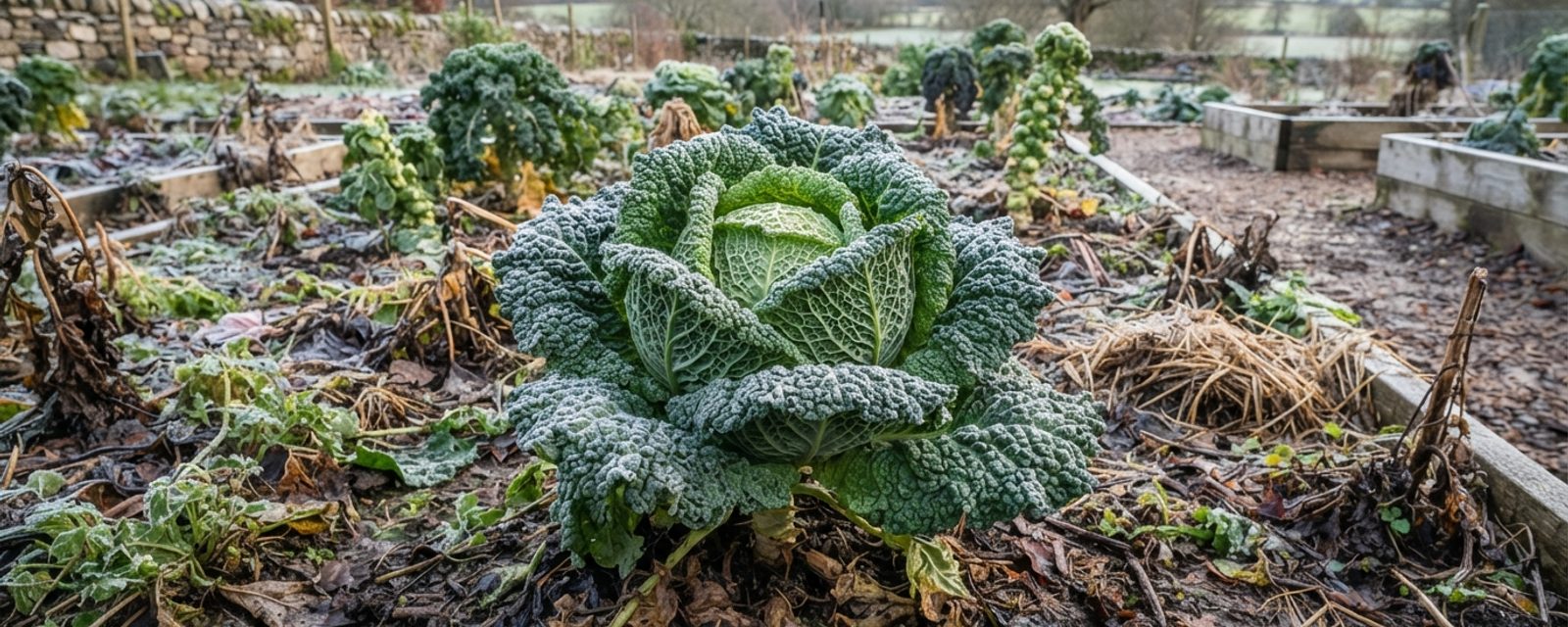
Tundra is the only one of the six that's actually classed as a winter cabbage on its own page, and it's the only one that stands as a finished, mature head through the cold months rather than as a young overwintering plant. Rated H5, it "can be harvested from October to February," producing "solid, round, sweet, crisp heads with an excellent flavour", a Savoy type, described as one of the hardiest cabbages available, with dense crinkled leaves. If the job you want done is "a solid head still standing in the ground in January," Tundra is doing a different job from the other three hardy varieties on this list, not just a slightly colder version of the same one.
For sowing dates, spacing and how to plant it out, the full growing guide covers technique for all four cabbage types in detail. Standing crops are also a magnet for hungry pigeons once other food is scarce, protection advice applies just as much to a Tundra head in January as it does at planting time.
Advantage, Duncan and Winterjewel: spring types, overwintered as young plants
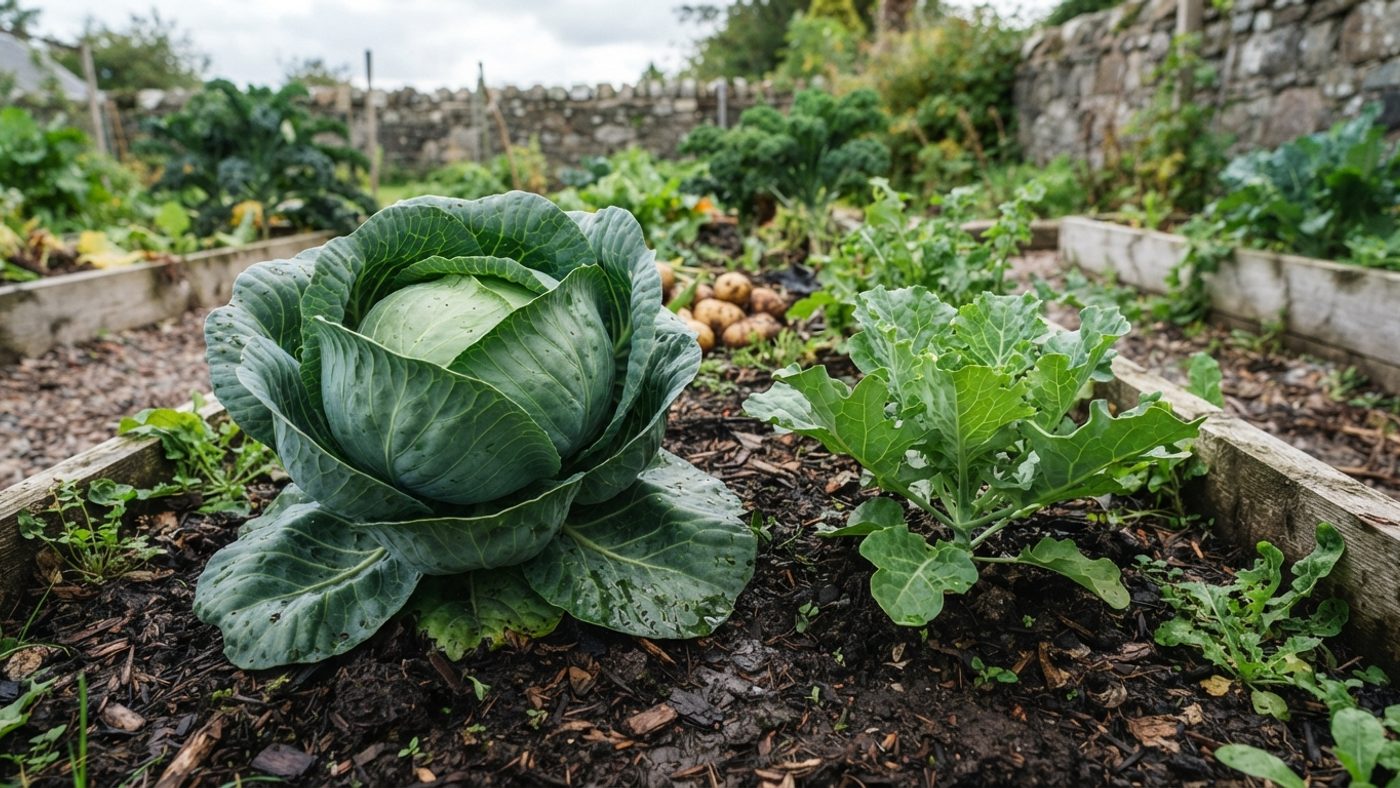
These three are grouped together on their own pages as spring cabbages, and all three follow the same strategy: sow late summer or autumn, let the plant overwinter as a small, unhearted plant, then either cut it as loose spring greens or let it form a proper heart the following spring. That's a genuinely different way of using winter than Tundra's, the plant isn't feeding you in winter, it's surviving winter so it can feed you in the hungry gap that follows it.
Advantage carries the highest formal hardiness rating of any of the six, H6, hardy to -20°C, the top rating short of "hardy anywhere." Its own page describes it as "a very versatile crop that can provide a year-round harvest of 'spring' greens from successional sowings, or can be left to form a pointed heart the following spring." Duncan and Winterjewel are both rated H5. Winterjewel's own page is unusually specific about its disease risk, stating it "may be susceptible to club rootA soil-borne fungal disease of the brassica family that swells and distorts roots, and survives in soil for years. Full definition →, particularly in acidic soil." Nearly half of Scottish farm soil samples tested by SRUC came back below pH 5.8, well under the pH 6.0-6.2 most crops want, a note about acidic soil isn't boilerplate here the way it might be for a variety grown mainly in the English lowlands.
Because all three spend winter as a young, unhearted plant rather than a finished head, they're the group actually exposed to bolting risk from a hard cold snap, where the plant sends up a flower stalk and stops forming a proper head at all, instead of just growing more slowly. Spring cabbage is named specifically as a cold-triggered biennialA plant that completes its life cycle over two years: growth in year one, then flowering, seeding and dying in year two. Full definition → bolter: a young plant tricked by a cold spell into flowering the following spring rather than heading up, a real risk for a young plant sitting through a Scottish winter and spring. Tundra, already a mature head by the time winter sets in, and the two summer varieties below, never in the ground over winter at all, don't carry the same exposure.
Regency and Red Jewel: summer varieties, and a real AGM discrepancy
Regency and Red Jewel are both listed with an AGM tag on the general cabbage summary page. Neither one's own individual plant page displays or mentions an AGM anywhere.
Both are summer-cropped and rated accordingly low for hardiness: Regency H2 (needs protection below 1°C) and Red Jewel H3 (half-hardy, -5 to 1°C). Neither is a weaker cabbage than the winter-hardy four, they're simply grown and finished within a single mild season, with no expectation of facing a real frost. Regency forms "very uniform and compact hearts with a strong base and good standing ability" and crops June to September; Red Jewel is the only red cabbage among the six AGM varieties, producing "large, tightly packed hearts with crisp, ruby red leaves" from July to October. If you want red cabbage specifically, Red Jewel is currently the only AGM-listed option, but don't plan on it standing through a Scottish winter the way Tundra will.
What variety choice doesn't fix: club root
Every one of the six AGM varieties' own pages lists club root as a disease it "may be susceptible to", none of the six is described as club-root resistant. Hybrid cabbages bred specifically for clubroot resistance do exist in the wider seed trade (Kilaton is the best-known), but Kilaton carries no AGM and its own plant page doesn't state a resistance claim directly. No, choosing a different AGM cabbage variety will not get you around club root on acidic Scottish soil. The standard growing advice for cabbage is direction, not a target range, apply lime the winter before sowing to raise the pH above 6, which discourages the disease without eliminating it once it's established. If club root is already present in your soil, sowing into modulesA tray divided into small individual cells, each sown with its own seed or seedling, so each plant grows undisturbed roots until it's ready to plant out. Full definition → to give plants a head start before they meet infected ground helps more than any variety choice on this list will.
None of the six differ on the rest of the standard brassicaThe cabbage family: cabbage, kale, broccoli, cauliflower, Brussels sprouts, kohlrabi, swede, turnip and more, sharing the same pests, diseases and rotation rules. Full definition → pest list either: cabbage white caterpillars can strip a plant in days without insect-proof mesh from planting, and cabbage root fly maggots attack the roots of young plants, less troublesome in Scotland's cool summers than further south, but still worth meshing or fitting collars against. Variety choice among the six changes nothing here either.
Which one for your situation
| Your situation | Pick | Why |
|---|---|---|
| Short on bed space, want the shortest occupancy | Regency or Red Jewel | Both sown and cleared within a single season, months rather than the better part of a year the other four take |
| Already growing Duncan or Winterjewel, deciding whether to switch | Advantage, only for the extra hardiness margin | Same overwintered-young-plant strategy and spring harvest window as Duncan/Winterjewel; the H6-vs-H5 difference matters most on an exposed plot |
| Want red cabbage | Red Jewel | Only AGM-listed red variety of the six |
| Have club root in the soil already | None of the six on hardiness grounds, lime and rotate instead | All six are club-root susceptible; variety choice doesn't solve it |
Common questions
Which of the six AGM cabbage varieties is actually the hardiest?
By formal hardiness rating, Advantage, at H6, rates a band higher than Tundra's H5. But "hardiest" and "best winter cabbage" aren't quite the same question here, Advantage survives winter as a small unhearted plant and gives you a spring harvest, while Tundra is the one that stands as a finished, cuttable head through the coldest months. Pick based on when you want to eat it, not the H-number alone.
Are Regency and Red Jewel actually AGM varieties, or not?
Both carry the AGM tag on RHS's general cabbage summary page, but neither variety's own individual plant page displays or mentions an AGM award anywhere. Treat the award as genuine but inconsistently carried through to the variety-specific listing.
Is any AGM cabbage variety resistant to club root?
No. All six of the AGM varieties covered here are listed on their own pages as susceptible to club root, the same as any other cabbage. Nearly half of Scottish farm soil tested by SRUC came back below pH 5.8, so liming to raise pH above 6 and rotating brassicas around the plot are the actual defences here, variety choice among the six doesn't change this one.
Why does a "spring cabbage" spend winter in the ground instead of being sown in spring?
Confusingly, spring cabbages (Duncan, Winterjewel, Advantage) are sown the previous autumn and overwintered as small plants specifically so they're ready to crop early the following spring, the name refers to the harvest season, not the sowing season. That overwintering stage is also why they're the group most exposed to cold-snap boltingA plant switching early into flowering and seed production, usually triggered by stress, after which leaves, roots or bulbs turn bitter or unusable. Full page →, unlike Tundra's mature winter heads or the two summer varieties that are never in the ground over winter at all.
Sources
10 sources, recorded with what each was used for
- Brassica oleracea (Capitata Group) 'Tundra': Hardiness rating (H5), AGM confirmation, harvest window, club root/disease susceptibility list
- Brassica oleracea (Capitata Group) 'Duncan': Hardiness rating (H5), AGM confirmation, spring-type classification, harvest window
- Brassica oleracea (Capitata Group) 'Winterjewel': Hardiness rating (H5), AGM confirmation, spring-type classification, acidic-soil club root note
- Brassica oleracea (Capitata Group) 'Advantage': Hardiness rating (H6), AGM confirmation, versatile/successional cropping description
- Brassica oleracea (Capitata Group) 'Regency': Hardiness rating (H2), summer-type classification, harvest window; confirms no AGM badge on own page
- Brassica oleracea (Capitata Group) 'Red Jewel': Hardiness rating (H3), red-cabbage classification, harvest window; confirms no AGM badge on own page
- Cabbages: grow your own: General variety list showing AGM tags and sub-type groupings for all six varieties
- Bolting: Mechanism of cold-triggered biennial bolting, including spring cabbage by name
- Brassica oleracea (Capitata Group) 'Kilaton': Clubroot-resistant hybrid cabbage, checked for AGM and resistance claims (neither shown on its own page)
- Acidic soils could be affecting production on many Scottish farms: Soil-sample pH data across Scottish farms