
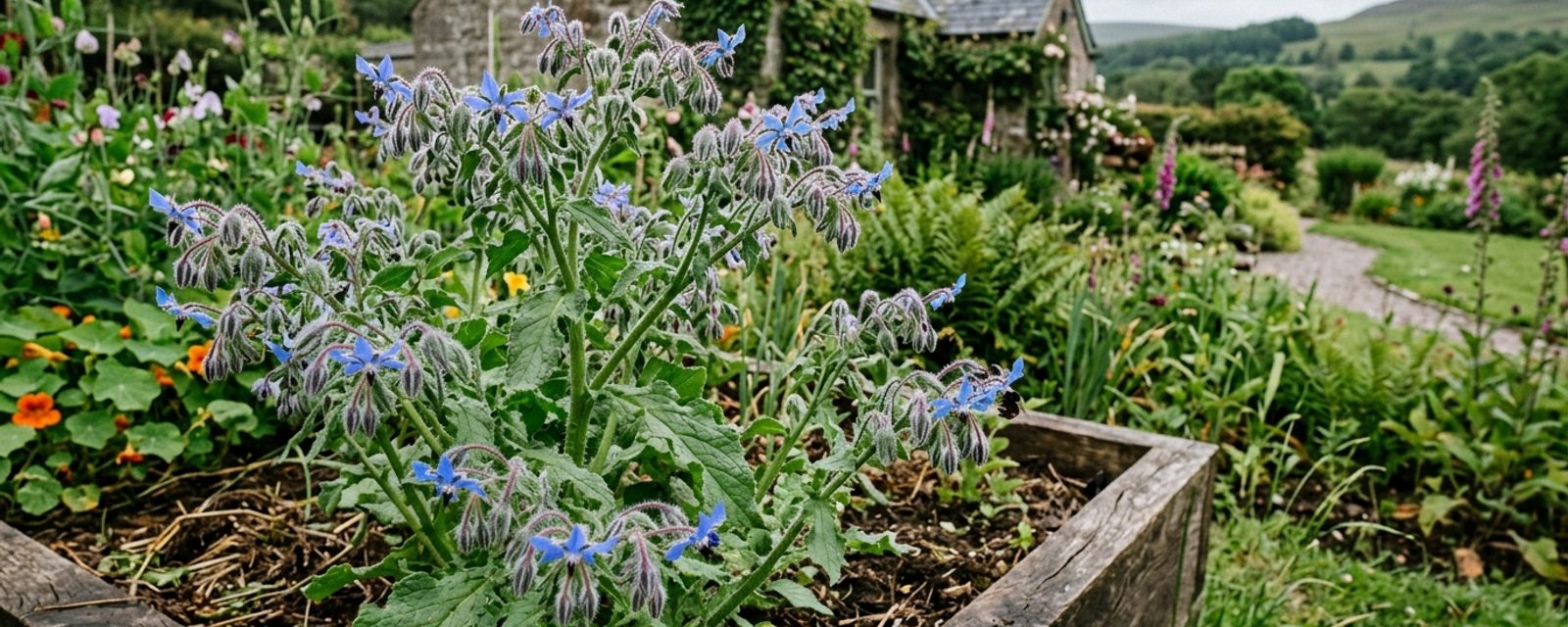
Borage sends down a taprootA single, thick, dominant root growing straight down from a plant, storing energy and anchoring it, as opposed to a spreading mass of fine roots. Full definition → before it does almost anything else, driving straight down into the soil profile while the top growth is still a seedling rosette. That single thick root is why every source treats borage as a plant you sow where it will grow rather than one you raise in trays and move later: disturb that root at transplanting and the plant frequently fails to recover, regardless of which of the four RHS-recognised varieties you're growing. All four share this trait, which matters more for variety selection than it might seem, it rules out "trial a few varieties in pots first" as a strategy, and pushes the real decision earlier, to seed-buying time.
Quick answer
For most Scottish gardens, kitchen plot, pollinator patch, or general ornamental border, the standard blue-flowered Borago officinalis is the strongest all-round choice: fully hardy (H5The RHS's H1a–H7 scale for how much cold a plant can survive outdoors, H1a being tender indoor-only and H7 hardy anywhere in the UK. Full definition →, near the top of the UK hardiness scale), the most widely available seed, and the variety treated as the default. Choose Borago officinalis 'Alba' instead if you want a paler colour scheme or are specifically drawn to its classification as a herbaceous perennial rather than an annual/biennialA plant that completes its life cycle over two years: growth in year one, then flowering, seeding and dying in year two. Full definition →; choose Borago pygmaea if what you actually want is a low, spreading, clump-forming bed plant rather than an upright annual that self-seeds freely, bearing in mind it's described as "short-lived" rather than permanent.
Why variety choice matters in Scotland specifically
Borage's H5 hardiness rating matters less in Scotland than it might suggest: the standard species and 'Alba' are annual/biennial and typically finish for the year at the first hard autumn frost regardless of root hardiness, so the practical Scotland question is less "will it survive winter" and more "how long will it keep flowering into a shorter growing season, and how reliably will it self-seed for next year in a cooler summer." B. pygmaea's perennial habit changes that calculation, which is part of why it's treated separately below. All four are sown outdoors from mid-spring, after the last frost, and want full sun for the strongest flowering, the full growing guide covers exact sowing timing and method.
The four varieties, compared
Only four borage varieties carry their own individual plant pages, and none carries an RHS Award of Garden Merit.
| Variety | Flower colour & shape | Hardiness / lifecycle | Growth habitA plant's characteristic shape and manner of growth, such as upright, spreading, creeping or bushy. Full definition → | Distinguishing trait |
|---|---|---|---|---|
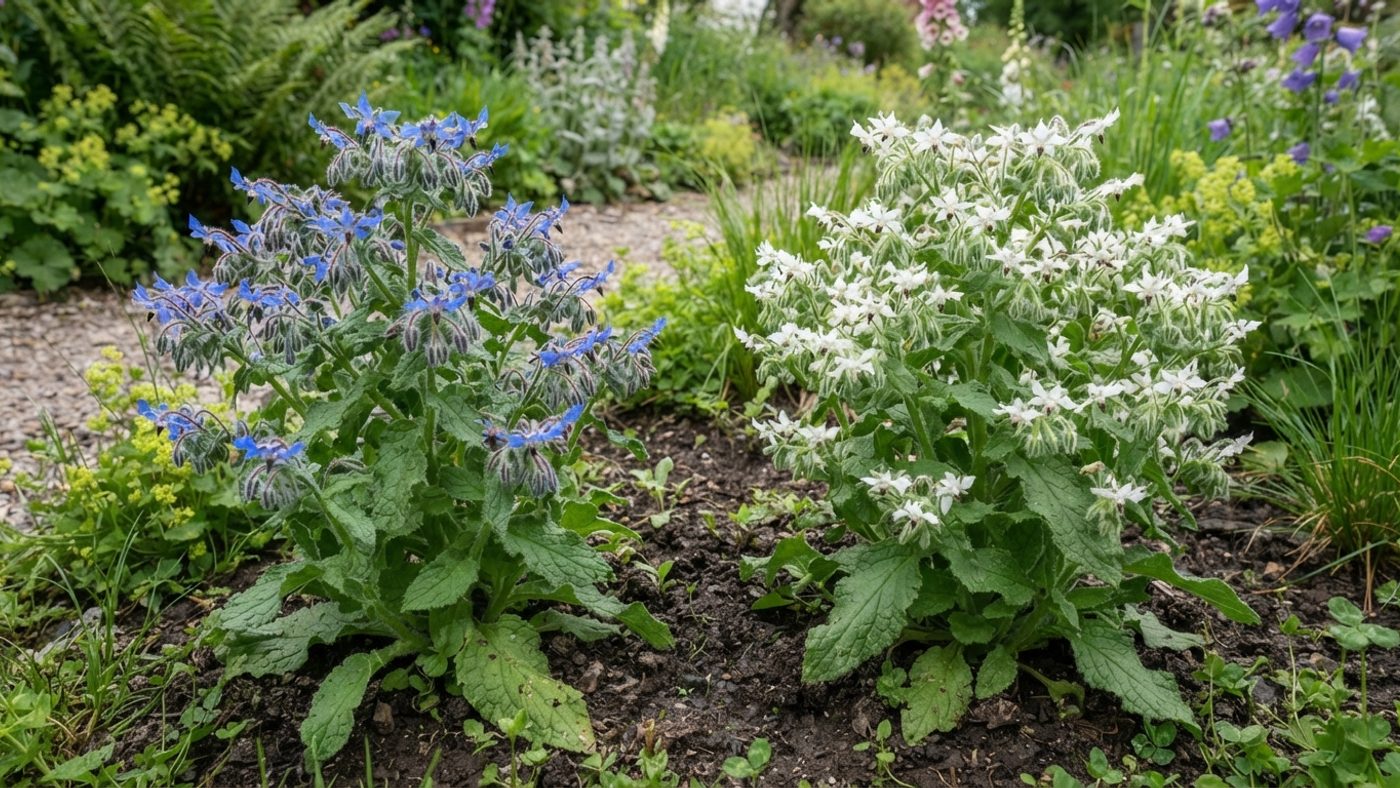
| Borago officinalis (species) | Bright blue, star-shaped, ~2cm | H5; annual/biennial; reaches full size in 1-2 years | Upright, 0.5-1m tall, 0.1-0.5m spread | The default, most widely grown form |
| Borago officinalis 'Alba' | White, star-shaped | H5; classified as herbaceous perennial, clump-forming, columnar upright habit; reaches full size in 1 year | Clump-forming, columnar upright, 0.5-1m tall, 0.1-0.5m spread | White flowers instead of blue; classification differs from the species (perennial vs annual/biennial) |
| Borago officinalis 'Bill Archer' (v) | Not published | Not published | Not published | Cream-variegated foliage (the "(v)" denotes variegated) |
| Borago pygmaea | Pale blue, bell-shaped | H5; herbaceous perennial, explicitly "short-lived"; reaches full size in 1-2 years | Rosette-forming, clump-forming, low and spreading, 0.5-1m tall but 0.5-1m spread | Genuinely different growth form, a spreading/creeping perennial, not an upright annual |
"Reaches full size" is a separate time-to-maturity figure for how long a plant takes to grow to its stated height and spread, distinct from the annual/biennial/perennial lifecycle question in the column next to it.
'Bill Archer' is a genuine outlier in this table: family and genus information is published for it but no hardiness rating, no height/spread figures, and no cultivation section of the kind given to the other three. It's also less widely stocked by seed suppliers than the standard species or 'Alba', worth knowing before planning a bed around it specifically.
Which variety for your situation
Culinary/kitchen-garden use. The standard species is the practical choice, it's the variety both sources frame as the everyday borage, with the largest, best-documented flowers for garnishing and the leaves most commonly used young. Its wide availability as seed also makes it the easiest to source reliably.
Ornamental colour-scheme planting. If a border is planned around white, cream or pale tones, 'Alba' is the direct fit, white star-shaped flowers instead of blue, on a plant with a columnar, clump-forming habit rather than the species' looser upright form.
Pollinator-focused planting. The species and 'Alba' are the strongest documented choices: 'Alba' is specifically named on the "Plants for pollinators" list, and the species is the variety most consistently associated with pollinator value across both sources. B. pygmaea's smaller bell-shaped flowers are also visited by pollinators, but it isn't singled out on the pollinator list the way 'Alba' is. Its longer flowering window (early summer through autumn) is worth noting for a Scottish garden specifically: it covers pollinators later into the season than the species' summer-only flowering, useful once most other early-summer nectar sources have finished.
A permanent low bed plant vs a self-seeding annual patch. This is the clearest either/or in the range. The species behaves as an annual/biennial that self-seeds readily, good for an informal patch that renews itself, but worth deadheadingRemoving spent flowers before they set seed, which redirects a plant's energy into further flowering rather than seed production. Full definition → before seed sets if you want to keep it to one area rather than let it spread through neighbouring beds, since it's a plant that establishes itself readily once it's got a foothold. B. pygmaea is the closer fit for a deliberate low perennial planting, with its rosette-forming, clump-forming, spreading habit, but "perennial" here doesn't mean permanent: it's explicitly flagged as short-lived, so budget for eventual replacement or divisionPropagating a clump-forming perennial by digging it up and splitting it into several smaller pieces, each with roots and shoots attached. Full definition → rather than treating it as a plant-once feature.
A smaller or edging spot. B. pygmaea's lower, spreading form (up to 1m spread against a similar height) suits edges and smaller beds better than the taller, more upright species and 'Alba'.
Foliage/variegation interest. 'Bill Archer' is the only variety offering variegated cream-and-green leaves rather than plain foliage. It's a legitimate reason to choose it, but far less growing detail is published for it than for the other three, so treat any hardiness or spacing figure you find for it elsewhere with more caution than for the species, 'Alba', or B. pygmaea.
Spacing and mature size: sources disagree
Spacing figures differ across sources rather than converging on one number:
| Source | Spacing | Height | Spread |
|---|---|---|---|
| RHS general growing guide | ~50cm | — | — |
| Gardener's World (planting distance) | 60cm | ~90cm | ~60cm |
| Gardener's World (thinning seedlings) | at least 30cm | — | — |
Rather than pick one silently, treat this as a range of roughly 30-60cm and err toward the wider end if you want plants to reach their full spread without crowding, that matters more for the naturally wider-spreading B. pygmaea than for the upright species.
Soil pH: a genuine gap in the published data
No specific pH preference or figure is published for borage by either source. The position is broader, tolerant of chalk, clay, loam and sand, and "any" pH, without narrowing further, which is reassuring on the acidic, peaty soils common across much of Scotland where many other herbs are fussier.
Blackfly, and borage as a companion plant
Young borage growth is genuinely attractive to blackfly, and this cuts both ways. Framed only as damage, it's a pest problem; framed as companion planting, it can draw blackfly away from more vulnerable plants nearby, part of borage's wider reputation as a companion plant, traditionally grown alongside strawberries and tomatoes as much as for its own pest-drawing effect, a long-standing gardening practice rather than something quantified with figures. If blackfly is a recurring issue in your garden, that's worth weighing as a point in borage's favour rather than only a maintenance cost. Powdery mildew and slugs are also documented pests of borage across all four varieties. Leaf-mining flies are a further documented pest.
Staking top-heavy plants
Mature borage, particularly the taller upright forms, can become top-heavy as flowering progresses and benefit from staking with canes to stop stems flopping or snapping, a straightforward practical step worth planning for at planting time rather than reacting to once plants lean, since the deep taproot makes it awkward to reposition a plant that's already fallen over.
Beyond fresh garnish: crystallized flowers
The growing guide covers harvesting flowers and young leaves for fresh use. Beyond that, borage flowers can also be crystallized, a specific culinary preparation distinct from using them fresh as a garnish, and worth knowing if you're growing specifically for kitchen use.
A caution applies alongside any culinary use: borage's hairy leaves and stems can cause contact dermatitis, so handling with care (gloves) is worth doing regardless of variety. Beyond that one-off handling caution, it's also advised that borage shouldn't be consumed regularly or frequently without professional medical advice, a limit on frequency of use rather than a reason to avoid it altogether.
Watering and a workaround for the taproot problem
Established plants tolerate dry spells reasonably well once the taproot is down, needing regular watering mainly while young or in a container, where the free-drainingSoil that lets water pass through quickly rather than pooling, so roots aren't sitting in wet ground after rain. Full definition → compost mix dries out faster than open ground. For gardeners who want a head start without disturbing that taproot, sowing into deep root-trainers or biodegradable pots, planted out, pot and all, rather than tipped out and disturbed, is a common way to gain a few weeks over direct sowing without triggering the transplant failure both sources warn about.
Common questions
Is 'Alba' really a perennial, or will it behave like the annual species in a Scottish garden?
Its own plant page classifies 'Alba' as a herbaceous perennial with a clump-forming, columnar upright habit, which is different from the classification given to the standard species (annual/biennial). This is a genuine, directly sourced distinction, but neither source details how that plays out in practice in a Scottish garden, whether it reliably persists as a true perennial or still relies partly on self-seeding isn't specified in the sourced material, so it's worth treating as an open detail rather than a guarantee.
Is Borago pygmaea actually a long-term perennial, or will it need replacing?
It's classified as a herbaceous perennial but explicitly described as "short-lived". It isn't a plant-once-forever option, expect it to need eventual renewal, whether through self-seeding or division, rather than persisting indefinitely like a long-lived perennial would.
Is 'Bill Archer' worth choosing given how little is published about it?
It's a legitimate choice if variegated foliage is specifically what you want, it's the only one of the four varieties with that feature. But its own page doesn't give a hardiness rating, height/spread figures, or a cultivation section the way it does for the other three, so treat any specific claims about its hardiness or behaviour in a Scottish garden with more caution than for the species, 'Alba', or B. pygmaea.
Which variety is best for pollinators?
'Alba' has the strongest single credential, it's specifically named on the RHS's own "Plants for pollinators" list, which the other three don't carry. If you're choosing on pollinator value alone rather than colour preference, that's the tie-breaker; otherwise the species and 'Alba' are treated similarly across both sources.
Will borage self-seed reliably in a Scottish garden, or does the cooler summer make that unreliable?
Both sources describe borage as self-seeding readily, without a regional caveat, so there's no published reason to expect it to behave differently in Scotland. A cooler, shorter summer stands to reason to mean fewer weeks of seed-set than further south, though neither source states this directly, deadhead promptly if you want to limit how much sets seed, or leave flowers on later in the season if you want the patch to renew itself the following year.
Sources
6 sources, recorded with what each was used for
- Borago officinalis plant page: The standard species' hardiness rating, height/spread, flower description, foliage, growing conditions, pests and AGMThe RHS's Award of Garden Merit: a UK-wide trials award for reliable performance, not a Scotland-specific recommendation. Full definition → status
- Borago officinalis 'Alba' plant page: 'Alba's flower colour, foliage, the perennial/clump-forming/columnar classification, pollinator-list feature, and growing conditions
- Borago officinalis 'Bill Archer' (v) plant page: The variegated-foliage trait and to confirm the limited depth of published data for this cultivarA plant variety that arose or was bred under cultivation and is kept true by deliberate propagation, rather than a naturally occurring wild species. Full definition →
- Borago pygmaea plant page: Its hardiness, short-lived perennial classification, rosette/clump-forming habit, flower colour and shape, and growing conditions
- Borago growing guide: General soil pH/tolerance framing and the general spacing figure
- How to grow borage: The alternative spacing/size figures, the blackfly/companion-planting angle, staking advice, crystallized-flower use, the consumption caution, and confirmation of the transplanting mechanism