
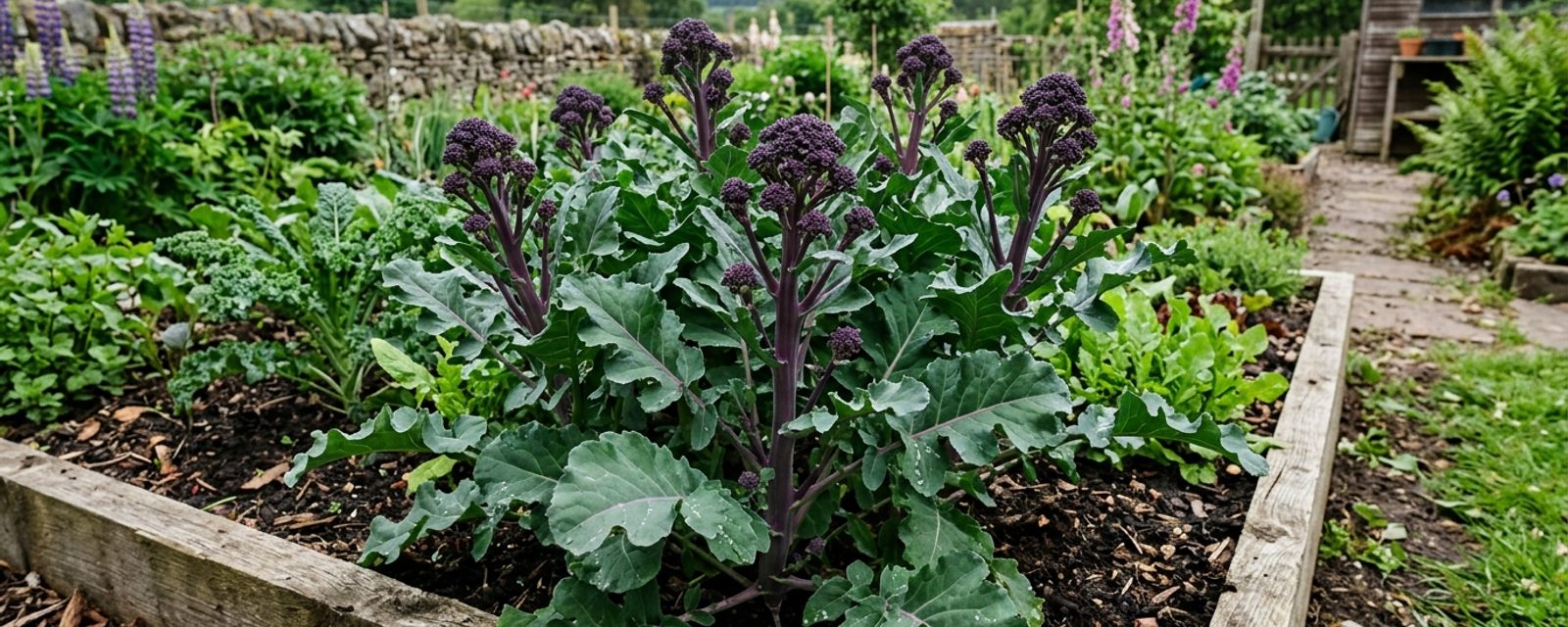
You sow this crop in spring, and then you wait. Not for a few weeks like a lettuce or a radish, but for the best part of a year, through summer, autumn, and the worst of a Scottish winter, before the plant gives you anything to eat. The reward for that patience lands at exactly the right moment: February and March, the "hungry gap" when the polytunnel is bare, the leeks are finished, and nothing else on the plot is ready. A well-chosen sprouting broccoli variety fills that gap with fresh purple spears, picked a few at a time over several weeks, right when there's least else to harvest.
Quick answer
Red Fire is the strongest all-round choice for Scotland: it holds RHS Award of Garden Merit status, carries the top H5 hardiness ratingThe RHS's H1a–H7 scale for how much cold a plant can survive outdoors, H1a being tender indoor-only and H7 hardy anywhere in the UK. Full definition →, and is the only one of the five recommended varieties with an explicit "over-winters well" claim on its own listing. Choose Claret instead if heavy side-shoot yield matters more to you than winter toughness, or Mendocino if you want an earlier, non-overwinteredKeeping a plant alive and intact through the cold months, whether left outdoors, moved under cover, or stored dormant. Full definition → summer crop rather than a spring hungry-gap harvest.
Sprouting broccoli, not calabrese
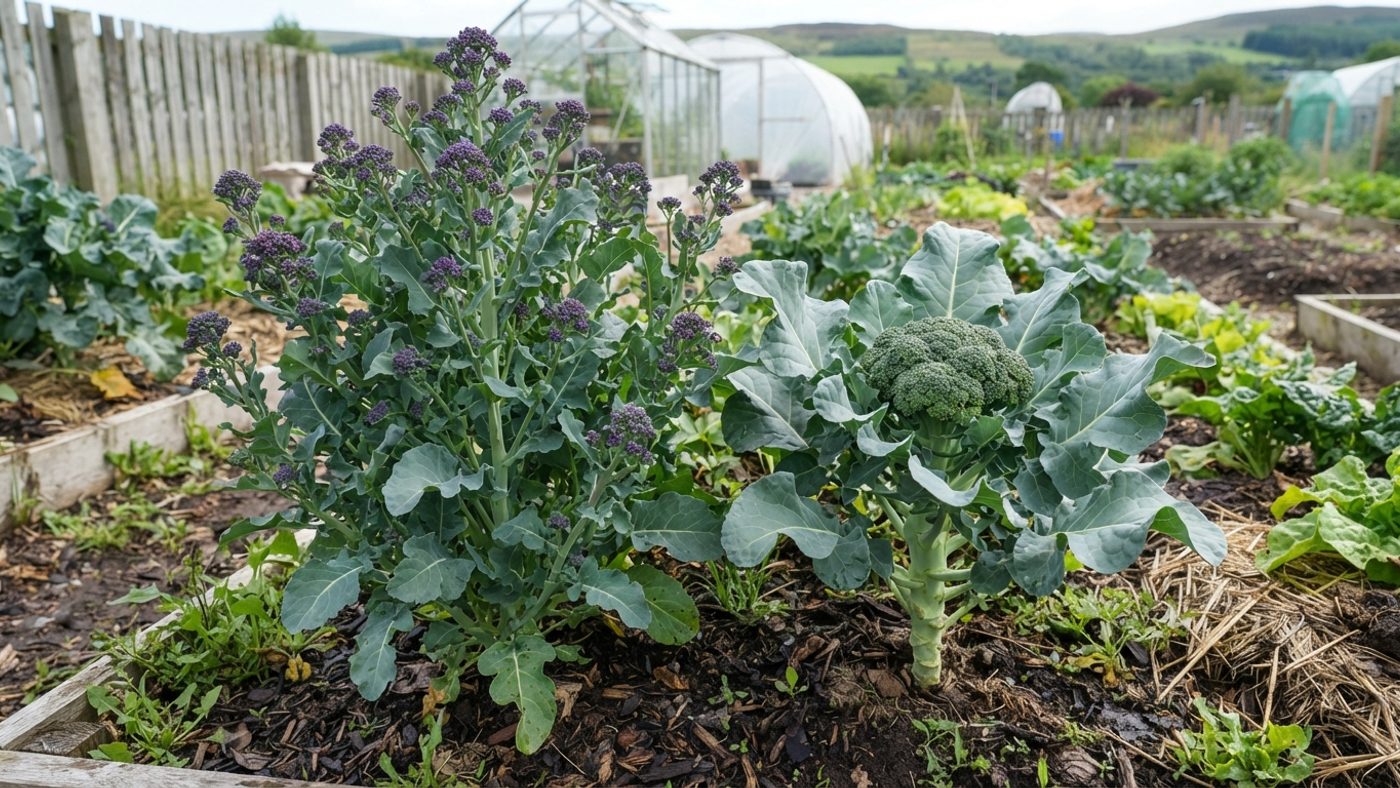
The "broccoli" on supermarket shelves, a single large green head, is calabrese. What this article covers is a different plant: sprouting broccoli, which produces small clusters of usually purple buds on the tips of long, leafy stems, picked repeatedly over weeks rather than cut once. It's the sprouting type that copes with a Scottish winter and delivers a hungry-gap harvest; calabrese doesn't offer that.
The five recommended varieties compared
Five recommended varieties exist. Four carry the RHS Award of Garden Merit (AGMThe RHS's Award of Garden Merit: a UK-wide trials award for reliable performance, not a Scotland-specific recommendation. Full definition →); one doesn't. Hardiness ratings split the AGM group too: H5 means hardy through severe UK winters (-15 to -10°C), H4 means hardy through most of the UK but not the harshest winters (-10 to -5°C). Purple sprouting broccoli as a type is rated hardy to around -12°C, within that same H4-H5 band.
| Variety | AGM | Hardiness | Harvest window | Notable trait |
|---|---|---|---|---|
| Cardinal | Yes | H5 | Spring to early summer | Large, deep-purple spears; crops over a long period |
| Claret | Yes | H4 | Late spring to early summer | Extremely vigorous, heavy-cropping, large tender shoots |
| Mendocino | Yes | H5 | July through to the following May | Early maincropThe main, usually latest-sown and longest-growing type of a crop, grown for bulk and storage rather than an early harvest. Full definition →; August planting gives March–April harvest |
| Red Fire | Yes | H5 | October to March | "Over-winters well and easy to pick", explicit overwintering claim |
| Red Admiral | No | H4 | Autumn to spring; crops from November | Vigorous, high-quality spears, but no AGM |
Red Admiral is a decent variety in its own right, vigorous, cropping from as early as November, but it carries no AGM badge on its own listing. The gap between it and the four AGM varieties is real enough to matter when you're choosing.
Which one for your situation
Hardiness and a genuine overwintering track record matter most here, more than spear size or AGM status alone.
Red Fire is the best overall pick. It combines H5 hardiness with the most explicit overwintering language of any of the five: it "over-winters well and easy to pick," with an "excellent flavour and texture," on a harvest window running October to March that lands squarely in the hungry gap. Cardinal and Mendocino share the same H5 rating and are strong alternatives, but neither carries as direct an overwintering statement on its own listing.
Claret wins if yield is your priority and you can accept lower hardiness. It's "extremely vigorous" and "heavy-cropping," with large tender shoots, a genuine advantage for anyone wanting maximum side-shoot production, though that vigour also means giving it the wider end of broccoli's 60-80cm spacing range rather than crowding it in. Its H4 rating means it's hardy through most of the UK but not rated for the most severe winters, so it's worth pairing with a sheltered spot rather than the most exposed corner of the plot.
Mendocino suits a different goal entirely: an earlier, non-overwintered crop. Sown April to June and transplanted June to July, it can be treated as an early maincrop harvesting from July, rather than held over winter for a spring cut. An August planting also gives an early harvest between March and April, a middle path between a full overwinter and a summer crop, if timing your sowing that way suits your plot.
Cardinal sits as a solid, dependable H5 option with large, deep-purple spears and a long cropping period, a safe choice if Red Fire isn't available. Red Admiral remains usable for an autumn-into-spring crop, but without AGM backing or the H5 rating, it's a step down from the four recommended AGM varieties for a Scottish hungry-gap planting.
Soil, pests, and the growing guide
None of the five varieties above is documented as clubroot- resistant, so lime, modulesA tray divided into small individual cells, each sown with its own seed or seedling, so each plant grows undisturbed roots until it's ready to plant out. Full definition →, and rotationMoving each crop family to different ground each year, on a multi-year cycle, so pests and diseases that build up in soil don't get a repeat host. Full definition → carry the full weight of prevention whichever you grow. Broccoli prefers a soil pH of 6 to 7; on acidic soil, common in Scotland, applying lime the winter before sowing helps correct that and deter clubrootA soil-borne fungal disease of the brassica family that swells and distorts roots, and survives in soil for years. Full definition →, one of the more serious risks with this crop. Starting plants in modules rather than direct-sowing also reduces clubroot exposure, and rotating brassicasThe cabbage family: cabbage, kale, broccoli, cauliflower, Brussels sprouts, kohlrabi, swede, turnip and more, sharing the same pests, diseases and rotation rules. Full definition → around the plot rather than replanting the same ground each year is the other main defence. Watch too for cabbage white caterpillar, cabbage root fly, flea beetle, slugs, and birds and pigeons, netting the crop from the day it's planted out deals with the caterpillars and pigeons together. A tall, months-long standing crop also needs staking against wind once autumn gales set in. Hot weather can trigger bolting in broccoli, which is treated as a cool-summer crop risk. Once the central spear is cut, harvesting it regularly is what keeps side-shoots coming, leave spears too long and the plant stops producing as many. For full sowing dates, spacing, staking, and harvest technique, see the broccoli growing guide.
Common questions
Is purple sprouting broccoli the same as the broccoli in supermarkets?
No. Supermarket broccoli is calabrese, a single large green head cut once. Purple sprouting broccoli produces small purple bud clusters on long stems, picked repeatedly over several weeks.
Which broccoli variety is most likely to survive a Scottish winter?
Red Fire and Cardinal both carry the top H5 hardiness rating and the RHS Award of Garden Merit, but Red Fire is the only one with an explicit "over-winters well" statement on its own listing.
Does Red Admiral have the RHS Award of Garden Merit?
No. Red Admiral is listed among the recommended varieties but does not carry AGM status, unlike Cardinal, Claret, Mendocino, and Red Fire.
Why does soil pH matter for broccoli in Scotland?
Broccoli prefers a soil pH of 6 to 7. Scotland's soils are often naturally acidic, which raises clubroot risk; applying lime the winter before sowing helps correct this.
Can I grow broccoli for a summer harvest instead of overwintering it?
Yes. Mendocino is suited to this: sown April to June and transplanted June to July, it can be treated as an early maincrop cropping from July, rather than held over winter.
Sources
7 sources, recorded with what each was used for
- Broccoli: grow your own: The sprouting-vs-calabrese distinction, the five recommended varieties list, and grow-your-own variety summaries
- Brassica oleracea (Italica Group) 'Cardinal': AGM status, hardiness rating, and plant description
- Brassica oleracea (Italica Group) 'Claret': AGM status, hardiness rating, and plant description
- Brassica oleracea (Italica Group) 'Mendocino': AGM status, hardiness rating, sowing/harvest timing, and overwintering note
- Brassica oleracea (Italica Group) 'Red Fire': AGM status, hardiness rating, sowing/harvest timing, and overwintering claim
- Brassica oleracea (Italica Group) 'Red Admiral': Confirms the absence of AGM status, hardiness rating, and plant description
- How to grow purple sprouting broccoli: The -12°C cold tolerance figure and soil pH/lime guidance