
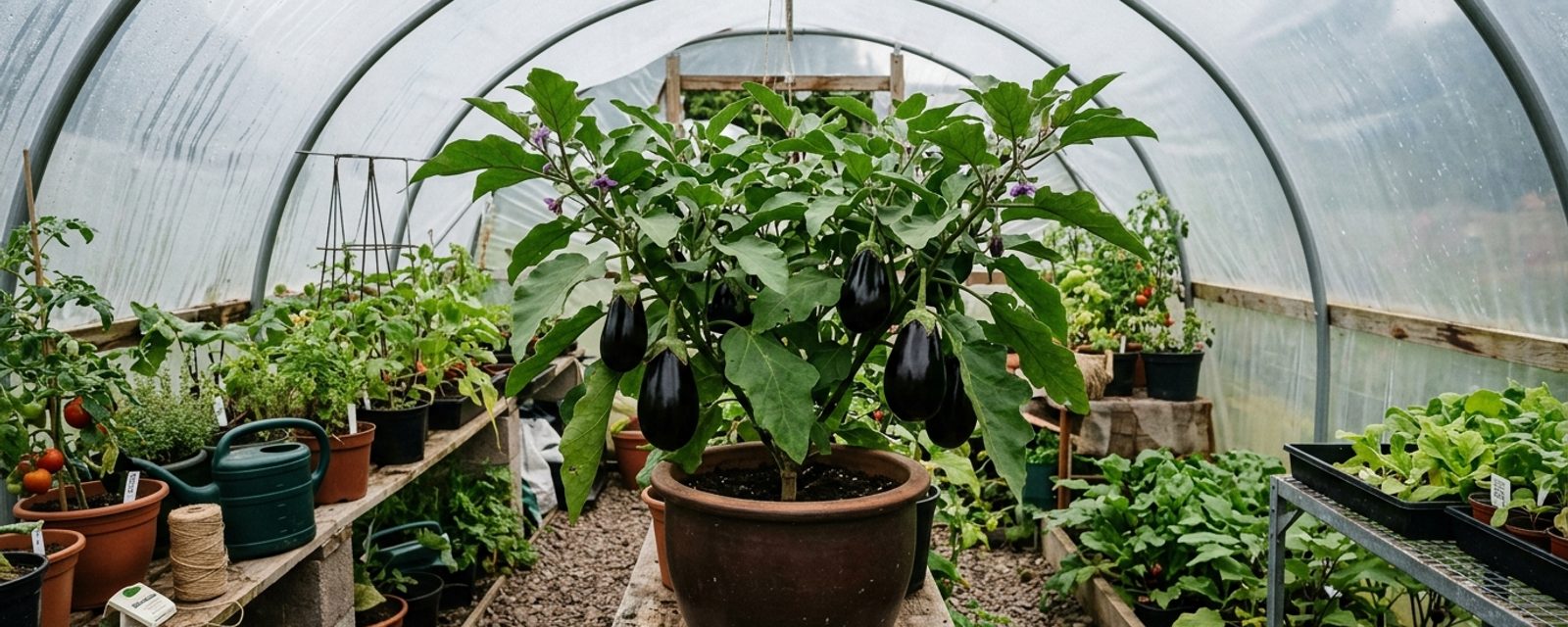
Solanum melongena
Aubergines need at least five months from sowing to harvest even in their best outdoor conditions, close to a season Scotland doesn't reliably give — which is exactly why variety choice matters so much here.
Five months is the number worth sitting with. Sown as early as January or February, that puts an outdoor harvest right up against, or past, when a Scottish autumn turns. A greenhouse or polytunnel doesn't just help this crop along, it's realistically what makes that five months achievable at all.
Sowing
Buying a graftedJoining a chosen fruiting variety onto a separate rootstock, so the tree grows the fruit of one plant on the roots of another. Full definition → plant instead of sowing from seed is a real option worth weighing, see Grafted Vegetable Plants in Scotland → for what grafting actually buys a grower here and when it's worth the extra cost.
Sow indoors from January in a heated greenhouse or conservatory, usually from February for an unheated greenhouse, or early March if you're aiming for eventual outdoor growing. Seed needs at least 21°C to germinateA seed sprouting: breaking dormancy and putting out its first root and shoot, given the right warmth and moisture. Full definition →, then 16-18°C once through, on a warm, bright windowsill. Prick seedlings out into their own 7.5cm pot or moduleA tray divided into small individual cells, each sown with its own seed or seedling, so each plant grows undisturbed roots until it's ready to plant out. Full definition → once the first true leaves appear.
Planting
Plant into a heated greenhouse in April, an unheated greenhouse in early May, or outdoors from late May or early June once frost has passed, only in very mild locations or a long, hot summer, and even then in the hottest, sunniest spot available. Enrich the soil with garden compost or well-rotted manure two weeks ahead, or mulchA layer of material spread over the soil around plants to suppress weeds, retain moisture, and improve soil structure as it breaks down. Full definition → the surface for a no-digA growing method that avoids turning the soil over, building fertility instead by adding organic matter on the surface. Full definition → bed. Space plants around 60cm apart in the ground; Gardener's World gives a tighter 40cm for the same crop, a genuine disagreement worth knowing. Plant at the same depth the seedling was growing at, insert a support cane straight away, and cover outdoor plantings with clochesA small, portable clear cover placed over an individual plant or short row to trap warmth and keep off wind, rain and pests. Full definition → or plastic-free fleeceA lightweight, breathable fabric laid or draped over plants to trap a little warmth and keep off frost, wind and some flying pests. Full definition → for a couple of weeks.
In containers, use a pot at least 30cm wide, one plant to a pot, or two in a standard growing bag.
Varieties
All three varieties below carry the RHS Award of Garden Merit, a UK-wide award rather than a Scottish one.
RHS also lists 'Clara' with AGMThe RHS's Award of Garden Merit: a UK-wide trials award for reliable performance, not a Scotland-specific recommendation. Full definition →, its early-maturing trait already covered by Bonica and Kaberi. Gardener's World names five entirely different varieties (Moneymaker, Fairy Tale, Little Fingers, Melanzana Violetta di Firenze, Asian Bride), with no overlap and no AGM confirmation for any.
★ Our pick for Scotland
BonicaAGM
Early cropping, large glossy black fruit, suited to unheated glasshouses
The early pick built for an unheated greenhouse.
Why this one: It's specifically suited to an unheated glasshouse, which matches how most Scottish growers actually run a greenhouse or polytunnel, and pairs that with early cropping, the trait that matters most against this crop's demanding five-month season.
Also worth considering
KaberiAGM
Compact, thornless, bred for containers, fast-maturing egg-sized fruit
Combines two traits that matter here at once: compact enough for container growing where greenhouse space is tight, and fast-maturing, which helps against the same season pressure Bonica's earliness addresses from the other direction.
GalineAGM
Compact, ideal for containers, small glossy egg-shaped fruit
A second compact/container variety alongside Kaberi, worth including since container growing is the realistic route for many Scottish growers working with limited greenhouse or polytunnel space.
Best Aubergine Varieties for Scotland → compares all named aubergine varieties head-to-head, with the practical detail that doesn't fit in a summary card.
Care
Keep up a steady supply of moisture: container plants may need watering daily in hot weather, and inconsistent watering brings on blossom end rot. Mist the leaves regularly, ideally twice a day, with tepid water, which also helps discourage red spider mite. Feed container plants every two weeks with an organic high-potassium liquid fertiliser once the first flowers appear, at reduced strength compared with tomatoes since aubergines grow more slowly; ground-grown plants in enriched soil often need none at all.
Pinch outRemoving the soft growing tip of a stem to stop upward growth and make the plant branch out sideways instead. Full definition → the tip of the main stem to encourage bushier, more productive side-shoots once the plant reaches around 30cm tall; Teagasc pinches earlier, at about 20cm, with a possible second pinch at 40cm if new growth keeps running tall rather than branching out. Tie the main stem to a sturdy cane as it grows, adding further support for side-shoots once fruit starts to form.
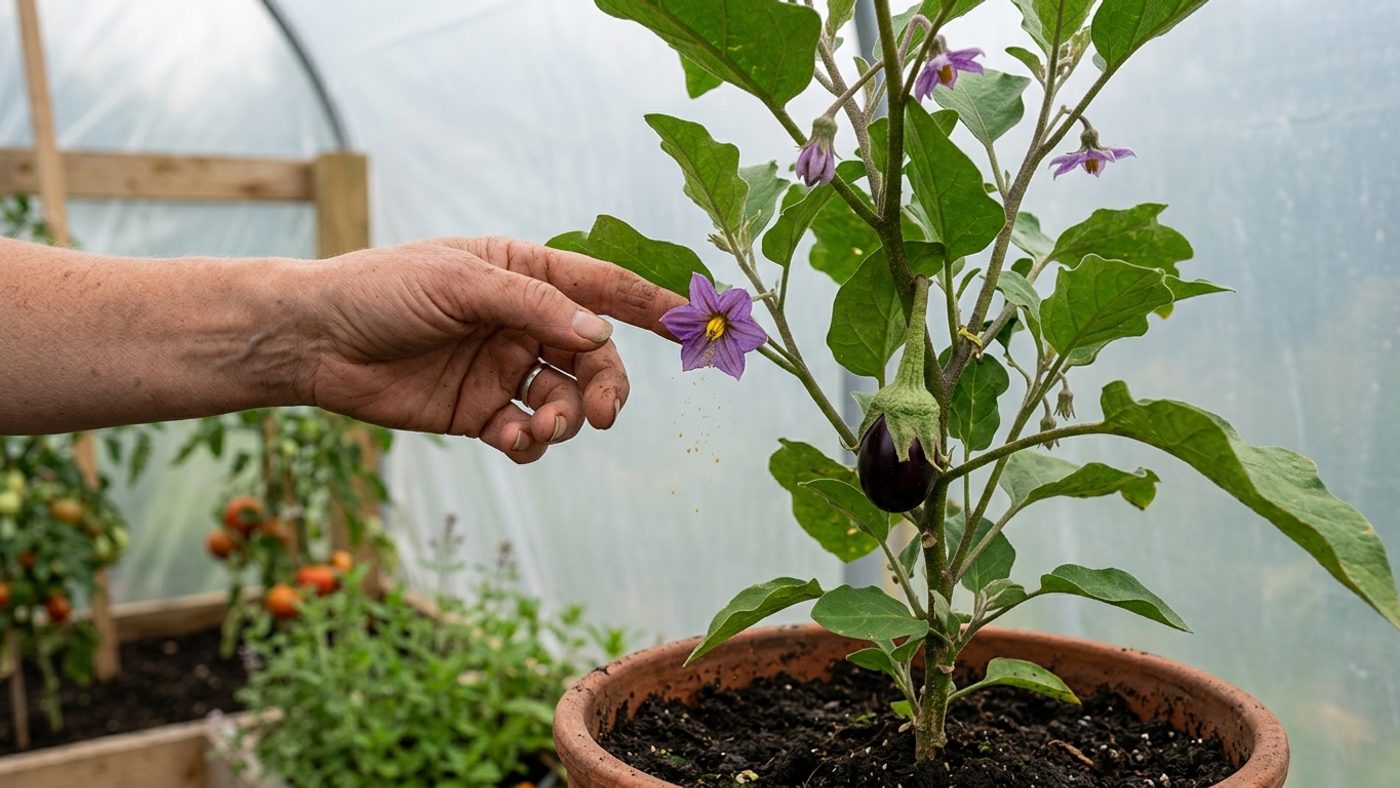
Open greenhouse vents on warm days while plants are in flower so pollinating insects can reach them, or help things along by gently tapping or shaking the flowers yourself to release pollen, particularly useful in a closed greenhouse with little insect access.
For larger varieties, once five or six fruits have started to form, remove any further flowers so the plant's energy concentrates into the fruit already set. Remove any new fruits that appear after late summer, since they're unlikely to ripen in time.
Harvesting
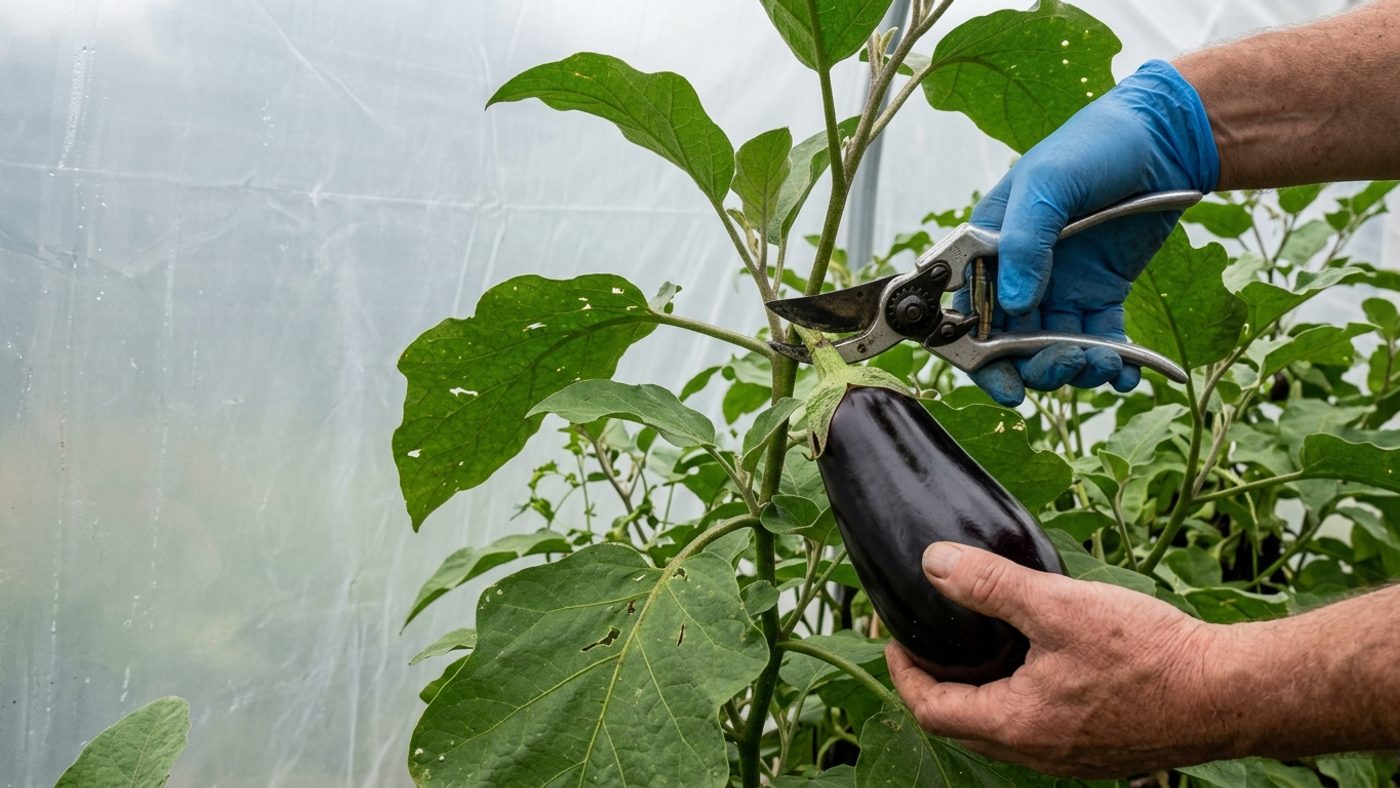
Ready from August onwards. Pick fruit as soon as it's full-sized, ripe and well-coloured with a glossy skin; a dulling skin means it's over-ripe and the flesh may turn bitter. Cut with a sharp knife or secateurs, leaving about 2cm of stalk on the fruit. Picking regularly encourages more to develop. Aubergines keep for about two weeks refrigerated, though they're at their best used promptly.
Common problems
- Aphids are a genuine risk on this crop, checked for regularly along with other sap-sucking insects.
- Glasshouse whitefly feeds on sap and leaves sticky honeydew behind.
- Blossom end rot follows inconsistent watering.
See more problems
- Red spider mite is worse in dry conditions; regular misting helps deter it.
- Poor fruiting often comes down to a summer that wasn't warm enough, or a spot that's too cold, particularly for anything attempted outdoors.
Common questions
Can aubergines actually ripen outdoors in Scotland?
It's a genuine stretch: outdoor sowing-to-harvest takes at least five months plus the hottest, sunniest spot available, which a Scottish season rarely allows; a greenhouse or polytunnel is what makes that timeline realistic. Full sourced breakdown: <a href='/tools/garden-myths/aubergines/'>Aubergine Myths →</a>
At what height should I pinch out an aubergine plant?
Sources genuinely disagree: RHS says around 30cm, Teagasc says about 20cm with a possible second pinch at 40cm. Pinch once in that range and consider a second pinch if the plant keeps growing tall rather than branching. Full sourced breakdown: <a href='/tools/garden-myths/aubergines/'>Aubergine Myths →</a>
Should I leave every aubergine flower to try for more fruit?
Not late in the season: remove new fruits that appear after late summer, since they're unlikely to ripen in time and just spend the plant's remaining energy on fruit that won't mature. Full sourced breakdown: <a href='/tools/garden-myths/aubergines/'>Aubergine Myths →</a>
Does leaving more fruit per stem give a bigger total harvest?
No, the opposite if size matters: thin fruit to one or two per stem to grow them bigger, and for larger varieties stop new flowers once five or six fruits have set. Full sourced breakdown: <a href='/tools/garden-myths/aubergines/'>Aubergine Myths →</a>
Sources
3 sources, and what each was used for
- RHS: the under-cover recommendation and its outdoor caveats including the five-month season requirement, sowing method and temperature, transplant timing for heated/unheated greenhouse/outdoor routes, spacing, container growing, watering and its mite-deterring misting technique, feeding, support, pinching out, pollination via greenhouse ventilation, fruit-number management and late-summer flower removal, harvesting method, four named AGM varieties, aphids, red spider mite, whitefly
- Teagasc: independently corroborates germination temperature (21-25C) and reduced feeding strength versus tomatoes; gives a genuinely different pinching height (20cm, then a second pinch at 40cm) against RHS's 30cm, shown as a real disagreement; adds fruit-thinning to 1-2 per stem, the 2cm-stalk harvest detail, blossom end rot's link to inconsistent watering, and a storage figure (about two weeks refrigerated) that RHS's page doesn't give at all
- gardenersworld.com: gives a different spacing figure (40cm) against RHS's 60cm, shown as a genuine disagreement; adds hand-pollination by tapping or shaking flowers as an alternative to relying on greenhouse ventilation alone; gives yield figures (six fruits per plant for larger varieties, ten for smaller) more precise than RHS's 'five or six'