
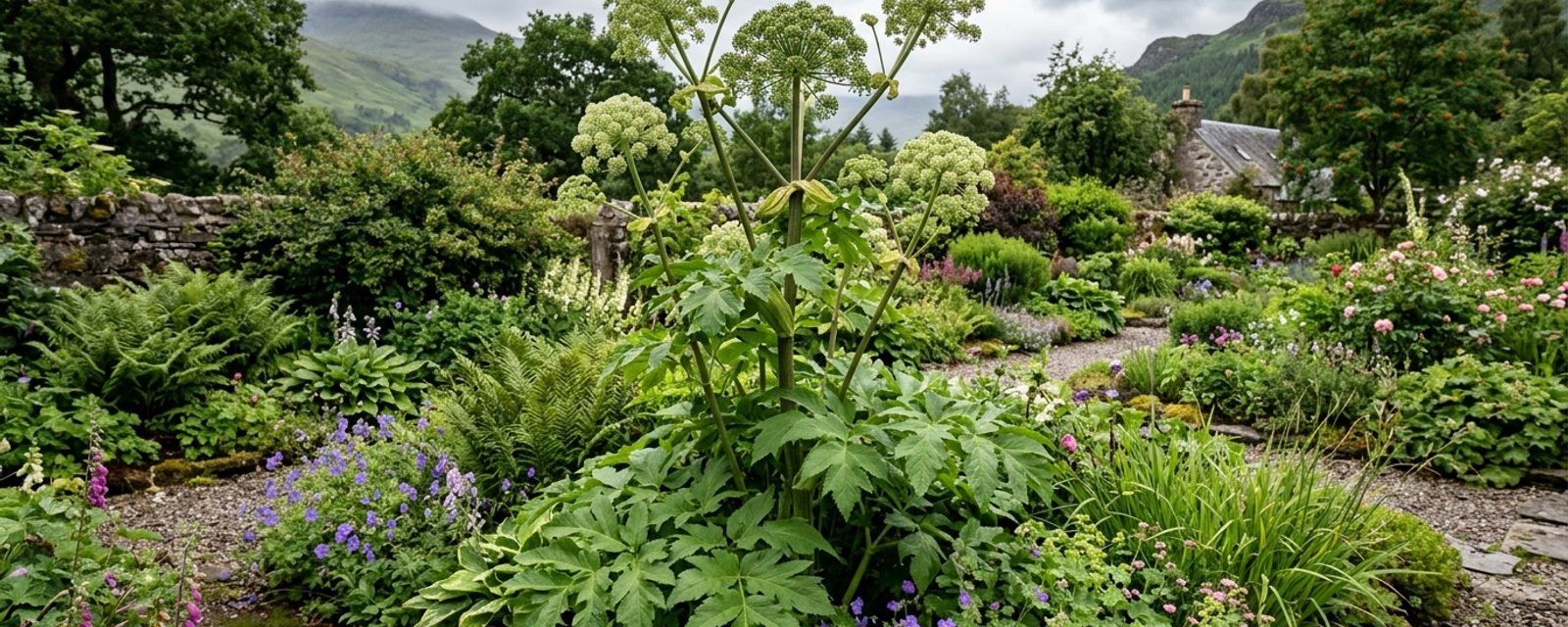
Angelica is a short-lived giant: it spends its first two to five years building a thick tap rootA single, thick, dominant root growing straight down from a plant, storing energy and anchoring it, as opposed to a spreading mass of fine roots. Full definition → and a rosette of leaves, then throws up a single towering flower spike, sets seed, and dies, a monocarpic life cycle it shares with only a handful of garden plants. That trait matters more than hardiness when picking a form, because every named angelica eventually follows the same script regardless of variety. What does vary is how the plant behaves along the way, and Scotland's climate happens to suit the genus unusually well: cool growing conditions are directly preferred by angelica, which lines up with the cooler, wetter summers typical of Scotland. The real choice facing a Scottish gardener isn't which form survives the winter, several share the same top hardiness ratingThe RHS's H1a–H7 scale for how much cold a plant can survive outdoors, H1a being tender indoor-only and H7 hardy anywhere in the UK. Full definition →, it's whether you want to eat it or simply look at it, and which size and flowering season fits the space you have.
Quick answer
For most Scottish gardens wanting a genuinely useful plant, Angelica archangelica is the best overall pick: it's the classic culinary species, fully hardy (H6, down to -20°C), and its softer stems and leaves make it the easiest of the group to actually cook with. If you want angelica purely for its flowers and don't need to eat it, Angelica gigas wins instead, with the most dramatic deep purple-plum flower heads of any form; for a small border where the full-size species would swamp everything else, Angelica sylvestris 'Ebony' is the better choice, staying under a metre tall while carrying near-black foliage and the RHS Award of Garden Merit.
The culinary vs ornamental split
Only two of the six named forms are grown for eating: A. archangelica and A. edulis. Both are fully hardy and share the same broad culinary uses, candied stems, flavouring for liqueurs, a pairing with rhubarb and stewed fruit, but archangelica has the softer, more tender stems and leaves, which is why it's the species most commonly recommended for the kitchen.
The other four forms, A. sylvestris, A. gigas, A. sylvestris 'Ebony', and A. sylvestris 'Vicar's Mead', are ornamental or wildlife plants, not food. They're grown for architectural height, flower colour, foliage, or pollinator value, and none of them is the plant to reach for if you're after angelica for the table. For self-seeding, deadheadingRemoving spent flowers before they set seed, which redirects a plant's energy into further flowering rather than seed production. Full definition →, and sowing timing, the full growing guide covers all three in detail.
Comparing the six forms
| Variety | Hardiness | Height | Culinary or ornamental | Flowering time |
|---|---|---|---|---|
| A. archangelica | H6 (-20 to -15°C) | 1.5–2.5m | Culinary | Early–midsummer |
| A. edulis | H6 (-20 to -15°C) | 2.5–4m | Culinary | Early–midsummer |
| A. sylvestris (wild angelica) | H5 | 1.5–2.5m | Ornamental / wildlife | Late summer–early autumn |
| A. gigas | H6 (-20 to -15°C) | 1.5–2.5m | Ornamental | Late summer–early autumn |
| A. sylvestris 'Ebony' | H5 | 0.5–1m | Ornamental | Late summer |
| A. sylvestris 'Vicar's Mead' | H5 | 1–1.5m | Ornamental | Late summer–autumn |
A. edulis is the outlier for scale, reaching up to 4m on a hollow flower stem. Wind is a real risk at that height in an exposed garden, common on Scotland's coasts and in upland gardens, and staking angelica in exposed sites is worth doing rather than assuming the stem will hold itself up unsupported; it's worth doing for archangelica too once the flower spike starts to rise.
Which one for your situation
- Want to cook with it: A. archangelica for tender stems and leaves, or A. edulis if you have the space for its considerably larger frame and want the same culinary uses.
- Want the most dramatic flowers: A. gigas, with domed umbels (the flat-topped, umbrella-shaped flower clusters typical of the carrot family) in deep purple-plum rather than the greenish-white typical of the genus. It also draws pollinators well.
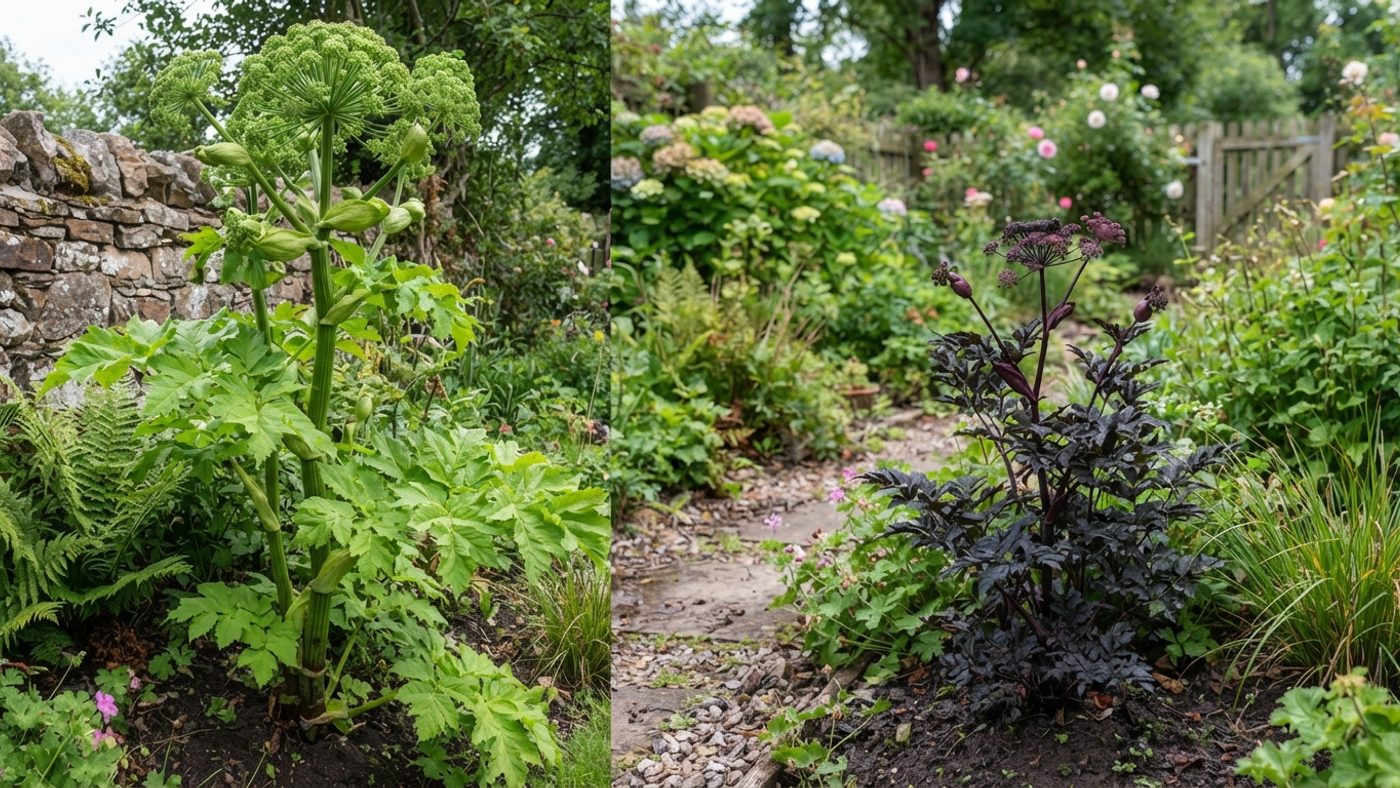
- Small border, limited space: A. sylvestris 'Ebony', under a metre tall, with near-black dividedPropagating a clump-forming perennial by digging it up and splitting it into several smaller pieces, each with roots and shoots attached. Full definition → foliage that carries the display even before the pink-grey flowers open, and the only one of the six forms to hold the RHS Award of Garden Merit. Like the rest of the genus it's still monocarpic, so its display is one good season rather than a permanent fixture.
- Wildlife or meadow planting: A. sylvestris, the true wild form, tolerant of a broader range of soil conditions than the cultivated forms and flowering later in the season when many other carrot-family plants (umbellifers) are past their best.
- A middle-height ornamental: A. sylvestris 'Vicar's Mead', bridging the gap between 'Ebony' and the full-size wild species at 1–1.5m, with large pink-purple flower heads on upright purple stems.
Soil pH
Angelica isn't fussy about pH: the individual plant pages for archangelica, edulis, and 'Ebony' all show tolerance for acid, alkaline, and neutral soils. No exact range is published to target, so treat a soil test result as reassurance rather than a figure to aim for.
Handling angelica safely
Angelica's sap can irritate skin and cause burns in sunlight, a reaction common across the carrot and celery family it belongs to. Wear gloves and cover exposed skin when cutting or handling stems on a sunny day. Foraging wild angelica isn't advisable, since it can be confused with several toxic look-alike species, stick to plants you've grown or bought rather than picking from the wild.
Pests
Aphids, slugs and snails, powdery mildew, and celery leaf mining fly are the pests to watch for, and Scotland's damp summers keep slugs, snails, and mildew especially active, worth checking young growth after wet spells regardless of which form you've planted. All six named forms carry the same pest risk. See the full growing guide for detail on managing each of these.
Common questions
Which angelica should I grow if I want to eat it?
A. archangelica for the more tender stems and leaves, or A. edulis if you want a taller plant with the same culinary uses. The other named forms are ornamental only and aren't grown for the kitchen.
Is the sap actually dangerous?
It can irritate skin and cause burns in sunlight through a reaction common to the carrot and celery family. Cover up and wear gloves when cutting stems in sun; this isn't unique to angelica among umbellifers.
Does 'Ebony' still die after flowering like the others?
Yes. 'Ebony' is monocarpic like every other form here, it flowers once, typically in its first or second year given its shorter time to maturity, then dies. Its Award of Garden Merit reflects its garden merit while alive, not any exemption from the life cycle.
Does angelica need staking?
Not always, but it's worth doing in an exposed or windy spot, especially for the taller forms. A. edulis can reach 4m on a hollow stem, and staking angelica generally is recommended once plants are sited somewhere exposed rather than sheltered.
Is angelica likely to be confused with dangerous plants in the garden?
The real risk is around foraging wild angelica, which can be confused with toxic look-alikes. Grown deliberately from known seed or plants, this isn't a concern for the forms compared here.
Sources
9 sources, recorded with what each was used for
- How to grow angelica: Cool-climate preference, culinary vs ornamental grouping, staking advice
- Angelica archangelica plant details: Hardiness, size, maturity time, culinary use
- Angelica edulis plant details: Hardiness, size, pest/disease notes
- Angelica sylvestris plant details: Hardiness, size, flowering time, wildlife use
- Angelica gigas plant details: Flower colour, ornamental use, pollinator value
- Angelica sylvestris 'Ebony' plant details: Size, AGMThe RHS's Award of Garden Merit: a UK-wide trials award for reliable performance, not a Scotland-specific recommendation. Full definition → status, foliage
- Angelica sylvestris 'Vicar's Mead' plant details: Size, flower description
- Giant hogweed: Checked for angelica look-alike risk
- How to grow angelica: Sap irritant warning, foraging caution, culinary uses