
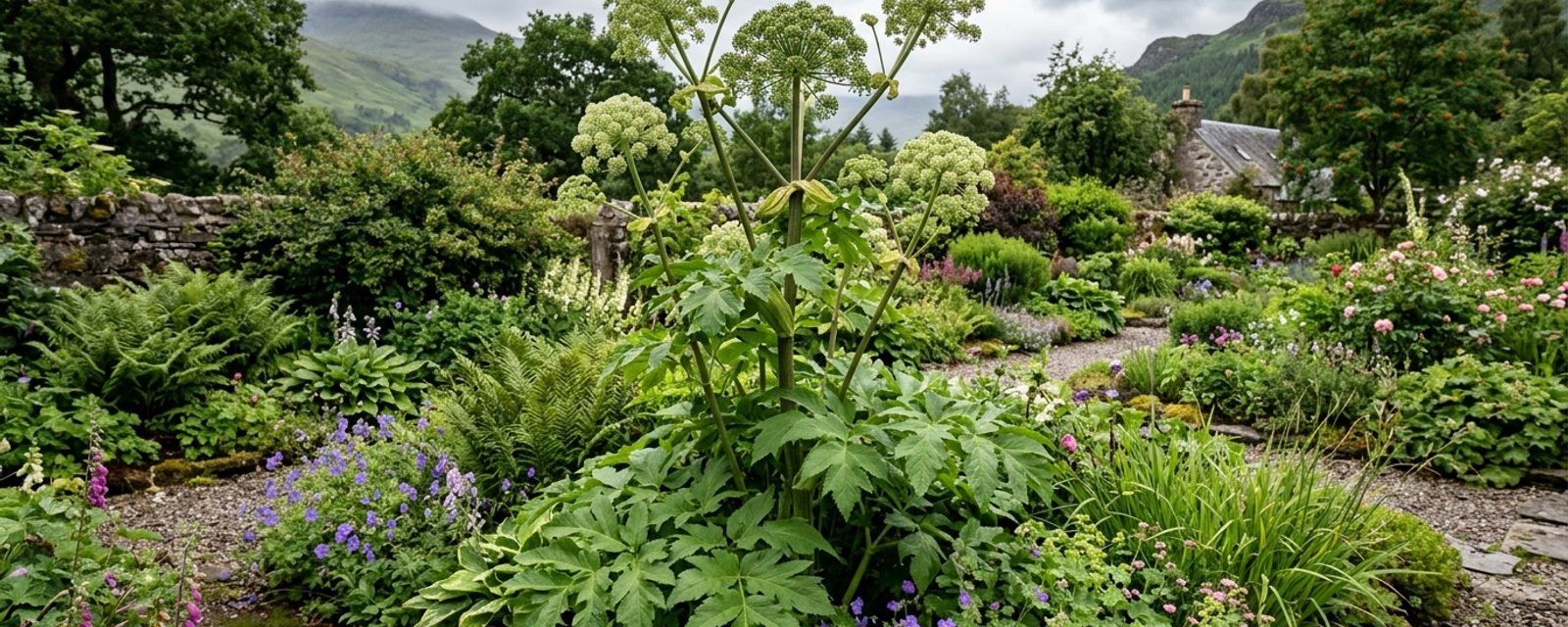
Angelica archangelica
Angelica genuinely prefers cool, damp conditions, a real climate match for Scotland, but it comes with two catches: the plant can die after its first flowering, and it can't be grown in a pot at all.
It's a tall, statuesque biennialA plant that completes its life cycle over two years: growth in year one, then flowering, seeding and dying in year two. Full definition → or short-lived perennial, reaching two to three metres, which rules it out for a small border on size alone before climate even enters the picture. A deep tap rootA single, thick, dominant root growing straight down from a plant, storing energy and anchoring it, as opposed to a spreading mass of fine roots. Full definition → is what makes container growing impossible, and what lets the plant reach that height from a single season's growth once established.
Site and soil
Partial shade suits it best, or a sunny border if it's mulchedA layer of material spread over the soil around plants to suppress weeds, retain moisture, and improve soil structure as it breaks down. Full definition → well. Soil should be moist but well-drained, ideally forked through with well-rotted organic matter before planting; avoid very sandy soil and hot, exposed sites, since angelica dislikes drying out. Space plants 60-90cm apart, giving that deep tap root room to run straight down rather than trying to work around a container.
Sowing and planting
Sow fresh seed on the surface of peat-freeCompost made without peat, which is harvested from a slow-forming, carbon-storing wetland habitat that peat extraction damages. Full definition → compost mixed with 30% horticultural sand, uncovered since light is needed to germinateA seed sprouting: breaking dormancy and putting out its first root and shoot, given the right warmth and moisture. Full definition →, at 10-13C in a cold frame or unheated greenhouse; germination takes one to three months. Dried seed needs cold stratification at 4C for four to six weeks first. Either way, expect two to three years to first flowering. Autumn sowing is also an option, direct into the soil or in modulesA tray divided into small individual cells, each sown with its own seed or seedling, so each plant grows undisturbed roots until it's ready to plant out. Full definition →. Plant young plants late winter to early spring, at the same depth as the pot, and apply a 6-10cm mulch layer.
Care through the year
Water during dry spells for good stem growth, and mulch again with well-rotted compost in early spring; no supplemental feeding is needed otherwise. Angelica archangelica is monocarpic and typically dies after flowering; cutting off flower stems before they set seed often lets the plant last a second year instead.
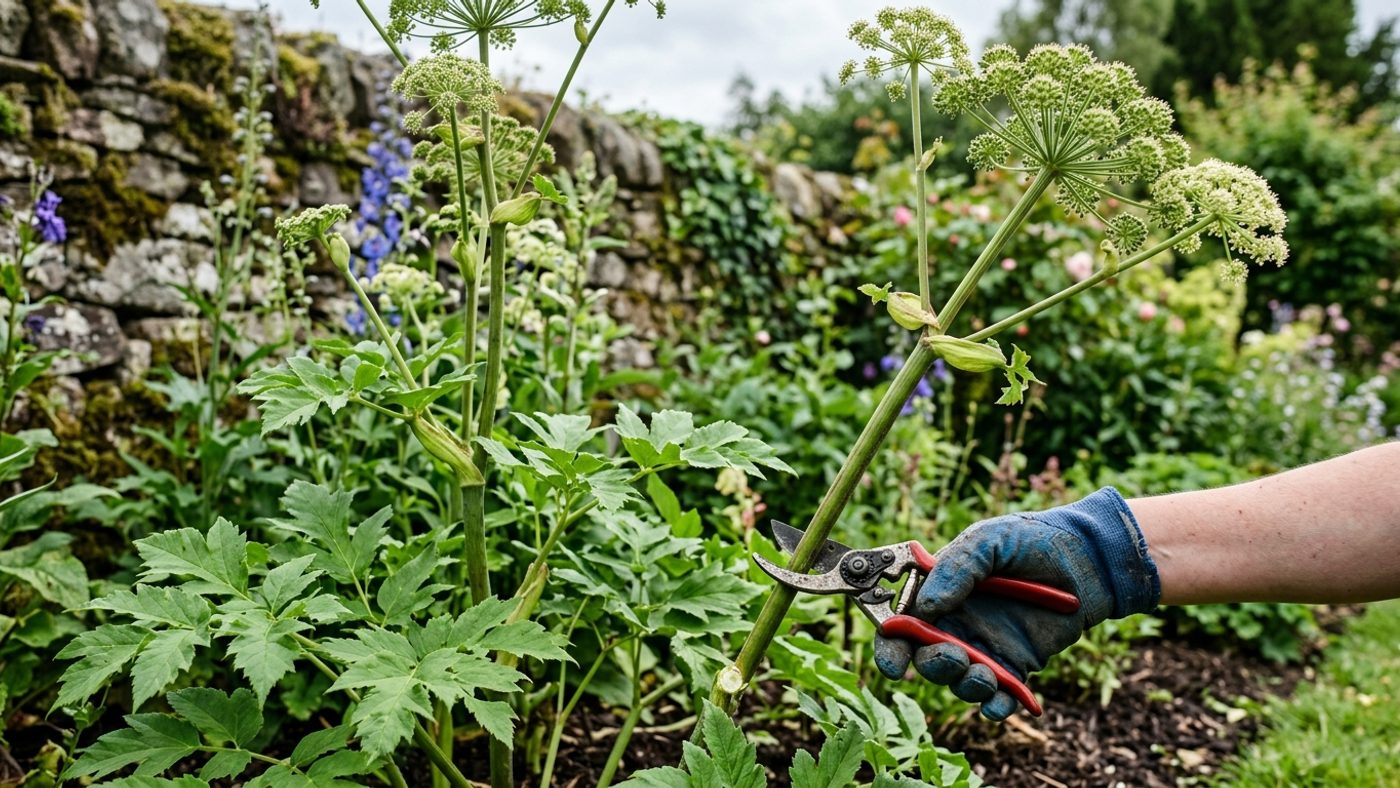
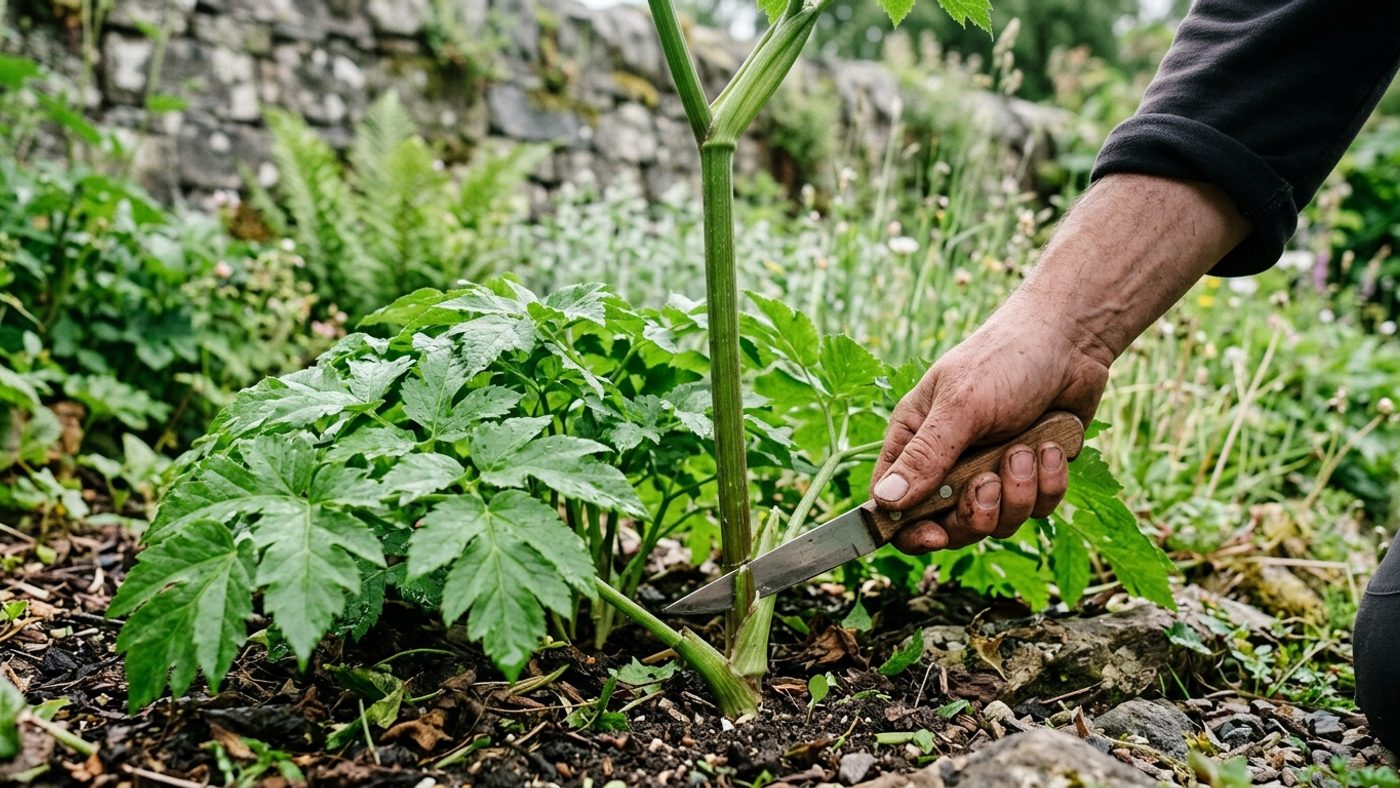
Left to flower and seed, it self-seeds readily, so new seedlings can appear in a border on their own. Propagate by divisionPropagating a clump-forming perennial by digging it up and splitting it into several smaller pieces, each with roots and shoots attached. Full definition → too: cut back stems and dig up the plant in autumn of its second year, dividing the roots with a sharp knife.
Harvesting
Harvest young, tender stems in late spring, before flower stalks form, from Angelica archangelica specifically for the best culinary result.
Varieties
Angelica archangelica is the direct culinary recommendation, H6The RHS's H1a–H7 scale for how much cold a plant can survive outdoors, H1a being tender indoor-only and H7 hardy anywhere in the UK. Full definition →-hardy and preferred over five other forms (A. edulis, A. sylvestris, A. gigas, A. sylvestris 'Ebony', A. sylvestris 'Vicar's Mead'). A. edulis is also culinary; the rest are wildflower-meadow and ornamental, not culinary — 'Ebony' is the only one of the six to carry the RHS Award of Garden Merit.
★ Our pick for Scotland
Angelica archangelica
The culinary species · H6 · softer stems and leaves
The preferred culinary type, with softer stems and leaves than the wilder species, and a genuine H6 hardiness rating.
Why this one: No AGMThe RHS's Award of Garden Merit: a UK-wide trials award for reliable performance, not a Scotland-specific recommendation. Full definition → award exists for either culinary angelica (only the ornamental A. sylvestris 'Ebony' carries one). H6 confirms it comfortably outlasts a Scottish winter, and softer stems and leaves make it the better culinary harvest than Angelica gigas.
Also worth considering
Angelica gigas
Dark red stems · deep purple-plum flowers
A genuinely different plant from the culinary species, not just a colour variant: grown as a dramatic ornamental border plant rather than for eating, for a gardener after a striking flower head over a culinary stem harvest.
Best Angelica Varieties for Scotland → compares all named angelica varieties head-to-head, with the practical detail that doesn't fit in a summary card.
Common problems
- Aphids can affect vigour and distort growth.
- Slugs and snails are a particular risk to young seedlings and plants.
- Powdery mildew can appear in dry summers; keeping plants well watered helps.
See more problems
- Celery leaf mining fly larvae can tunnel within leaves.
Common questions
Will my angelica plant keep coming back after it flowers?
Not reliably: Angelica archangelica is monocarpic and typically dies after flowering, though cutting the flower stems off before they set seed can let it last a second year. Full sourced breakdown: <a href="/tools/garden-myths/angelica/">Angelica Myths →</a>
Does angelica need a hot, sunny spot?
No, the opposite: angelica prefers a cool climate and damp, partly shaded conditions, and dislikes very sandy soil or hot, exposed sites. Full sourced breakdown: <a href="/tools/garden-myths/angelica/">Angelica Myths →</a>
Can I grow angelica in a pot?
No: it needs a deep tap root that a container can't accommodate, so give it open ground instead. Full sourced breakdown: <a href="/tools/garden-myths/angelica/">Angelica Myths →</a>
Sources
3 sources, and what each was used for
- RHS: biennial/monocarpic habit, site/soil, spacing, sowing method, planting months, self-seeding, harvesting, feeding/watering, mulching, varieties, common problems
- RHS: H6 hardiness rating for Angelica archangelica specifically
- gardenersworld.com: autumn sowing option, division propagation method, organic matter at planting, watering in dry periods, pest confirmation