
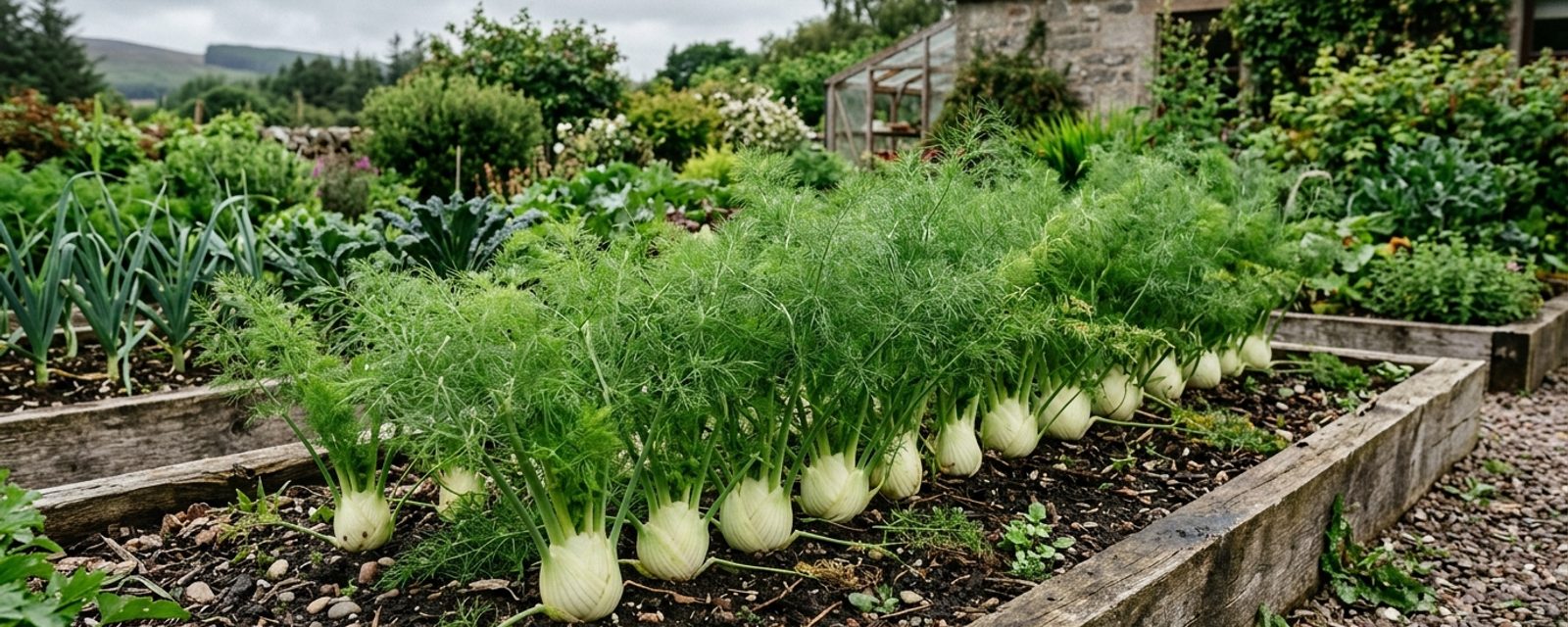
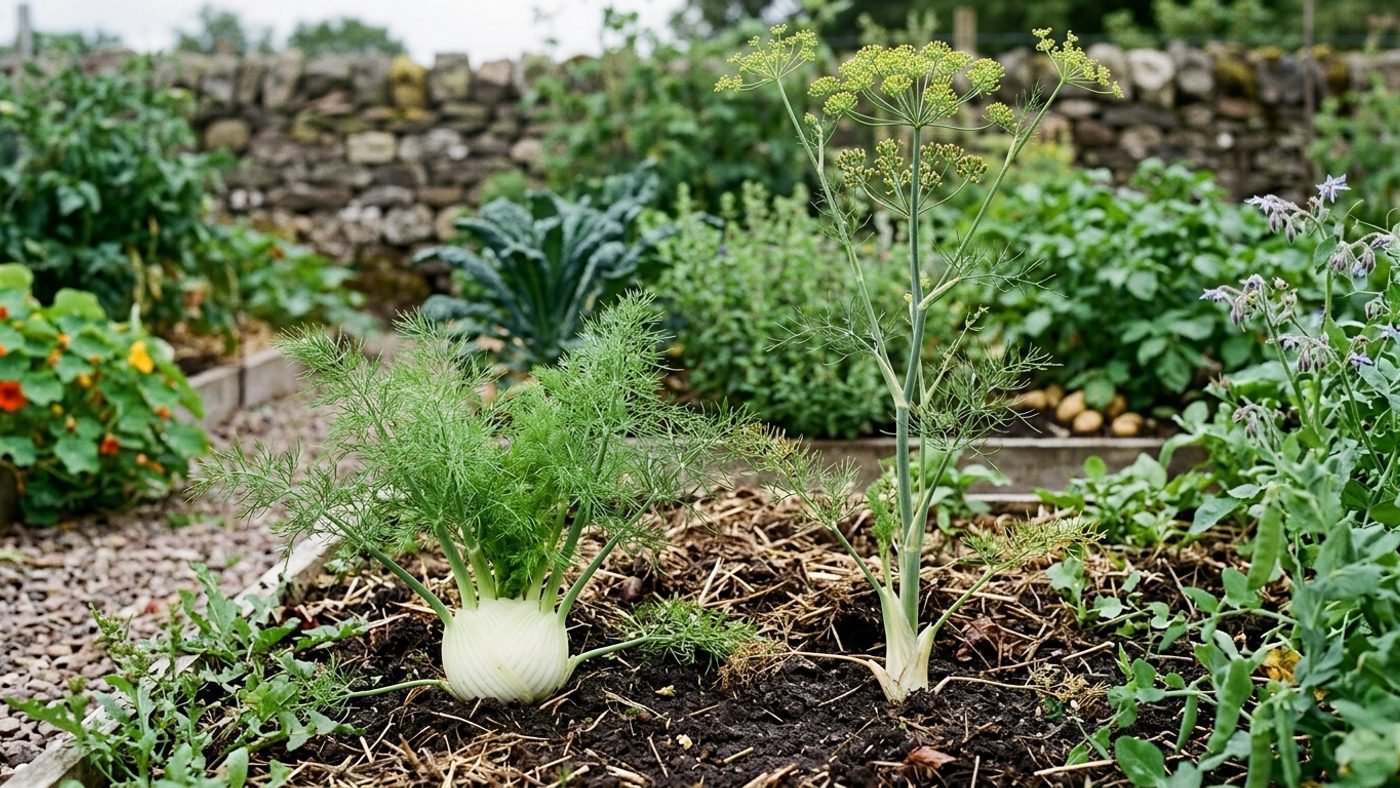
Florence fennel doesn't bolt because a plant "decides" to give up on the bulb. It boltsA plant switching early into flowering and seed production, usually triggered by stress, after which leaves, roots or bulbs turn bitter or unusable. Full page → because the growing point at the centre of the plant switches from making leaf tissue to making a flower stem, and in Foeniculum vulgare var. azoricum that switch is unusually easy to trigger. The swollen "bulb" gardeners are growing for isn't a bulb at all, it's a tightly packed stack of leaf-stem bases wrapped around that central growing point. As long as the growing point stays vegetative, the stack keeps thickening. The moment it commits to flowering, growth redirects upward into a stem instead of outward into the bulb, and the tissue that's already there turns fibrous and woody as the plant reallocates resources to seed production. There's no going back once that switch has flipped.
Quick answer
For a Scottish garden, Dragon is the safest default, with genuine bolt resistance. Rondo is the pick for an early, under-cover crop. Zefa Fino is quicker to mature but carries no stated bolt resistance, so it needs a sheltered, well-watered spot to do well.
What flips it is any one of three stresses acting on the plant: cold temperatures, a dry soil, or physical disturbance to the roots at transplanting. Each is independently sufficient; the plant doesn't need two at once. None of the three carries a specific temperature or day-length figure, which means there's no safe numeric threshold to plan around: the only reliable strategy is reducing exposure to all three at once.
A warm, sheltered, sunny site is the starting recommendation for this crop, and it does real work against two of the three triggers at once: shelter cuts exposure to cold, and a sunny, sheltered spot dries out less erratically than an exposed one, though it still needs watching for drought. Cold-frame or container growing (a large pot, at least 40cm across, holds up to three plants) is worth considering on an exposed plot for the same reason; anything that buys shelter from wind and cold is doing double duty here. A cool, changeable Scottish summer plainly raises exposure to the cold trigger, and probably slows early growth too: a transplant sitting in cooler soil takes longer to put on the root growth that lets it shrug off a knock, so it spends more days in that vulnerable early stage, giving root disturbance and any dry spell in that window more chances to do damage before the plant's established. Taken together, every one of these precautions, a bolt-resistant variety, moduleA tray divided into small individual cells, each sown with its own seed or seedling, so each plant grows undisturbed roots until it's ready to plant out. Full definition → raising, a later sowing date, consistent watering, is worth treating as necessary here, not just good practice.
Why variety choice is the first decision, not an afterthought
Sowing date and watering discipline both help, but they manage risk after the fact. Variety choice is the one decision made before a seed goes in the ground, and it's the only one that changes how much margin the other two need to provide. Seven named Florence fennel varieties are worth knowing about, and they sit at genuinely different points on bolt resistance.
Dragon and Rondo both hold the RHS Award of Garden Merit (AGMThe RHS's Award of Garden Merit: a UK-wide trials award for reliable performance, not a Scotland-specific recommendation. Full definition →), and Dragon is the best overall pick for Scotland: the clearer bolt-resistant variety of the two, and the safest default on an exposed or unpredictable site. Rondo's real advantage is that it's suitable for growing under cover, sown in a greenhouse or on a warm windowsill from late spring, which removes the cold trigger from the equation entirely rather than just tolerating it, and its early-cropping habit gets the bulb harvested before a late-summer cold snap gets the chance to matter. Zefa Fino carries no AGM and no stated bolt resistance; its advantage is being quicker to mature, a real help in a short season, but that's the trade-off: it needs a sheltered, well-watered spot to make up for it.
Four further varieties are bolt-resistant per Gardener's World (not independently confirmed by RHS, see the note under the table below): Perfection (medium bulbs, delicate flavour, suited to early sowing), Cantino (strong flavour), Colossal (very large bulbs), and Amigo (regular, slightly flatter bulbs). Worth trialling any of the four if a specific trait, size, flavour, an early sowing window, matters more than sticking to Dragon or Rondo.
Variety comparison
| Variety | AGM | Bolt resistance | Notes | Best fit |
|---|---|---|---|---|
| Dragon | Yes (UK-wide) | Excellent resistance to bolting and yellowing (RHS) | Compact | Best overall; safest default for exposed or unpredictable Scottish sites |
| Rondo | Yes (UK-wide) | Not stated as bolt-resistant, but can be grown under cover, sidestepping the cold trigger | Quick-growing, uniform bulbs, early cropper | Growers with clochesA small, portable clear cover placed over an individual plant or short row to trap warmth and keep off wind, rain and pests. Full definition → or cold frames wanting an early harvest |
| Zefa Fino | No | None stated | Quick-maturing, medium-to-large, slightly flattened bulbs | Sheltered, warm sites with reliable watering; higher risk elsewhere |
| Perfection | No | Bolt-resistant* | Medium bulbs, delicate aniseed flavour | Early sowings, if trialling beyond the three AGM varieties |
| Cantino | No | Bolt-resistant* | Strong flavour | Flavour-first growers willing to trial it |
| Colossal | No | Bolt-resistant* | Very large bulbs | Growers prioritising bulb size |
| Amigo | No | Bolt-resistant* | Regular, slightly flatter bulbs | Similar profile to Zefa Fino, worth trialling as an alternative |
* Per Gardener's World, not independently confirmed by RHS.
Matching variety to the trigger you can't control
The practical question for each grower is which of the three triggers is hardest to manage on their own plot, and that answer changes with region: an upland or far-north garden faces more cold-trigger risk than a sheltered Central Belt allotment, so the same variety pick doesn't suit every Scottish site equally (see the Scotland climate guide for regional differences).
| Your situation | Trigger at risk | What helps |
|---|---|---|
| Cold-exposed or upland site | Cold | Dragon's stated bolt resistance, or Rondo grown under cover |
| Exposed to wind (coastal or open ground) | Cold and dry soil, indirectly, since wind chills and dries the plant faster | Shelter (a warm, sheltered site is the starting recommendation for this crop), plus consistent watering |
| Watering isn't reliable | Dry soil | Consistent watering; no variety here is described as drought-tolerant, so this one's on technique, not variety choice |
| Raising your own transplants | Root disturbance | One seed per module, never a shared tray, moved out at the same depth it was growing; applies whichever variety you've chosen |
Root disturbance at transplanting is, on its own, enough to trigger bolting, which is why module raising is recommended rather than a shared seedbed, transplanting from early May once frost risk has passed.
For direct sowing, the outdoor sowing window is June or July, once soil has warmed, at 1.5cm deep, thinning to 30cm apart, or as close as 10-15cm apart if you'd rather harvest small "mini veg" bulbs around 5cm wide instead of full-sized ones, a real option if a short season leaves you doubting a full bulb will mature in time. Running an early cover-grown Rondo crop alongside a later June-sown Dragon or Zefa Fino batch is a reasonable way to spread bolting risk across the season rather than betting on one window. If you need help working out exact succession timing for your part of Scotland, the Planting Calendar tool covers it. Sowing depth, watering routine and earthing-up steps behind those dates are in the full Florence fennel growing guide.
Soil, briefly
There's no UK-published pH range for Florence fennel. Other sources put it around 6.5 to 8, broadly neutral to slightly alkaline, rich in organic matter, a reasonable target rather than a Scottish-verified figure. Worth a word of caution regardless: many Scottish garden soils run naturally acidic, so hitting the upper half of that range may mean liming rather than assuming it by default; test your own soil before treating 6.5-8 as a given.
Harvest and what happens if you miss the window
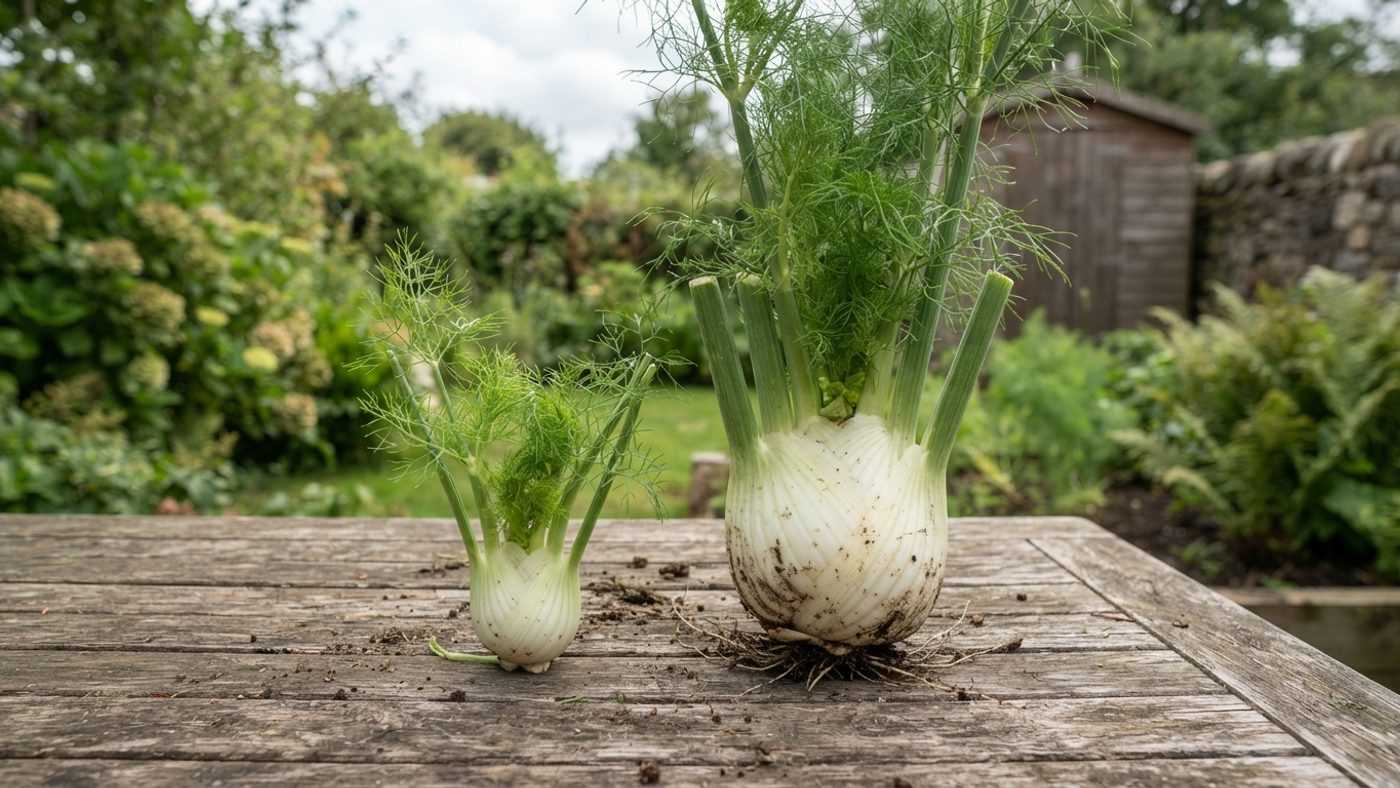
Whichever variety is grown, Florence fennel is cut rather than pulled: a sharp knife just below the bulb once it reaches 10-15cm across (from 5cm for mini veg), leaving the base and roots in the ground. That stump will send up small leafy shoots usable in salads, though not a second bulb. Roughly 14 weeks separates sowing from harvest, though timing shifts with sowing date and conditions, worth weighing against a Scottish autumn's earlier onset of cold and shorter days when deciding how late a sowing to risk. The harvest window only runs one way: leave a ready bulb too long and it elongates and turns woody regardless of variety, so a bolt-resistant pick buys margin against bolting early; it doesn't stretch how long a mature bulb can wait to be cut.
Slugs are the other practical risk at the seedling and young-transplant stage, when growth is soft and low to the ground; the slugs page covers control methods. For the bolting mechanism itself, including how it presents and what to do if it starts, see the bolting page.
Common questions
Which Florence fennel variety is most bolt-resistant for Scotland?
Dragon is the only one of the three verified varieties explicitly described as having excellent resistance to bolting and yellowing.
Does growing under cover stop fennel from bolting?
It removes cold as one of the three named triggers, which is meaningful in a Scottish summer, but drought and root disturbance at transplanting can still trigger bolting even under cover.
Can I sow Florence fennel directly instead of raising transplants?
Yes. The outdoor sowing window is June or July once soil has warmed, sown 1.5cm deep and thinned to 30cm apart. This avoids the root-disturbance trigger entirely, since there's no transplanting step.
Is Zefa Fino a bad choice for Scotland?
Not necessarily. It's quick-maturing, which suits a short season, but it carries no stated bolt resistance, so it needs a sheltered site and reliable watering to make up the difference.
What soil pH does Florence fennel need?
No UK figure is published. A general estimate of 6.5-8 (neutral to slightly alkaline) comes from a US source, not a Scottish-verified one.
Sources
3 sources, recorded with what each was used for
- RHS: Florence fennel, grow your own: Sowing method and window, spacing, the three bolting triggers, sun requirement, container growing, mini veg harvesting, and AGM/variety data for Dragon, Rondo and Zefa Fino
- Gardener's World: How to grow fennel: Bolting-risk framing, the roughly 14-week sowing-to-harvest figure, and bolt-resistance claims plus traits for Perfection, Cantino, Colossal, and Amigo (not independently RHS-verified)
- Utah State University Extension: Fennel in the Garden: The soil pH figure (6.5-8)