
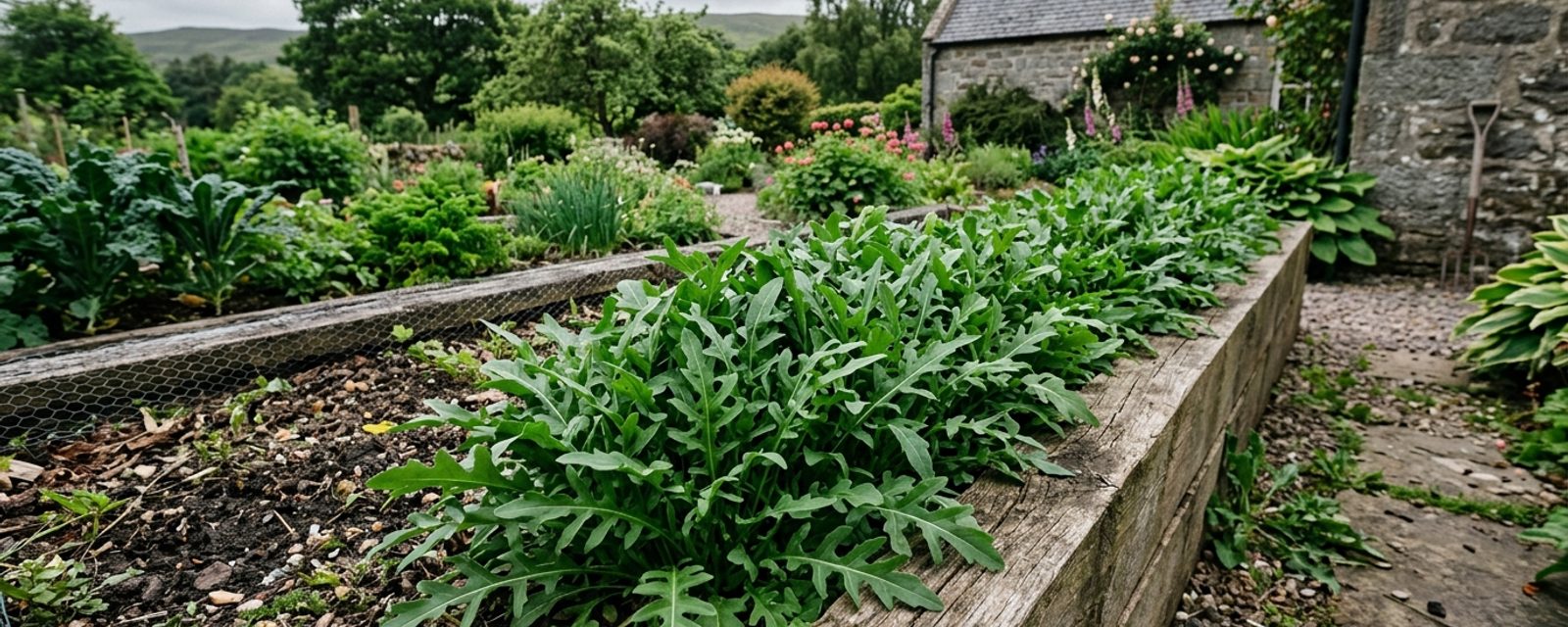
Rocket bolts, runs up a flower stem and, for one of the two plants sold under that name, stops being worth eating, in direct response to heat and stress. That single mechanism, more than any other factor, decides which rocket variety is worth your bed space. But "rocket" is not one plant with a spread of cultivarsA plant variety that arose or was bred under cultivation and is kept true by deliberate propagation, rather than a naturally occurring wild species. Full definition → sitting on a shelf. It's two different species sharing a common name, and the boltingA plant switching early into flowering and seed production, usually triggered by stress, after which leaves, roots or bulbs turn bitter or unusable. Full page → mechanism means something different for each.
Quick answer
Want a quick, repeat-sown crop? Grow salad rocket, Sky Rocket or Dragon's Tongue for the best bolt resistance. Want years of low-effort picking instead? Grow wild rocket, no named variety needed.
Salad rocket (Eruca vesicaria subsp. sativa) is an annual. It germinatesA seed sprouting: breaking dormancy and putting out its first root and shoot, given the right warmth and moisture. Full definition → fast, grows fast, and tastes mildest when young, and once it bolts, the plant is finished; the whole thing comes out and goes on the compost heap. Heat and stress are what trigger that bolt, and a stressed, overcrowded, thirsty row in a hot spell will run up a flower spike far sooner than a cool, evenly watered one.
Wild rocket (Diplotaxis tenuifolia) is a genuinely different plant: a hardy perennial, slower to get going, with a hotter, more mustard-like flavour and a tolerance for poorer, drier soil than most leaf crops manage. Crucially, it also bolts in response to heat, but bolting doesn't end it. A flowering wild rocket plant keeps producing leaves, the flowers themselves are edible, and with a bit of protection the plant can keep cropping into winter and start again the following spring.
That's why this article is really two variety questions, not one list: which salad rocket variety suits a changeable Scottish summer, and separately, whether to grow wild rocket at all given what it asks of you in return for the years of harvests it gives back. For soil prep, exact spacing, container growing and harvesting technique, see the rocket growing guide.
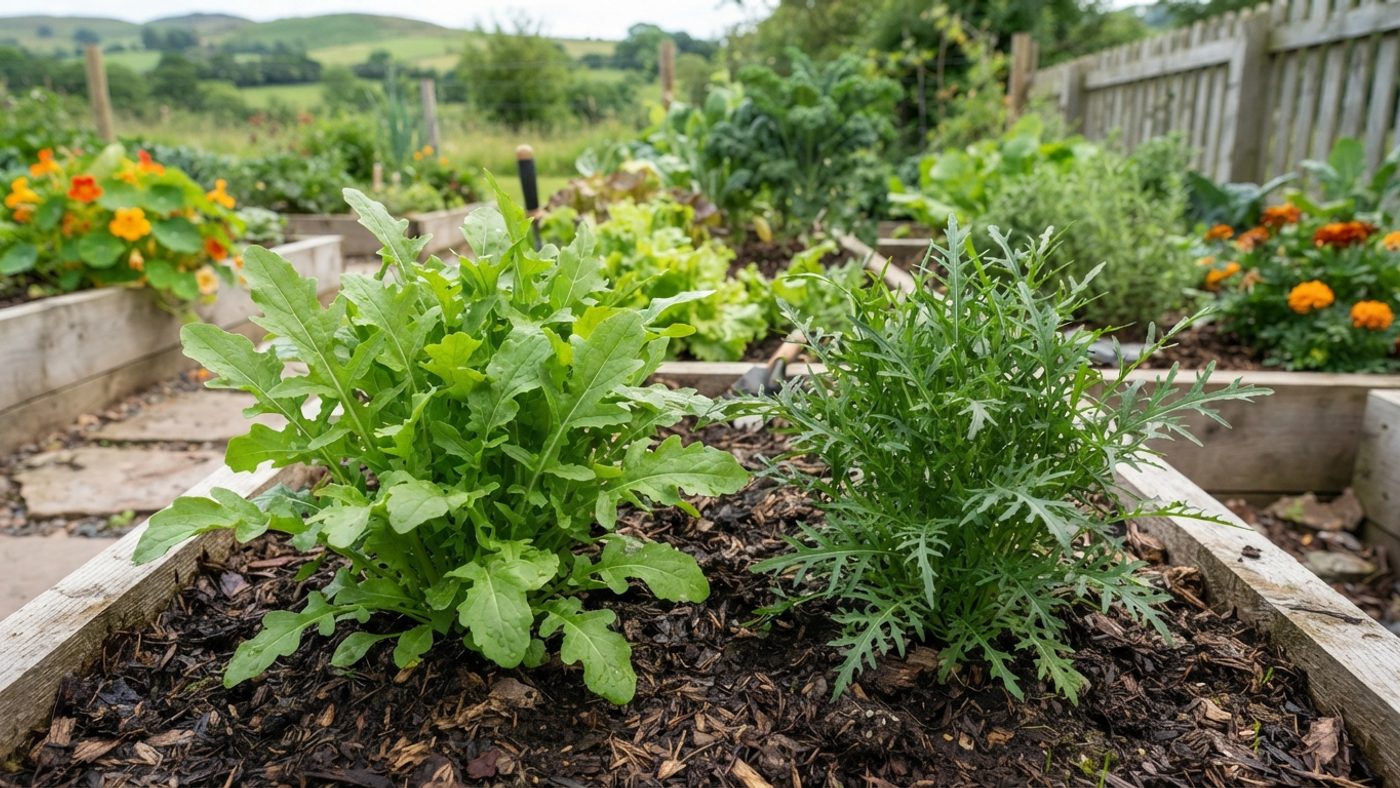
Salad rocket vs wild rocket: the real comparison
| Salad rocket (Eruca sativa) | Wild rocket (Diplotaxis tenuifolia) | |
|---|---|---|
| Life cycle | Annual | Perennial |
| Speed to establish | Fast | Slower |
| Flavour | Milder, especially when young | Hotter, more peppery/mustard-like |
| Soil tolerance | Prefers fertile, moisture-retentive soil | Tolerates poorer, drier soil |
| What bolting means | End of the plant, pull it out | Keeps cropping; flowers are edible too |
| Harvest window | A month or two, then it's over | Years, including through and after flowering, with protection into winter |
| Best suited to | Quick, repeat-sown crops for continuous fresh leaf | Smaller or less-improved plots, low-maintenance long-term cropping |
Salad rocket rewards a grower willing to keep sowing every couple of weeks and pull spent plants promptly. Wild rocket rewards patience early on in exchange for years of low-input picking afterwards. As a rough rule: if you're happy resowing every fortnight for a continuous fresh crop, go salad rocket; if you'd rather plant once and pick for years with little upkeep, wild rocket is the better fit. There's nothing stopping you growing both, in different corners of the plot, if you want both a quick crop and a long-term one.
Salad rocket: which variety, and why
Several salad rocket cultivars are named, well-documented UK garden varieties, Victoria, Sky Rocket, and Runway among them, and none of them carry the RHS Award of Garden Merit. That's not a mark against any individual variety; rocket as a crop sits outside that award scheme entirely, so AGMThe RHS's Award of Garden Merit: a UK-wide trials award for reliable performance, not a Scotland-specific recommendation. Full definition → isn't a criterion you can use to choose between rocket cultivars the way you might for tomatoes.
Sky Rocket combines wild rocket's stronger, hotter flavour with salad rocket's faster growth, a variety bred to close the flavour gap between the two species without asking for wild rocket's slower establishment. If the appeal of wild rocket is the flavour rather than the perennial habit, this is the salad-type answer to that.
Dragon's Tongue has purplish-veined leaves and is specifically noted for good bolt resistance. That matters for succession sowing: if you're running a rocket bed every two weeks through summer, a variety with genuine bolt resistance buys you a bit more slack between sowings and a bit more forgiveness if a hot spell or crowded row pushes some plants toward flowering early. Scotland's summers rarely deliver the sustained heat that triggers heavy bolting in the first place, but "rarely" isn't "never": a warm dry fortnight happens, and Dragon's Tongue is genuine insurance against it rather than insurance you need every year.
Three more round out the field, worth knowing for flavour range rather than for Scotland-specific traits:
| Variety | Leaves | Flavour |
|---|---|---|
| Victoria | Dark green, rounded | Strong, peppery for a salad-type |
| Runway | Fast-growing, deeply serrated | Standard salad rocket |
| Wasabi | Vigorous | Hot, spicy |
None of the three carry AGM either. The traits that matter most for a shorter, changeable Scottish season, faster growth without losing wild-rocket flavour, and bolt resistance for succession sowing, are what put Sky Rocket and Dragon's Tongue ahead of these three.
Scotland's real advantage here
The whole reason bolt resistance exists as a breeding trait is that heat and stress trigger it, and Scotland simply sees less of the sustained summer heat that does it, part of the same shorter, cooler season that shapes growing here generally (see the Scotland climate guide for the fuller picture). Other quick-bolting crops share the same advantage from the same underlying cause: a heat threshold Scottish summers seldom hit at intensity.
The advantage is fewer bad years, not immunity, and it isn't even across the country: a hot dry spell still happens, and an overcrowded row will trigger bolting regardless of the weather. The Scotland climate guide covers how much sun and rainfall vary between the wetter west and the drier east coast, worth checking against your own area rather than assuming "Scotland" is one climate. For troubleshooting a bed that's bolted anyway, the bolting page covers the causes and what to do.
Succession sowing: the plan this variety choice serves
Salad rocket reaches first harvest in four to six weeks and then gives you roughly a month or two of picking before it flowers and the plant is done. A single sowing, in other words, is a matter of weeks of supply, not a whole season's worth. Continuous rocket through summer means sowing again roughly every two weeks, so a new batch is always coming up to replace the one running out. Direct-sowing outdoors is the simpler approach for most of that run; raising a few modulesA tray divided into small individual cells, each sown with its own seed or seedling, so each plant grows undisturbed roots until it's ready to plant out. Full definition → under cover for the earliest sowing gives it a head start while outdoor soil is still cold, without the effort of doing that for every batch. The Planting Calendar tool is built for exactly this kind of repeat-sowing timing, worth using to plan out a rocket succession run rather than guessing at sowing dates from memory.
Wild rocket: is it worth growing, and which one
Wild rocket doesn't really have a "best variety" question in the same sense; named cultivars aren't really a thing here the way they are for salad rocket, wild rocket is mostly sold and grown as the species itself. The real decision with wild rocket is whether to give it space at all, and the case for it is specific:
- It tolerates poorer, drier soil than most leaf crops, which suits a smaller plot, a new bed that hasn't been improved yet, or a spot you don't want to spend effort feeding.
- It keeps producing after it flowers, including the flowers themselves, rather than being finished the way salad rocket is.
- With protection it can keep cropping into winter and start again the following spring, a genuinely long-lived leaf crop rather than a repeat-sown annual.
The trade-off is that it establishes more slowly than salad rocket, so it's a poor choice if you want a fast first harvest. If Sky Rocket's whole appeal is delivering wild rocket's flavour faster, the flip side is true too: true wild rocket asks for patience up front that Sky Rocket doesn't.
A clocheA small, portable clear cover placed over an individual plant or short row to trap warmth and keep off wind, rain and pests. Full definition →, cold frame or layer of fleeceA lightweight, breathable fabric laid or draped over plants to trap a little warmth and keep off frost, wind and some flying pests. Full definition → over the plants is what makes winter cropping from wild rocket realistic in a Scottish climate, the same cover used to extend salad rocket's outdoor sowing season at either end of the year (see the growing guide for the exact timing). No firmer cut-off than that is published for wild rocket specifically, so treat it as protection against the worst of the cold rather than a guarantee of picking right through a hard winter.
Soil pH
No UK source publishes a specific soil pH figure for rocket. A US extension service, Clemson Cooperative Extension in South Carolina, states a target soil pH of 6.0-6.5 for arugula alongside kale, mesclun, mustard, and Swiss chard as a group. Treat that as a reasonable starting point if you want a number to aim for, not as a confirmed Scottish figure; it's a general guide for brassicaThe cabbage family: cabbage, kale, broccoli, cauliflower, Brussels sprouts, kohlrabi, swede, turnip and more, sharing the same pests, diseases and rotation rules. Full definition →-family salad leaves, not one worked out for Scotland's climate specifically.
Pests and problems
Rocket shares its main problems with other quick brassica-family salad leaves:
- Flea beetle, shot-holes the leaves but only cosmetically; it doesn't stop the plant cropping. See the flea beetle page.
- Slugs and snails, the real threat to young seedlings, which can be wiped out in the first couple of weeks before they get going; a bigger risk here than in a drier region given how much damper Scotland runs generally, so protection matters most while plants are small. See the slugs and snails page for control methods.
- Bolting, salad rocket's defining weakness. See the bolting page for causes and what to do.
One more thing worth knowing rather than worrying about: rocket left to flower and set seed self-seeds readily, and volunteer plants can turn up in beds you didn't sow. It isn't a pest, and it's easy to deal with; pull unwanted seedlings while they're small, the same as any other volunteer, just worth knowing about before you assume a stray rocket plant came from somewhere else.
A note on flavour and watering
Overwatering dilutes rocket's peppery flavour, worth knowing since the instinct with a leaf crop is often to water generously, and worth watching for specifically on a naturally damp Scottish site where rain alone can already be doing more of the job than a drier region's soil would. The soil should stay consistently moist, not heavily watered, a small distinction, but one that affects how strong the crop actually tastes at harvest, on top of whichever variety you've chosen for flavour in the first place.
Common questions
Can I grow salad rocket and wild rocket in the same bed?
Yes. They're different enough in habit that they don't compete for space the way two salad rocket sowings would. A workable approach is a permanent corner of wild rocket for years of low-effort picking, alongside a fortnightly-resown row of salad rocket for a quicker, milder crop through summer.
Do any rocket varieties carry an RHS Award of Garden Merit?
No. None of the named varieties, salad or wild, carry AGM. Rocket sits outside that award scheme entirely, so it isn't a useful filter when choosing a rocket variety.
Why has my rocket bolted so fast, if Scotland's summers are supposed to be cooler?
Check three things: was there a hot, dry spell recently, was the row overcrowded, and was watering consistent? Any one of those can trigger bolting regardless of variety or climate.
How much rocket should I sow for a steady supply?
There's no published figure for this, so treat it as a starting point rather than a fixed rule: a row of around a metre, resown every couple of weeks through summer, is enough fresh leaf for most households eating rocket a few times a week.
What soil pH does rocket need?
There's no published UK figure. A US source suggests 6.0-6.5 for arugula as part of a group of brassica-family salad leaves, a general guide, not a confirmed target for rocket specifically.
Sources
3 sources, recorded with what each was used for
- RHS: How to grow rocket: Named varieties (Victoria, Sky Rocket, Runway, wild rocket), confirmation that none carry AGM, sowing timing and depth, spacing, sun requirements, harvest timing and technique, and pest notes (slugs, snails, flea beetle cosmetic damage)
- Gardener's World: How to grow rocket leaves from seed: Dragon's Tongue and Wasabi varieties, and the overwatering-dilutes-flavour note
- Clemson Cooperative Extension: Arugula, Kale, Mesclun, Mustard, and Swiss Chard: The 6.0-6.5 soil pH guide, clearly a US figure, not an RHS or Scotland-specific one