
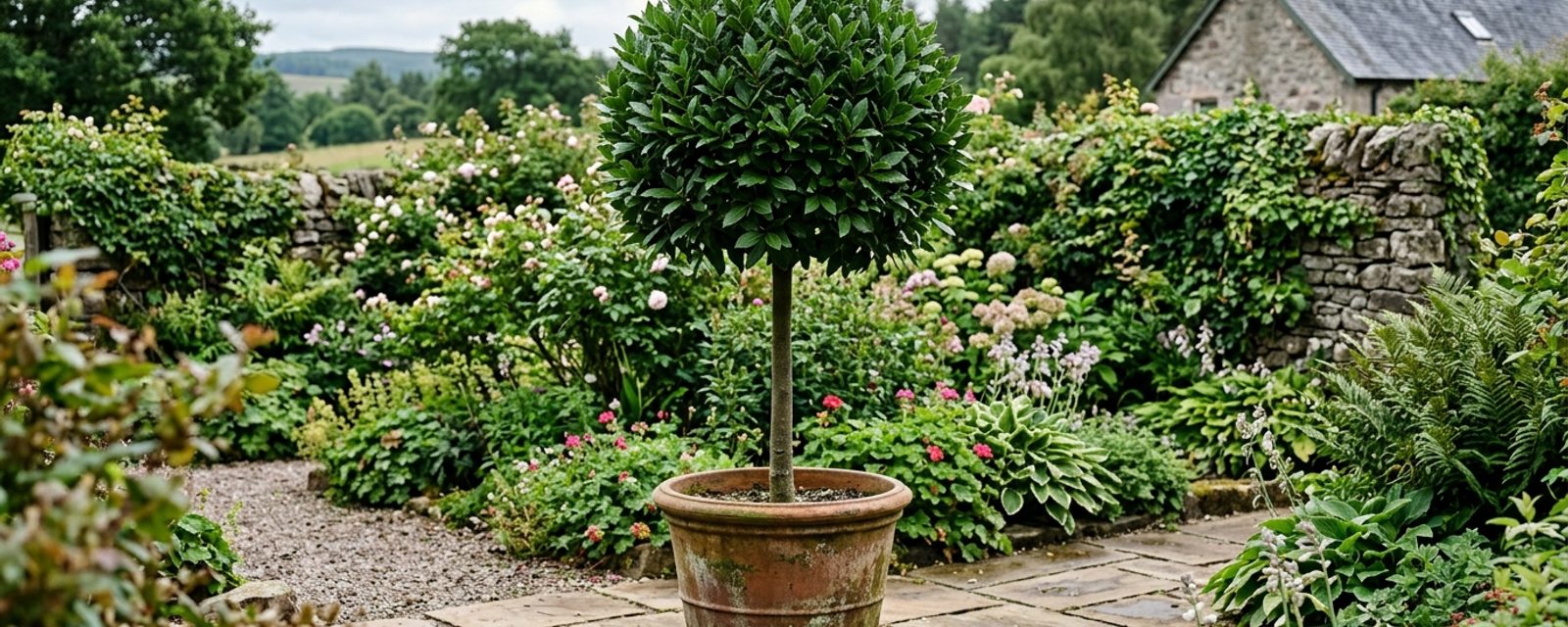
You're standing in the garden centre looking at three or four pots labelled simply "bay tree", all with slightly different leaves, and no explanation of which one you actually need, or maybe you're past that stage and looking at a bay that went black and crispy after last winter's hard frost, wondering if you bought the wrong variety entirely. Neither situation has an obvious answer on the label, and it's worth sorting out before you buy again or replace what you've lost.
Quick answer
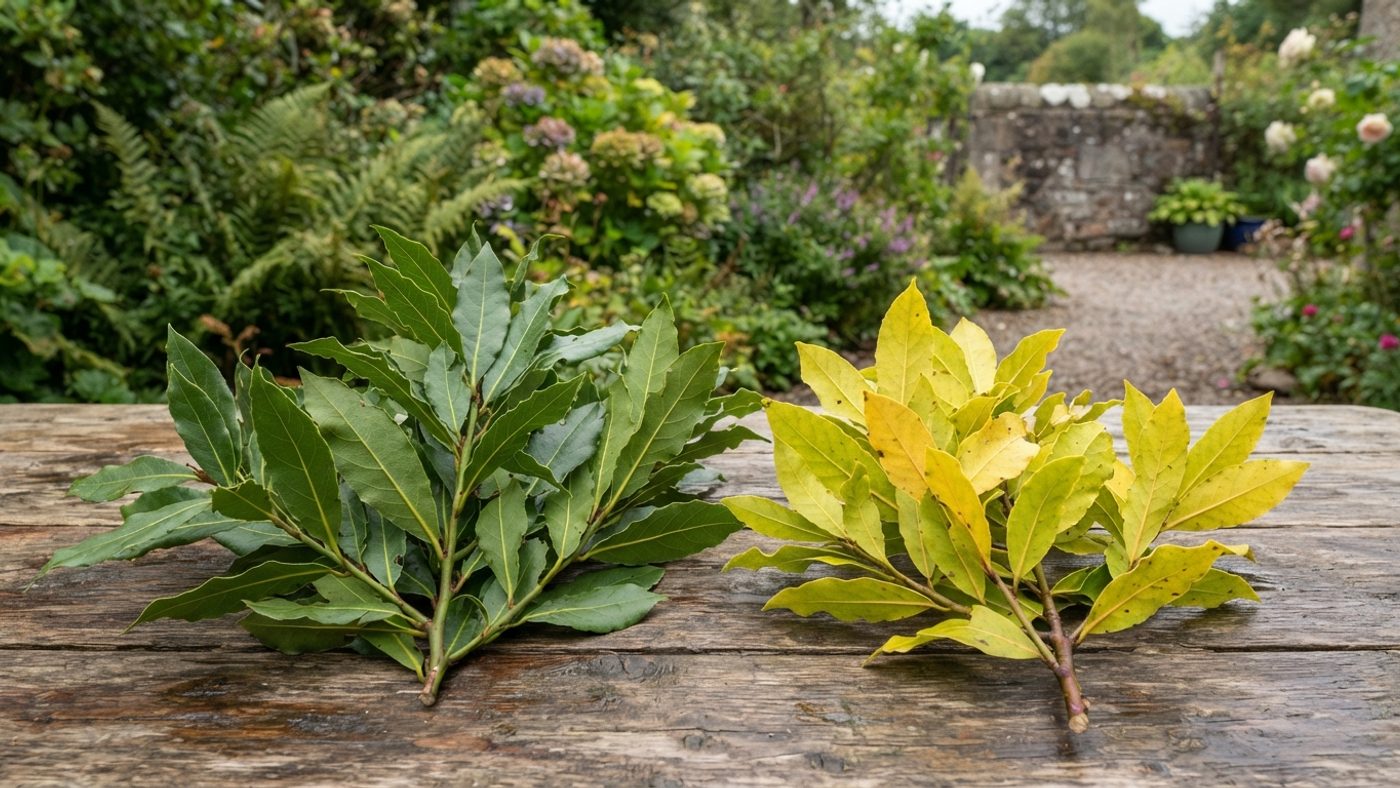
For most Scottish gardens, plain Laurus nobilis (the species) is the right pick: it's the classic culinary bay, by far the most widely available, and carries exactly the same hardiness ratingThe RHS's H1a–H7 scale for how much cold a plant can survive outdoors, H1a being tender indoor-only and H7 hardy anywhere in the UK. Full definition → as the two named forms below, so you lose nothing by choosing it. Reach for 'Aurea' instead if you want golden-yellow foliage that's brightest through winter and spring, or if you're working with limited space, since it stays smaller at maturity. Choose f. angustifolia (the "f." denotes a naturally occurring form of the species, not a bred cultivarA plant variety that arose or was bred under cultivation and is kept true by deliberate propagation, rather than a naturally occurring wild species. Full definition →) if you want an unusual narrow, willow-like leaf or you're planting somewhere the plain species would eventually outgrow.
That black, frost-blackened foliage from the opening scenario almost certainly isn't a sign you bought the wrong variety, it's a normal cold-damage response any of the three forms can show.
Why variety choice for bay isn't really about hardiness
All three forms carry the RHS Award of Garden Merit, and all three are rated H4 (-10 to -5°C), with no hardiness distinction between them, there's no basis for treating the golden or narrow-leaved forms as more tender or needier than the plain green species. But H4's floor of -10°C is a real limit, not a guarantee: an inland, upland or exposed Scottish garden can go colder than that on a hard night, a plausible explanation for a bay that's blackened after a bad winter, whichever of the three forms it was. Wind is the other risk the H-number doesn't capture, cold, salt-laden or simply exposed gales scorch and desiccate bay foliage independently of temperature, which makes an exposed, wind-scoured garden a harder site for bay than a sheltered one even at the same nominal frost minimum. A sheltered spot, against a south- or west-facing wall, or out of the prevailing wind, matters as much as the frost rating on paper. None of this differs by form; it's a siting question, not a variety one. For planting, container care and winter protection, see the full growing guide.
The real differentiator between the three is mature size and foliage appearance, not cold tolerance. That matters most for a container specimen, growing bay in a pot means it can be moved under cover for winter, and a naturally smaller form suits that arrangement better than one that wants to reach 8-12m.
One thing worth checking before you buy: several unrelated, toxic plants get sold or mistaken for bay, most commonly cherry laurel (Prunus laurocerasus) and Portugal laurel (Prunus lusitanica), both often labelled loosely as "laurel" in a garden centre. True bay is Laurus nobilis, has a distinctive spicy, aromatic scent when a leaf is crushed, and is the only one of the three safe to cook with. If a leaf has no scent, or an unpleasant almond-like one, it isn't bay. Fresh bay leaves are also best kept away from dogs and cats, which can find whole leaves a choking or gut-irritation risk.
The three forms head-to-head
| Variety | Ultimate size (H x S) | Foliage | Hardiness | Best use |
|---|---|---|---|---|
| Laurus nobilis (species) | 8-12m x 8m+ | Glossy dark green, classic culinary bay | H4 (-10 to -5°C) | Default choice; hedging, standards, general culinary use |
| Laurus nobilis 'Aurea' (golden bay) | 4-8m x 2.5-4m | Leathery golden-yellow, brightest in winter/spring; still fully edible | H4 (-10 to -5°C) | Smaller spaces; winter/spring colour interest |
| Laurus nobilis f. angustifolia (willow-leaved bay) | 4-8m x 4-8m | Long, narrow, wavy-edged, pale green; still aromatic and usable in the kitchen | H4 (-10 to -5°C) | Unusual texture; rounder habit than 'Aurea' since spread roughly matches height |
Choosing your first bay: what to actually look for
The plain species is the one most general garden centres stock as standard; 'Aurea' and f. angustifolia turn up less often and are more reliably found at a larger garden centre or a specialist herb nursery, so allow for a wider search if you want one of the two named forms specifically.
Whichever you're buying, check the leaves: you want healthy, dark green (or, for 'Aurea', clean gold) and shiny, with no yellowing, spotting, or visible pest damage. Skip anything showing signs of bay suckerA shoot that grows from a plant's roots or lower trunk, separate from the main framework, usually removed before it diverts energy. Full definition →, scale insects, or powdery mildew, these show up as distorted or discoloured leaf edges, sticky or scaly deposits on stems, or a pale, powdery coating, and they're far easier to avoid at purchase than to treat afterwards. None of the three are untreatable once established, either: a light scale infestation usually wipes off by hand, and affected shoots can simply be picked off for bay sucker, so a plant with a trace of either isn't necessarily one to rule out if everything else about it looks healthy.
Bay is naturally slow-growing, taking many years to reach a decent size. That's worth factoring into the budget decision: a small, cheap plant will need years of training before it looks or performs like anything substantial, while a larger, already-shaped specimen costs more upfront but gets you a usable, visually mature plant much sooner. This is also where clipped standard "lollipop" bay trees come from, that shape takes years to establish, which is exactly why a ready-trained standard costs so much more than an unclipped young plant of the same variety. Neither route is wrong; it depends on whether you're happy to wait.
Matching size to your space
Open ground with room to spare is where the plain species makes most sense, it's the easiest to find and there's no size penalty to worry about. A container on a balcony, a small patio, or a tight border is where the size difference in the table above becomes a real practical factor: choosing 'Aurea' or f. angustifolia over the species there means less regular pruning just to keep the plant in bounds, since both stay smaller left unclipped.
Soil pH doesn't factor into this choice either, all three tolerate acid, alkaline or neutral soil.
Is your bay actually failing, or is this normal?
Two common complaints get conflated, and they mean different things. Yellowing leaves are usually a watering problem, either over- or under-watering, and worth checking your regime before assuming disease. Blackened or browned leaves, by contrast, are typically frost or wind damage, particularly in young plants or container-grown specimens where the roots have less insulation than in open ground. If you're standing over a bay with black, scorched-looking foliage after a cold snap, that's very likely straightforward cold damage rather than a sign you chose the wrong variety or that the plant is dying outright, established bay often recovers and resprouts once the worst of winter passes. If the damage runs deeper, soft, mushy stems or a general collapse rather than just blackened leaf tips, that points toward root rot rather than frost. Persistent dieback alongside black, bootlace-like growths at the base or under the bark can indicate honey fungus, a rarer but serious diagnosis with no cure, worth ruling out before assuming the more common causes above if the plant is failing without an obvious cold or watering trigger. A dull, powdery coating on leaves rather than blackening points to powdery mildew rather than cold damage.
Pruning without leaf scorch
Use secateurs, not hedge shears, when shaping bay. Shears slice through leaves rather than cutting at a stem, and the cut edge of a sliced leaf browns and looks scorched within days, secateurs make a clean cut through the leaf stalk instead and avoid this entirely. This matters more for bay than for many other clipped evergreens because the leaves are large enough that shear damage is genuinely visible.
If you've inherited or let a bay grow leggyDescribes a plant that's grown tall, thin and sparse rather than bushy, usually from too little light or not being pinched out. Full definition → and overgrown, rejuvenation pruning can bring it back into shape, but it's worth splitting hard cutting-back over two consecutive late-spring prunes rather than doing it all in one go, going all at once risks shocking the plant. This applies regardless of which of the three forms you're working with, since none differ in their pruning response.
A note on storing your harvest
Unlike most soft herbs, where drying is a compromise you make when you can't use the fresh leaf in time, bay is genuinely at home dried. Dried bay leaves are a normal kitchen staple in their own right, not a lesser substitute for fresh, so there's little pressure to use up a bay harvest quickly, and drying is a legitimate way to store leaves rather than a fallback.
Common questions
Is 'Aurea' less hardy than plain bay?
No. All three forms, the species, 'Aurea', and f. angustifolia, are rated H4 (-10 to -5°C), with no hardiness distinction stated between them.
Which bay variety is best for a pot onMoving a plant into a larger pot as its roots fill the current one, giving it more room and fresh compost before it becomes pot-bound. Full definition → a balcony?
'Aurea' or f. angustifolia, both stay noticeably smaller than the plain species left unclipped, which means less pruning to keep a container plant in bounds. Neither removes the need for regular container care generally, just the size-management part of it.
Why did my bay's leaves turn black after frost, is it dead?
Almost certainly not. Blackened, scorched leaves after a cold snap are the plant's normal response to cold or wind, hitting young and container-grown plants hardest since their roots have less insulation than open ground. Established bay usually resprouts once conditions improve; soft, mushy stems or a wider collapse rather than just blackened tips is the sign that points to root rot instead.
Can I still cook with 'Aurea' or the willow-leaved bay, or only the plain species?
All three forms are fully edible and culinary-usable, 'Aurea' and f. angustifolia are grown more often for their ornamental appearance, but neither is off-limits in the kitchen.
Why are my bay's leaves yellow rather than black?
Yellowing is generally a watering issue, either over- or under-watering, and is a different problem from the blackening frost damage causes. Check your watering routine first before assuming pest or disease damage.
Sources
4 sources, recorded with what each was used for
- Laurus nobilis: Species hardiness rating, ultimate size/spread, growing conditions, and AGMThe RHS's Award of Garden Merit: a UK-wide trials award for reliable performance, not a Scotland-specific recommendation. Full definition → status
- Laurus nobilis 'Aurea': 'Aurea' hardiness rating, ultimate size/spread, foliage description, and AGM status
- Laurus nobilis f. angustifolia: f. angustifolia hardiness rating, ultimate size/spread, foliage description, and AGM status
- How to grow bay: Buying advice, slow growth rate/mature specimen cost trade-off, secateurs-vs-shears pruning guidance, staged rejuvenation pruning, and the yellow-vs-black leaf diagnostic distinction