
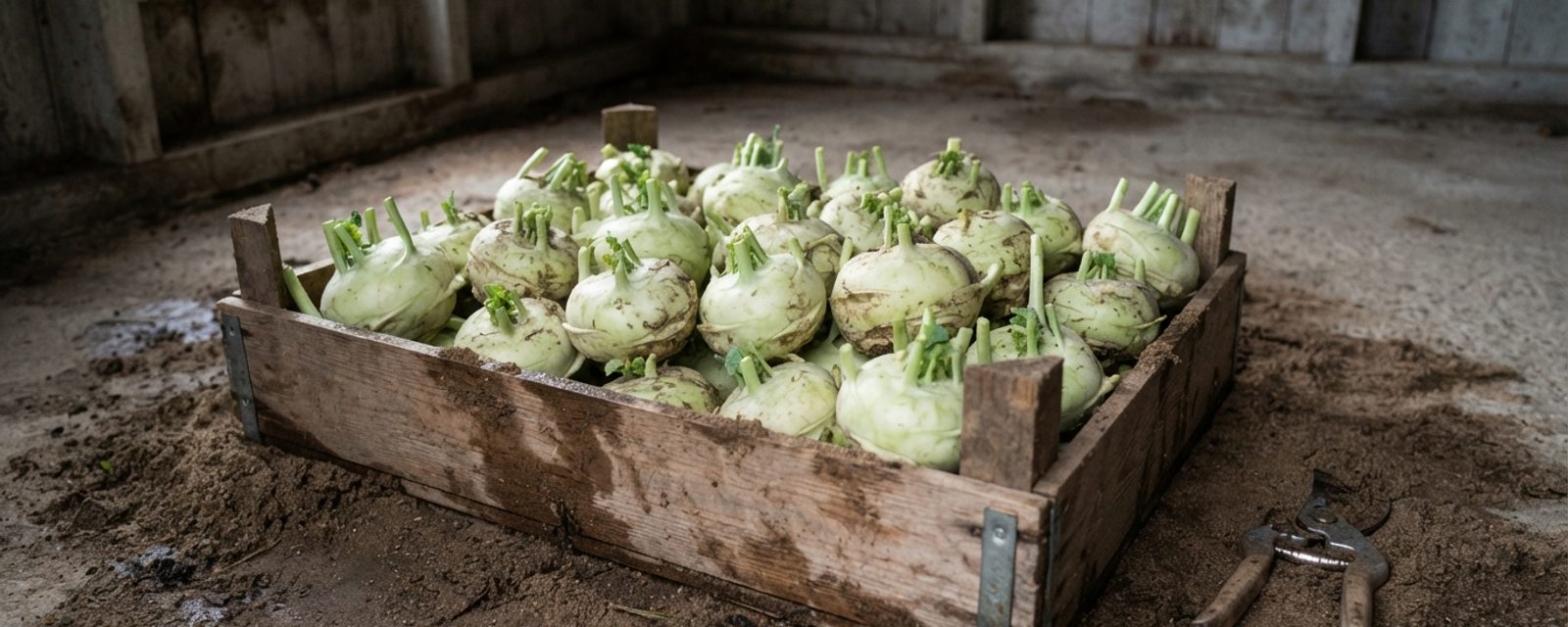
Kohlrabi isn't a root, it only looks like one. What you're actually storing is a swollen section of stem the plant has puffed up just above the soil line, and that difference in anatomy is why kohlrabi doesn't behave in storage the way carrots or beetroot do. It can be kept using the same cool, damp method gardeners use for true root vegetables, but no institutional source gives kohlrabi a stated keeping time the way they do for its neighbours in the vegetable bed.
Below: what the method actually is, and what's genuinely uncertain about how long it holds.
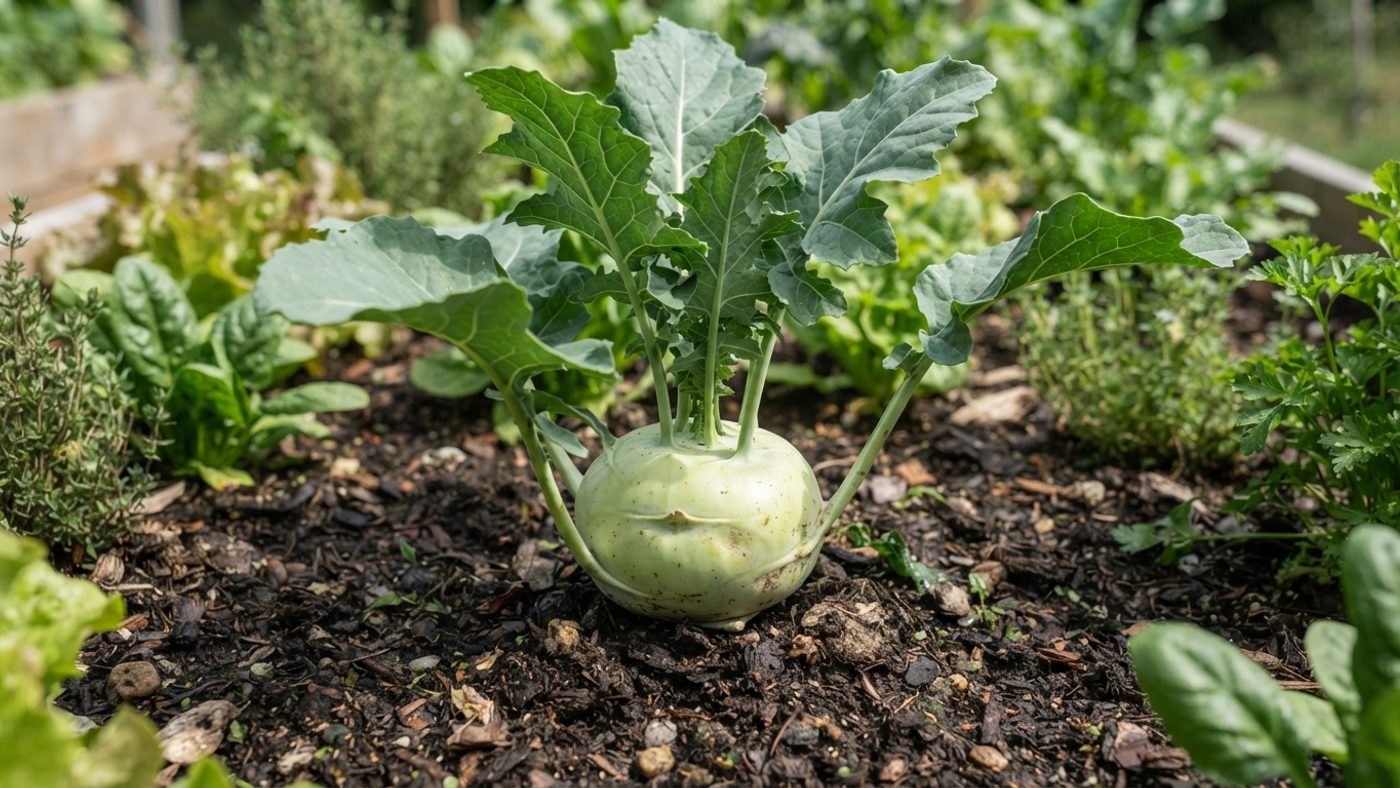
Why kohlrabi doesn't store like a root
A carrot or a beetroot is built to survive underground over winter, that's the plant's own strategy for getting through to a second growing season, and it's part of why they hold up so well in a box of damp sand. Kohlrabi has no such strategy. The part you eat is the stem, swollen just above ground level, and its job is short-term: bulk up fast, flower the following year. The kohlrabi growing guide already covers this, kohlrabi matures in as little as 8-12 weeks from sowing, has a narrow harvest window at golf-ball to tennis-ball size (roughly 5-7cm across) before the texture turns woody, and its leaves are best cooked soon after cutting rather than kept.
None of that changes once the bulb is out of the ground. A vegetable bred for a fast life cycle and a narrow harvest window doesn't automatically gain months of shelf life just because it's been cut loose from the plant. That's the physiological reason to expect kohlrabi to be a shorter keeper than a true root crop, even before looking at what the storage authorities actually say.
What the sources actually say
RHS's kohlrabi growing guide has no dedicated storage or harvest-keeping section at all. The closest it comes is guidance for the kitchen, peeling, then grating or chopping into salads and coleslaw, or steaming, sautéing, or adding to stews, alongside the instruction to harvest at golf-ball to tennis-ball size before it turns woody. There's no guidance there for keeping a harvested bulb over winter.
RHS also runs a dedicated page on storing root vegetables, covering beetroot, carrots, celeriac, parsnips, salsify, scorzonera, swedes, turnips, winter radishes, and Hamburg parsley, with methods including in-ground straw covering, boxing in sand or peat-substitute, and clamping. Kohlrabi does not appear anywhere on that page.
Garden Organic takes a different view. Its guide to harvesting and storing vegetables groups kohlrabi together with carrots, parsnips, beetroot, turnip, swede, and celeriac as storage organs of biennialA plant that completes its life cycle over two years: growth in year one, then flowering, seeding and dying in year two. Full definition → plants that store easily, and gives one method for the whole group: don't wash the crop, brush off excess soil instead; twist the leaves off close to the crownThe base of a perennial plant where roots and shoots meet, often sold and planted as a ready-made dormant plant rather than grown from seed. Full definition → rather than cutting them; layer the bulbs in shallow crates or boxes, separated by a slightly damp packing material, leaf mould, sand, sieved soil, untreated sawdust, or coir; and keep the crates very cool, at 0-4°C. That's a real, usable method. What it doesn't include is a duration figure, for kohlrabi or for the group as a whole.
The honest storage window
Kohlrabi's fast growth and thin skin, compared with a true root's, are reasoning rather than a figure lifted from a source: no authority has measured kohlrabi's storage life the way RHS measured beetroot's. Use the Garden Organic method for short-to-medium keeping, check on the bulbs often, and don't plan on it lasting through to spring the way a store of carrots or swede might.
Unlike a carrot or beetroot, which sit fully underground, the kohlrabi bulb swells above the soil surface. That rules out an option true root crops get: mulchingA layer of material spread over the soil around plants to suppress weeds, retain moisture, and improve soil structure as it breaks down. Full definition → a row and leaving it in the ground over winter relies on the soil itself for insulation, and there's no soil covering the part being protected here. The same reason rules out clamping, the traditional mound-of-straw-and-soil method used for swede and other Scottish root crops, clamping works by burying the pyramid, and there's nothing below ground to bury. A crate in a cool shed is the practical route. Swede, a genuine long-keeper grown in the same beds around the same time of year, is easy to assume kohlrabi will behave like, it won't: lift kohlrabi ahead of the first frost expected for the local area rather than leaving it in on that assumption.
The storage method, step by step
- Lift before the ground turns woody. Harvest at golf-ball to tennis-ball size, larger bulbs are already tougher and won't improve in storage.
- Check each bulb before it goes in. A split, a soft patch, or slug or root-fly damage all give rot a way in once packed against sound bulbs, use a damaged one in the kitchen straight away instead.
- Don't wash the bulbs. Brush off excess soil by hand. Washing or scrubbing can damage the skin.
- Remove the leaves. Twist them off close to the crown rather than cutting, and use them straight away.
- Pack in a shallow crate. Layer the bulbs with a slightly damp packing material between them, sand, sieved soil, leaf mould, untreated sawdust, or coir all work.
- Store at 0-4°C. A shed, unheated garage, or cool cellar is the target, cool enough to slow the bulb down, not so cold it freezes. In a hard cold snap an unheated shed can drop below that range, so check the crate especially during one rather than assuming the building alone is doing the job unattended.
- Check regularly. Given the lack of a stated keeping time, treat this as a short-to-medium store and inspect every couple of weeks rather than packing it away and forgetting it until spring.
Neither source gives a target humidity figure to go with the 0-4°C range. Damp, not wet, packing material does the same job in practice: it's the shrivelling and mould checks below that tell you whether the balance is right, rather than a number on a hygrometer. Freezing (peeled, diced, blanchedExcluding light from part of a growing plant, usually by earthing up, wrapping or covering, so it grows pale, tender and less bitter. Full definition → briefly, then cooled and bagged) or pickling the bulb are the more reliable routes to a genuinely longer-term result than the crate method can promise, worth considering for part of a harvest rather than committing the whole crop to a shed with no stated shelf life.
Timing against the first frost
Lifting kohlrabi before a hard frost matters as much as the storage method itself, a frosted bulb is a poor candidate for any kind of keeping. A few relevant dates from the frost dates page, itself built on Met Office station data, for context:
| Location | Typical first autumn frost |
|---|---|
| Edinburgh/Lothians | Mid-to-late October |
| Aberdeenshire | Early-to-mid October |
| Highland glens | Late September |
Checking on stored kohlrabi
Because there's no institutional benchmark for how long kohlrabi should last, checking in on the crate is the main safeguard against losing the crop unnoticed. Look for softening or give when pressed, a sign the bulb is breaking down, remove it before it affects neighbouring bulbs. Sprouting or shooting means the bulb is past its best and should be used immediately. Mould on the packing material means it's gone beyond slightly damp to wet, refresh it if it feels sodden. Shrivelling means the store is too dry or too warm, move the crate somewhere cooler and more humid if this shows up early.
Common questions
How long does kohlrabi actually keep in storage?
No RHS or Garden Organic figure exists to quote here, this is the one question those two sources simply don’t answer for kohlrabi. Check the crate every couple of weeks and use bulbs as they start to soften rather than waiting for a fixed date, since there isn’t one to wait for.
Can I store kohlrabi in the fridge instead of a crate?
Yes, for a small amount you’ll use fairly soon: an unwashed, trimmed bulb in the crisper drawer works the same way the crate method does, just at a smaller scale. The crate-and-cool-store method earns its extra effort once you’re storing more than a fridge drawer can hold.
My kohlrabi bulb has a small blemish, can I still store it?
Better not to risk it alongside sound bulbs. Use a blemished one in the kitchen straight away rather than packing it into the crate, since any weak point in the skin gives rot an opening, and there’s no long storage window here to gamble with in the first place.
What can I do with the leaves if I’m not eating them straight away?
Not much beyond a day or two in the fridge, they wilt faster than the bulb keeps. If you’ve got more than you’ll use immediately, treat them the same as any leafy green: cook and freeze them rather than trying to store them raw alongside the crated bulbs.
Why doesn’t RHS have a kohlrabi storage page like it does for beetroot and carrots?
That’s not stated anywhere on RHS’s site, so it can’t be answered with certainty. What can be said is that RHS’s dedicated root-vegetable storage page doesn’t include kohlrabi among the crops it covers, consistent with kohlrabi being treated differently from true root crops.
Does purple kohlrabi store better than green?
No source says either way. The purple/green difference is about growing, not keeping: purple varieties are hardier and slower to mature in the ground, a different question from how long a harvested bulb lasts in a crate.
Sources
3 sources, recorded with what each was used for
- RHS: Kohlrabi — grow your own: Confirms no dedicated storage section exists, the golf-ball-to-tennis-ball harvest size, and preparation/eating guidance
- RHS: Root vegetables — storing: Confirms which crops RHS covers for root storage (beetroot, carrots, celeriac, parsnips, salsify, scorzonera, swedes, turnips, winter radishes, Hamburg parsley) and that kohlrabi is absent from the page
- Garden Organic: Harvesting and storing vegetables: The kohlrabi storage method (no washing, twist off leaves, layer in crates with damp packing material, 0-4°C), its grouping of kohlrabi with true root crops, and confirmation that no duration figure is given