
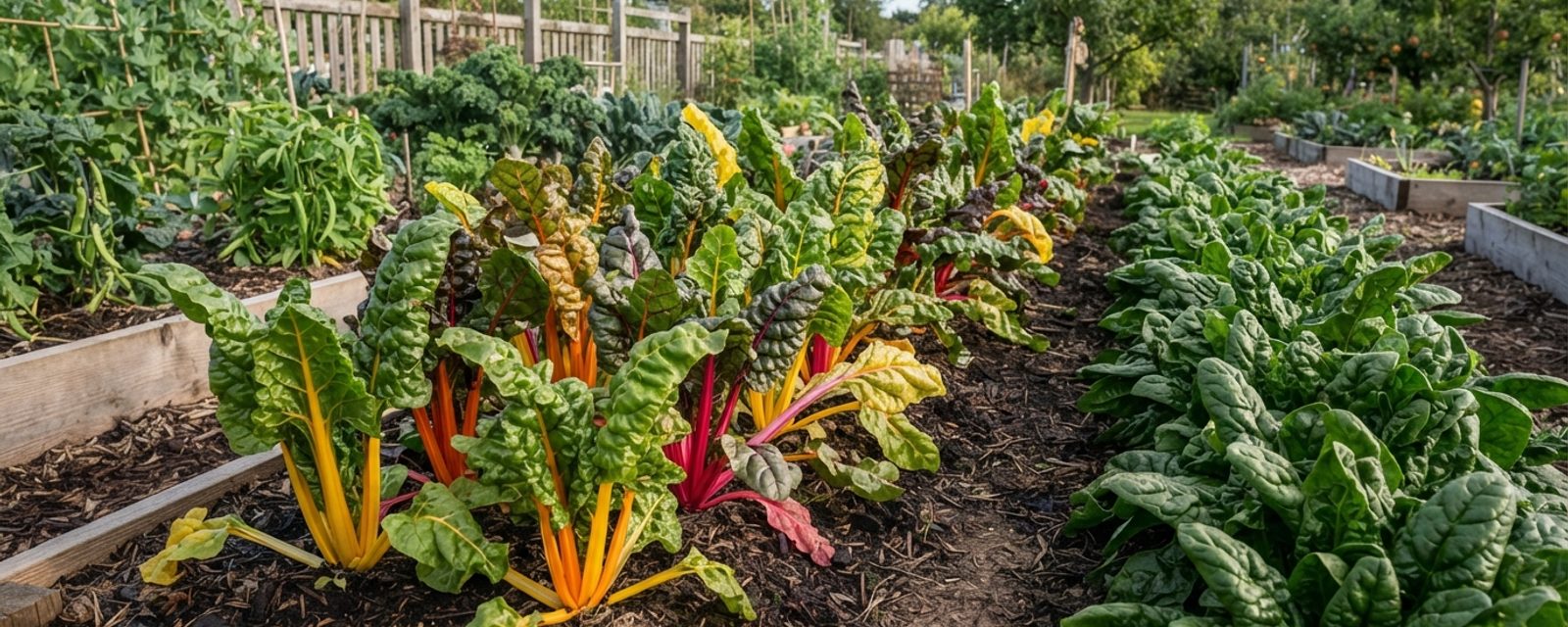
Most UK sowing guides give chard and spinach the same treatment: sow in spring, harvest through summer, done. That works fine in the south. It doesn't quite work here. Scotland gets close to an hour more daylight around the summer solstice than the south of England does, and spinach reads day length as one of its cues to bolt, running to flower and no longer making usable leaf, in a change that can't be undone. A sowing schedule written for Surrey can have Scottish spinach running to flower while the chard sown alongside it, on the same day, in the same bed, is still quietly producing. These two crops don't glut the same way, and treating them as interchangeable is where most of the frustration comes from.
Chard and spinach are not the same shape of glut
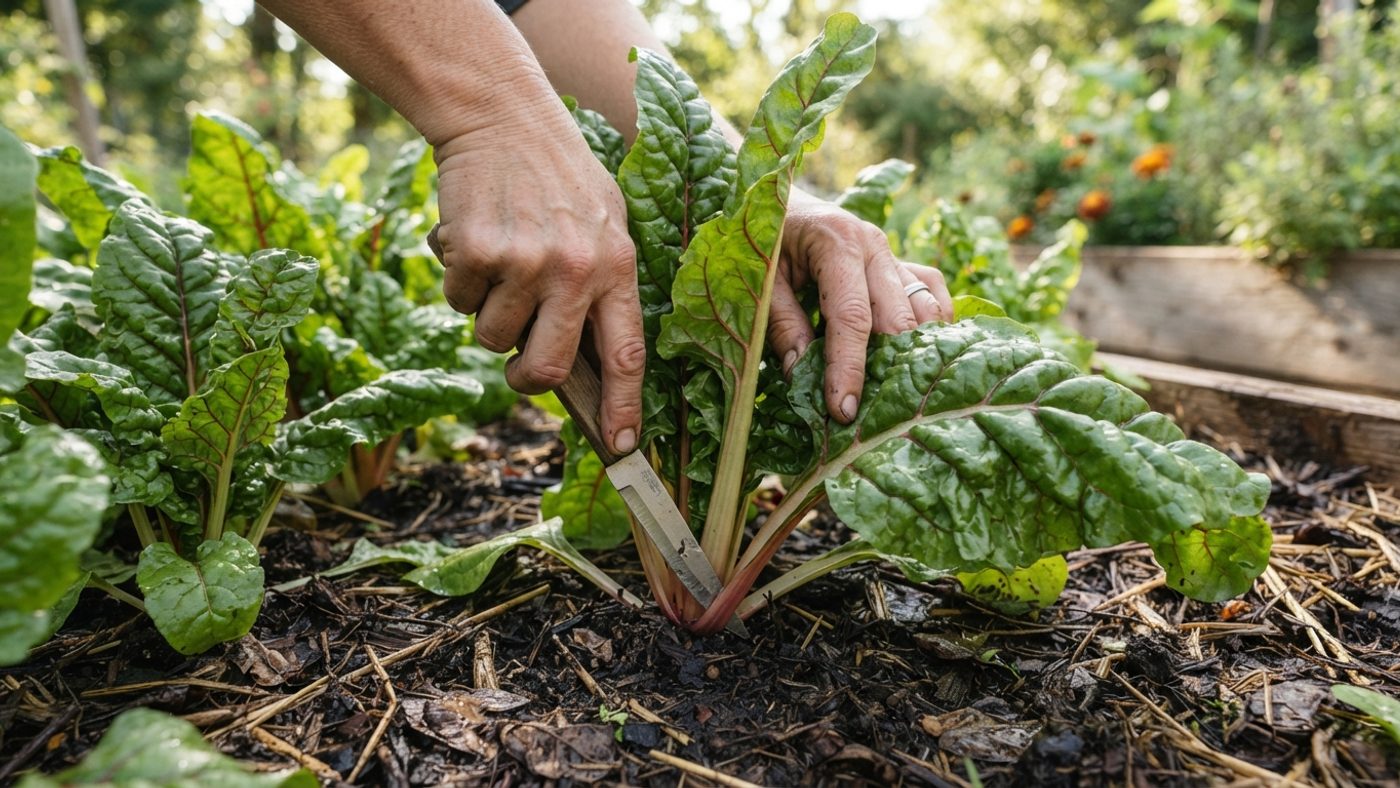
Chard is a genuine cut-and-come-again crop. The chard growing guide and RHS both describe two sowing windows (one in spring, one in mid-summer) that between them keep plants producing pickings for months, in some years close to year-round. Take only the outer leaves and cut cleanly at the base, and the plant keeps sending up more from the centre. Established plants can even be cut hard, right back, and will regenerate a fresh flush of leaves for the next round. Chard does eventually bolt in hot weather, and once it does in earnest it stops being productive, but getting there takes a lot longer than it does for spinach, and removing flower stems as they appear buys extra weeks. Chard's boltingA plant switching early into flowering and seed production, usually triggered by stress, after which leaves, roots or bulbs turn bitter or unusable. Full page → trigger being heat rather than day length is, if anything, a second piece of good news for a Scottish garden: a cooler, cloudier summer with fewer sustained hot spells than further south is exactly the condition chard tolerates best.
Spinach is a different plant behaviourally, even though it sits in the same "leafy glut" conversation. It reaches harvest quickly (see the table below for the timings), but the productive window from there is short, because spinach bolts under three separate triggers: heat and drought, day length, and root disturbance from transplanting. Day length is the one that matters most for a Scottish bed sown on an English timetable: with close to an hour more daylight around the solstice than further south, spinach here can be pushed toward flowering earlier than a UK-wide guide assumes, even in a summer that isn't particularly hot. The chard garden-myths page and spinach garden-myths page both land on the same conclusion from different angles: a single chard sowing genuinely outlasts a single spinach sowing, and it isn't close.
Does picking more encourage more growth?
For chard, yes: cutting outer leaves regularly is exactly what keeps a plant productive rather than letting it get leggyDescribes a plant that's grown tall, thin and sparse rather than bushy, usually from too little light or not being pinched out. Full definition →. Light, frequent harvesting is the recommended technique, not a workaround.
For spinach, picking generously also encourages more leaves in the short term: cut plants right down to about 2.5cm above the soil and they'll regrow multiple times. The catch is that this only delays bolting, it doesn't prevent it. Once day length and temperature tip a spinach plant toward flowering, no amount of picking will hold it back for long. Harvesting hard is worth doing, but it buys days, not months.
The more reliable lever for spinach specifically is dodging the trigger rather than out-picking it: a spring sowing (roughly March, per the spinach growing guide) timed to crop and finish before the summer solstice on 21 June, and a second sowing from later summer into early autumn once day length is shortening again, both sit outside the window where day length is actively pushing the plant toward flower. A bolt-resistant variety such as Mikado, named in the spinach growing guide, helps too, and light shade through the longest weeks keeps the soil and the plant itself cooler, taking some of the heat trigger out of the equation alongside the day-length one, though neither removes the trigger entirely; the timing is what does the real work. For exact sowing windows and spacing, see the spinach growing guide.
Chard vs spinach at a glance
| Chard | Spinach | |
|---|---|---|
| Time to first harvest | Several weeks from sowing | Baby leaves ~1 month; mature leaves ~2 months |
| Productive season | Several months; potentially most of the year with a spring and mid-summer sowing | Weeks, then bolts |
| Bolting triggers | Hot weather (comparatively bolt-resistant) | Heat and drought, day length, transplant stress |
| Does more picking help? | Yes, cut-and-come-again is the standard method | Delays bolting, doesn't prevent it |
| Succession sowing needed? | Not really, one good spring sowing already spans months | Yes, short, frequent sowings suit its bolt-fast habit |
Two things worth knowing beyond the table. PerpetualA strawberry type that produces smaller flushes of fruit continuously through the season, rather than one large crop over a few weeks. Full definition → spinach (also sold as spinach beet) is a type of leaf beet rather than true spinach, and crops for months in the same manner as chard; the spinach growing guide covers that distinction in full if you're choosing between the two for next season. And "several months" for chard and "weeks" for spinach are both season-dependent: a cool, damp Scottish summer stretches spinach's window; a hot one compresses it further.
Succession sowing: why it matters for spinach and barely matters for chard
The general technique (staggered sowing intervals, catch-cropping, working backward from your first frost date) is covered in full in succession planting for beginners, which already lists spinach as a crop worth sowing every 2–3 weeks precisely because it bolts fast.
Spinach benefits from short, frequent sowings because each individual sowing has a narrow window before it bolts; stagger the sowings and you stagger the bolting, turning one hard deadline into a rolling supply. It's also the same lever as the day-length dodge above, applied repeatedly: a run of small, frequent sowings through spring and again from later summer into autumn means several separate windows either side of the 21 June solstice, rather than betting everything on one sowing that may or may not land clear of the trigger. Chard doesn't need the same treatment, because a single spring sowing (April, per the chard growing guide) is already slow to bolt and keeps producing for months on its own; a second sowing around July, within the chard growing guide's April–July sowing window, is there to extend the season into autumn and cover any gap rather than to dodge an imminent bolt. Succession sowing solves a real problem for spinach. For chard it's a nice-to-have.
For the general mechanics of bolting itself (why annual crops like spinach respond to heat, drought and long days while biennialA plant that completes its life cycle over two years: growth in year one, then flowering, seeding and dying in year two. Full definition → crops respond to cold instead), the bolting explainer covers the underlying biology.
Keeping a short-term surplus
There's no specific figure for how many days either crop will keep once picked. The general approach: keep leaves unwashed, dry, and cool (a fridge crisper drawer is the practical option for most kitchens), and use them within a few days rather than treating them as a long-term store. This is a genuine short-term measure, not a substitute for adjusting how much you sow; a bed that keeps producing faster than a few days' worth of eating is better managed by picking less, picking earlier, or succession sowing than by relying on the fridge to absorb the excess.
Common questions
Does picking chard or spinach more often make it grow back faster?
For chard, yes, regular light picking of outer leaves is the standard way to keep it productive. For spinach, generous cutting also produces regrowth, but it only delays bolting rather than preventing it; timing the sowing to avoid the longest days does more than picking hard.
Why does my spinach bolt faster in Scotland than gardening guides suggest?
Spinach bolts in response to day length as well as heat, and Scotland gets close to an hour more daylight around the summer solstice than southern England, where most general UK sowing advice is calibrated. A sowing timed for further south can run to flower earlier here than the guide implies.
Is perpetual spinach the same as true spinach?
No, perpetual spinach (spinach beet) is a type of leaf beet, not true spinach, and crops for months rather than weeks. The spinach growing guide covers the difference in detail.
Do I need to succession sow chard the way I would spinach?
Not really. A single spring chard sowing already produces for months, so a second sowing (commonly in July) is mainly about extending the season into autumn rather than avoiding an imminent bolt, unlike spinach's every-2–3-week succession sowing.
How long will picked chard or spinach keep before it needs eating?
There's no specific shelf-life figure for either crop. Kept unwashed and cool (a fridge crisper drawer is fine), both are best treated as a few days' supply rather than stored longer-term.
Sources
3 sources, recorded with what each was used for
- RHS: Chard, grow your own: Sowing windows, cut-and-come-again method, season length, bolting behaviour
- RHS: Spinach, grow your own: Sowing windows, time to harvest, bolting triggers (heat/drought, day length, transplant stress), succession sowing guidance, bolt-resistant variety Mikado
- Garden Organic: Spinach (Annual) growing guide: Harvesting/regrowth method (cutting to 2.5cm), bolting in warm conditions