
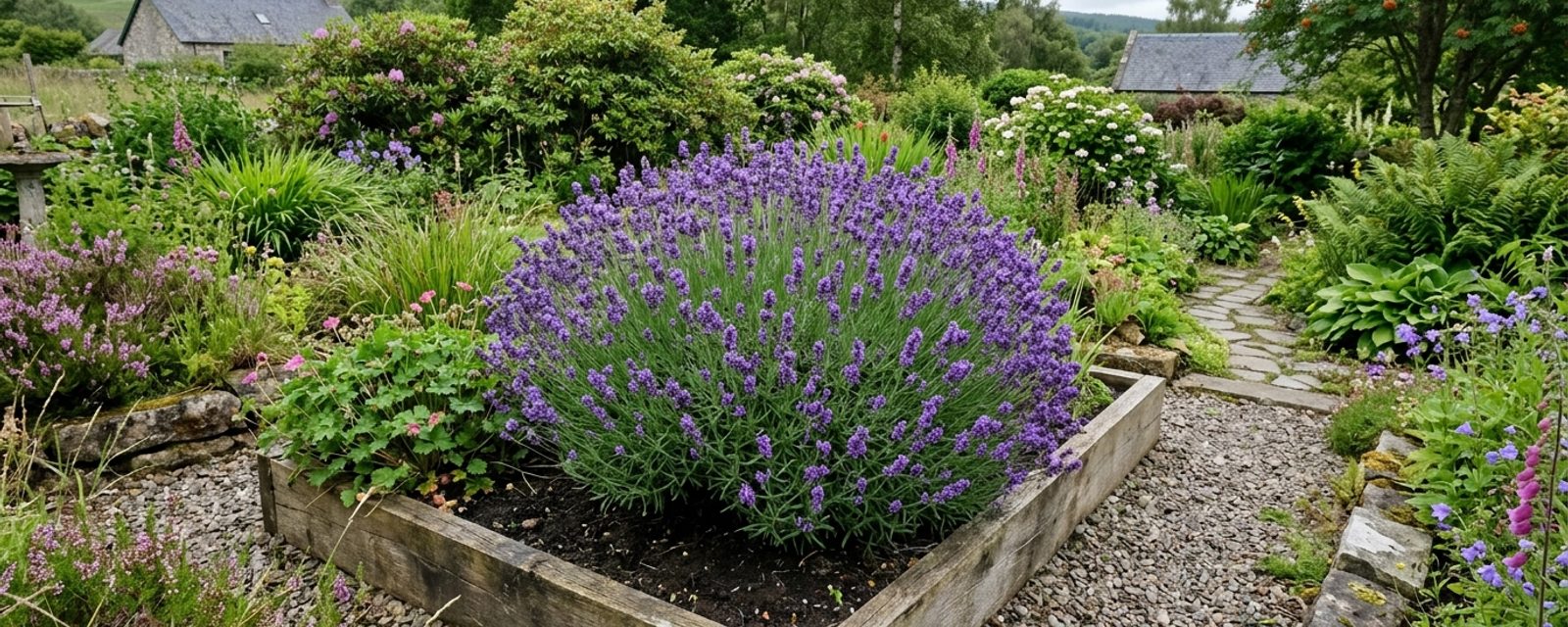
Lavandula angustifolia (English lavender)
Lavender is genuinely marginal in Scotland, but not for the reason many gardeners assume: English lavender is hardy enough to overwinterKeeping a plant alive and intact through the cold months, whether left outdoors, moved under cover, or stored dormant. Full definition → outdoors, and the real risk is wet, heavy soil, not cold. French and Spanish types are a different story entirely, with a real hardiness gap that changes which one to choose on acid soil.
A grey, aromatic, evergreen shrub that stays compact for years given the right ground, lavender wants poor, free-drainingSoil that lets water pass through quickly rather than pooling, so roots aren't sitting in wet ground after rain. Full definition → soil rather than a rich, well-fed bed: the opposite of what most border plants ask for.
Site and soil
Choose a spot in full sun with free-draining soil, ideally neutral to alkaline and on the poorer, less fertile side; avoid heavy clay, waterlogged ground, shade and damp spots altogether. On acid soil, French lavender is the better-suited type, though it's also the more tender one, better grown in a movable container than planted straight into open ground here. Space plants 90cm apart as individual specimens, or 30-45cm apart for a hedge. For containers, use a 30-40cm diameter pot with drainage holes, filled with peat-freeCompost made without peat, which is harvested from a slow-forming, carbon-storing wetland habitat that peat extraction damages. Full definition → multipurpose compost or John Innes No. 2 mixed with 25% coarse grit.
Planting and propagation
Plant April to May, going into the ground immediately after buying, and water regularly through the first growing season, especially in dry weather. Propagate by softwood or semi-ripe cuttings in early to midsummer, or hardwood cuttings in late autumn after flowering. Seed is possible too, collected from dried seedheads in late summer and sown in spring, but a named cultivarA plant variety that arose or was bred under cultivation and is kept true by deliberate propagation, rather than a naturally occurring wild species. Full definition →'s seed may not resemble the parent plant, so cuttings are the more reliable route for keeping a specific variety true. Semi-Ripe Cuttings: Reading the Bend Test → covers how to judge exactly when a shoot is ready, rather than going by the calendar alone.
Care through the year
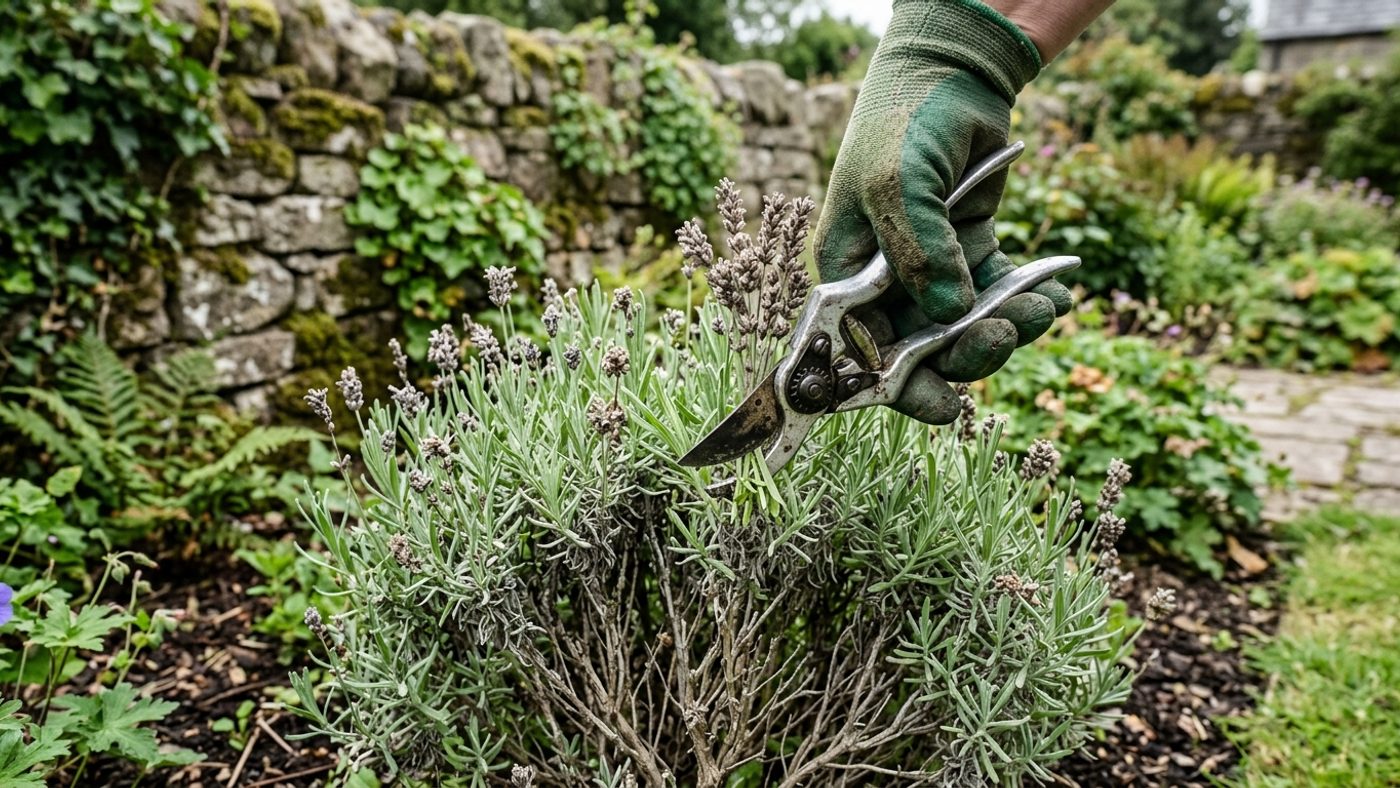
Established ground plants are drought-tolerant and need no feeding, since lavender actually prefers low-nutrient soil; container plants need watering once or twice weekly in dry summer weather. Prune annually in late summer after flowering, removing spent flower stalks and about 2.5cm of leaf growth, and never cut into woody stems. Older plants naturally become straggly and woody; since lavender establishes quickly from new stock, replacing an old plant is usually more effective than trying to rejuvenate it.
Winter
English lavender in free-draining soil needs no special winter protection at all. Container plants of any type should be kept fairly dry and sheltered from excess rain over winter. French, Spanish and other tender types genuinely need moving somewhere frost-free for winter, since they're less hardy and shorter-lived outdoors than English lavender.
Harvesting
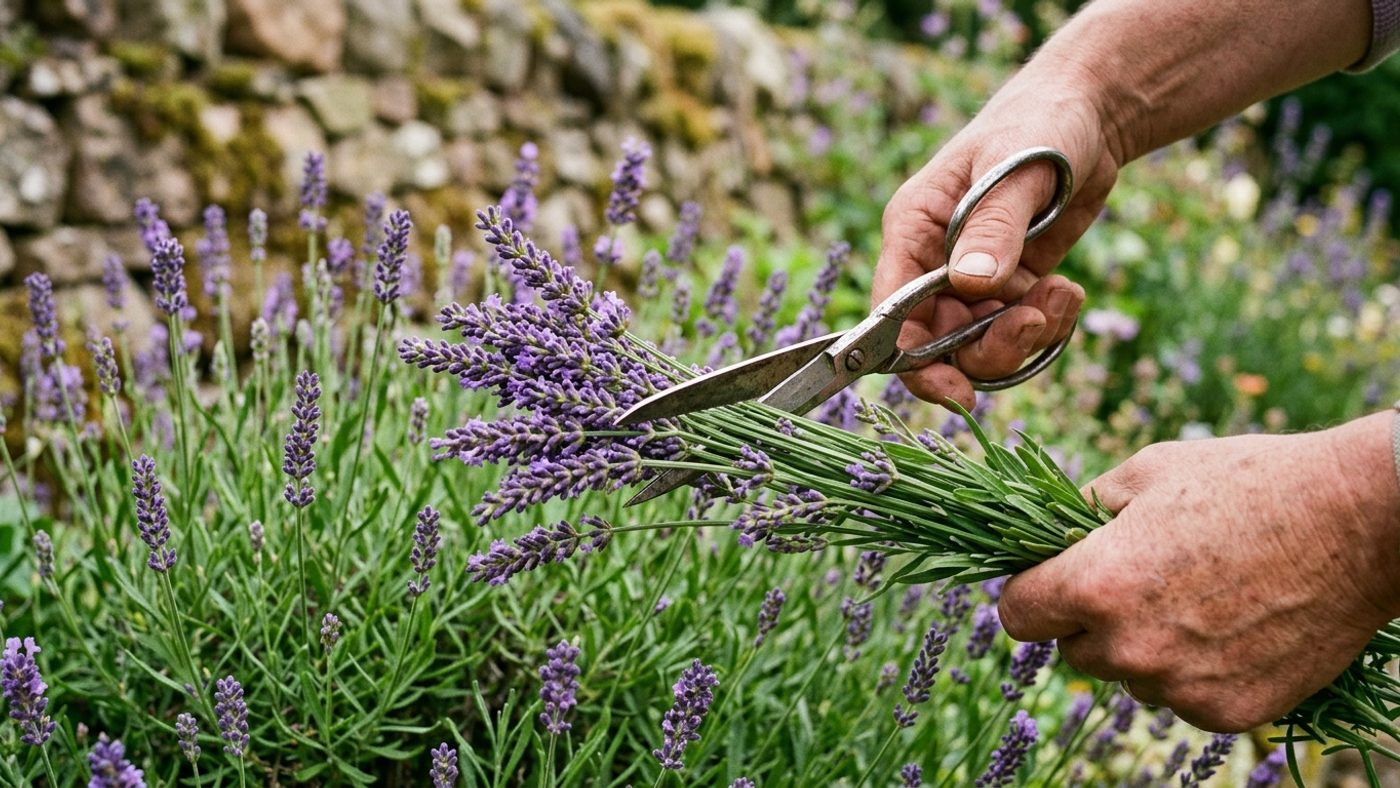
Cut flower spikes in early to mid-summer, just before they're fully open, for the strongest fragrance.
Varieties
Ten AGMThe RHS's Award of Garden Merit: a UK-wide trials award for reliable performance, not a Scotland-specific recommendation. Full definition → varieties exist across English, hybrid and Spanish types. English cultivars (Hidcote, Imperial Gem, Miss Katherine, Beechwood Blue) all carry H5 hardiness, not just an award; hybrid and Spanish AGM cultivars on the same list range down to H3The RHS's H1a–H7 scale for how much cold a plant can survive outdoors, H1a being tender indoor-only and H7 hardy anywhere in the UK. Full definition →, a meaningfully lower bar.
★ Our pick for Scotland
HidcoteAGM
English lavender · H5 · deep violet-purple
The most widely available English lavender, AGM-rated and carrying a genuine H5 hardiness rating.
Why this one: The most widely available English lavender, which matters when sourcing plants locally, and slightly larger and more vigorous than Imperial Gem, the other H5 pick here.
Also worth considering
Imperial GemAGM
English lavender · H5 · compact, dark violet
A second AGM, H5 English lavender, more compact than Hidcote, useful for a smaller border or edging.
Best Lavender Varieties for Scotland → compares all named lavender varieties head-to-head, with the practical detail that doesn't fit in a summary card.
Common problems
- Root rot follows wet or heavy soil far more often than any pest does; raised beds or containers with sharp drainage are the real defence.
- Rosemary beetle is a metallic purple-and-green beetle that chews leaves and flowers down to greyish stumps; plant health usually isn't affected, and hand-picking beetles and larvae off keeps numbers down.
- Sage and Ligurian leafhopper causes pale mottling on leaves, usually cosmetic rather than serious.
See more problems
- Cuckoo spit is cosmetic damage only; no treatment is needed.
- Xylella fastidiosa is a notifiable bacterial disease not currently found anywhere in the UK, but lavender is named a high-risk host if it ever arrives. Favour UK-grown plants over recent imports, and report a suspected case to plant health authorities rather than trying to treat it yourself.
Common questions
Is lavender too tender to grow in Scotland?
No, not English lavender: it's hardy and can overwinter outside in free-draining soil. What actually kills lavender is wet, heavy soil, not cold. Full sourced breakdown: <a href="/tools/garden-myths/lavender/">Lavender Myths →</a>
Are all lavender varieties equally hardy?
No: English lavender AGM cultivars mostly carry an H5 hardiness rating, while French, Spanish and hybrid types range down to H3, a meaningfully lower bar. Full sourced breakdown: <a href="/tools/garden-myths/lavender/">Lavender Myths →</a>
Does lavender need alkaline soil?
No: lavender generally prefers neutral to alkaline soil; on acid ground, French lavender is the better-suited type. Full sourced breakdown: <a href="/tools/garden-myths/lavender/">Lavender Myths →</a>
Can I cut an old, woody lavender plant hard back?
No: cutting into woody stems should be avoided. Once a plant has genuinely gone woody and straggly, propagate a replacement from cuttings rather than trying to rescue the old one. Full sourced breakdown: <a href="/tools/garden-myths/lavender/">Lavender Myths →</a>
Sources
3 sources, and what each was used for
- RHS: site/soil, spacing, sowing/planting, propagation, pruning, watering, hardiness comparison between English and French/Spanish types, container growing, common problems, Xylella risk
- RHS: AGM variety list with hardiness ratings by type
- gardenersworld.com: neutral-to-alkaline soil preference, French lavender as the acid-soil alternative, drought tolerance vs wet-soil risk, pruning after flowering