
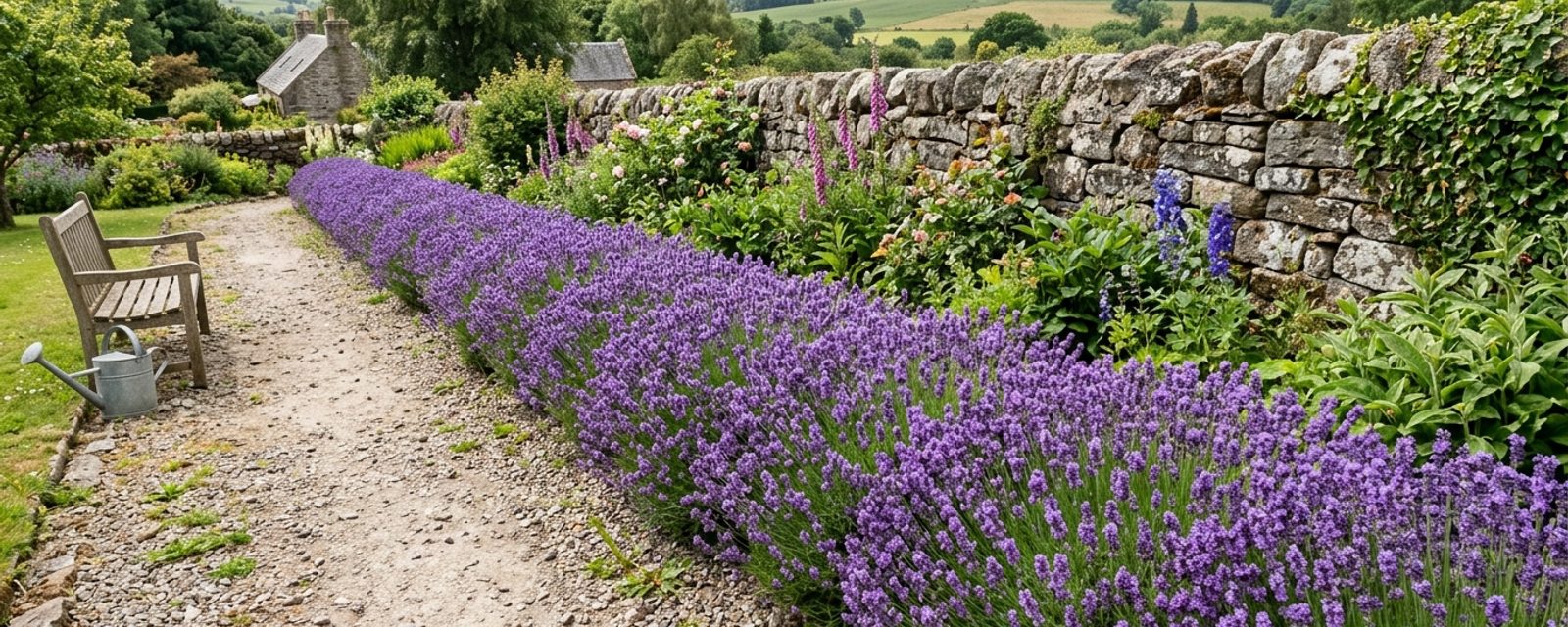
Lavender has a reputation as the easiest plant in the garden: full sun, poor soil, leave it alone, and it thrives on neglect. Follow the standard pruning advice to the letter in much of Scotland and a lavender can still turn brown, go leggyDescribes a plant that's grown tall, thin and sparse rather than bushy, usually from too little light or not being pinched out. Full definition →, or simply rot at the base within a couple of seasons. That's rarely a pruning mistake. A perfectly-cut lavender will still struggle in a spot that keeps its roots wet, because what the plant is sitting in and where usually decides its fate before the secateurs ever come out.
Why lavender struggles here, and it isn't really about acidity
It's tempting to assume Scotland's more acidic soils are the problem, since lavender is so strongly associated with the alkaline chalk downs of southern England and the limestone hills of Provence. English lavender (Lavandula angustifolia), lavandin (L. × intermedia) and French lavender (L. stoechas) are all in fact listed as tolerating acid, alkaline or neutral soil, pH itself is not what kills a Scottish lavender.
Water is what kills it. Lavender demands free-drainingSoil that lets water pass through quickly rather than pooling, so roots aren't sitting in wet ground after rain. Full definition → soil and will not thrive in heavy clay or any soil that becomes waterlogged; grown in wet or heavy ground, it can suffer root rot that leads to its premature death. That single requirement collides with how much of Scotland's ground is actually built:
| Ground type | Share of Scotland's land | What it means for lavender |
|---|---|---|
| Podzols, naturally acid but free-draining | 23.7% | Fine on pH, and drainage is usually workable here too |
| Peat, wet, spongy, slow to drain | 22.5% | A difficult base for lavender without major amendment |
| Gleys, waterlogged soils | 20.6% | The most direct match for the "will not thrive" warning above |
Scotland's soils are, as a whole, more organic, more leached and wetter than most of the rest of Europe, which is also why a standard home pH test is worth doing before planting anything nearby that does mind acidity, even though lavender itself doesn't. The country's Central Belt sits mostly on mineral soils that garden much like the rest of the UK, while the Highlands and Southern Uplands are dominated by the peaty, slow-draining ground above, especially in the west.
| Area | Typical annual rainfall |
|---|---|
| Coastal eastern Scotland | under 700mm |
| Southern Grampians | over 1500mm |
| Western half of Northern Scotland | at least 1700mm |
| Near Fort William | over 4000mm |
None of this is destiny for any one garden. A coastal, sandy-soiled plot can drain just as freely as anywhere in England, and English lavender 'Hidcote' is one of RHS's own recommended shrubs for open coastal planting. But across a lot of the country, especially inland, upland and to the west, a garden bed dug straight into unmodified clay or peaty gley recreates the exact conditions lavender is warned against, and no amount of correct pruning fixes that on its own.
Siting and drainage: the decision that happens before pruning does
Lavender needs full sun and won't tolerate shade, a south, east or west-facing spot in the open, not tucked against a shady wall, and one that's also sheltered from wind and driving rain rather than fully exposed to it. Beyond sun, everything else is about keeping the roots dry.
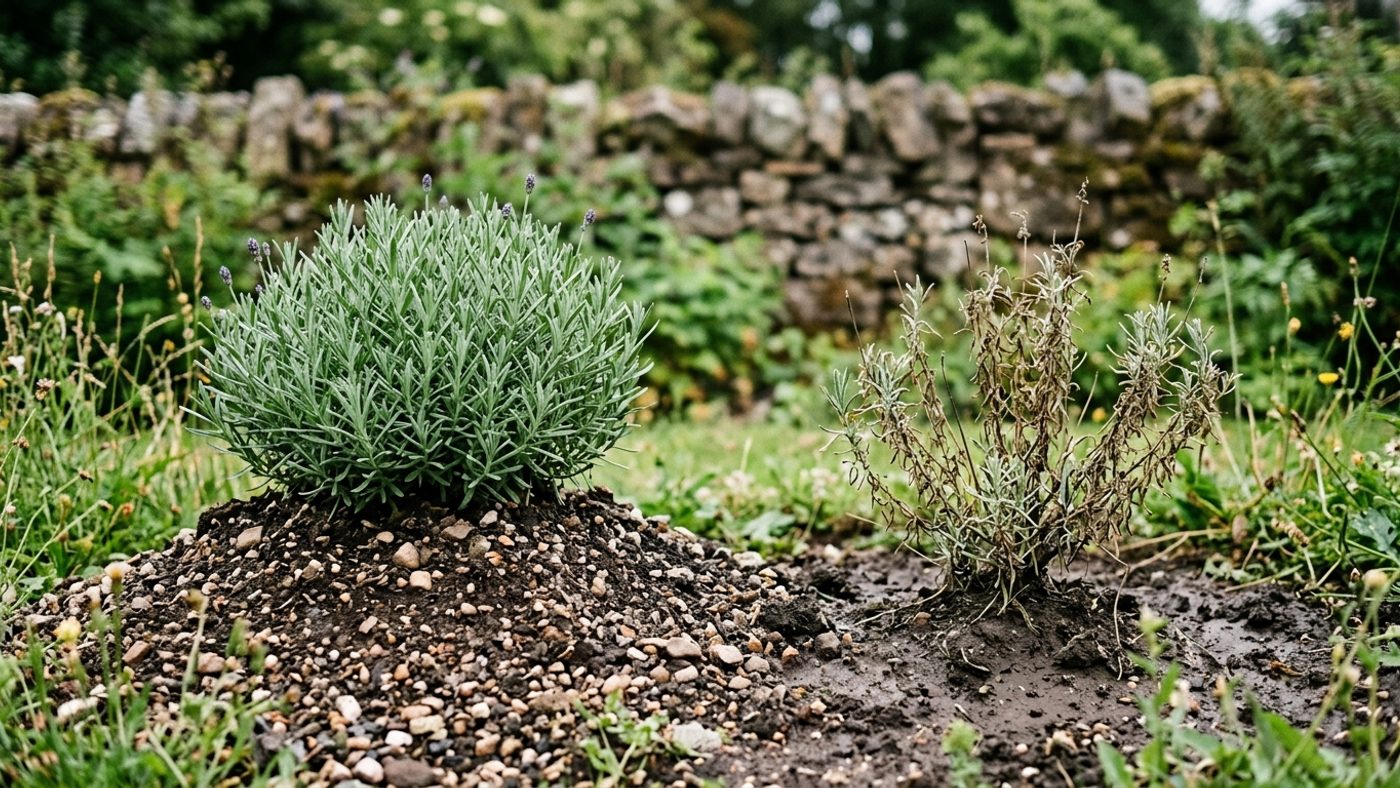
- On anything heavier than a light, free-draining soil, plant on a mound, ridge or raised bed roughly 20-30cm high, so roots never sit in standing water after a wet spell, and work coarse grit into that raised area to help stop it reverting to the wet ground around it.
- In containers, use a large pot (roughly 30-40cm across) with generous drainage holes, and mix in coarse grit, up to a quarter of the total volume, into the compost. Raise the pot onMoving a plant into a larger pot as its roots fill the current one, giving it more room and fresh compost before it becomes pot-bound. Full definition → feet or bricks so the holes stay clear, and lift off any saucer or tray before winter so it never stands in collected rainwater.
- Less hardy container lavender is worth moving under cover for winter, kept fairly dry, a cold greenhouse or a sheltered rain-shadow spot against a wall both work, watering it only occasionally rather than through the wet months as normal, since sitting wet in the cold is what actually causes rot and grey mould over winter, not the cold on its own.
- Don't feed for lushness. Lavender wants low-nutrient soil; high-nitrogen fertiliser or manure produces soft, floppy growth, and floppy stems that flop into each other and stay damp are exactly the conditions that invite grey mould, one of the few diseases lavender is genuinely susceptible to (rosemary beetle is the other one worth watching for). Potash-based feeding supports flowering instead, without that risk.
- Space plants around 90cm apart as individual specimens, or 30cm apart for a hedge (45cm for larger cultivarsA plant variety that arose or was bred under cultivation and is kept true by deliberate propagation, rather than a naturally occurring wild species. Full definition →), close enough to knit together without crowding out the airflow that keeps foliage dry, the same damp, crowded conditions that favour grey mould.
A pH kit is still worth using before planting anything else nearby that does care about acidity: a pH of 7.0 counts as neutral, anything below that as acid, and a pH around 6.5 is usually reckoned the best general-purpose garden soil.
Timing the planting itself matters as much as the site. Lavender is best planted in April or May, as the soil is naturally warming and fresh stock is in garden centres, and should never go in over winter, when a young plant is most vulnerable to rotting in cold, wet soil before its roots have had a chance to establish, exactly the risk a well-drained site is built to avoid, but a young plant with an unestablished root system is more exposed to it than a mature one.
For the fuller picture of soil types across Scotland, see our Scotland soil types page.
Which lavender for a Scottish garden
Not every lavender handles a Scottish winter the same way, and the type planted affects both how forgiving the site can be and how the plant should be pruned. RHS hardiness ratings run on a UK-wide scale from tender to fully hardy; H5 means a plant survives most UK winters, including severe ones, down to -10 to -15°C, and H4The RHS's H1a–H7 scale for how much cold a plant can survive outdoors, H1a being tender indoor-only and H7 hardy anywhere in the UK. Full definition → means hardy through most of the UK but down to a slightly milder -5 to -10°C. "AGMThe RHS's Award of Garden Merit: a UK-wide trials award for reliable performance, not a Scotland-specific recommendation. Full definition →" (Award of Garden Merit) marks a cultivar the RHS judges a genuinely good garden performer, based on trial and expert assessment.
| Type | Hardiness | Typical use | Note for Scotland |
|---|---|---|---|
| English lavender (L. angustifolia), e.g. AGM cultivar 'Hidcote' | H5 (-15 to -10°C) | Compact border and edging plant | The hardiest choice; still needs free drainage, tolerant of acid soil |
| Lavandin (L. × intermedia) | H5 (-15 to -10°C) | Larger form, hedging, later and longer flowering | Equally hardy to English lavender; same drainage requirement |
| French/Spanish lavender (L. stoechas) | H4 (-10 to -5°C) | Distinctive "rabbit-ear" flowers, containers | Somewhat less cold-hardy and shorter-lived; the same drainage rule applies, on top of that colder-weather risk |
English lavender and lavandin are hardy enough for most of the country once they're sited well. French and Spanish lavender is the one to treat with more caution: it's the more cold-tender, shorter-lived option even in its native range, so a hard frost is more of a risk to it specifically than to the other two, grow it somewhere sheltered from wind and cold, or in a container that can be moved under cover for winter, and that risk falls away.
When and how to prune
Once a lavender is well sited, pruning is straightforward, and it's genuinely the same technique across the hardy types.
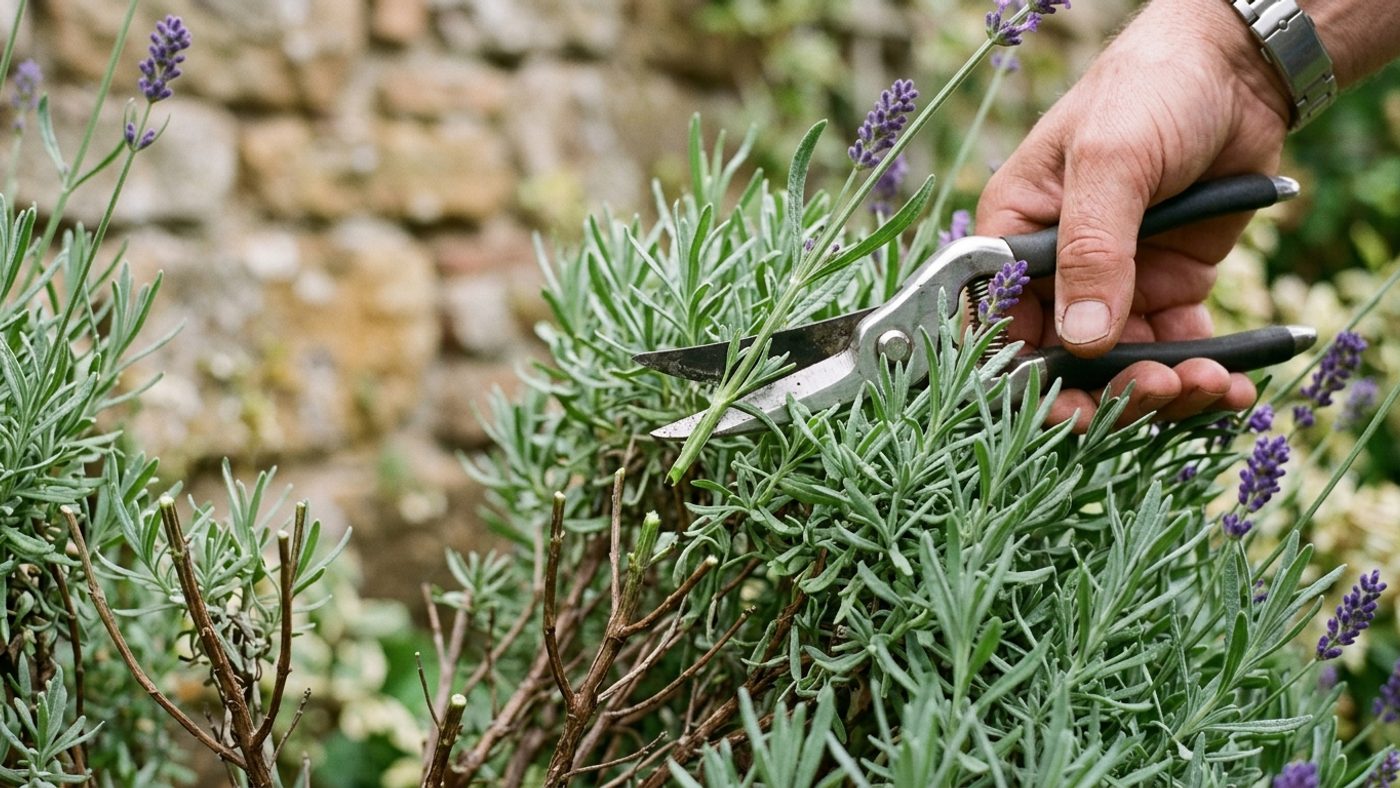
Prune annually, right after flowering has finished, typically late summer once the last flower spikes have faded. Remove the spent flower stalks along with about 2.5cm of the leafy growth beneath them, working over the whole plant with shears (or stem by stem with secateurs, on a smaller plant) to leave an even, rounded shape rather than an uneven mix of long and short stems. The one rule that can't be broken: never cut back into the bare, woody stem below the leafy growth. Lavender doesn't regenerate easily from old woodWhether a plant fruits on stems grown the previous year (young wood) or on older, established branches (old wood), which decides how it's pruned. Full definition →, so a stem cut back that hard usually just dies rather than resprouting, which is also how to check a stem before you cut it: if it's still got leafy green growth on it, it's safe to trim into; below that, on the bare brown wood, it isn't.
Autumn is the timing to avoid on wetter, colder sites: pruning then can leave a plant more vulnerable to winter damage, because the fresh cut and the newly exposed growth have less time to toughen up before the cold, wet months set in, worth taking most seriously on the peaty, higher-rainfall ground described above, and less of a concern on a well-drained coastal plot. Get the main cut done as soon as flowering finishes in late summer instead of waiting into autumn once the weather has turned. If foliage looks untidy or frost-damaged going into spring, a light cosmetic tidy-up then is fine; that's a separate, smaller job from the late-summer structural prune, not a replacement for it.
A straggly, woody plant: renovate or replace?
Because lavender won't reliably regrow from cuts into old wood, there's no real renovation option once a plant has gone leggy and bare at the base, a hard cut back into that old wood tends to kill most of those stems outright rather than force fresh growth, leaving a bare, gappy plant instead of the clean regrowth a hard prune produces on other shrubs. Even with correct annual pruning, lavender is a relatively short-lived shrub and will generally need replacing after around 10 years; on a poorly-drained site the practical lifespan is shorter still, since root rot can take a plant out well before old age does.
Replacing a lavender doesn't have to mean buying a new one. Cuttings taken from a healthy plant in early to midsummer (softwood or semi-ripe) grow into plants identical to the parent, a cheap way to keep a cultivar you already know suits your garden going once the original gets too woody to save, useful for a hedge too, where losing one plant to old wood or rot is a smaller job to patch from a cutting than to replace with a bought-in plant that won't quite match the rest of the row.
Common questions
Do I need to make my soil less acidic for lavender?
No. English lavender, lavandin and French lavender are all listed as tolerating acid, alkaline or neutral soil. The soil trait that actually matters for lavender is drainage, not pH — spend the effort on a raised bed or grit rather than a lime treatment.
My lavender is going brown and dying even though I pruned it correctly — what’s wrong?
Root rot from sitting in wet or heavy soil is a common cause of lavender dying that has nothing to do with how or when it was cut. If the bed doesn't drain freely, replanting on a mound, raised bed or in a large pot is more likely to fix it than a change in pruning.
Can I prune my lavender in autumn?
It's best avoided on wetter, colder sites, inland, upland or peaty ground rather than a free-draining coastal spot. Prune as soon as flowering finishes in late summer instead, and save any tidying of frost-damaged growth for a light trim in spring.
How do I fix a woody, leggy lavender with bare stems at the base?
There isn't a reliable renovation cut, because lavender doesn't regrow well from old wood. A plant that's gone leggy and bare is usually better replaced, ideally from a cutting off the same plant, than hard-pruned, and it's worth checking whether the site itself is holding too much water before planting the replacement in the same spot.
Which lavender is hardiest for a Scottish garden?
English lavender and lavandin are both rated H5, hardy down to -15 to -10°C, and are the safer long-term choice for an open border. French and Spanish lavender is rated H4, a little more cold-tender, so it does best in a container that can be moved to shelter over winter, or in the most sheltered spot available.
Sources
10 sources, recorded with what each was used for
- RHS: How to Grow Lavender: Siting, free-drainage requirement, raised bed/mound and container guidance, spacing, feeding, planting timing, propagation, pruning timing and technique, autumn-pruning caution
- RHS: Lavender (Plant Guide): Sun requirements, general siting, French/Spanish lavender lifespan
- RHS: Plants for Coastal Areas: Lavender ('Hidcote') as a recommended shrub for open coastal planting
- RHS: Lavandula angustifolia: English lavender's H5 hardiness rating, soil pH tolerance, pruning group, rosemary beetle/grey mould susceptibility, typical lifespan
- RHS: Lavandula x intermedia: Lavandin's H5 hardiness rating and soil pH tolerance
- RHS: Lavandula stoechas: French/Spanish lavender's H4 hardiness rating and soil pH tolerance
- RHS: Soil pH: pH definitions and the general-purpose garden soil benchmark
- RHS: Container Maintenance: Pot drainage, raising containers, winter care for less-hardy container lavender
- Met Office: Regional Scottish rainfall range
- gov.scot: The Scottish Soil Framework: Scotland's soil composition (podzol/peat/gley), and the Central Belt vs Highlands/Southern Uplands drainage contrast