
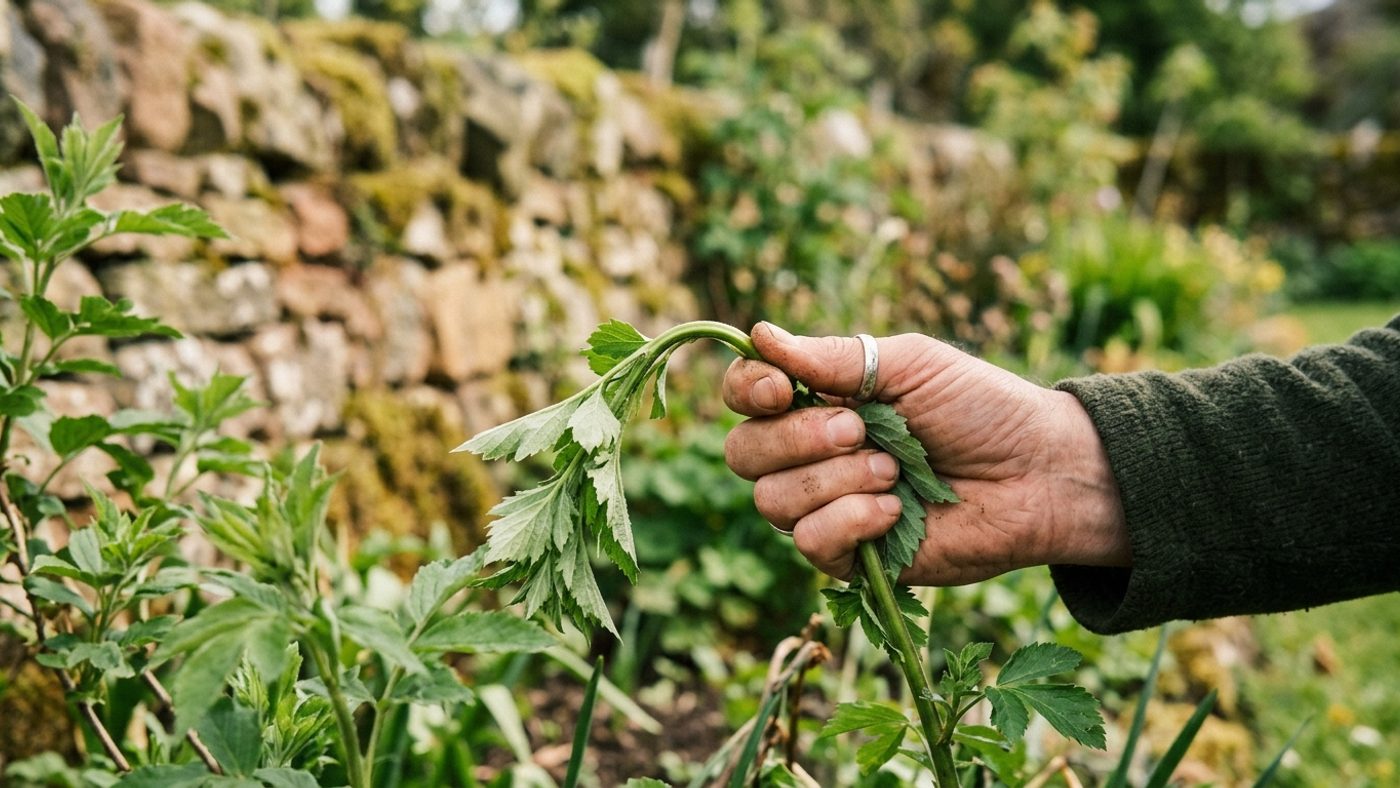
Take a shoot of this year's growth between finger and thumb, a few centimetres back from the tip, and bend it. If it just folds over and hangs there, floppy as a length of wet string, it's too soft: put it back and try again in a couple of weeks. If it won't bend at all, or cracks partway along its length with a dry, woody snap that leaves the bark torn rather than parted, it's gone too far the other way. What you're after is the shoot that bends with a bit of real resistance, holds for a moment, and then gives way at the base with a clean, single snap, no tearing, no long splinter of bark hanging on. That's the moment. That shoot is ready to become a cutting.
What the bend test is actually telling you
A shoot growing this season starts the year soft and green, mostly water and thin-walled cells, which is why a spring shoot bends without resistance and never really snaps, it just kinks. Over the growing season, the cells nearest the base of that shoot start laying down more rigid material and the tissue stiffens from the base upward, while the growing tip stays soft for longest. The bend test is a hand check for exactly that transition: still-soft wood folds; wood that's firmed up cleanly at the base but is still soft further up snaps crisply at that firm point; wood that's gone fully hard and woody all the way along resists bending altogether or shatters unevenly rather than parting in one place.
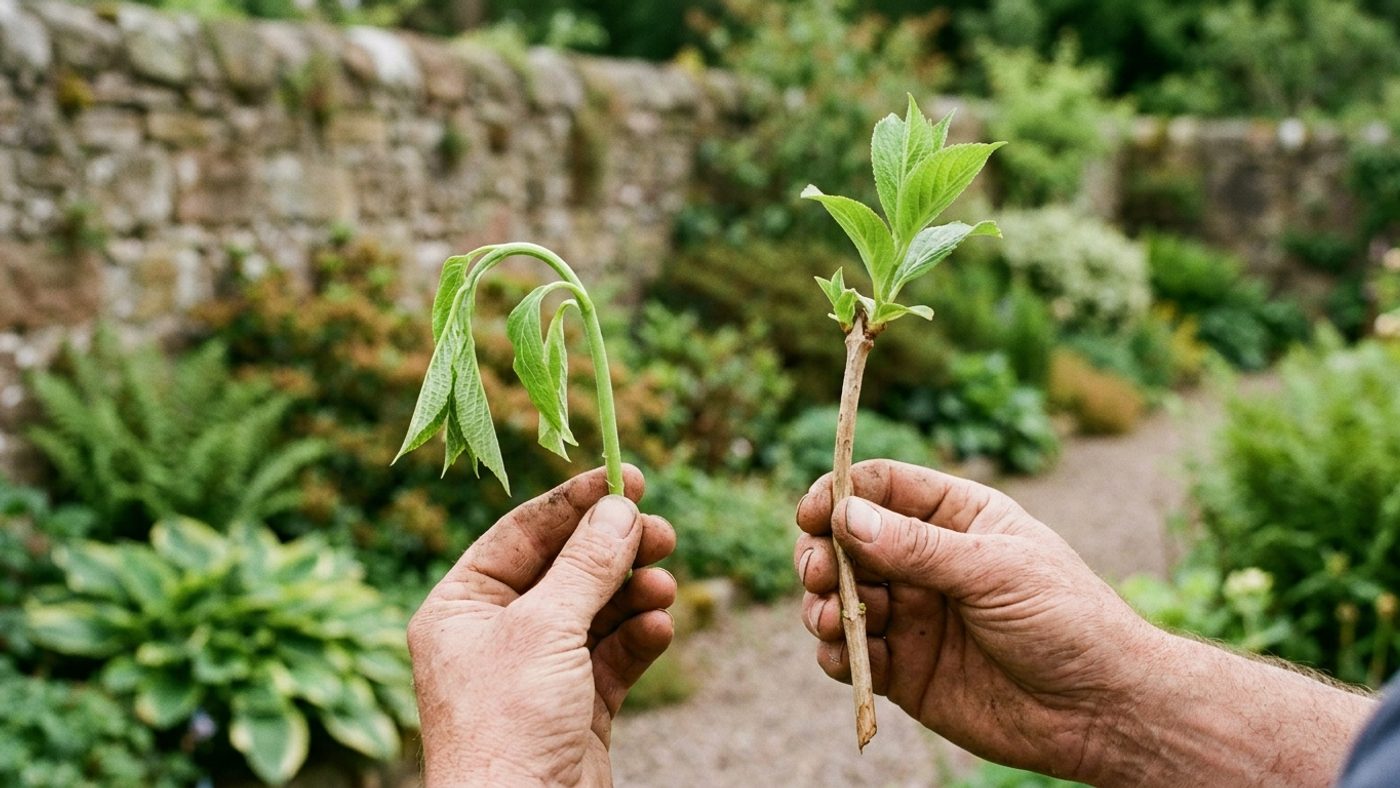
That middle stage is what "semi-ripe" means. A semi-ripe cutting is taken from this season's growth once its base has firmed while the tip is still soft, which is why the test is worth doing by hand rather than by date on a calendar: two shoots on the same plant, or the same shrub in two different summers, don't firm up at exactly the same time, and a soft shoot rooted too early or a fully hardened one taken too late both root less reliably than one caught at the right stage.
When to test
The general window for semi-ripe cuttings runs from summer into early autumn, and it's worth checking shoots through that whole stretch rather than picking one date and taking everything on the day. Softwood cuttings, taken from the same season's growth but earlier, before any of it has firmed, are a separate technique for late spring and early summer; hardwood cuttings, taken from fully ripened, leafless wood in mid-autumn to late winter, are the other end of the same idea.
Scotland's growing season starts later than further south, sometimes considerably later inland and at altitude, more detail on how much later by region is on our frost dates page, and a later start can mean this year's shoots take a little longer to reach the firm-based, soft-tipped stage the test is checking for. A shoot that's still folding limply in mid-July on an upland or inland garden isn't behind, it's simply not there yet: check again every week or two rather than forcingCovering plants to exclude light and speed early, tender growth in the dark, most associated with rhubarb and sea kale in late winter. Full definition → the date.
Taking the cutting
Choose a non-flowering, vigorous shoot on a healthy plant, ideally one that's already passed the bend test rather than one picked first and tested after. Work quickly once it's cut: first thing in the morning, when the whole plant is at its most hydrated after the cool of the night, rather than in the afternoon heat once it's already lost water through the leaves, and use clean, sharp secateurs throughout.
- Cut a length of 10–15cm, trimming just below a leaf node.
- Strip the leaves from the lower half of the cutting and remove the soft, unripe tip, leaving three or four pairs of leaves.
- If any remaining leaves are large, cut them in half to cut down on water loss while the cutting has no roots to replace it.
- For a shrub that's slow or reluctant to root, two techniques help: wounding, shaving a thin sliver of bark, about 2.5cm long, from one side of the stem to expose more of the tissue that produces roots; or a heel cutting, pulling a sideshoot away from a main stem with a small strip of the older wood still attached, rather than cutting it cleanly. Box roots reliably without either extra step.
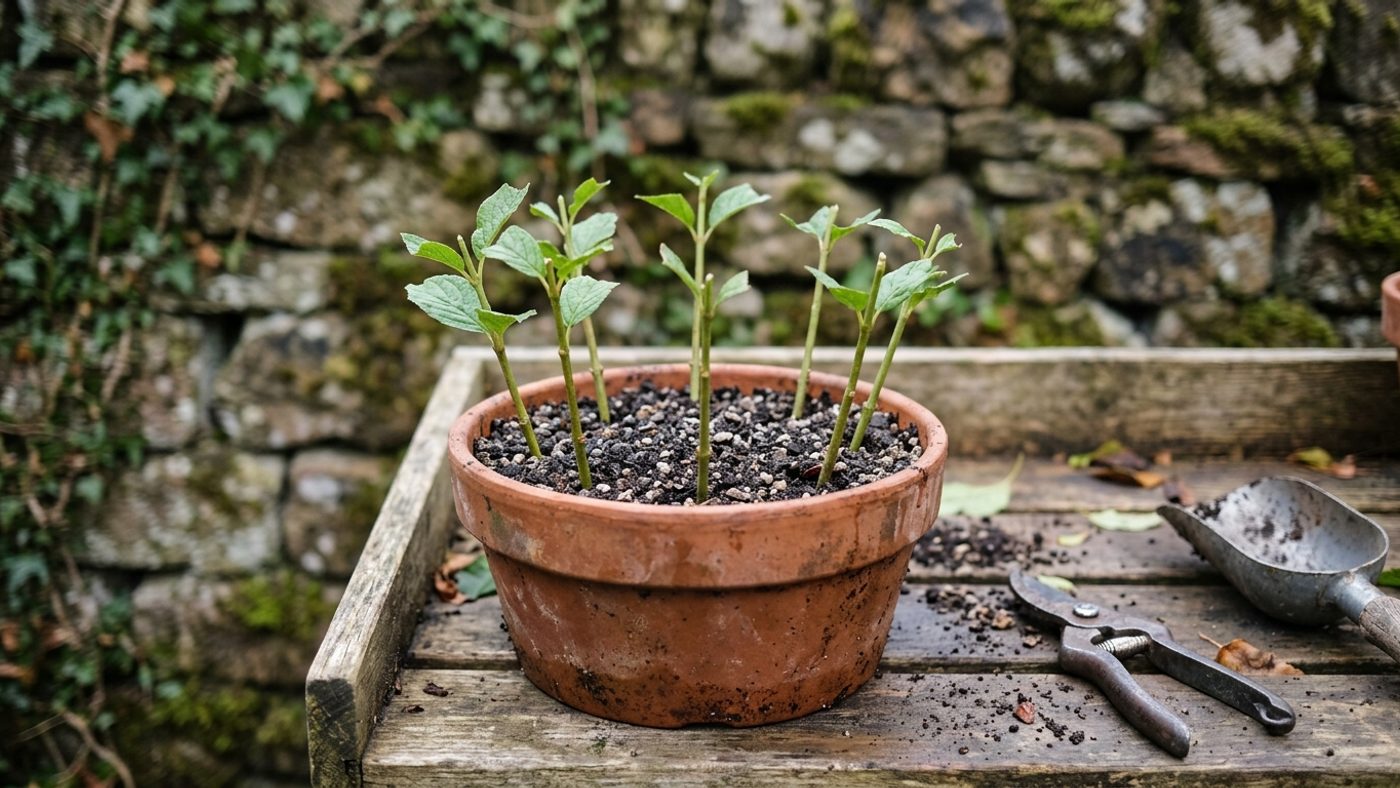
- Insert into free-drainingSoil that lets water pass through quickly rather than pooling, so roots aren't sitting in wet ground after rain. Full definition → cutting compost, a 50:50 mix of peat-freeCompost made without peat, which is harvested from a slow-forming, carbon-storing wetland habitat that peat extraction damages. Full definition → potting compost and sharp sand works well, several cuttings can share one pot spaced a couple of centimetres apart round the edge rather than needing one pot each, then water in and let it drain fully.
Rooting and aftercare
Cuttings taken in summer need a warm, light spot out of direct sun and, critically, humid air around the leaves while there are no roots to draw up water: a propagator lid, a clear plastic bag, or a cold frame all do the job. Bottom heat usually isn't necessary for cuttings taken in summer, though anything taken later, into early autumn, roots faster with it.
Keep the compost moist but not waterlogged, and check cuttings regularly: fungal mould and rot are the main way a batch is lost, and the fix is prompt removal of anything that's gone over, along with daily venting to stop the covered, humid air turning stagnant. Once new growth shows that rooting has taken, or roots are visible through the pot's drainage holes, start hardening the cutting off gradually over two to three weeks, opening the propagator or removing the cover for longer each day, before potting onMoving a plant into a larger pot as its roots fill the current one, giving it more room and fresh compost before it becomes pot-bound. Full definition →. Keep the hardening-off pots somewhere sheltered from wind rather than out in the open, a newly potted rooted cutting has a small root system and dries out fast if it's also fighting a breeze.
Slugs and snails go for soft young shoots and seedlings ahead of almost anything else in the garden, and a freshly potted rooted cutting is exactly that kind of target once it's hardening offGradually getting young plants raised indoors used to outdoor conditions over 7–14 days before planting out, so cold, wind and direct sun don't shock or damage them. Full definition → outdoors. Growing it on a little further in its pot before it goes anywhere more exposed is the more reliable protection; grit or copper rings around a pot are a common go-to, but slugs simply travel underneath a surface barrier rather than being stopped by it, so don't rely on one alone.
The cutting won't be a mature, winter-hardy plant by the time a Scottish autumn or winter arrives, whatever the parent shrub's own hardiness ratingThe RHS's H1a–H7 scale for how much cold a plant can survive outdoors, H1a being tender indoor-only and H7 hardy anywhere in the UK. Full definition →, so a cutting rooted late in the summer is safest overwinteredKeeping a plant alive and intact through the cold months, whether left outdoors, moved under cover, or stored dormant. Full definition → somewhere sheltered, a cold frame, an unheated greenhouse, or a sheltered spot against a house wall, rather than planted straight out into its final position. Give it the following spring to go out, once it's had a full growing season behind it.
Four plants that suit this method well, and why it's worth doing more than one
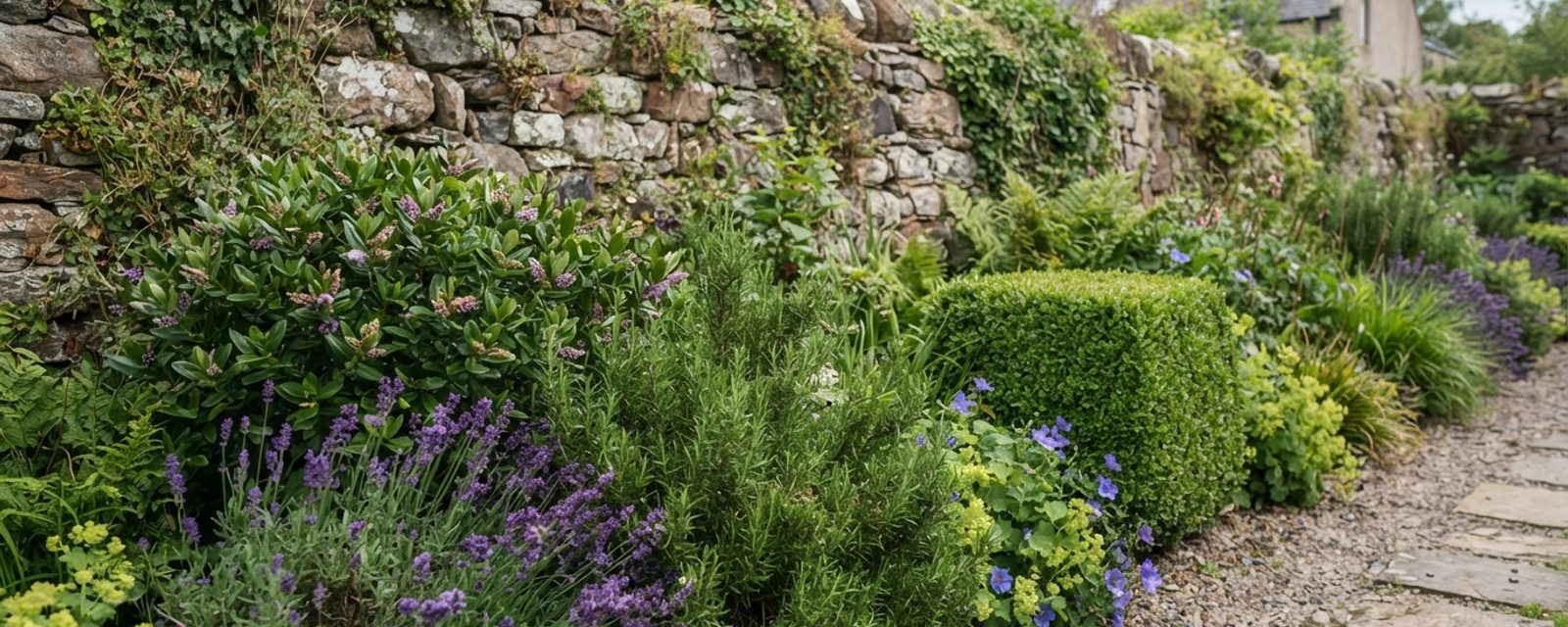
Lavender, rosemary, hebe and box all take reliably from a semi-ripe cutting judged the same way, by feel rather than by date.
| Plant | Best cutting method & timing | RHS hardiness | Worth knowing |
|---|---|---|---|
| Box (Buxus sempervirens) | Semi-ripe, early to midsummer | H6 (-20 to -15°C, hardy throughout the UK and northern Europe) | No wounding needed; box blight and box tree caterpillar, not cold, are the real risk |
| Rosemary (Rosmarinus officinalis) | Softwood (late spring–summer) fastest; semi-ripe (summer) a reliable fallback; layeringPropagating a new plant by pinning a low, flexible stem into the soil while still attached to the parent, so it roots before being cut free. Full definition → also works | H4 (-10 to -5°C, excludes inland valleys, altitude, central/northerly areas) | Layering needs no propagator at all |
| Lavender (Lavandula spp.) | Softwood or semi-ripe, early to midsummer | H5 for English lavender (-15 to -10°C) | Hardy on cold alone, but still prone to root rot on wet ground, hardiness doesn't fix a badly drained site |
| Hebe | Semi-ripe, summer to mid-autumn; small-leaved types root best specifically at this stage | H3–H4, most garden varieties (down to about -10°C) | Rots more readily than it fails to root, keep on the dry side |
H4 is officially defined as hardy through most of the UK "apart from inland valleys, at altitude and central or northerly locations", a description that covers a great deal of inland and upland Scotland by name, not just the mild coastal fringe, so rosemary and most garden hebes face a real frost risk here that a purely southern reading of "H4" wouldn't suggest. Lavender's H5 rating is safer on cold alone, but root rot from wet or heavy ground is the more common way a Scottish lavender is actually lost, and that risk has nothing to do with hardiness, it's about drainage: peat and gley soils, both poor-draining, together make up over 43% of Scotland's land area, more on siting it to avoid that in our lavender pruning and siting guide. Box, at H6, is genuinely safe from cold here, box blight and box tree caterpillar are its real risks instead, and the caterpillar has already reached Scotland alongside England, Wales and Ireland, more on both in our topiary basics guide. Either way, a rooted spare kept somewhere sheltered costs little to grow on, and losing one cutting out of several matters far less than losing the only plant, the same logic behind taking a rosemary cutting to replace an old, woody plant rather than nursing it back.
Box
In a heated propagator, box can root in around eight weeks; left in a cold frame or unheated greenhouse it takes closer to eight months. Either way it's a slow plant afterwards, worth pinching outRemoving the soft growing tip of a stem to stop upward growth and make the plant branch out sideways instead. Full definition → once it's shooting to keep it bushy, and it typically takes three to four years in a nursery bed before a cutting is a garden-ready plant, a project for patience rather than a quick fix for a gap in a hedge.
Hebe
Keep a rooted hebe on the dry side through its first sheltered winter rather than treating it like the others, it's the one of the four that rots faster than it struggles to root, the same wet-ground sensitivity that makes free drainage worth the effort for it as much as for lavender. Expect flowering within about two years of a cutting rooting.
Common questions
What if I get the bend test wrong and take a cutting too early or too late?
It usually just means a lower success rate rather than an outright failure. A cutting taken slightly early can still root, but it's more prone to wilting and rot before it does; a cutting taken slightly too late roots more slowly and less reliably. Take a few extra cuttings rather than relying on just one or two, so a partial failure doesn't mean starting over.
Do semi-ripe cuttings need rooting hormone?
No, most of the plants covered here root reliably without it. It can help with a genuinely reluctant subject, alongside wounding the base, but it isn't a routine step for lavender, rosemary, hebe or box.
Can I take semi-ripe cuttings outdoors without a propagator?
A cold frame, or even a clear plastic bag loosely tied over the pot, does the same job as a heated propagator, just more slowly. Open ground, kept consistently moist and in partial shade, also works for the toughest of these plants, box especially, but rooting takes longer and losses are higher without the covered, humid environment.
Why did my cutting go mouldy instead of rooting?
Fungal mould and rot are the most common reason a batch of cuttings fails, usually from compost kept too wet, air kept too stagnant, or a dead leaf left to rot against a healthy cutting. Vent the propagator daily, remove anything that's gone over straight away, and let the compost dry slightly between waterings rather than keeping it saturated.
What's the difference between taking a cutting by layering and taking a semi-ripe cutting?
Layering roots a stem while it's still attached to the parent plant, by pegging a low, flexible stem down into the soil until it forms its own roots, then severing it. It needs no propagator, pot or aftercare regime, but it only works on a plant with stems low and flexible enough to reach the ground, rosemary is one of the few here suited to it; lavender, hebe and box are better taken as cuttings proper.
Sources
16 sources, recorded with what each was used for
- RHS: Cuttings, semi-ripe: General method, timing, suitable plants, wounding and heel-cutting techniques, aftercare, rooting risks
- RHS: Cuttings, hardwood: Hardwood timing/definition, contrast with semi-ripe
- RHS: How to take semi-ripe cuttings (School Gardening): "Bendy but not too soft" stage description, step-by-step, multiple cuttings per tray
- RHS: Propagation techniques: Hygiene, morning/turgidity timing, humidity principles
- RHS: Box (Buxus sempervirens) growing guide: Box-specific propagation timing, rooting duration, aftercare
- RHS: How to Grow Rosemary: Rosemary propagation methods and timing, layering
- RHS: Lavender growing guide: Lavender propagation methods and timing
- RHS: Hebe growing guide: Hebe propagation, hardiness notes, overwintering, flowering timescale
- RHS: Buxus sempervirens (plant profile): Box hardiness rating
- RHS: Lavandula angustifolia (plant profile): English lavender hardiness rating
- RHS: Rosmarinus officinalis (plant profile): Rosemary hardiness rating
- RHS: Hebe albicans (plant profile): Representative hebe hardiness rating
- RHS: Hardiness rating: Official H4/H5/H6 definitions, including H4's "inland valleys, at altitude and central or northerly locations" caveat
- RHS: Box tree caterpillar: UK/Scotland distribution and damage
- RHS: Slugs and snails: Vulnerability of soft young growth, ineffectiveness of barrier methods
- gov.scot: The Scottish Soil Framework: Peat and gley proportion of Scotland's land area