
Rubus (Tayberry Group)
The tayberry has a genuinely documented Scottish breeding story behind its name, an exceptional hardiness ratingThe RHS's H1a–H7 scale for how much cold a plant can survive outdoors, H1a being tender indoor-only and H7 hardy anywhere in the UK. Full definition → that stands on its own regardless of that history, and a real cost to weigh if you choose a thornless cultivarA plant variety that arose or was bred under cultivation and is kept true by deliberate propagation, rather than a naturally occurring wild species. Full definition → over the original.
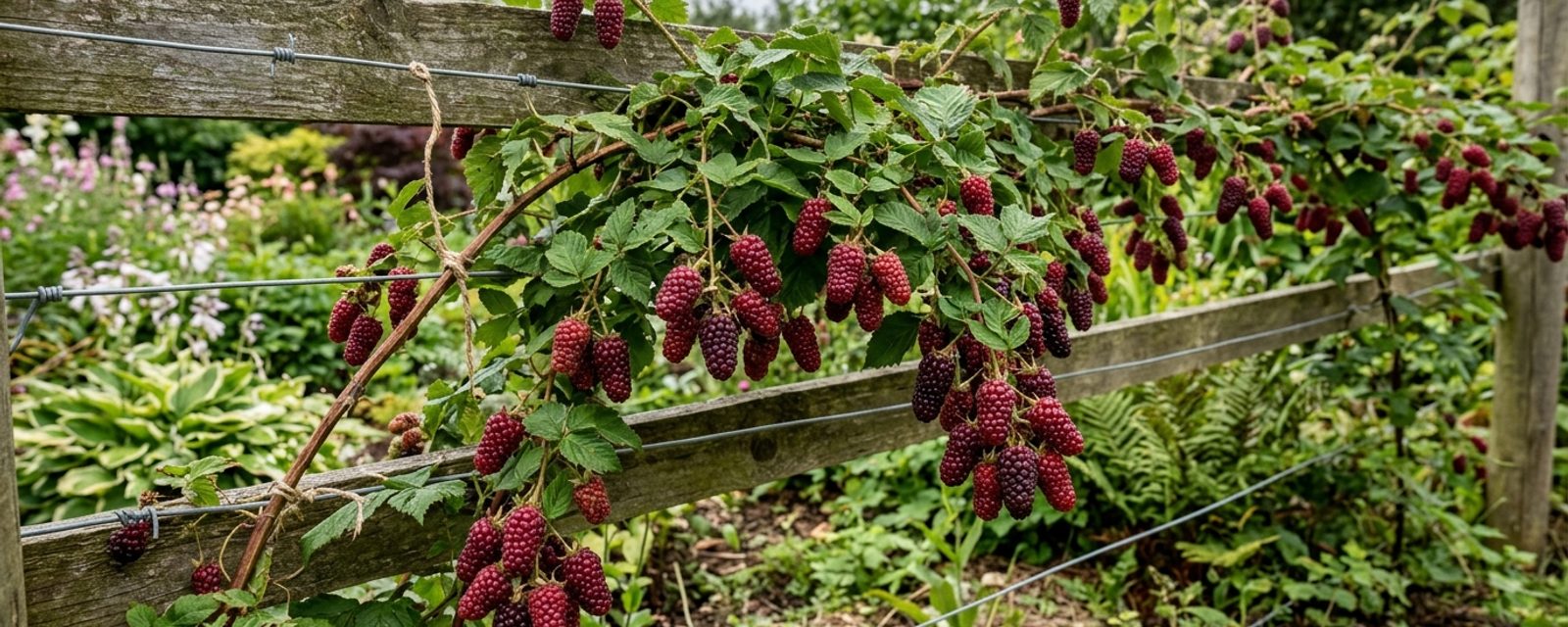
A tayberry is a cross between a loganberry and a black raspberry, larger and more aromatic than either parent, grown the same way as blackberries: trained onto wires rather than left to scramble. Unlike most Scottish-bred fruit, which shares a naming convention across a whole breeding programme's output (Glen, Ben, Loch), the tayberry's origin is a single, specific, well-documented story: one variety, two named breeders, one named institute, one named river.
Site and planting
Choose a sunny, sheltered site where possible; soil should be fertile and well-drained. Plant mid-autumn to early spring, ideally while dormant. The standard tayberry's own RHS listing gives a mature spread of 2.5-4m, placing it at the vigorous end of spacing — allow up to 4m between plants accordingly, or 2.5-3.5m for a less vigorous cultivar.
Training and support
Set up horizontal wires on a wall, fence or posts, the same spacing as blackberries: about 45cm apart, with the lowest wire roughly 45cm above the ground. The standard variety does best trained against the sheltered side of a fence or wall rather than out in the open. Tie in canes as they grow rather than letting them scramble, which matters for any cultivar, since a loose cane is a genuine hazard to brush past while working nearby, and even the usually-thornless standard variety can carry occasional thorned growth.
Care
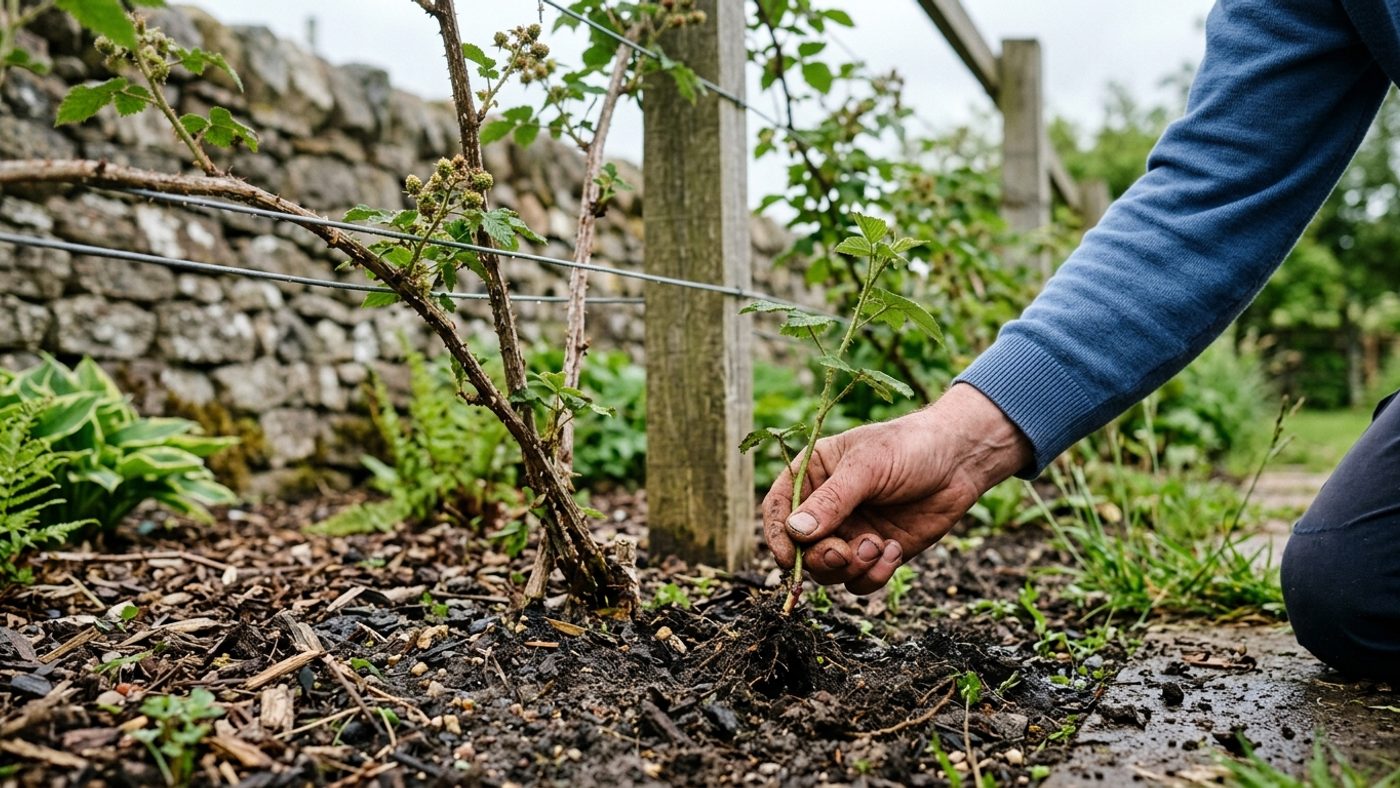
Water well after planting and through any prolonged dry spell in the first growing season; established plants shouldn't need routine extra watering. Mulch each spring with organic matter — a well-mulchedA layer of material spread over the soil around plants to suppress weeds, retain moisture, and improve soil structure as it breaks down. Full definition → plant generally needs no additional feeding, the same low-maintenance routine as blackberries. A tayberry is clump-forming and can sucker, sending up new growth beyond where it was originally planted, so keep an eye on the base of the plant and remove any suckersA shoot that grows from a plant's roots or lower trunk, separate from the main framework, usually removed before it diverts energy. Full definition → growing outside the area you want it to fill.
Pruning
Once well established, cut fruited canes down to the ground in late autumn, and tie in the new canes that grew over summer for next year's crop. This is earlier in the year than autumn-fruiting raspberries, which are cut back closer to late winter: worth checking rather than assuming the same timing carries over from a similar-looking cane fruit.
Varieties
A genuine trade-off runs through all three named cultivars: the original, usually-thornless but not guaranteed so, carries the only RHS AGMThe RHS's Award of Garden Merit: a UK-wide trials award for reliable performance, not a Scotland-specific recommendation. Full definition → and the highest hardiness rating, while the two fully or near-fully thornless options both give up two hardiness bands for more reliable handling.
Buckingham and Medana are each named separately from the standard tayberry.
★ Our pick for Scotland
Tayberry (standard)AGM
Usually thornless canes · H7 · large elongated red fruit
Rated H7, hardy in the severest European continental climates below -20°C, an exceptional hardiness rating. Bred at the Scottish Crop Research Institute, Invergowrie, and named after the River Tay.
Why this one: Crossed at the Scottish Crop Research Institute, now the James Hutton Institute, by Derek Jennings and David Mason between 1976 and 1979, deliberately named after the river running past the institute.
Also worth considering
Buckingham
Thornless · H5 · large well-flavoured fruit
Fully thornless, a firmer guarantee than the standard variety's usually-thornless canes, but rated H5, two full hardiness bands below it. No AGM.
Medana
Slightly thorned · H5 · large juicy aromatic fruit
A middle option: named 'slightly thorned' rather than fully thornless, still H5. No AGM.
Best Tayberry Varieties for Scotland → compares all named tayberry varieties head-to-head, with the practical detail that doesn't fit in a summary card.
Harvesting
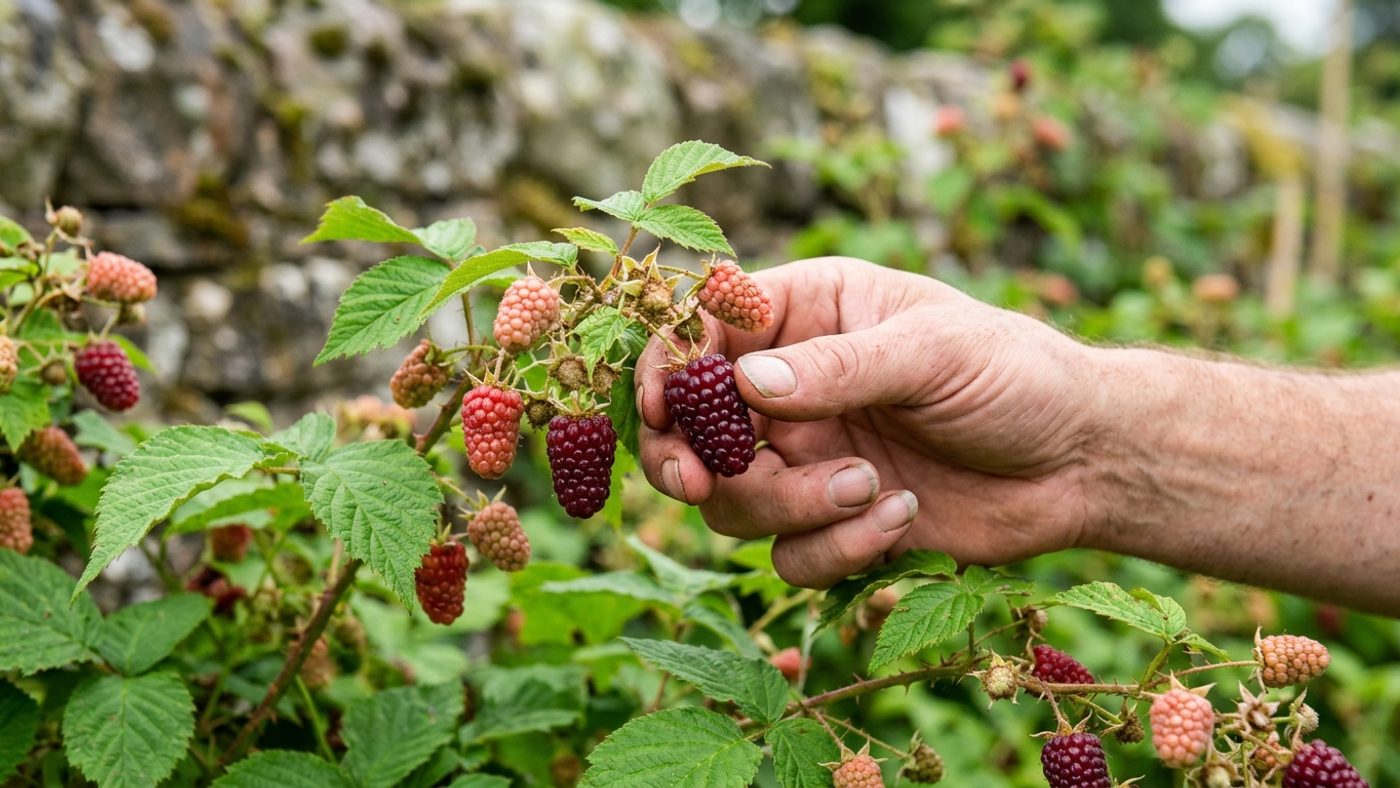
Ready from July to August. Fruits are elongated, up to 4cm long, and continue to darken as they finish ripening: wait for the deepest colour before picking for the best flavour, the same colour-based ripeness cue as most cane and berry fruit. Eat fresh or use for jam and puddings, and freeze any surplus quickly, since a soft fruit like this doesn't keep well once picked.
Common problems
- Birds strip ripening fruit fast; net plants raised on a framework rather than draped directly over the canes.
- Aphids distort new growth and shoots.
- Raspberry beetle larvae feed inside ripening fruit.
See more problems
- Grey mould affects fruit and canes in damp conditions; good airflow from correct training helps prevent it.
- Raspberry viruses can affect tayberries too, causing weak growth and poor cropping with no cure; buy certified virus-free stock.
- Mites can cause poor fruit set and uneven ripening. Red berry mite, the specific cause of this on blackberries, is named by RHS as not affecting other cane fruits, tayberries included.
- Honey fungus is a rare but serious root disease with no cure; remove and destroy an affected plant.
Common questions
Is the tayberry actually connected to Scotland, or is it just a name?
Genuinely connected: it was bred at the Scottish Crop Research Institute, now the James Hutton Institute, in Invergowrie by Derek Jennings and David Mason, crossing a loganberry with a black raspberry between 1976 and 1979, and named after the River Tay running past the institute. Full sourced breakdown: <a href="/tools/garden-myths/tayberries/">Tayberry Myths →</a>
Are all tayberry varieties thornless?
Not quite: the original tayberry, the only one of the three main cultivars with an RHS AGM, is described as usually thornless rather than guaranteed; Buckingham is fully thornless and Medana is 'slightly thorned'. Full sourced breakdown: <a href="/tools/garden-myths/tayberries/">Tayberry Myths →</a>
Does choosing a guaranteed-thornless tayberry cost anything?
Yes: Buckingham, the fully thornless cultivar, is rated H5, two full hardiness bands below the standard tayberry's H7, so guaranteed thornlessness comes with a real hardiness cost worth weighing rather than assuming it's simply the improved version. Full sourced breakdown: <a href="/tools/garden-myths/tayberries/">Tayberry Myths →</a>
When should I prune a tayberry?
In late autumn, not spring: once established, cut fruited canes down to the ground and tie in the new canes that grew over summer for next year's crop. Full sourced breakdown: <a href="/tools/garden-myths/tayberries/">Tayberry Myths →</a>
Sources
5 sources, and what each was used for
- RHS: shared cultivation routine with blackberries: site and soil prep, planting timing and spacing, wire training (spacing, tying in), watering, feeding, and the group-level problems list. Tayberry is named directly as one of the page's own 4 AGM varieties.
- RHS: H7 hardiness, AGM, fruit size and colour-change ripening cue, disease susceptibility (grey mould, rarely honey fungus), pruning method (cut fruited canes to the ground in late autumn, tie in new canes), height/spread
- RHS: thornless habit, H5 hardiness rating, no AGM (checked directly), fruit description, season of use
- RHS: slightly thorned habit (between standard and Buckingham), H5 hardiness rating, no AGM (checked directly), fruit description
- James Hutton Institute: confirms the tayberry's origin at the Scottish Crop Research Institute (now James Hutton Institute), bred by Derek Jennings and David Mason in Invergowrie, deliberately named after the River Tay. Used strictly for breeding provenance, not as a suitability claim.