
Somewhere between Christmas and the new year, a length of one-year-old woodWhether a plant fruits on stems grown the previous year (young wood) or on older, established branches (old wood), which decides how it's pruned. Full definition → gets cut from a neighbour's apple tree, or your own, during winter pruning. It goes into a plastic bag in the fridge, or gets heeled into a sheltered corner of soil, and waits. That's scion wood, a cutting from the variety you actually want to grow, joined at the graftJoining a chosen fruiting variety onto a separate rootstock, so the tree grows the fruit of one plant on the roots of another. Full definition → onto rootstockThe root system and lower stem a fruit tree is grafted onto, chosen to control the tree's eventual size rather than for its own fruit. Full definition →, the separate rooted plant that controls the eventual tree's size and vigour. It stays dormant for weeks before the graft itself happens, normally in March or early April, while both the scion and the rootstock it's joined to are still fully asleep. Miss that window and the wood dries out, breaks bud too early, or simply stops being usable.
Grafting fruit trees is a technique built entirely around timing, and most of what goes wrong for beginners happens before the knife ever touches the wood.
Why graft instead of just buying a tree
Every grafted fruit tree sold by a nursery is already the product of this process, a named variety joined onto a rootstock chosen to control its eventual size and vigour. For most gardeners, buying that finished tree is simpler and more reliable than doing the graft themselves. The reasons people graft at home instead tend to be specific: propagating a tree they already love rather than gambling on seed-grown fruit, which rarely comes true to the parent variety; keeping an old or local variety going when it isn't sold commercially any more; or top-working an established tree, grafting a new variety onto the branches of a mature tree that's already occupying garden space, rather than digging it out and starting again. Taking scion wood from a tree that's already cropping well in your own garden or a neighbour's, rather than ordering it in from further south, also means starting from wood that's already proven it copes with the local conditions the graft will have to grow on in. James Grieve, one of the most reliable apple varieties for Scottish gardens, was raised by an Edinburgh nurseryman before 1893, exactly the kind of locally-bred variety grafting from an existing tree is worth doing for, rather than a variety only sold as bought-in nursery stock.
Whatever the source, check the donor tree itself before cutting anything: avoid wood from a tree showing canker (sunken, cracked bark lesions) or other visible disease, since grafting can carry that problem straight onto the new tree along with the variety.
Two techniques, two situations
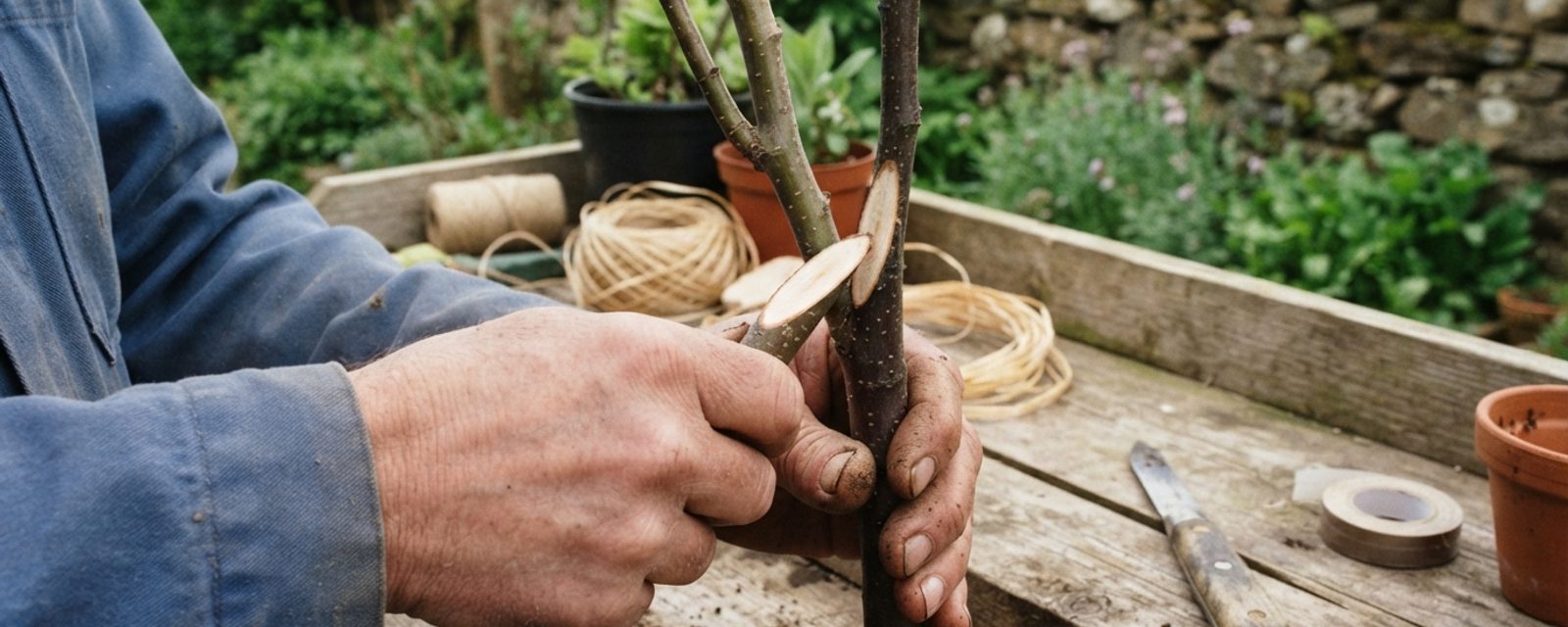
Whip and tongue grafting is the standard beginner method, used on young, pencil-thickness wood, typically joining a scion onto a rootstock that's been planted a year earlier. Both scion and rootstock get a matching sloping cut with a second, shorter cut partway down to form an interlocking "tongue," so the two pieces lock together and hold themselves in place while they're bound. It's the technique most home grafters start with because the wood is manageable and the cuts, while precise, don't require reaching into an existing tree's canopy.
In practice it comes down to five steps:
- Cut the rootstock and scion to matching diameters.
- Make one long sloping cut across the end of each.
- Make a second, shorter downward cut partway along each sloping face to form the interlocking tongue.
- Push the two pieces together so the cut faces and tongues lock and the cambium lines up as closely as possible on at least one side.
- Bind the join tightly with tape or raffia and seal any exposed cut edge with grafting wax.
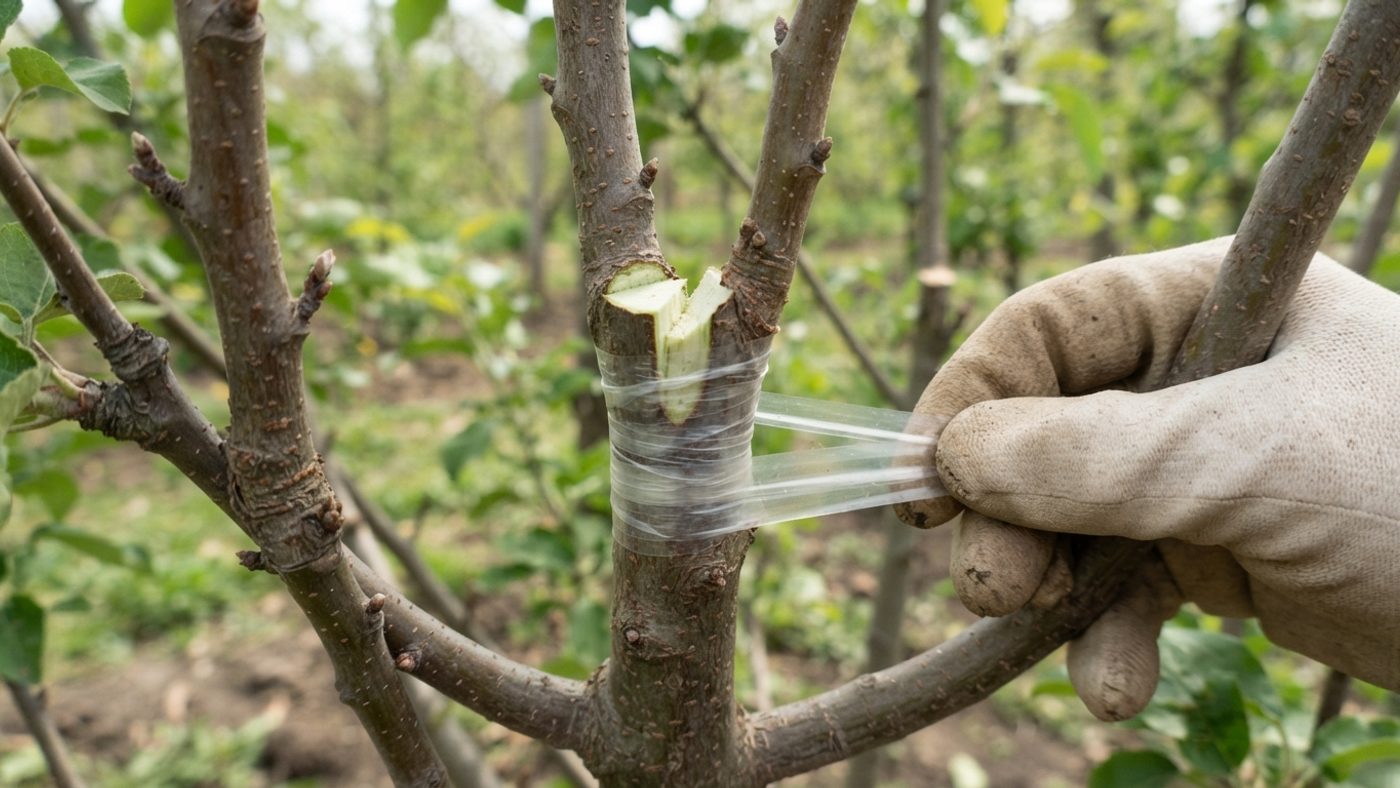
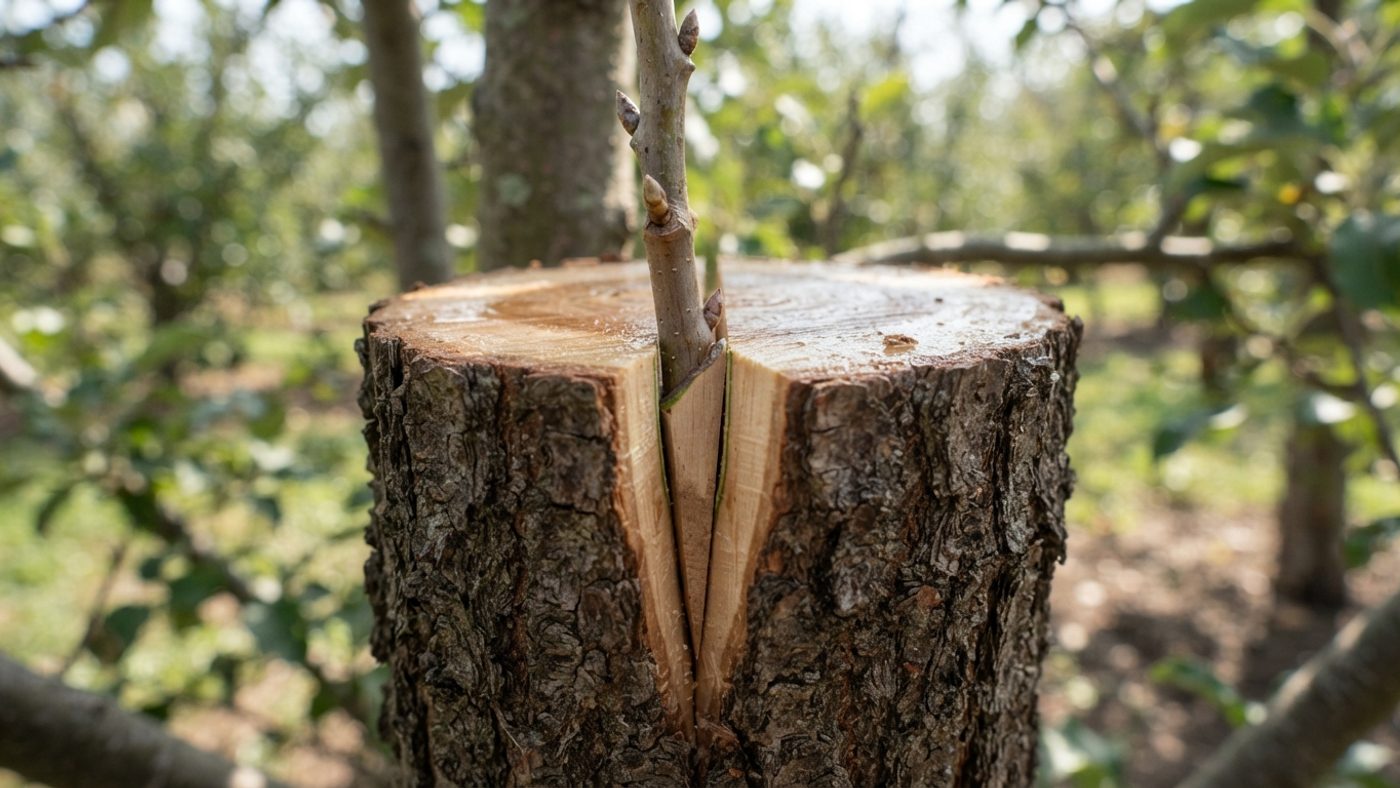
Cleft (or rind) grafting is used for top-working, joining new scion wood onto the thicker branches of an already-established tree, rather than onto young rootstock. It's a different job: instead of two similarly-sized pieces of wood meeting on equal terms, a scion is inserted into a split or slit made in a cut branch stub, exploiting the fact that the branch is far thicker than the scion. It's how an existing mature tree gets converted to a different variety without replanting.
What the graft actually depends on
Underneath the bark of both scion and rootstock is a thin green layer called the cambium, the tissue that has to touch and fuse for a graft to take. Success depends on lining up as much cambium contact as possible; ideally the layers touch on both sides of the cut, but a graft can still succeed if they only meet on one side. This is also why rootstock and scion need to be a similar diameter, too great a mismatch and there isn't enough cambium overlap to work with.
Three things matter beyond the cut itself: a sharp grafting knife, sterilised between uses, that produces a flat, flush cut rather than a ragged one; grafting tape or raffia to bind the union tightly enough that it can't shift while it heals; and grafting wax, or a similar sealant, over any exposed cut surface to stop it drying out or letting in infection while the union forms. The tape or raffia comes off once callus tissue is visible at the join, usually around eight weeks after grafting. Once the graft has taken, check the rootstock below the union through the growing season and remove any shoots growing from it, left in place, they compete with the scion variety and can eventually take over the tree.
Whip-and-tongue and cleft grafting both work through the dormant late-winter/early-spring window covered here. A separate family of techniques, chip budding and T-budding, where a single bud rather than a length of wood is inserted under the rootstock's bark, runs on the opposite calendar, from mid-summer into early autumn. Budding is a different technique with its own timing and isn't covered in depth here, but it's worth knowing it exists as the other main route into propagating a fruit tree.
Realistic expectations for a first attempt
A clean-looking cut is no guarantee of success, and a few losses are normal even for people who've done this for years. Where a graft fails, an imprecise cut, a poor cambium match, or scion wood that wasn't in good condition are the usual causes. Occasionally a union that looked successful at the time fails months or years later, from an underlying incompatibility between the two plants rather than anything done wrong on the day. Trying more than one graft at a time, on more than one rootstock, improves the odds of at least one taking, and it's the practical reason experienced grafters rarely do just one.
Separately, Teagasc's forestry-grafting research, which covers the same underlying cambium biology rather than fruit trees specifically, found that callus formation is fastest in a specific temperature band, roughly 15-25°C, with the union typically taking six to ten weeks to form depending on species. Late winter and early spring in a temperate garden sit well below that ideal range, wider below it, for longer, in Scotland than further south, which is why grafted material is usually kept in a propagator, cold frame, or other sheltered spot rather than left fully exposed while the union knits together.
The Scottish timing question
Scotland's frost pattern runs later than southern England's. Met Office data shows a clear north-south split in average last air frost dates:
| UK area | Typical average last air frost |
|---|---|
| Southern and coastal England | Before the end of April |
| Further north / higher elevation Scotland | Well into May, in places into June |
The full regional breakdown, station by station, is on the frost dates page.
Given the frost data above, the practical read is to watch local bud break rather than a fixed calendar date: in a garden where the frost-free window opens later than the March/early-April period most general UK grafting advice assumes, the buds themselves are the more reliable signal that scion and rootstock are both ready.
Common questions
Can I graft a fruit tree onto any rootstock?
No, scion and rootstock need to be compatible related plants, and similar enough in stem diameter for their cambium layers to align at the cut. Mismatched material is a common cause of graft failure.
When should I collect scion wood in Scotland?
Scion wood is typically cut from healthy, vigorous one-year-old shoots in December or January, then stored heeled into soil or refrigerated in a sealed plastic bag. With Scotland’s frost-free window opening later than in southern England, the graft itself may not happen until well into April, so scion wood here often needs to keep dormant in storage for longer, not necessarily cut any earlier.
Do I need a greenhouse to graft fruit trees at home?
Not strictly, but keeping newly grafted plants in a propagator or unheated greenhouse, with the compost kept just moist rather than wet, gives the union a more stable environment to form callus in.
How long before I know if a graft has worked?
Callus tissue is usually visible at the union within about eight weeks, which is also when binding tape or raffia can be removed. Bud growth from the scion the following spring is the clearer sign of success.
Is it cheaper to graft my own trees than buy grafted ones?
Not necessarily, once a grafting knife, tape, and wax are accounted for, and given that some grafts will fail. It's usually chosen for propagating a specific tree or preserving a variety, not to save money.
Sources
4 sources, recorded with what each was used for
- RHS: Grafting ornamental plants and fruit trees: Whip-and-tongue technique, timing (March/early April), chip/T-budding timing, scion wood collection and storage, tools, cambium alignment, callus timing, and causes of graft failure
- RHS: Malus domestica 'James Grieve': James Grieve's origin, raised by an Edinburgh nurseryman before 1893
- Met Office: Why frost can still occur in late spring: North-south UK pattern in average last air frost date, used for the Scotland-versus-southern-England timing comparison
- Teagasc: Grafting for Forestry Research: The general woody-plant cambium mechanism and the 15-25°C ideal temperature range and 6-10 week timeframe for callus/union formation, physiology shared across grafted trees generally