
Most cabbage advice is written for the part of the season when you're eating as you go, spring cabbage cut as loose greens in April, summer heads pulled in July, autumn hearts used up before the weather turns. None of that is written for the question that actually matters once the clocks go back: what do you do with a cabbage you don't want to eat this week? Storage is a different decision from harvest timing, and it only applies to one of the four cabbage types you might be growing.
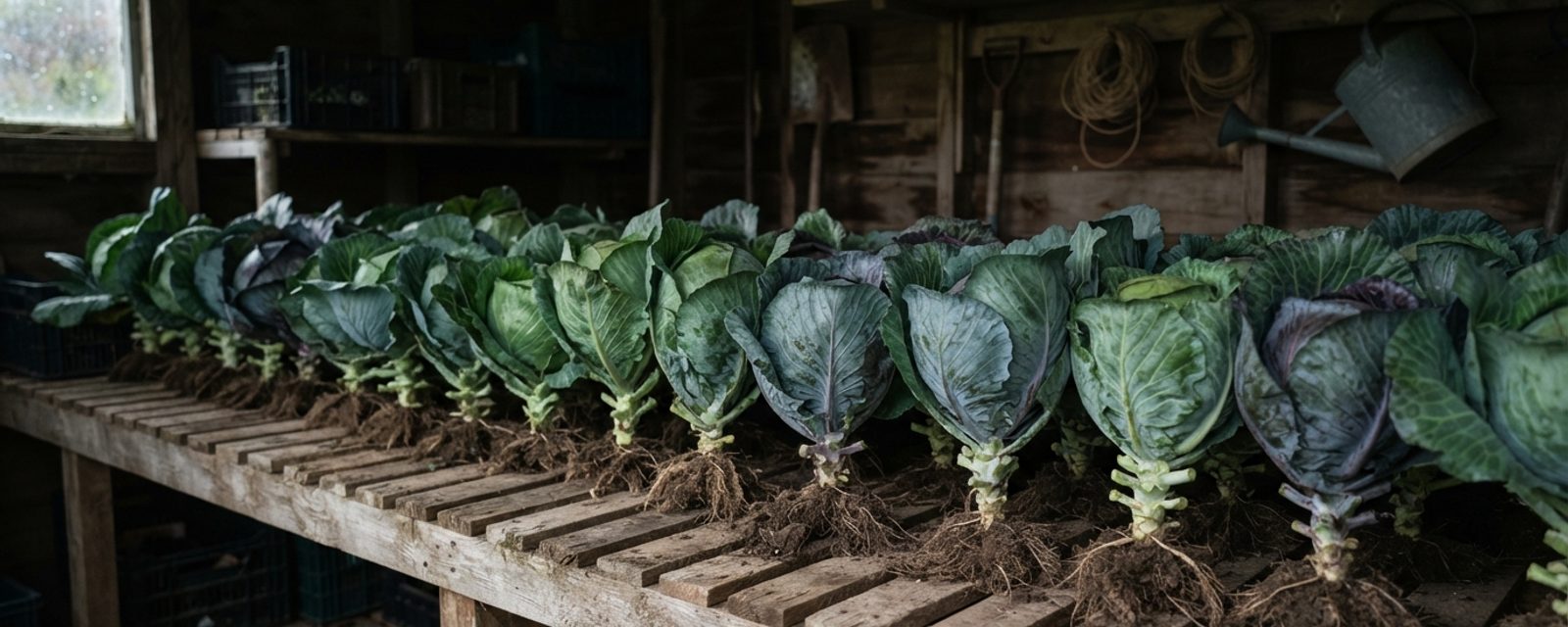
Only winter cabbage varieties are worth storing long-term, and the method isn't the sand-and-box approach you'd use for carrots or beetroot. You lift before the first hard frost, leave the roots on or at least 15cm of stem, and stand the heads upright on slatted shelves somewhere cold, dark and dry, covering them with straw or newspaper if temperatures drop further. Done right, that gets you several months of storage from a single autumn harvest.
Which cabbages are actually worth storing
This matters because it's easy to assume cabbage is one crop with one storage answer, and it isn't. The cabbage growing guide covers four types, spring, summer, autumn and winter, and storage claims only attach to the last of these.
Garden Organic's guidance is specific: firm red and white winter cabbage will store for several months if harvested before the first frost. RHS's grow-your-own advice is broader but less detailed, saying only that some winter cabbages can be stored for several months in a cool, dry, frost-free place, a claim wide enough to cover Savoy-type winter cabbages like Tundra, even though Garden Organic's specific method was described for red and white types rather than Savoy by name. Neither source puts a firm end date on "several months." Working from a typical Scottish harvest before first frost, in October or November, several months of storage points toward heads lasting into January or February for most gardens, a reasonable planning window rather than a guarantee, since a milder or damper store will shorten it.
Spring and summer cabbages don't get a storage claim from either source. They're grown to be eaten through their own season, and neither RHS nor Garden Organic describes a way to hold them beyond the fridge life already covered in the growing guide. Autumn cabbage, despite being one of RHS's four named types, also isn't described as a storage crop by either source.
| Cabbage type | Storage claim | Source |
|---|---|---|
| Winter (red/white) | Stores several months if harvested before first frost | Garden Organic |
| Winter (incl. Savoy, e.g. Tundra) | Stores several months in a cool, dry, frost-free place | RHS |
| Autumn | No storage claim | — |
| Summer | No storage claim; grown for fresh eating through summer | — |
| Spring | No storage claim; grown for loose greens/small hearts | — |
For a full comparison of which named varieties suit which purpose, see Best Cabbage Varieties for Scotland.
When to lift for storage
The timing is the whole trick: harvest before the first frost, not after it, which runs against the instinct that a hardy winter cabbage can simply be left in the ground and dealt with whenever. Once frost has actually reached the head, the storage window has closed, this is about beating the frost, not surviving it in store. In practice, that means watching the forecast in your own area rather than working from a fixed calendar date, the frost dates page has typical first-frost timing for your area.
The storage method
The method breaks down into a set of steps:
- Harvest before the first frost. Once frost is forecast, that's the cut-off. Check each head as you cut it: strip off loose, damaged or slug-eaten outer leaves and set aside any head with a split or soft patch for the kitchen now rather than the store.
- Leave the roots intact, or at least 15cm of stem. Either works equally well, what matters is that the cut surface isn't left exposed, since that's where rot starts first. This is the opposite of trimming a head down close for the kitchen.
- Stand the heads upright on slatted shelves. Slats allow air to move around the head rather than trapping moisture against it.
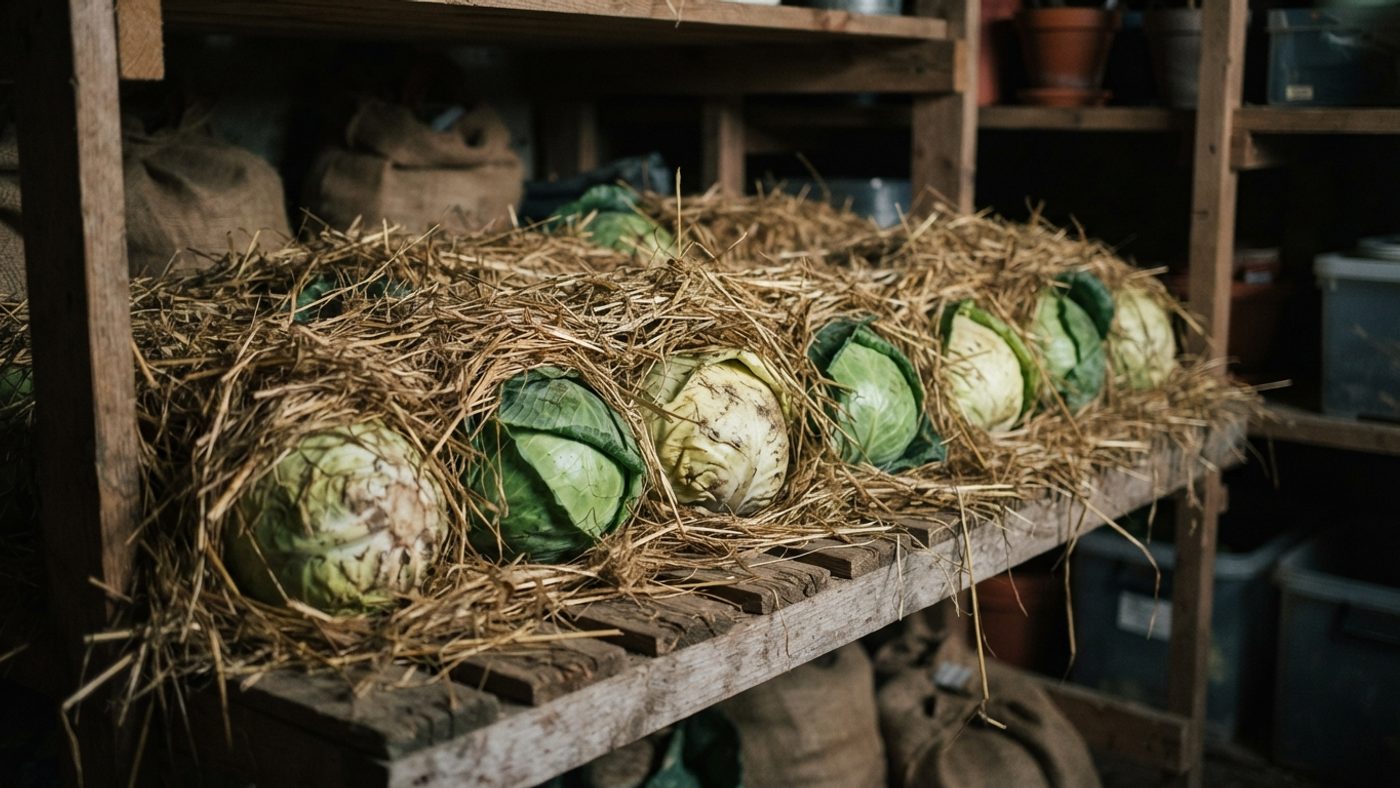
- Cover with straw or thick layers of newspaper if temperatures drop. This is a response to cold snaps specifically, not a permanent wrapping.
- Hold at 0-4°C. That's Garden Organic's stated ideal range for the store itself.
The reason it's a different method comes down to what's actually being stored. Carrots and beetroot are roots, and RHS's separate root-vegetables-storing advice packs them into boxes of damp sand or compost, keeping a body of tissue hydrated in a dark medium while its natural dormancy holds. A cabbage head isn't a root and isn't buried in anything, it's stood in the open air on a shelf, and the roots-or-stem allowance is there to stop the cut end drying out or rotting, not to keep the head alive the way a stored carrot is. RHS's root-storage method doesn't extend to cabbage.
A traditional earth-and-straw clamp, the outdoor method familiar from root-crop storage, isn't described for cabbage by either source either. Slatted-shelf storage indoors is the documented alternative.
Will a Scottish shed actually hold 0-4°C?
Garden Organic's 0-4°C target is a narrow band, and an unheated outbuilding isn't a fridge: it swings with the outside air, just with less extreme peaks and troughs than open ground. The risk isn't an average cold day, it's the cold snap that pushes the shelf below freezing, exactly what the straw-or-newspaper covering is aimed at. The other way the method can fall short is a stretch of mild, damp weather: a shed sitting well above 4°C for days at a time won't freeze anything, but it also isn't the cool, dry environment either source describes, and damp air works against the dry half of that condition regardless of temperature. A cheap min/max thermometer left on the shelf for a week tells you which side of that line your own space actually sits on.
On pests: neither source addresses protecting stored cabbage from mice or slugs once it's off the plant, only from cold. Worth trying, as ordinary shed practice rather than sourced advice: keep stored heads up off the floor on the slatted shelving already recommended, since mice tend to travel along skirting and floor level rather than mid-shelf, and use a lidded wooden crate rather than an open shelf if mice are a known problem, though a fully sealed plastic box works against the dry condition by trapping condensation.
Checking on stored cabbage through winter
Check stored heads regularly rather than leaving them until you need one. Look for softening or discoloured outer leaves at the point where the head meets the stem, removing affected leaves rather than the whole head if the inner leaves are still firm; any sign of rot spreading from the cut stem, the point most exposed to damp; condensation or a damp smell in the storage space, a sign the dry half of the target isn't being met; and pest damage to outer leaves, which is cosmetic more often than not. A cabbage that's starting to go doesn't need to be thrown out immediately, the outer leaves take the damage first and can usually be stripped back to sound material underneath.
Common questions
Can I store a Savoy cabbage like Tundra the same way as a red or white winter cabbage?
Yes. RHS names Savoy types as included in its broader claim that winter cabbages can be stored for months, while the detailed method, roots or 15cm stem, slatted shelves, cold-snap covering, 0-4°C, comes from Garden Organic’s advice for red and white types. Nothing in either source suggests Savoy needs different handling.
I don’t have a shed or garage, is there anywhere else I can store winter cabbage?
Any cold, dark, dry space works in principle: an unheated porch, a cool spare room, or a cold frame with the covering added on frosty nights. What matters is staying close to the 0-4°C target and keeping the air dry, not which building it happens to be.
What can I do with a summer or autumn glut, since they don’t store the same way?
Neither RHS nor Garden Organic describes a way to hold summer or autumn cabbage long-term the way winter cabbage stores, so use them up rather than trying to extend them. Shredding and freezing, or fermenting into sauerkraut, are common ways gardeners deal with a glut of either type, separate techniques from the winter-cabbage storage method described here.
Do I need to wash the heads before storing them?
Neither source addresses washing before storage. Given that the method relies on the store being dry, adding moisture at the point of storage runs against that condition, so leaving heads unwashed until you’re ready to use them is the more consistent approach.
What’s the difference between this and just leaving winter cabbage standing in the ground?
Leaving hardy winter types standing in the ground through winter cold is a separate approach covered in the cabbage growing guide, and it’s valid if your ground doesn’t waterlog or freeze solid. The storage method here is for cabbage you’ve already lifted, which matters if you need the bed back or hard frost is imminent.
Can I store a cabbage that’s already been frosted in the field?
Garden Organic’s advice is to harvest before the first frost, which implies frosted heads are outside the storage window it describes. Neither source states what happens to a head that’s already been frosted, so treat one as near-term eating rather than long-term storage.
Sources
3 sources, recorded with what each was used for
- RHS: Cabbages — grow your own: The "some winter cabbages... several months in a cool, dry, frost-free place" line extending storage to winter cabbage generally, and Tundra as a hardy winter Savoy type
- RHS: Root vegetables — storing: Confirms this page does not cover cabbage, contrasting the sand/box mechanism used for root crops
- Garden Organic: Harvesting and storing vegetables: The core storage method: red and white winter cabbage storing for several months if harvested before first frost, roots-intact-or-15cm-stem instruction, slatted shelves, straw/newspaper covering for cold snaps, 0-4°C target