
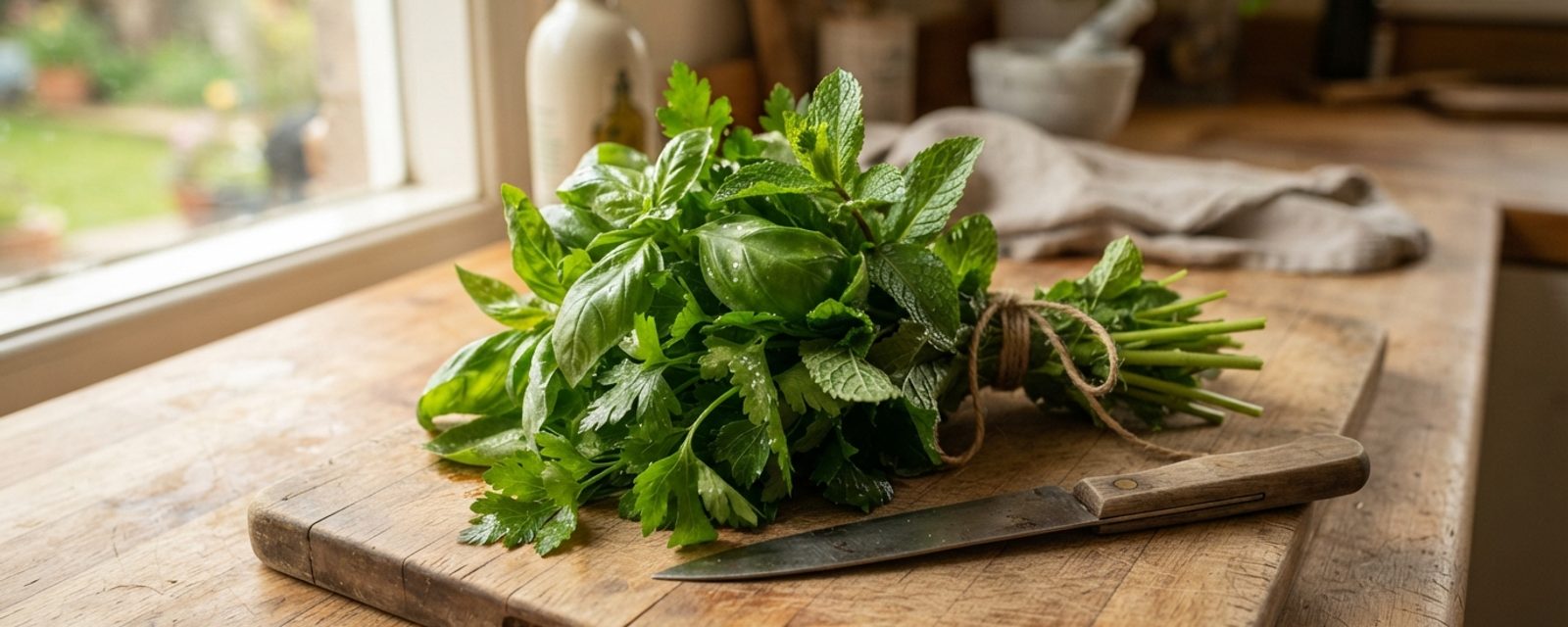
Our companion piece on herbs that dry well, covering rosemary, thyme, sage, oregano, bay, lavender and the two savories, deals with herbs whose flavour compounds sit inside tough, waxy, low-moisture leaves, which is exactly the tissue structure that survives slow air-drying with its aromatic oils intact. Basil, chervil, dill, parsley, coriander, chives, tarragon, mint, lemon balm and sorrel are built the opposite way: thin cell walls, high water content, and flavour carried in volatile compounds, the aromatic oils that evaporate easily and give each herb its scent and taste, which are much more exposed to heat and air as that water leaves the leaf. Whether that specifically ruins the flavour, and how badly, isn't the same story from one herb to the next.
RHS growing guidance actually says something explicit about the fresh-vs-dried flavour gap for five of these ten herbs. Chervil's page notes that "the delicate anise flavour does not withstand cooking, so leaves are added to salads and to hot dishes... just before serving," a heat-sensitivity that applies just as much to the sustained gentle heat of drying as to a hot pan. Tarragon's page states plainly that "dried leaves have a milder flavour" than fresh. Mint's page recommends freezing over drying outright: "freezing preserves their flavour better." Lemon balm's page says dried leaves make a decent tea "although the flavour is much milder than with fresh leaves." And parsley's page notes that "dried parsley has less flavour than fresh leaves."
Dill sits in an odd middle ground: the RHS page gives full instructions for hang-drying dill leaves and storing them in an airtight jar, but doesn't comment either way on how the flavour compares once dried. For basil, coriander, chives and sorrel, the RHS growing guides don't mention drying or freezing the leaves at all (coriander's page only discusses drying the ripened seed for storage, a separate use of the plant); the freezing methods below for those four are general kitchen practice rather than RHS-stated advice.
What actually works: freezing, done properly
Freezing suspends rather than removes water, so the volatile compounds that give these herbs their character stay largely where they were when you picked the leaf, the trade-off is texture, not flavour. None of the herbs' RHS pages state a freezer storage timeframe: use frozen batches for cooked dishes within the next few months for the best flavour, rather than as an indefinite store.
A compressed Scottish summer cropping window, covered fully further down, tends to hand you more leaf at once than a kitchen can use fresh before the next flush arrives, so having one of these methods ready for whatever's cropping heavily right now matters more here than in a piece written for a longer, more even season.
The same harvest-timing habit that helps the woody herbs in the companion piece helps here too: pick on a dry morning once the dew has burned off but before the day's heat sets in, so less of the leaf's aromatic oil has evaporated before it goes in the freezer.
Ice cubes in water
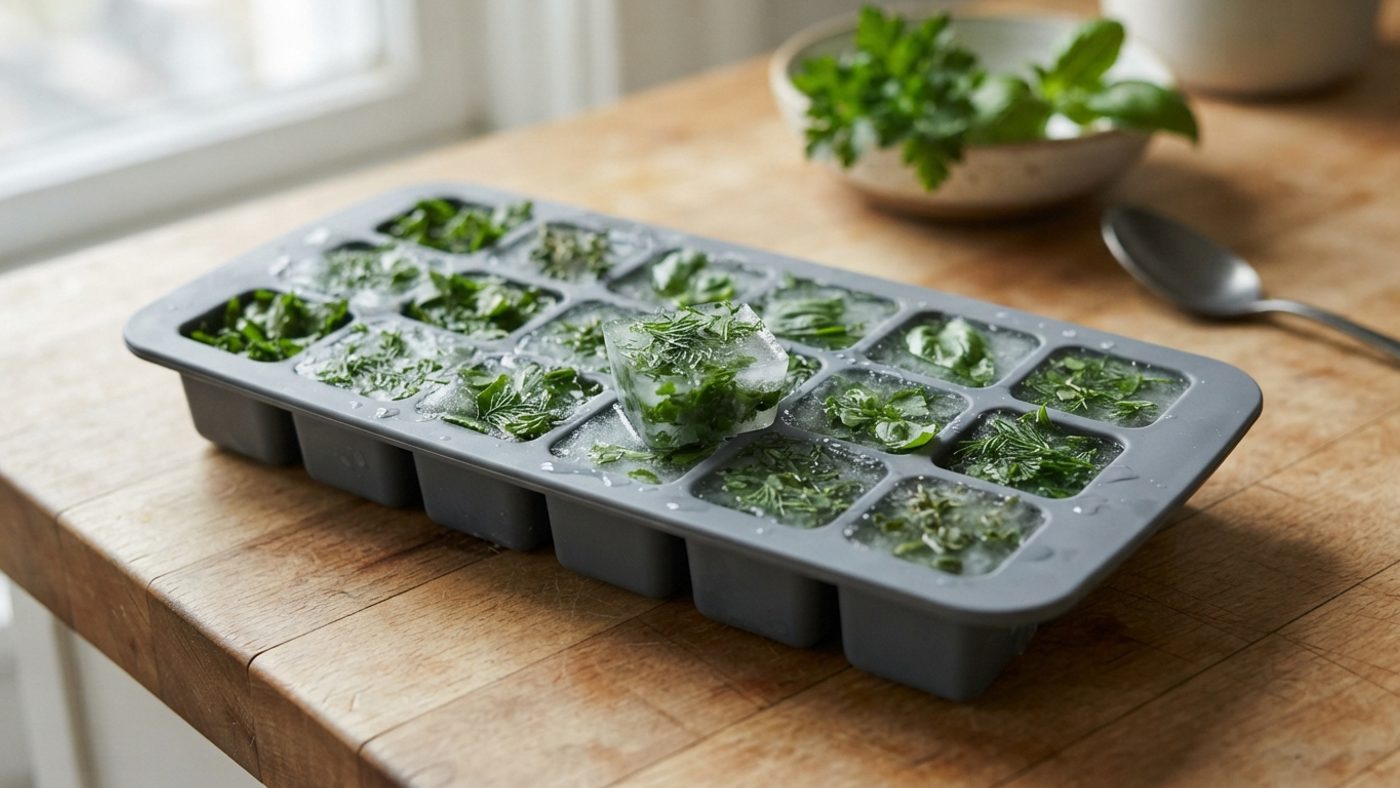
This is the only freezing method RHS spells out for any of these ten herbs: its parsley guidance says to "chop the leaves and add to an ice-cube tray, then top up with water and freeze," so the cubes can go straight into cooking. Water-based cubes suit herbs that are heading into something already wet and cooked, soup, stock, stew, a sauce base, where a small amount of ice melting in isn't a problem. Parsley, dill, chives, and sorrel (which is almost always cooked down anyway) all work well this way. Fill each well roughly two-thirds with chopped leaf before topping up with water, so you're not just freezing flavoured ice.
Ice cubes or portions in oil
The same tray method works with oil instead of water, and suits herbs headed for a sauté pan, a dressing, or anything where a splash of water would dilute the dish. This is the better route for basil in particular: RHS's basil guide doesn't address freezing, but general kitchen practice is that raw basil leaves frozen loose or in water tend to go dark and limp on thawing, and coating the chopped leaf in oil before freezing protects it far better than water does. Tarragon and chervil, both delicate, both prone to blackening if bruised, also do well portioned into oil rather than left bare in a bag. A genuine basil glut is also worth blending into a basic oil-and-basil paste before freezing rather than freezing the leaf alone, the same oil-protection principle, just processed first.
Whole sprigs, frozen flat
For herbs you use as a recognisable sprig rather than as fine chopped leaf, dill fronds dropped into a pot of new potatoes, mint sprigs muddled into a drink or steeped for tea, freeze the whole sprig laid flat on a tray until solid, then transfer to a bag. The sprig keeps its shape well enough to identify and portion out, even though the leaf itself softens completely once thawed; that softening is fine for a dish that's going to be cooked or steeped anyway, just not for a garnish meant to be eaten raw and crisp.
Chopped and bagged (flat-freeze)
For herbs you use often in small pinches, basil, parsley, chives, and coriander leaf (general kitchen practice for coriander, since RHS's page only covers drying the seed), chop the leaf, spread it thinly in a freezer bag, press out the air, and snap off what you need straight from frozen. This avoids thawing more than you're using, and pressing the air out before sealing is what actually keeps the rest of the batch from freezer burn longer than a loosely packed bag would. Label and date each bag as you fill it, with several herbs on the go across a season, a frozen block is impossible to identify by eye alone.
Herb butter (compound butter)
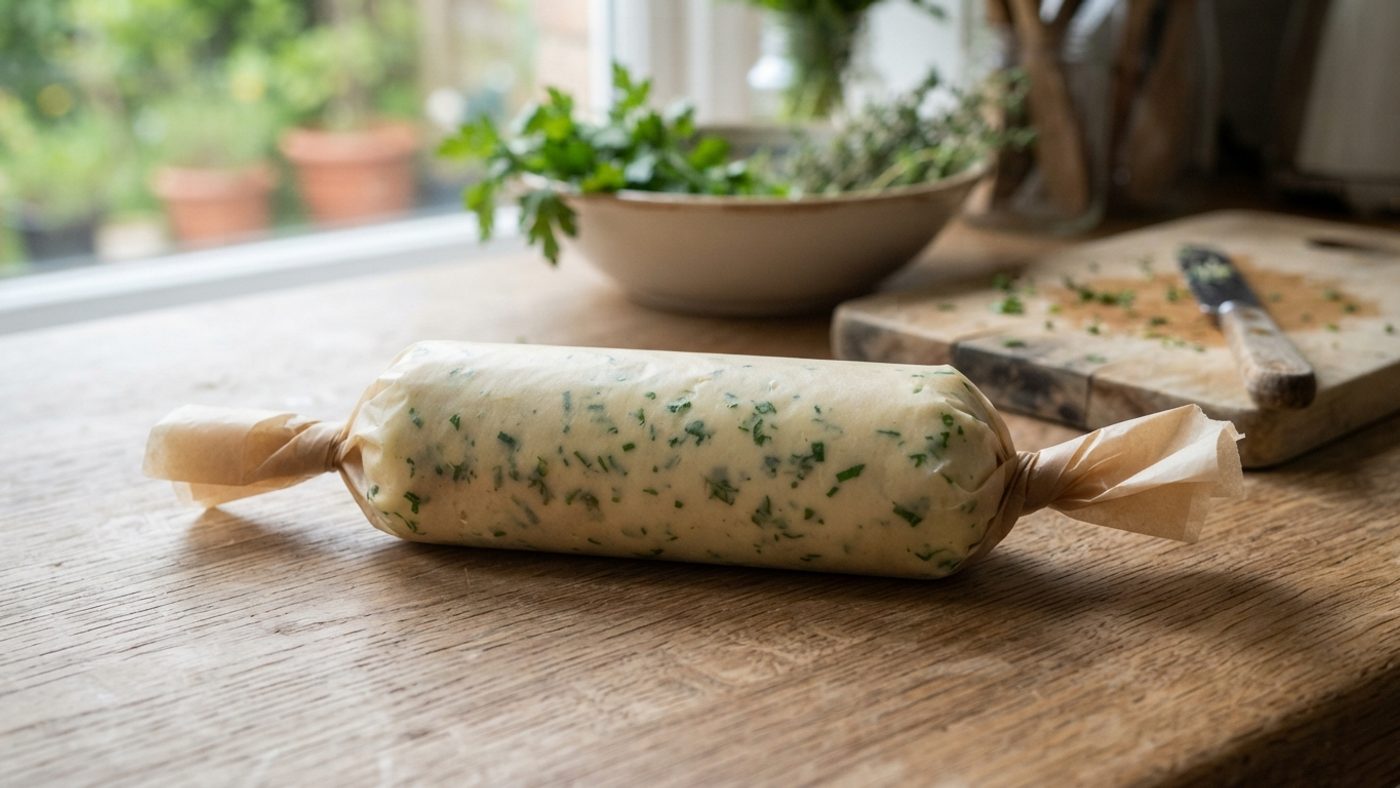
Soften unsalted butter, beat in finely chopped herb, then roll the mixture into a log in baking paper or cling film and freeze it whole, slicing off coins as needed. This suits herbs with a bit of structure and a flavour that holds up to fat: tarragon and chives are the classic pairing here (tarragon butter melting over a steak or fish, chive butter into new potatoes), and it's a genuinely useful route for using up a tarragon or chive glut that ice cubes don't cover as elegantly.
| Herb | RHS finding on drying | Best freezing method(s) |
|---|---|---|
| Basil | Not addressed | Chopped in oil (tray or bag); avoid freezing bare leaves in water |
| Chervil | Flavour doesn't withstand heat/cooking | Chopped in oil or a little water |
| Dill | Drying instructions given, no flavour comment | Whole sprigs, or chopped in water for soups/stocks |
| Parsley | Dried parsley has less flavour than fresh | Chopped in water (ice cubes) or flat-frozen bags |
| Coriander (leaf) | Not addressed (page only covers drying seed) | Chopped and flat-frozen in bags |
| Chives | Not addressed | Chopped in water, or herb butter |
| Tarragon | Dried leaves have a milder flavour | Chopped in oil, or herb butter |
| Mint | Freezing preserves flavour better than drying | Whole sprigs, or chopped in water |
| Lemon balm | Dried flavour much milder than fresh | Chopped in water or oil |
| Sorrel | Not addressed | Chopped in water (it's usually cooked down anyway) |
Chervil: the clearest case for skipping drying altogether
Chervil is the one herb in this group where the case against drying is made in the strongest terms. Our Garden Myths tool, the site's own fact-checked verdict on common growing claims, has already tested this one specifically for chervil and names freezing, in oil, butter, or a little water, as the fallback preservation method instead of drying, the same heat-sensitivity behind chervil's poor showing dried in the first place.
There's a second, separate problem for chervil: RHS notes it's "prone to boltingA plant switching early into flowering and seed production, usually triggered by stress, after which leaves, roots or bulbs turn bitter or unusable. Full page → in hot dry weather" and recommends a cool, partly shaded spot for summer sowings, since the plant runs to flower quickly once conditions push it that way. The same Garden Myths entry draws the practical conclusion for a Scottish grower, rather than banking on one sowing to see out the summer or one dried batch to see out the winter, sow chervil little and often, and freeze the surplus from each flush as it comes.
The Scottish angle: a short window concentrates the surplus
A longer, more even growing season lets you harvest soft herbs in a slow trickle you can keep pace with fresh, a bit of basil here, a handful of parsley there. Scotland's later last frost and shorter frost-free season push these tender, frost-sensitive herbs' outdoor sowing and planting-out dates later, which compresses the same amount of summer growth into fewer usable weeks than a UK-wide growing guide assumes, exactly what turns "I should freeze some of this" into "I need to freeze most of this, now," a batch-preservation problem rather than a top-up-the-jar one.
Dill and coriander sharpen that squeeze further by bolting fast once triggered. RHS is specific that heat and dryness, not daylength, is the trigger for both:
| Herb | RHS-stated bolting trigger | RHS-recommended delay tactic |
|---|---|---|
| Dill | Hot, dry conditions | Part-shade, consistent watering |
| Coriander | Hot, dry weather | Part-shade, consistent watering |
Once either crop bolts, leaf production stops, so a sudden warm spell can end the fresh-picking window abruptly and leave a one-off glut of leaf that's worth freezing in that moment rather than losing to the compost heap. The same little-and-often sowing chervil benefits from is worth applying to dill, coriander and basil too, rather than one large sowing that bolts or gets used up all at once, several smaller batches through the season spread out both the harvest and the freezing task.
Common questions
Can you freeze basil without it turning black?
RHS’s basil guide doesn’t address freezing directly, but coating chopped basil in oil before freezing, rather than freezing bare leaves or leaves in water, gives much better protection against the leaf discolouring and going limp on thawing.
Which of these ten herbs is actually fine to dry?
None of them dry as well as the woody herbs in the companion article. Dill is the closest thing to an exception: RHS gives a full drying method for it and doesn’t note a flavour penalty, though it doesn’t rate the dried result against fresh either.
How long do frozen herbs keep their flavour?
There’s no RHS-stated figure for any of these ten, so use the working guide above: a few months for best flavour, rather than an open-ended store.
Is herb butter better than ice cubes?
They suit different herbs and different uses rather than one being categorically better. Herb butter suits sturdier, richer-flavoured herbs like tarragon and chives, especially where the dish already involves fat. Ice cubes in water suit herbs headed into a soup, stock or stew where a little extra liquid doesn’t matter.
Can I freeze whole sprigs instead of chopping?
Yes, and it suits herbs like dill and mint that you use as an identifiable sprig rather than fine-chopped, laid flat on a tray until solid, then bagged. The leaf softens on thawing, which is fine for a dish that will be cooked or steeped, but not for a raw garnish.
Would a dehydrator work better than air-drying for these herbs?
None of the ten RHS pages address dehydrator use, and it’s worth being clear on why it likely wouldn’t help much anyway: the problem with these herbs isn’t slow, damp air-drying specifically, it’s that their flavour compounds are lost to heat and evaporation however the water leaves the leaf. A dehydrator speeds up the same process rather than avoiding it.
Sources
10 sources, recorded with what each was used for
- RHS: Basil, Grow Your Own: Bolting behaviour, harvest guidance, absence of drying/freezing content
- RHS: Chervil, Grow Your Own: Flavour/heat sensitivity, bolting in hot dry weather, succession sowing guidance
- RHS: Dill, Grow Your Own: Drying method, bolting trigger (hot, dry conditions), harvest timing
- RHS: Parsley, Grow Your Own: Freezing (ice-cube) and drying methods, dried flavour note, bolting guidance
- RHS: Coriander, Grow Your Own: Bolting trigger (hot, dry weather), seed-drying method, absence of leaf-freezing content
- RHS: Chives, Grow Your Own: Harvest timing, absence of drying/freezing content
- RHS: Tarragon, Grow Your Own: Drying and freezing confirmation, dried flavour note
- RHS: Mint, Grow Your Own: Freezing preserves flavour better than drying, harvest timing
- RHS: Lemon Balm, Grow Your Own: Dried flavour much milder than fresh, harvest timing
- RHS: Sorrel, Grow Your Own: Harvest timing, absence of drying/freezing content