
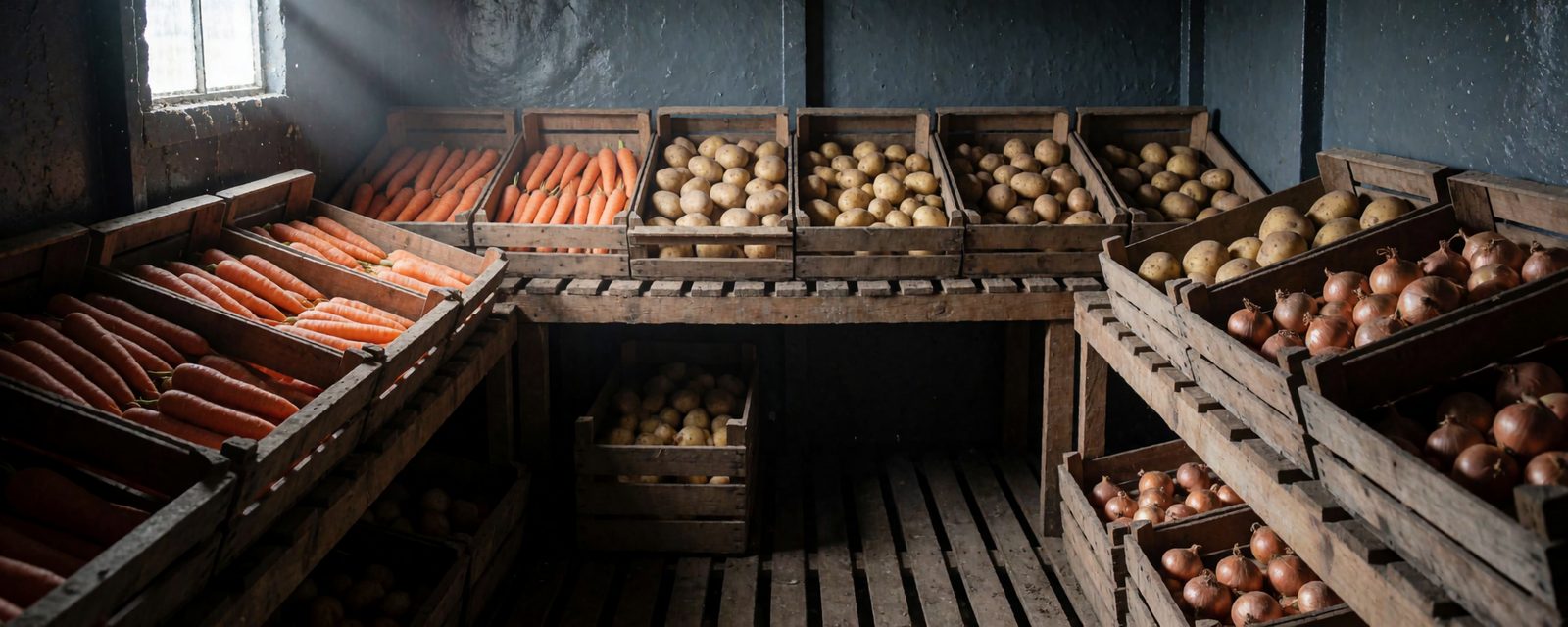
A harvested vegetable is still alive. It's still respiring, burning stored sugars and starches, releasing carbon dioxide, water vapour and heat, exactly as it did on the plant, just without a root system or leaves to replace what it loses. That respiration rate roughly doubles for every 10°C rise in temperature. Halve the temperature around a stored carrot or potato and you roughly halve the rate at which it consumes itself. That single fact is the entire physical justification for every root cellar, cold shed and clamp ever built: cold storage doesn't preserve a vegetable so much as slow down its dying.
The other three conditions that matter, darkness, humidity, and airflow, follow the same logic from different angles. Moisture loss through the skin causes shrivelling, so the air around stored produce needs to stay humid enough to slow evaporation but not so still and damp that it condenses and rots. Light and warmth are the two triggers that push a dormant potato tuberA swollen underground stem or root a plant uses to store energy, which can also grow into a new plant, the classic example being a potato. Full definition → or onion bulb into active growth, sprouting, and in potatoes, greening, so darkness keeps that dormancy switch off. And because sealed, stagnant air lets both condensation and rot-causing fungi build up around stored crops, some ventilation is needed even in a fundamentally cold space.
Getting a carrot into damp sand or hanging an onion in a net sack only works if it then sits somewhere that actually holds cold, dark, humid, ventilated, frost-free air around it for months on end. Building or finding that space is what follows.
Why each condition matters
| Condition | What happens without it | Physical reason |
|---|---|---|
| Cold (roughly 0-10°C depending on crop) | Faster softening, sprouting, weight loss | Respiration and enzyme activity roughly double for every 10°C rise |
| Darkness | Sprouting in onions and potatoes; green, bitter skin on potatoes carrying solanine (a natural toxin) | Light and warmth are the dormancy-breaking triggers; light-induced greening comes with a build-up of solanine |
| Humidity (roughly 85-95% for most roots, drier for onions and squash) | Shrivelling and weight loss in root crops; sprouting in potatoes if too humid and poorly ventilated | Vegetables lose water through the skin into drier surrounding air; too much still moisture instead encourages sprouting and rot |
| Ventilation | Condensation, mould, rot spreading between crops | Still, damp air around produce lets moisture and rot-causing fungi build up on the surface |
| Frost-free | Produce turns to mush on thawing, no recovery possible | Ice crystals rupture cell walls |
Useful working temperature bands by crop group:
| Crop group | Target temperature |
|---|---|
| Root vegetables (carrots, parsnips, beetroot, turnip, swede, celeriac) | 0-4°C |
| Potatoes | 5-10°C, kept away from light |
| Onions, shallots, garlic | 2-4°C, with free air movement |
| Pumpkins and squash | 10-15°C, drier air |
That spread is the reason a single space rarely suits everything, a cold, humid corner that's perfect for carrots will slowly rot a squash, and a mild, dry shelf that suits onions will let potatoes sprout.
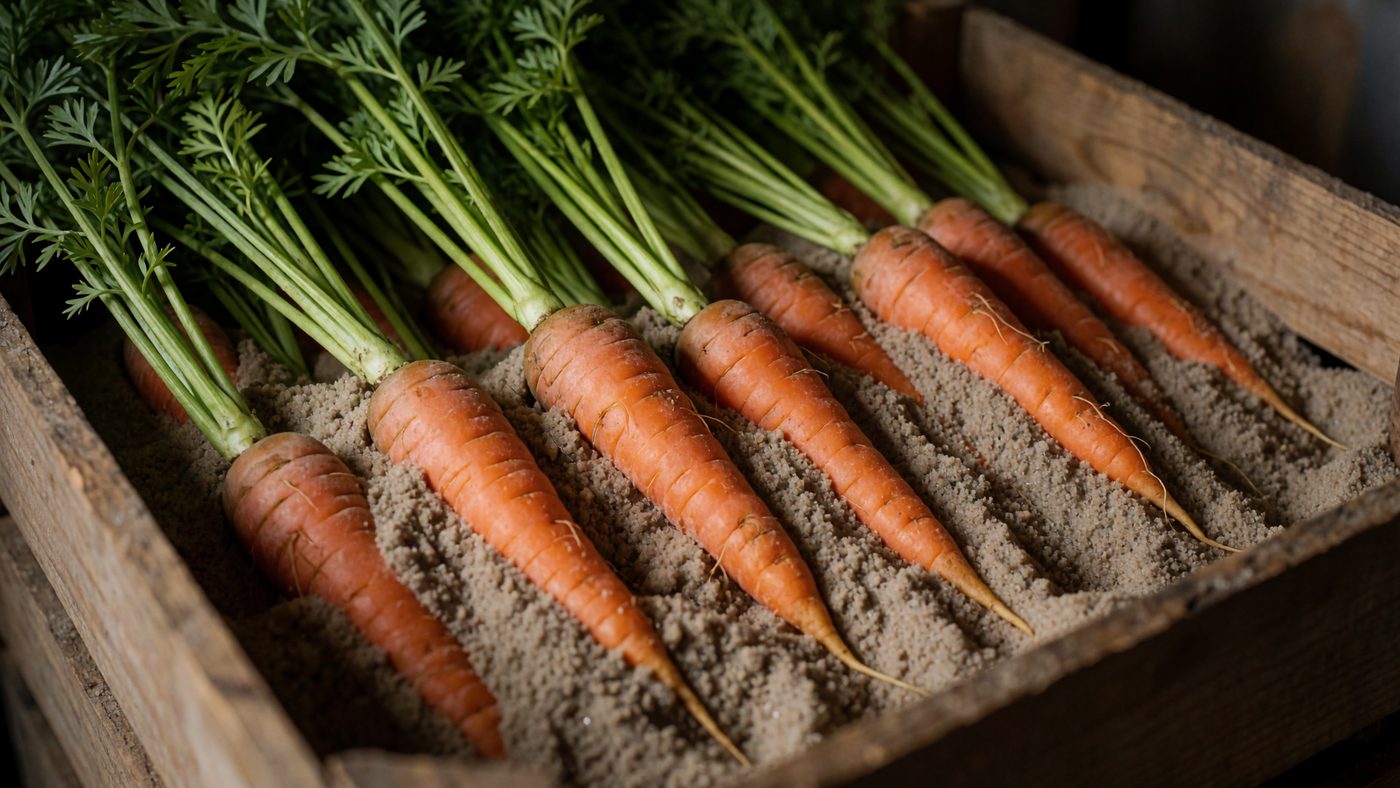
A "frost-free, dark place such as a shed or cellar" is the standard description, with roots that lose moisture easily, carrots, celeriac, swedes, beetroot, packed in layers of moist sand or a peat-substitute specifically "to prevent shrivelling." That's the humidity principle in practice: damp packing material keeps a boundary layer of moist air right against the root's skin, slowing the outward diffusion of its own moisture, even where the wider shed air is drier. "Frost-free" is doing real work in that phrase too, it isn't a given in an unheated Scottish outbuilding, which is the whole subject of the next section.
What counts as a viable space
Most Scottish gardens and allotments already have something close to what's needed, even if it wasn't built for the purpose.
| Space | Typical cost | Frost risk | Capacity | Effort |
|---|---|---|---|---|
| Unheated garage | None (already have it) | Moderate — better insulated than a shed, still exposed on an outside wall | Good — shelving, floor space | Low |
| Garden shed | None to low | High in an exposed or timber-only shed | Moderate | Low |
| North-facing outbuilding/lean-to | None to low | Moderate, depends on construction | Moderate to good | Low |
| Under-stairs cupboard or unheated porch | None | Low — inside the heated part of the house | Small | Very low |
| Dug root cellar | High — excavation, drainage, structure | Low once built — ground insulates | Very good | High |
| Clamp (outdoor mound) | Very low — straw and soil | Moderate to high in an exposed or upland site | Good for one crop at a time | Moderate |
| Retired fridge or chest freezer (unplugged) | Low to none — often free second-hand | Low — well insulated, and rodent- and light-proof by design | Small to moderate | Low |
Garage or outbuilding. The advantage here is straightforward: across the UK, the west and north of the country run cooler than the east and south, which puts most of Scotland at the cooler end of that gradient, an unheated structure sits closer to the target storage range for longer here than an equivalent shed in a warmer part of England, making it a genuinely useful passive fridge substitute rather than just a fallback. The trade-off is that an uninsulated garage or timber shed offers almost no thermal buffering, so a hard frost outside becomes a hard frost inside within hours, a real risk on any exposed site, and worth taking seriously on an unsheltered Highland or island plot, where winters run harder still. A bare concrete floor also sits colder than the air above it, so crates are better raised on a pallet or slatted shelf than left sitting directly on the slab.
Cupboard or porch. Sitting inside the heated part of the house, these rarely get properly cold, but they're reliably frost-free and easy to keep dark, which suits onions and garlic better than root vegetables that want it colder.
A genuine dug root cellar. The ground a metre or so down stays close to a stable annual mean temperature year-round, which is what makes an excavated cellar work as well as it does, once built, it needs almost no active management. But it's a serious undertaking: drainage has to be right, or it becomes a bog rather than a cellar. In practice that means siting it on sloping or free-drainingSoil that lets water pass through quickly rather than pooling, so roots aren't sitting in wet ground after rain. Full definition → ground where possible, digging a gravel-filled sump or French drain below the floor level to carry water away, and keeping the structure clear of the water table, a cellar dug into heavy, waterlogged clay without any of this will flood. The labour and material cost put it out of reach for most gardens; it suits someone with the space, the time, and a harvest large enough to justify it.
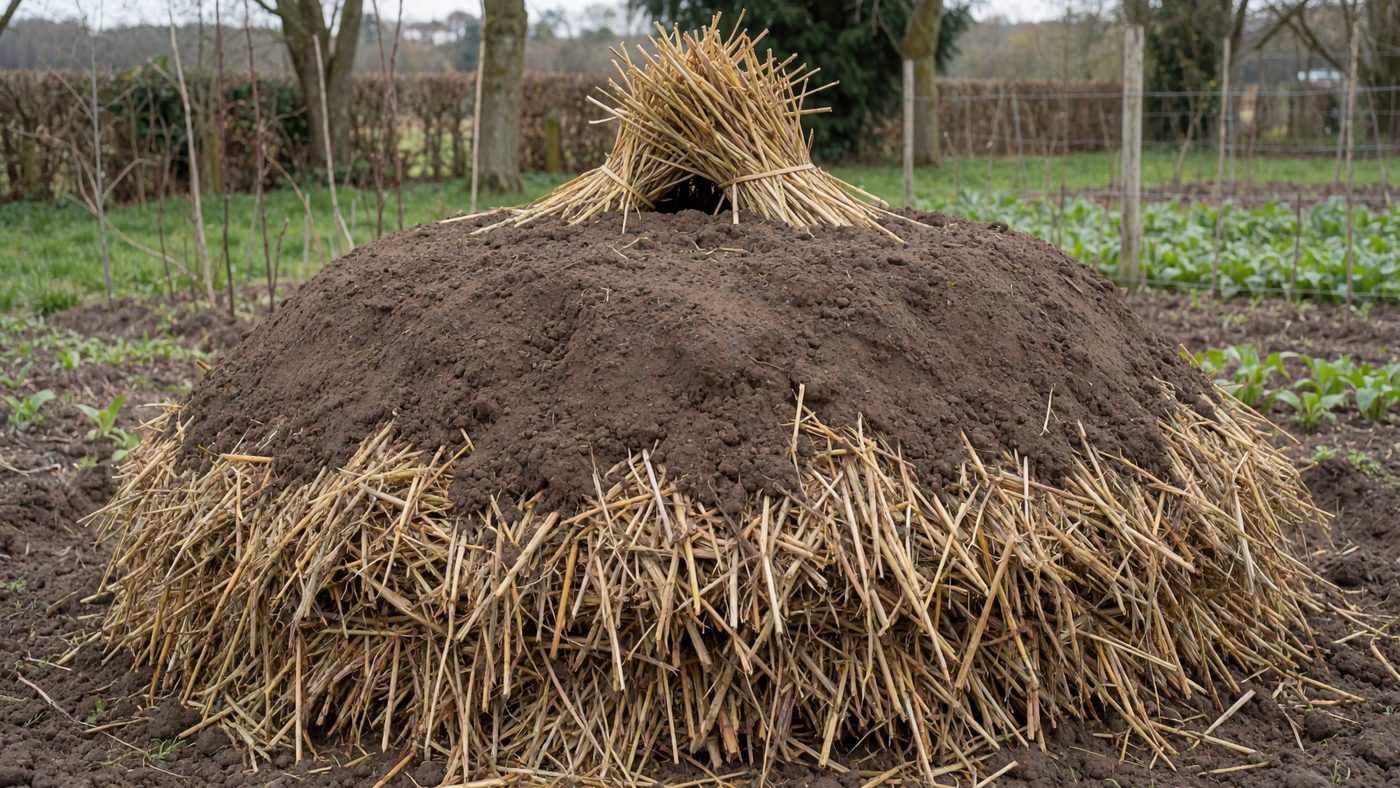
A clamp. The traditional, low-cost option for a large one-off harvest of roots, mainly potatoes, with nowhere else to put them. Build on a sheltered, well-drained site (a house wall is a reasonable spot), start with a layer of straw, pile the roots into a pyramid roughly a metre high, cover with a further 20cm of straw, then 15cm of soil packed smooth with the back of a spade so rain runs off rather than in. A tuft of straw left poking through the soil acts as a chimney, letting excess heat and moisture escape rather than condensing inside the mound. A clamp is the most exposed option on this list, it has no wall or roof buffering it from the weather, so on a more exposed upland or coastal site, an insulated shed or garage is the safer bet than relying on straw and soil alone. Rodents are a known risk with clamps specifically, since a mound of stored roots sitting outdoors all winter is exactly what mice and rats look for.
Retired fridge or chest freezer. Unplugged and used purely as an insulated box, an old fridge or chest freezer sited in a shed or partly sunk into the ground makes a small but genuinely effective cool store, well insulated against both frost and summer warmth, naturally dark, and close to rodent-proof by design. It suits a modest quantity, not a full allotment's harvest, but it's a low-cost option worth knowing about specifically because it solves the frost, light and rodent problems all at once.
Sizing the space. As a rough working figure: a standard 40-litre plastic crate holds around 20-25kg of root vegetables, so a full winter's worth of carrots, potatoes and onions from an allotment-sized plot generally needs several such crates' worth of floor or shelf space, not a shelf or two. Measure the available floor and shelf area against roughly how much came out of the ground at harvest before assuming a cupboard or single shelf will do.
Shelving and racking. Untreated timber shelving softens and eventually rots in a consistently damp, cold space; wire, slatted, or plastic racking that lets air pass underneath and around stored crates avoids trapping the still, damp air that causes mould, and lasts far longer than solid board shelving in the same conditions.
Getting humidity right in the space itself, not just the packing. A garage or shed that's bone-dry inside can undershoot the target humidity even with good packing material, since dry air around the crates keeps drawing moisture out through it. An earth or unsealed concrete floor holds more ambient moisture than a sealed, painted one; where the floor is sealed and the air runs dry, a shallow tray of damp sand or occasionally damping down the floor helps bring the air itself closer to the target range, not just the boundary layer right against each root.
Ventilation without losing the cold. For a room-sized space rather than a clamp, the aim is a small amount of passive air movement, not a draught: a vent brick or a permanently cracked-open window high on one wall, ideally on the side away from the prevailing wind, lets stale, moist air escape without flooding the space with outside warmth. Sealing a space completely to keep it cold is counterproductive, that's exactly the still, stagnant air that lets condensation and mould take hold.
Light-proofing a space that isn't naturally dark. A garage or outbuilding with a window is a common case, and daylight through it is enough to trigger sprouting and greening even if the space is otherwise cold and well set up. Covering the glazing, a piece of board, blackout fabric, or simply painting over it, deals with this permanently rather than relying on remembering to keep produce covered.
Keeping times vary a lot by crop: carrots, potatoes, onions, garlic and shallots, and apples and pears each have their own packing method and realistic timeframe. Several of them (onions, garlic, squash, potatoes) keep far longer if they're properly cured first, a period of warm, dry, well-ventilated air straight after harvest that toughens the skin, rather than going straight into the cold store still damp and thin-skinned; the per-crop pages above cover curing alongside packing.
One thing worth keeping in mind about a shared, unzoned space: apples and some other ripening fruit give off ethylene gas as they store, and ethylene is exactly the trigger that pushes a potato out of dormancy and into sprouting. Storing apples in the same box, or the same tight corner, as your potato sacks works against the darkness and cold you've otherwise got right, keep the two apart even within one cool store.
What goes wrong, and why
Frost damage. Water inside a plant cell expands as it freezes, and the ice crystals rupture the cell walls from the inside. There's no recovery from this, a frozen-and-thawed potato or carrot turns soft, watery and often discoloured within a day or two, because the cell structure that gave it firmness is physically gone. This is the main failure mode of an unheated garage or shed in a hard winter, and the reason produce is sometimes moved indoors or wrapped more heavily during a forecast cold snap rather than left to fend for itself.
Damp and rot. The reverse problem, too much still moisture without airflow, lets rot-causing organisms establish on the surface of stored crops and spread from one piece of produce to its neighbours, storage rots take hold fastest exactly where conditions are inadequate. A single soft or damaged item left in a box of otherwise sound roots is often the starting point, since damaged skin is where rot organisms get in; check stock periodically and remove anything going soft before it spreads.
Poor airflow and mould. Related to damp, but distinct: even in a cold, reasonably dry space, air that never moves lets condensation collect on produce and on nearby surfaces, and mould follows. This is a particular risk with alliums, which the guidance for onions and garlic emphasises need free air circulation, net sacks rather than sealed bags, rather than a sealed box.
Light and greening. Chlorophyll and solanine both build up in a potato's skin when it's exposed to light, and the two happen together, a potato skin that's visibly turned green has also developed elevated levels of solanine, a natural toxin concentrated just under the skin. Potatoes "must be kept away from light" specifically "to prevent toxin development." A well-greened potato tastes bitter and should be peeled generously or discarded rather than eaten as is; the fix in storage is simply an opaque sack or box in a genuinely dark space, not a lit shelf.
Rodents and pests. Mice and rats are drawn to stored roots and grain-adjacent materials like straw, and a clamp sitting outdoors all winter is particularly exposed. Indoors, the fix is largely about the container and the space: solid boxes or hessian sacks off the floor, gaps under doors blocked, and no gaps in outbuilding walls or floors that a mouse can use as an entrance. Traps or a Larsen-style deterrent are a last resort once produce is already being taken.
Monitoring and keeping the space working
A cool store doesn't need active climate control, but it does need occasional attention:
- A min-max thermometer is the single most useful piece of equipment for an unheated space, it records the lowest and highest temperatures reached since it was last reset, which tells you whether a cold snap actually dropped below freezing inside the store, not just outside it. Cheap and battery-free versions are widely available and worth the modest cost for anyone relying on a garage or shed through winter.
- Basic insulation, rigid foam board or even stacked straw bales against the coldest wall, buys a marginal unheated space several extra degrees of buffer in a cold snap, without heating it enough to undermine the point of a cool store.
- A plan for a hard freeze. In an exposed or poorly insulated space, the practical response to a forecast hard frost is usually to move the most vulnerable stock, potatoes especially, somewhere warmer for a few days, such as indoors, rather than trying to insulate the whole structure at short notice.
- Vermin-proofing as a one-off setup task: solid containers, blocked gaps, and checking periodically for droppings or gnaw marks rather than waiting until produce is visibly damaged.
- A periodic check of stock, every couple of weeks is reasonable, to catch and remove anything starting to soften or mould before it spreads to what's stored around it.
Common questions
Can I use an unheated garage as a root cellar?
Yes, for most of the storage season, an unheated garage generally stays closer to the target storage range for longer here than an equivalent space further south in the UK. The gap is hard frosts: an uninsulated garage on an exposed wall can drop below zero along with the outside air, so vulnerable stock like potatoes needs either extra insulation, a spot away from the coldest wall, or moving indoors during a forecast cold snap.
What temperature should a root cellar actually be?
It depends on the crop rather than one fixed number, root vegetables want it colder (0-4°C) than onions or squash. That range is part of why a single unzoned space is a compromise for some crops rather than others.
Why did my stored potatoes turn green?
Light exposure, in storage or in the ground before harvest. Green skin means a build-up of chlorophyll and, alongside it, the natural toxin solanine, concentrated just under the skin. The fix is darkness, an opaque sack or box rather than an open shelf, and any green-skinned potatoes should be peeled well past the green or discarded rather than eaten as they are.
Is a dug root cellar worth building for a normal-sized garden?
Usually not, unless storage needs are genuinely large. The labour and drainage work are substantial, and an existing unheated garage, shed or outbuilding, insulated where needed, gets most gardens most of the way there for a fraction of the effort.
How do I stop mice getting into stored vegetables?
Solid containers off the floor, gaps in walls and under doors blocked before produce goes in, and periodic checks for droppings or gnawed produce rather than waiting until damage is obvious. A clamp built outdoors is more exposed to rodents than an indoor space and is worth checking more often through winter.
Sources
4 sources, recorded with what each was used for
- RHS: Root Vegetables, Storing: Frost-free/dark storage guidance, moisture-loss/shrivelling prevention via damp packing material, clamp construction dimensions and materials, storage rots and rodent risk
- RHS: Potatoes, Growing for Festive Season: Frost-free storage guidance for lifted potato tubers
- Garden Organic: Harvesting and Storing Vegetables: Crop-group temperature bands, the darkness/solanine link for potatoes, ventilation guidance for alliums and squash
- Met Office: UK Regional Climates: The general UK-wide pattern that places in the east and south run drier, warmer and sunnier than those further west and north