
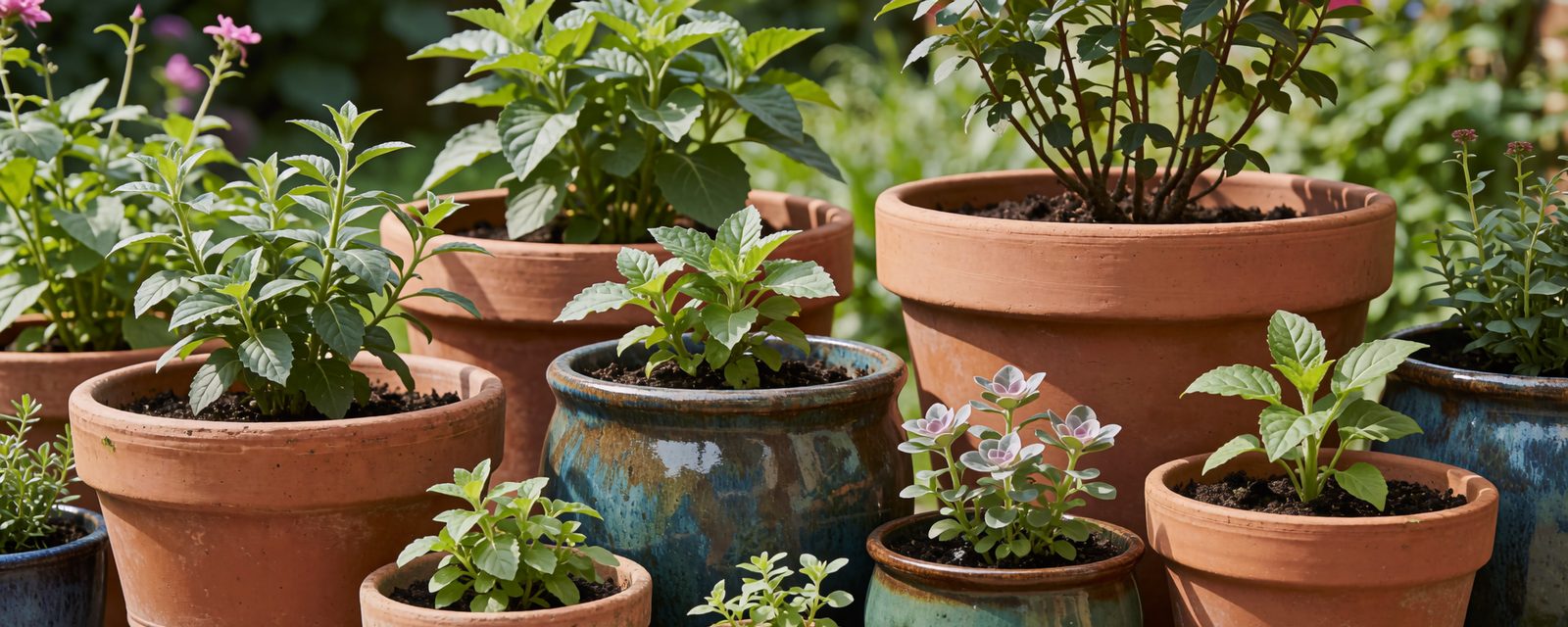
Almost every practical difference between plastic, terracotta, glazed ceramic and biodegradable pots comes down to one physical property: porosity, whether the material's wall has microscopic pores that let air and moisture pass through, or whether it seals them in.
Unglazed terracotta is fired clay, and firing leaves the clay body full of tiny interconnected pores. Water in the compost can migrate outward through the pot wall and evaporate from its outer surface, and air can move inward the same way. Plastic and resin pots are a single continuous polymer skin, nothing passes through the wall itself, only through the drainage holes and the open compost surface. Glazed ceramic sits in between physically but behaves like plastic in practice: the ceramic body underneath the glaze is often just as porous as terracotta, but the glaze is a non-porous coating fired onto the surface, and it blocks the pore network the same way a coat of paint would. Biodegradable pots, coir, paper/peat, cardboard and fibre, are porous in a different, more literal sense: their walls are not just permeable to moisture, they are actively broken down by it.
Everything that follows, how fast a pot dries out, what it does to root health, how heavy it is to shift, how it wears over the years and how it looks, is a downstream consequence of that one wall property.
Watering and moisture: the everyday practical difference
Because water can evaporate through the whole surface of an unglazed terracotta pot, not just from the compost surface, terracotta dries out measurably faster than a sealed plastic pot of the same size holding the same compost. RHS states plainly that unglazed terracotta pots "are porous so dry out more quickly than other materials," while plastic containers "don't dry out as easily." Glazed ceramic, because the glaze seals the pore network, holds moisture closer to how plastic does rather than how bare terracotta does.
In practice this cuts both ways rather than making one material simply "better":
| Material | Drying behaviour | Best suited to | Watch out for |
|---|---|---|---|
| Plastic/resin | Retains moisture longest; compost stays wetter for longer between waterings | Thirsty crops (courgettes, leafy salads), forgetful or infrequent waterers, self-watering setups | Overwatering and waterlogging in a wet spell, since there's no wall to buffer excess moisture |
| Unglazed terracotta | Dries fastest; compost surface and wall both lose moisture to the air | Mediterranean herbs and any plant that resents wet roots (rosemary, thyme, lavender) | Drying out completely in hot spells or if watering is missed, especially in smaller pots |
| Glazed ceramic | Close to plastic, the glaze blocks the clay's natural porosity | Ornamentals and anything you'd otherwise put in terracotta but want a lower-maintenance watering schedule | Same overwatering risk as plastic, plus condensation can collect where drainage is poor |
| Biodegradable (coir/paper/fibre) | Porous and absorbent; wicks moisture and dries quickly, especially in small volumes | Short-term seed starting and young transplants only | Small volume dries out fast and needs frequent checking |
The practical upshot is that terracotta suits a gardener who tends to overwater, or a plant that dislikes sitting wet, while a sealed material suits a gardener who waters infrequently or a plant that wants consistent moisture. Neither is objectively better, the right choice depends on the plant and the person watering it.
One buying trap worth checking before the porosity question even comes up: many decorative glazed ceramic pots are sold with no drainage hole at all, since they're designed as an outer "cache pot", a decorative sleeve a plastic nursery pot sits inside, rather than a growing container in its own right. A sealed wall plus no drainage hole is a genuinely different, worse problem than the glaze simply reducing porosity, check for a hole, or plan to drillA shallow, straight groove made in prepared soil for sowing seed into, at a set depth so germination and rows are even. Full definition → one, before planting directly into a glazed ceramic pot rather than using it to hide a plastic nursery pot inside.
Colour plays a smaller but real part too: a dark-coloured pot of any material absorbs more heat from the sun than a pale one, which warms the compost (and can dry it out) faster. On a cool day that's a genuine advantage for getting compost up to germinationA seed sprouting: breaking dormancy and putting out its first root and shoot, given the right warmth and moisture. Full definition → temperature sooner; in a hot spell it adds to whichever material's own drying tendency is already at work.
Does Scotland change this calculus?
Terracotta's faster-drying trade-off is usually described as a downside, but how much of a downside it actually is depends on how hard the sun and heat are working to pull moisture out of the pot in the first place, and that varies a lot across the UK. Met Office long-term averages (1991-2020) make the gap concrete:
| Location | June-August average max temperature | June-August sunshine hours |
|---|---|---|
| Edinburgh (Royal Botanic Garden) | ~18.6°C | ~492 hours |
| Heathrow (southern England) | ~22.3°C | ~627 hours |
Heathrow runs noticeably warmer and gets around a quarter more sunshine. Evaporation from a porous pot wall is driven mainly by heat, sunshine and air movement, so a cooler, less sunny summer around Edinburgh means terracotta pots there can be expected to dry out less aggressively than the same pots would in southern England. Scotland's own climate isn't uniform, a sunnier east coast garden won't see the same gap as a cloudier west coast one, but the direction holds broadly across the country: terracotta's watering demands are somewhat less punishing here than the material's reputation suggests further south, though a run of dry, sunny days, which does happen, will still catch out an unwatched terracotta pot.
The same figures cut the other way for plastic: less UV loading over a Scottish summer means plastic pots left outdoors here fade, stiffen and become brittle more slowly than the same pots would further south, so the UV degradation covered under durability below is somewhat gentler here too, for the same underlying reason.
Less evaporation isn't only a drying-speed story, though, it's also a waterlogging one. A sealed plastic or glazed pot has no wall to lose excess moisture through, and Scotland's generally wetter, more overcast weather means compost in a sealed pot outdoors can stay saturated for longer after rain than it would in a drier climate, which raises the same waterlogging risk already flagged in the table above, good drainage holes and a raised pot matter more here for that reason, not less.
Root health: what the evidence actually supports
The claim repeated across gardening advice is that a porous pot wall lets oxygen reach the roots from the sides as well as the top, and that this reduces roots circling round and round the inside of the pot looking for oxygen-rich growing medium. That circling is what "pot-bound" and "root girdling" both describe, the same underlying problem, just two names for it.
What is well supported: RHS is clear that pot-bound roots are a real and common problem in container growing. Left too long in one pot, a plant's roots become congested and start "spiralling around the bottom and sides" of the container, which can restrict drainage, lead to root rot, and mean the roots fail to grow out properly once the plant is finally moved to a larger pot or the open ground. The RHS's remedy is straightforwardly practical: check roots periodically and repot before they become pot-bound, teasing out or trimming a spiralling rootballThe mass of roots and the soil or compost clinging to them, as it comes out of a pot or out of the ground when a plant is lifted. Full definition → when you do.
What is less clearly supported: the specific claim that a porous wall meaningfully changes how much oxygen reaches the roots, as opposed to sealed plastic or glazed ceramic, isn't something RHS guidance on repotting or container growing addresses directly, its advice on preventing pot-bound roots is about repotting on time, not about pot material. Root circling happens in unglazed clay pots as well as plastic ones once a plant has outgrown its container, and RHS guidance treats pot-bound growth as a function of time-in-pot and root volume rather than material porosity. Porosity almost certainly makes some difference to gas exchange at the pot wall, but next to simply repotting on schedule, that difference isn't established as the main lever, the more actionable fix for root health in any material is the same: don't leave a plant pot-bound.
Weight and portability
Terracotta and ceramic pots are substantially heavier than plastic ones of the same size, clay itself is a dense material, so even before compost goes in, a terracotta pot can weigh several times as much as an equivalent plastic one, and the gap only grows once both are filled and watered. This is a separate issue from whether the pot itself survives a hard frost. A large frost-proof terracotta pot's weight is actually useful outdoors in one respect, it "provides extra stability to prevent trees blowing down in windy weather," but the same weight "makes relocation difficult," while lightweight plastic containers are "easier to move around the garden." That stability point is worth more weight in an exposed or coastal Scottish garden than a sheltered English one, since wind, not just cold, is a routine hazard for anything standing tall in a pot here.
That difficulty matters most at exactly the moment a Scottish gardener needs to act fastest: bringing tender potted plants under cover once the first frosts of autumn arrive (see the regional frost dates for specific timing for your area). A citrus, olive or pelargonium left in a large glazed or terracotta pot may need two people, a sack truck or a plant caddy to shift indoors or into a greenhouse, and that becomes a real logistical barrier when a cold snap arrives with only a day or two's warning. A plastic or resin pot holding the same plant can generally be picked up and carried by one person.
Light plastic cuts both ways in wind, too: the same low weight that makes a pot easy to carry also makes it easy for wind to tip, roll or blow off a patio, deck or windowsill, especially once it's been watered lightly rather than saturated. In an exposed or coastal garden, standing lightweight pots somewhere sheltered or grouping them together matters as much for wind stability as it does for a heavy terracotta pot's own built-in stability.
Everyday durability and cost
Away from frost, each material wears differently over ordinary years of outdoor use:
- Plastic/resin, the cheapest option up front and widely available, but UV exposure over several outdoor seasons causes plastic to fade, become brittle and eventually crack or shatter, particularly in cheaper, thin-walled pots. Recycled-content and UV-stabilised plastics last longer, and, as above, Scotland's lower summer sunshine hours mean this wears more slowly here than in a sunnier part of the UK.
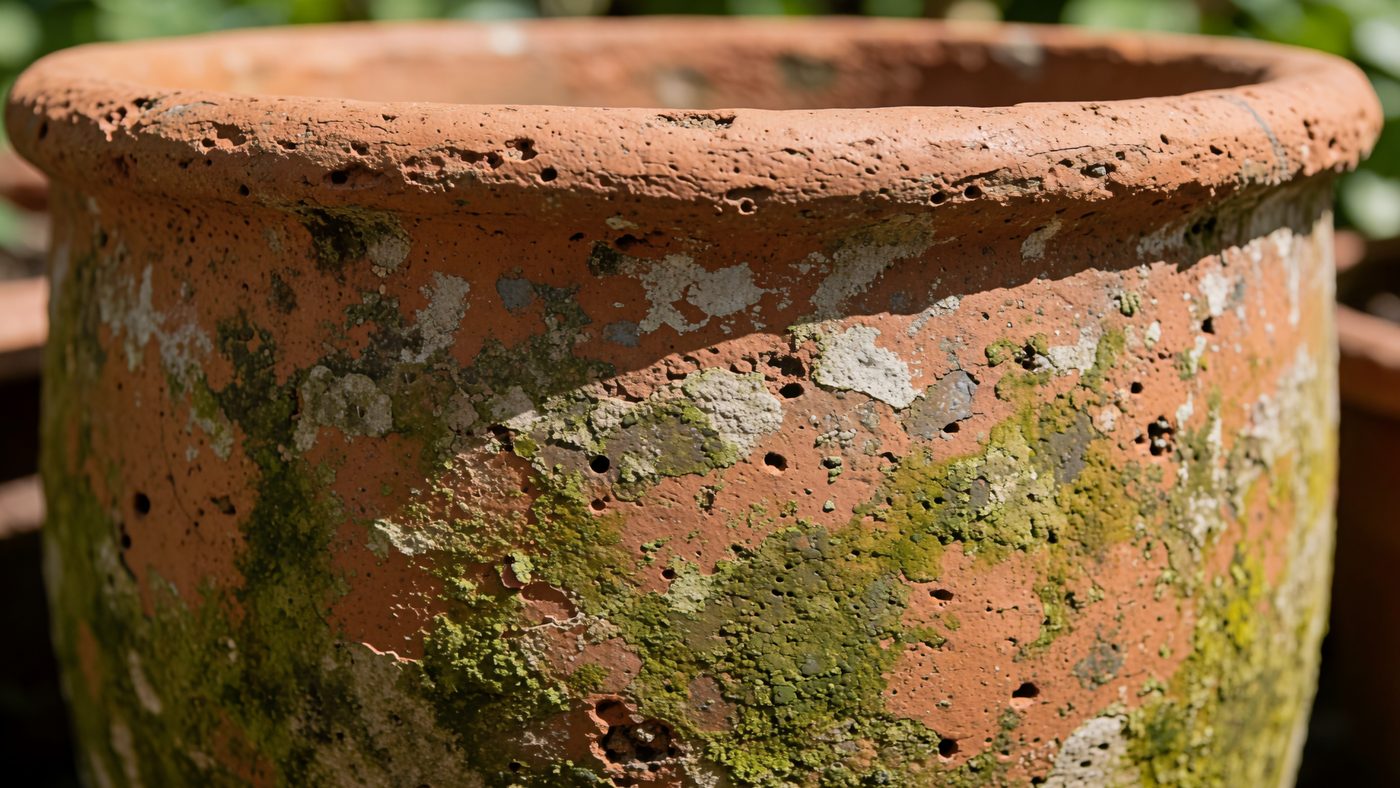
- Unglazed terracotta, reasonably durable if not exposed to hard frost, but its porous outer surface is exactly what makes it prone to picking up green algae staining, white mineral deposits (limescale) from hard water, and general weathering discolouration over the years. Good-quality terracotta, properly cared for, can last for many years according to RHS.
- Glazed ceramic, the glaze itself can chip on impact, exposing the more porous body underneath at the chip and giving staining or moisture a way in; otherwise ceramic is durable and colour-stable.
- Biodegradable (coir/paper/fibre), not built for multi-year outdoor durability at all; these are designed to break down, typically within one growing season, which is a feature for their intended seed-starting use and a limitation for anything else.
On cost, plastic is consistently the cheapest per pot at any given size, biodegradable pots sit in a similar low-cost bracket for their single-season use, and terracotta and glazed ceramic command a higher price, often several times the cost of an equivalent plastic pot rather than a marginal difference, particularly for larger or frost-proof-rated pieces. Exact prices vary too much by retailer and size to give a reliable figure here, but that multiple, not a small premium, is the realistic expectation when comparing like-for-like sizes.
What about wood and metal?
Timber planters and barrels, and metal containers (galvanised steel, zinc, or the softer weathering-steel/corten look), don't fit the porosity story the same way: wood and metal walls neither pass moisture through like terracotta nor seal it in completely like plastic, and the practical differences that matter are their own. An untreated timber planter will rot from the inside out where it stays permanently damp against wet compost, so a plastic liner or a rot-resistant timber (oak, cedar, treated softwood) matters more for a planter's lifespan than the wood species alone suggests. Metal containers have the opposite failure mode to terracotta in a Scottish winter: sitting outdoors year-round they don't crack under frost expansion the way rigid clay can, but a dark metal container heats up fast in direct summer sun, which can genuinely stress roots close to the wall on a hot day, a smaller risk here than in a sunnier part of the UK, following the same logic as the sunshine-hours comparison above. Both are usually priced and bought as a look and a size rather than a practical choice against the four core materials above, and both benefit from the same drainage-hole check already flagged for glazed ceramic.
Appearance
This is a genuinely minor factor next to watering behaviour, weight and durability, but it's worth a line. Terracotta's warm, weathered orange tone and glazed ceramic's range of finishes are why many gardeners choose them for anything on display near a door, patio or window box despite the practical trade-offs. Plastic now comes in finishes designed to mimic stone, lead or terracotta at a fraction of the weight and cost, closing some of the aesthetic gap for anyone prioritising practicality. Biodegradable pots are not designed to be looked at: they're plain brown fibre or card, and by the point they'd need to look presentable they've usually already gone into the ground, pot and all, or been potted onMoving a plant into a larger pot as its roots fill the current one, giving it more room and fresh compost before it becomes pot-bound. Full definition → into something else, they're working pots for a nursery bed or windowsill, not a finished display container.
Biodegradable pots for seed starting and young plants
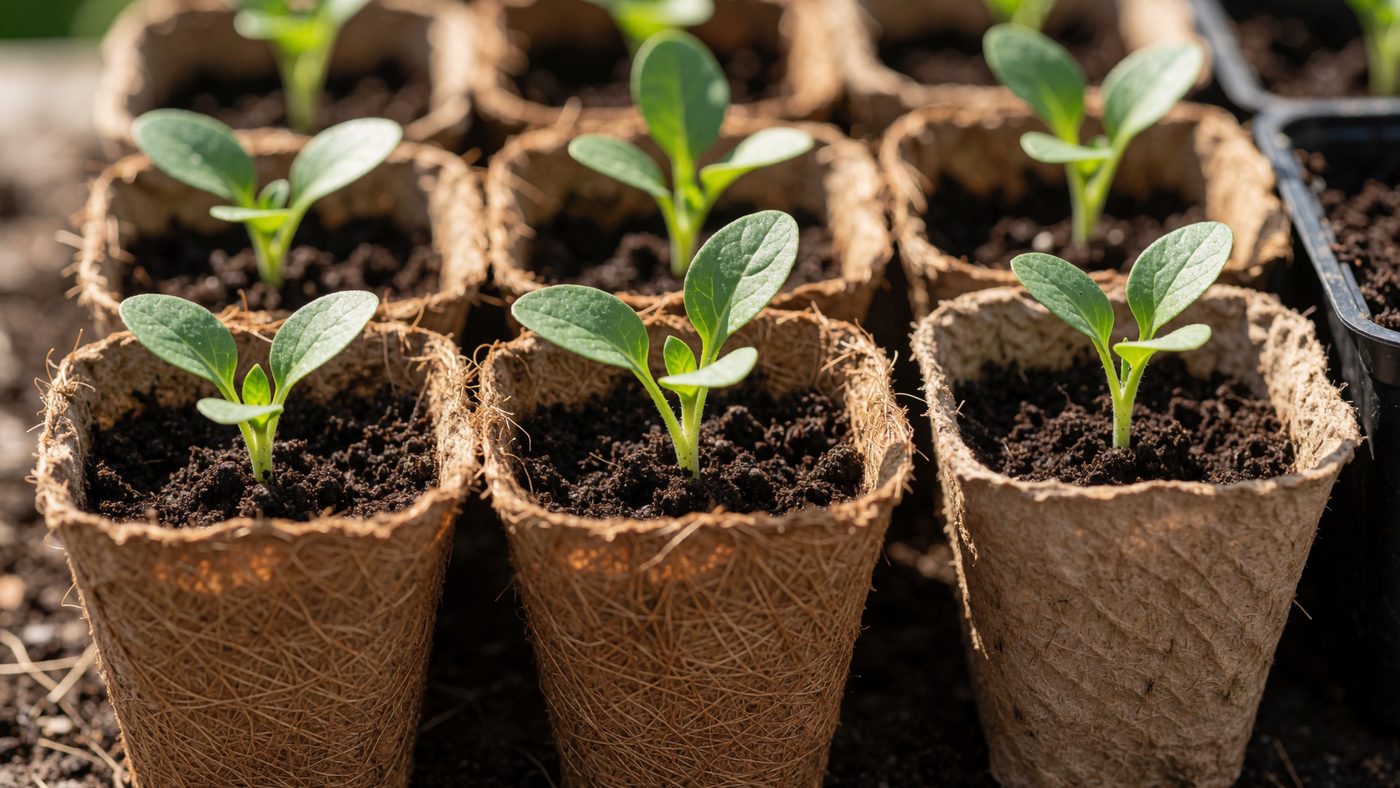
Coir pots, paper or peat pots, and cardboard/fibre pots are designed for one job: starting seeds or growing on young plants to a size where they can be planted, pot and all, straight into the ground or a larger container. RHS recommends using "biodegradable or recyclable containers when sowing seeds indoors," describing biodegradable materials as those "decomposed by fungi, bacteria and micro-organisms, so it doesn't persist indefinitely in the environment," and it favours small pots or modular trays generally because they let "seedlings be transplanted with minimal root disturbance."
That's the genuine advantage: planting the whole pot means the root system is never pulled apart or exposed to open air the way it is when a seedling is tipped out of a plastic pot and its rootball handled directly. For crops that resent root disturbance, and for a short Scottish growing season, where a transplant setback of even a week or two eats into a growing window that's already tight, that's a real, mechanically sound benefit.
The limitations:
- Breakdown speed is inconsistent. These pots are designed to decompose, but how fast depends heavily on soil moisture, soil biology and material thickness. In compost or soil that stays reliably moist, a coir or thin paper pot can soften and let roots through within a few weeks of planting out. In drier conditions the same pot can persist largely intact for a full season, acting as a mild physical restriction on the roots rather than disappearing as advertised, a cost that bites harder against a short growing season, where there's less time to spare recovering from a slow start, than against a longer one.
- Slugs like the damp base. A biodegradable pot's fibrous base sitting on wet soil or compost keeps that contact point consistently moist, which is exactly the condition slugs favour, worth checking young transplants in biodegradable pots for slug damage a little more often than the same plants in a raised plastic tray.
- They dry out fast. Because the whole wall is absorbent and porous, and because these pots are typically small, compost inside a biodegradable pot can dry out considerably faster than the same volume in plastic, which means seedlings in them need more frequent checking, not less.
- Cost versus benefit is a genuine open question. Biodegradable pots typically cost more per unit than reused plastic modulesA tray divided into small individual cells, each sown with its own seed or seedling, so each plant grows undisturbed roots until it's ready to plant out. Full definition → or trays, for a single season's use, and RHS's own container-growing advice on minimising root disturbance points to modular trays and small pots generally, not specifically biodegradable material, as the key factor. Where budget or plastic reduction matter more than transplant-shock avoidance, a reused plastic module tray achieves the same "minimal root disturbance" outcome RHS describes, without the inconsistent breakdown behaviour.
Biodegradable pots reduce root disturbance at planting-out, a real benefit for disturbance-sensitive crops on a short season, but their advantage of "just disappearing into the soil" shouldn't be assumed to happen reliably. Plant them slightly proud of the soil surface and tear away the pot rim after planting to reduce the wicking effect that can otherwise draw moisture up and out of the root zone.
For the rest of a seed-starting setup, trays, lighting, heat mats and timing, see the guide to building a budget seed-starting station. For which crops suit containers generally, see the guide to the top crops for containers and patios.
Buying for the long term: frost-proof vs frost-resistant
If buying terracotta or ceramic to leave outdoors permanently, look for a pot sold as frost-proof rather than only frost-resistant: frost-resistant means it can generally cope with occasional light frost, while frost-proof is tested and rated to survive repeated hard freezing without cracking. Wet compost that freezes expands, and a rigid, porous terracotta pot can crack under that pressure in a way a flexible plastic one doesn't, the full mechanism, and how to protect a pot through a hard Scottish winter, is in the guide to overwintering potted fruit trees.
Common questions
Do terracotta pots really need more watering than plastic ones?
Yes, as a rule. Grouping several pots together, terracotta included, slows the loss by sheltering each pot's sides from direct sun and wind, so a cluster of pots against a wall dries out more slowly than the same pots spaced apart on open ground.
Is glazed ceramic the same as terracotta for watering purposes?
No. The glaze seals the pot's natural porosity, so a glazed ceramic pot holds moisture much closer to how a plastic pot does, even though the clay body underneath is similar to unglazed terracotta. A chip in the glaze reopens a small patch of that porosity, so a chipped glazed pot can start drying slightly faster at the damage point even while the rest of the pot behaves like plastic.
Do plastic pots really harm root health compared with terracotta?
The evidence for this is weaker than the popular claim suggests. Pot-bound roots and root circling are real, well-documented problems in container growing, but RHS guidance frames the fix as repotting on time and correcting a pot-bound rootball at repotting, not as a reason to avoid plastic.
Will a biodegradable seed pot actually break down in the soil?
Often, but not reliably. Breakdown speed depends on how consistently moist the surrounding soil stays; in dry conditions a coir or paper pot can remain largely intact for a full season rather than disappearing as marketed, which can mildly restrict root growth rather than help it.
Are terracotta and ceramic pots worth the extra weight in a Scottish garden?
For anything permanently sited, the weight is only a minor issue, and it can even help stability against wind, a routine hazard in exposed or coastal gardens. For tender plants that will need bringing under cover once frosts start, a lighter plastic or resin pot is easier to shift quickly when the time comes.
Sources
7 sources, recorded with what each was used for
- RHS: Growing Plants in Containers, Expert Guide: Terracotta/plastic/metal/wood container material comparison, porosity and drying behaviour, frost-proof vs frost-resistant terracotta, plastic UV degradation
- RHS: How to Sow Seeds Indoors: Biodegradable pot definition, seed tray/modular tray/small pot options, minimal root disturbance at transplanting
- RHS: Using Peat-Free Compost for Seeds and Cuttings: Watering behaviour and moisture management specific to seed-starting compost
- RHS: How to Repot a Plant, Expert Guide: Pot-bound roots, root spiralling/girdling, and the recommended repotting fix
- RHS: Trees, Growing in Containers: Terracotta weight/stability trade-off, portability comparison with plastic, moving tender trees to frost-free shelter over winter
- Met Office: Edinburgh (Royal Botanic Garden No 2), location-specific long-term averages (1991-2020): Scottish summer average maximum temperature and sunshine hours
- Met Office: Heathrow, location-specific long-term averages (1991-2020): Southern England summer average maximum temperature and sunshine hours, for comparison with Edinburgh