
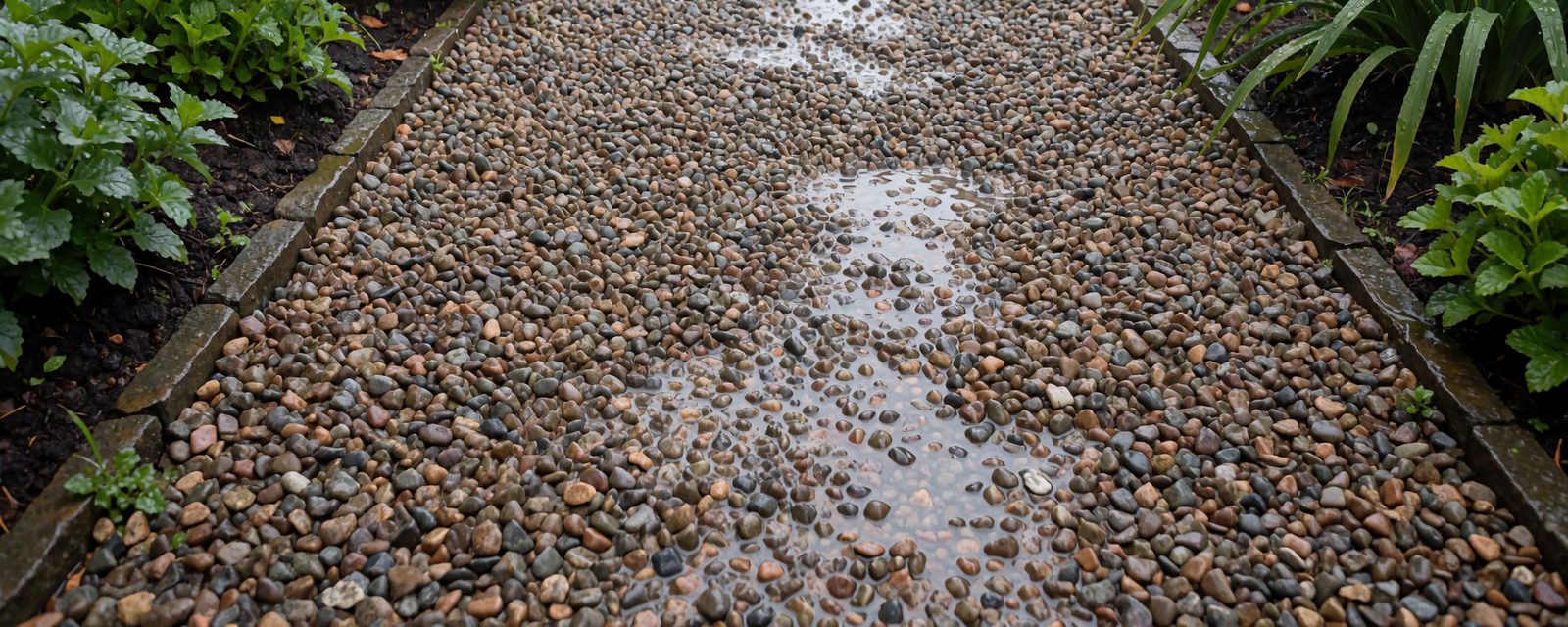
You're standing over a stretch of bare ground, or over a path that's failed, sunk in one corner, gone black and slick along the shaded side, weeds pushing up through gaps that used to be tight. A path is one of the few garden features you're not likely to redo for years, so the material you pick now needs to hold up wet, not just look right dry. Gravel, paving slabs, timber decking, bark or wood chip, and resin-bound aggregate all do the basic job of getting you from one part of the garden to another. They do not perform anywhere near the same once a surface stays damp for days at a time, which in most of Scotland is not the exception, it's the baseline.
What sustained damp actually does to a path surface
Scotland is consistently one of the wetter parts of the UK, and August 2026 shows the scale of that clearly: Scotland recorded 104.3mm of rain against England's 58.5mm, getting on for double England's total for the same month, according to Met Office regional figures. That was actually a slightly below-average August for Scotland itself, 87% of its own 1991-2020 norm for the month, so the comparison isn't an unusually wet month flattering the point; England's own August, at 78% of its norm, was drier still relative to its own baseline.
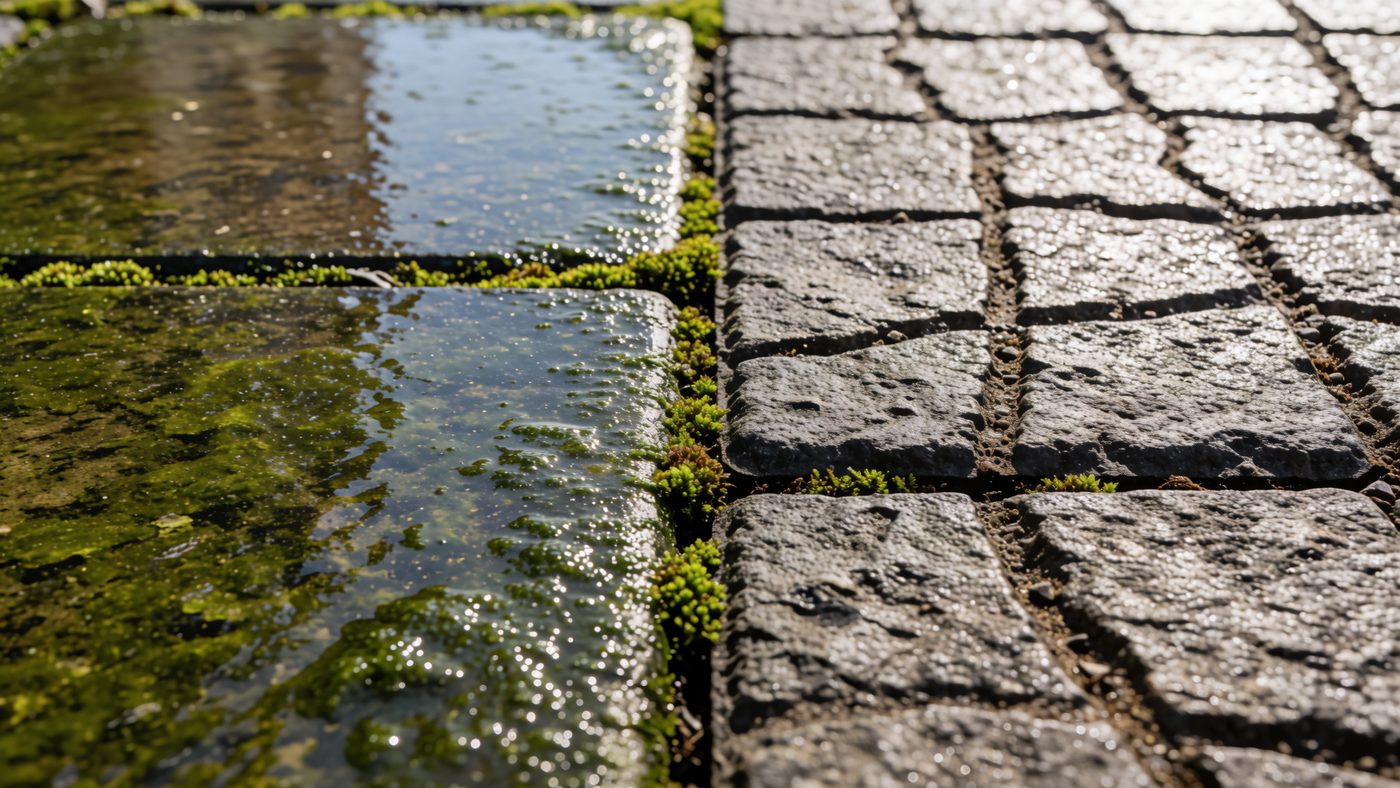
That sustained damp is the whole story behind why some path materials perform and others don't. Algae and moss need moisture and shade to establish, and growth is faster wherever air circulation is poor and a surface is compacted or slow to drain; a dark, slimy black staining that appears alongside them, distinct from moss's green cushions, is usually a separate organism, liverwort, which favours the same damp, shaded conditions but forms a flatter, denser mat and can be more slip-prone once established. A smooth, non-porous surface, sealed timber decking, polished or "wet-look" slabs, holds a thin film of water on top for longer after rain, which is exactly the condition these organisms need. A surface that lets water pass through it, or that's rough and textured enough to dry out fast, doesn't hold that film in the first place. The mechanism itself isn't unique to Scotland; a Scottish garden just meets the conditions for it far more often through the year than a garden further south does.
Texture affects a second, related risk directly, and one that matters more the more often a surface is wet: how much grip it still has underfoot. The UK Slip Resistance Group, the UK's professional slip-testing body, rates pedestrian surfaces on an R-scale from R9 to R13, with higher numbers meaning more resistance, and its own guidance warns that the lowest classification, R9, can be mistaken for adequate when it isn't. It notes that a surface's texture does the actual work: the raised "macro" profile of a textured finish cuts through a film of water or algae, while a smooth or worn-flat surface, and one where a fine "micro" texture has clogged with dirt, loses that grip over time even if it started out safe. In practice this means the surface finish you choose, and how well you keep it clear of grime and growth, matters as much as the base material, and matters more here than it would somewhere drier.
The five materials compared
| Material | Algae/moss risk | Slip risk when wet | Drainage | Frost-heave risk | Maintenance | Cost | Lifespan |
|---|---|---|---|---|---|---|---|
| Gravel (loose, on membrane) | Low on the stones themselves; can build up in compacted low spots | Low from algae, but loose or unbedded gravel is its own trip/slip hazard | Free-drainingSoil that lets water pass through quickly rather than pooling, so roots aren't sitting in wet ground after rain. Full definition → by nature | Low, if laid on a free-draining sub-base | Regular: raking, topping up, weed control at the membrane edges | Low | Base/membrane 15-20+ years; surface stone tops up every few years |
| Paving slabs | Moderate to high on smooth/polished finishes; lower on riven/textured finishes | Depends heavily on surface finish; smooth or algae-covered slabs are genuinely hazardous | Poor unless laid with a slight fall and, ideally, permeable jointing | Moderate on a poorly prepared base; low on a correctly built one | Periodic brushing/washing of joints and surface | Moderate to high | 20-30+ years if the base was built properly |
| Timber decking | High, especially shaded or north-facing boards | High once algae/moss establishes, until cleaned | Poor on solid boards; sheds surface water but the wood itself stays damp long after rain | Low direct risk to the deck itself, but posts/footings need frost-safe foundations | High: regular cleaning, annual oiling/sealing | Moderate | 15-25 years treated softwood; composite often longer |
| Bark / wood chip | Moderate; decomposing organic material feeds fungal and moss growth | Low from algae, but wet bark compacts and gets slick, not a stable underfoot surface | Good short-term percolation, breaks down into a denser, slower-draining layer over time | Low, since it's not a rigid surface to lift | High: needs regular topping up as it decomposes | Low | 1-3 years before a meaningful top-up is needed |
| Resin-bound aggregate | Low; the bound, textured surface sheds water and doesn't hold a film | Low when correctly laid with an anti-slip aggregate mix | Good to excellent; permeable systems let water pass straight through | Low on a properly specified permeable sub-base | Low: occasional brushing, no resealing needed for years | High | 15-20+ years |
Three points from that table are worth a closer look than a single row gives them:
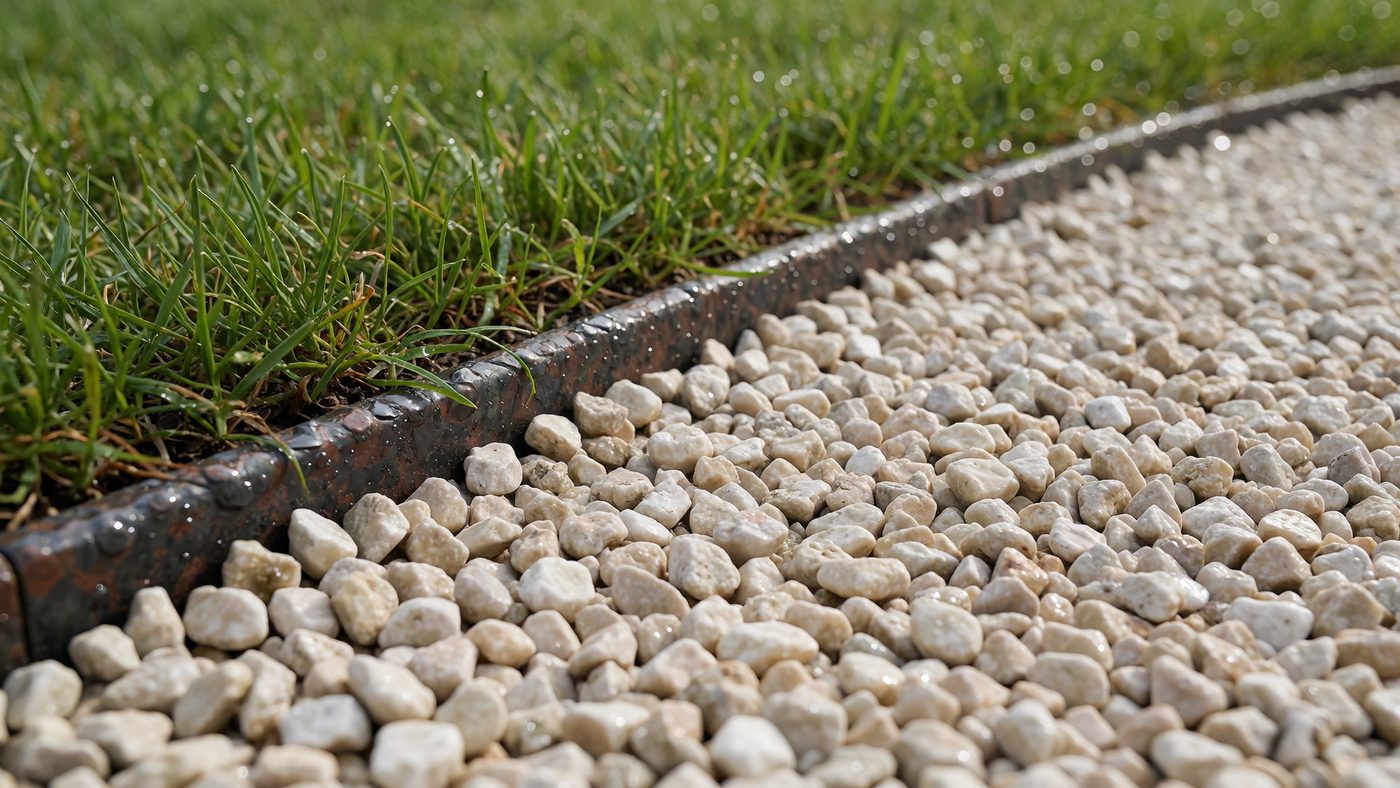
- Gravel's "low algae risk" depends on it staying loose and well-drained. Gravel that's been walked flat into a poorly-prepared base behaves more like compacted earth, and grows moss just as readily. It also needs a physical edge, metal or timber edging strips along the path line, to stop it migrating into beds or lawn once it's walked on repeatedly; skipping that is a common reason a gravel path looks scruffy within a year.
- Paving's whole risk profile swings on one choice: the surface finish. Riven (naturally split, rough-textured) or otherwise textured stone sheds water and grips well; a smooth, polished, or "wet-look" finish is the one that turns hazardous when wet. That applies whether it's natural stone, concrete, or porcelain, and it applies to reclaimed sandstone or whinstone setts and standard block paving too, both common choices in Scottish gardens: textured and porous ages well here, polished doesn't. A weed-suppressing membraneA permeable fabric laid over soil to block weeds while still letting water and air through, often planted through with holes cut for each plant. Full definition → laid under gravel or a sub-base needs to be a permeable geotextile rather than solid plastic sheeting, and overlapped and pinned properly at the joins, or it traps water underneath instead of letting it pass through.
- Resin-bound aggregate's strong showing across the board comes at the highest up-front cost of the five, which is exactly why it isn't the automatic answer for every path.
Exact price per square metre varies by region, supplier, and how much groundwork the base needs. As a rough rule of thumb, a DIY gravel or bark path is a fraction of the cost of a professionally laid resin-bound or natural stone path of the same size, since labour and base preparation, not the surface material itself, are what drive the price up on the latter two; get two or three local quotes before budgeting a feature path. It's also worth a quick check with your local council's planning department before covering a large area, particularly one that was previously lawn or bare ground, in solid, non-permeable material, since surface water drainage from hard standing near a house is the kind of thing planning rules address in some circumstances.
Timber decking: the material worth a second look
Decking is usually either recommended without qualification or written off outright, and neither is quite right for a Scottish garden. It performs worse than every other material here on algae and moss specifically, because a flat timber board holds moisture against its own grain for longer than gravel, stone, or resin can, and a shaded or north-facing run rarely gets enough sun to dry out fully between wet spells. That's a genuine, climate-driven weakness, not scaremongering. But it isn't a reason to rule decking out if you actually want it: composite (wood-plastic) decking tolerates cleaning and damp exposure noticeably better than timber, and either way it's a maintenance routine, not a one-off failure, that keeps it usable. A winter grit or salt spread is worth avoiding on decking specifically: it can damage the sealant and finish faster than the weather alone would, so keep decking clear with a stiff broom rather than de-icing products. Rock salt is also best kept off natural stone and some resin-bound surfaces, since it can stain or, on porous stone, contribute to surface damage over repeated winters; a clean sand or a proprietary path-safe de-icer is the safer choice across all the hard materials here, gravel and bark are the exception, since a loose surface simply doesn't hold ice in the same way. If you've already got decking and it's gone green, the guide to cleaning moss off decking and furniture covers exactly how to deal with that.
Frost heave: a real risk, but one you build your way around
Frost heave is what happens when water sitting in or under a path freezes, expands, and lifts part of the surface, sometimes unevenly, so slabs tip, gravel ruts, or a resin surface cracks. It needs two things together, standing water and hard frost, and Scotland supplies the second reliably: real ground frost most winters, with how many air-frost days a given garden actually sees varying more by region than the old broad-brush "Highlands coldest" assumption suggests (the full regional breakdown, station by station, is in the frost dates reference). A sub-base built from the right aggregate has enough gap between the stones to let water drain straight through rather than pool and freeze, and permeable sub-bases in particular have a strong record against frost heave, according to one UK paving manufacturer's technical guidance. The same principle holds for any hard surface: get water away from the base rather than let it sit, laying pipe or a gravel drain on a proper fall rather than assuming the ground will cope.
In practical terms, that means the same fix protects against algae and against frost heave: a genuinely free-draining base, whether that's compacted, permeable aggregate under gravel or slabs, a permeable jointing system, or a resin-bound system's own bonded sub-base, laid with a slight fall so water moves off rather than pooling. A path laid straight onto compacted clay or other poorly-drained subsoil, not unusual in a Scottish garden, is the one that's actually at risk, regardless of which surface material sits on top of it. Skipping proper base preparation to save a weekend's work is where a cheap path turns into an expensive one three winters later. Sloping or uneven ground adds a further complication worth planning for before choosing a material: loose gravel migrates downhill under its own weight and repeated footfall, so it needs check-strips or a shallower gradient than a bound surface would; resin-bound aggregate and slabs both cope with a slope better since they're fixed in place, and decking on a steep or uneven site usually needs a proper sub-frame on adjustable supports rather than boards laid straight onto the ground.
Exact depth and aggregate spec vary by material, ground conditions, and how heavily the path will be used, so treat any generic online figure with caution and check it against the specific product's own installation guidance or a local landscaper's advice; a domestic garden path needs less sub-base than a driveway, but the underlying principle, permeable material, properly compacted, laid to a shallow fall away from the house or towards a border, holds regardless of the material going on top.
Which material for which situation
A budget allotment or vegetable-plot path, one that mainly needs to keep boots out of mud between beds, is gravel's clearest use case: cheapest to lay, cheapest to extend, and its free drainage does real work against a climate that turns unsurfaced paths to mud for much of the growing season. It needs a properly compacted, free-draining base and a weed-suppressing membrane underneath it, not laid loose on soil, and it needs topping up periodically. For how wide to make the paths themselves and where to put them across a plot, see the allotment layout planning guide.
A garden feature path, the main route to a front door, a route through a border people will actually stop and look at, is where paving slabs or resin-bound aggregate earn their higher cost. Choose a riven or textured slab finish over a smooth or polished one for genuine wet-weather safety, and budget for proper base preparation rather than treating it as an optional extra; a feature path that heaves or grows algae within two winters undoes the investment. Resin-bound aggregate costs more again but combines the lowest ongoing maintenance here with strong looks and reliable drainage, worth it specifically where a path gets heavy year-round use and you don't want a recurring cleaning job.
A genuinely low-maintenance path rules out bark and wood chip outright, its short lifespan and constant topping-up is the opposite of low-maintenance, however cheap and natural it looks at first. Resin-bound aggregate is the strongest fit if budget allows; well-laid gravel on a solid base is the practical second choice if it doesn't, since its maintenance is periodic top-ups rather than a seasonal cleaning cycle.
If accessibility, wheelchair or mobility-aid use, a walking frame, is the deciding factor rather than weather performance alone, that's a different comparison with its own firmness and turning-circle requirements, covered directly in the accessible gardening guide.
Common questions
Does gravel actually stay usable in a wet Scottish winter, or does it just turn to mud?
Properly laid gravel, on a compacted, free-draining sub-base with a weed-suppressing membrane underneath, sheds water rather than holding it and stays usable through a wet winter. The failure case is gravel laid straight onto bare soil or clay with no membrane: it works itself into the ground, the base compacts, and it behaves much closer to bare earth within a season or two.
Is decking a bad choice for a Scottish garden?
Not automatically, but it's the material most affected by sustained damp, especially anywhere shaded. If you want the look of decking, composite boards handle repeated wet-weather cleaning better than timber, and either material needs a routine, not a one-off clean, to stay safe underfoot.
What actually causes frost heave, and is it a real risk here?
Water sitting in or under a path freezes, expands, and lifts the surface unevenly. It's a real mechanism and Scottish gardens get real ground frost most winters, so it does happen here, but the deciding factor is whether the base drains freely, not how hard the frost is. A path built on a properly compacted, free-draining sub-base is at low risk regardless of material; one laid straight onto poorly-drained clay is the one that heaves.
Which path material needs the least ongoing work?
Resin-bound aggregate needs the least: an occasional brush and no resealing for many years. Well-laid gravel is a reasonable second, needing only periodic topping up. Bark and wood chip need the most regular attention of any material here, typically a top-up every one to three years as it decomposes.
Can I mix materials on one path, gravel for most of it and slabs as stepping points, for example?
Yes, and it's a common practical compromise: solid stepping slabs set into gravel keep the main walking line firm and dry underfoot while gravel fills the rest more cheaply. The same base-preparation rules apply to both parts, so plan the sub-base as one job rather than two.
Sources
6 sources, recorded with what each was used for
- Met Office: Regional Values: Current rainfall comparison between Scotland and England, actual mm and percentage-of-1991-2020-average figures
- RHS: Algae and Moss on Hard Surfaces: Mechanism behind algae/moss growth on paving and decking, slip risk, and drainage-based prevention including permeable paving and edge drainage channels
- RHS: Front Gardens and Permeable Paving: Runoff increase from non-porous surfaces, permeable sub-base construction principle, and material cost range
- RHS: How to Install Garden Drainage: General principle of moving water away via a drain laid to a fall rather than letting it sit, applied to a hard-standing base
- Tobermore: Should I Be Concerned With Frost Heave? (UK paving manufacturer, trade/commercial technical guidance): Sub-base aggregate drainage principle behind frost-heave prevention
- UK Slip Resistance Group: Guidance and FAQs (UK professional slip-testing trade body): R-value rating scale for paving surfaces and the texture mechanism behind wet-surface grip