
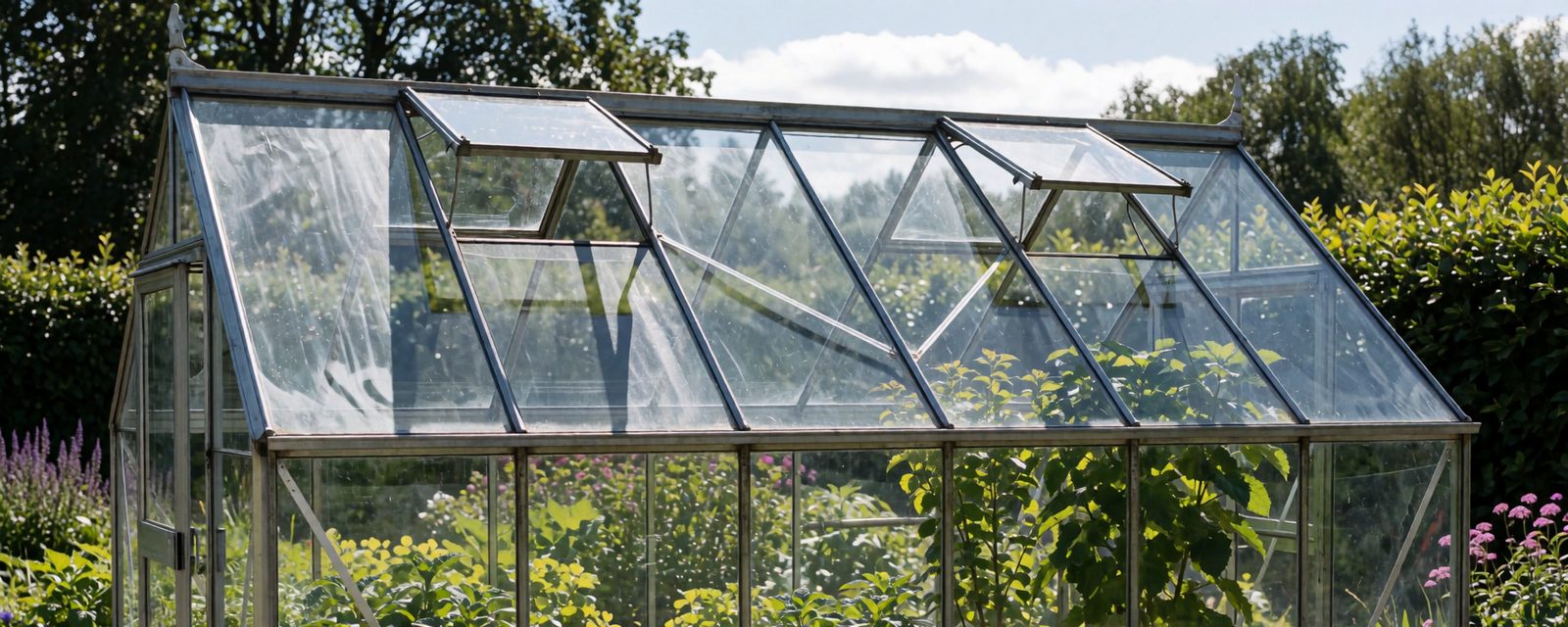
You're looking at a kit's spec sheet and it says "twin-wall 4mm polycarbonate glazing" or the polytunnel listing says "720 gauge polythene, 5-year UV warranty." Neither of those phrases means much until you know what gauge, wall count and micron thickness actually change about how the structure performs, how much light gets to the plants, how much heat it holds overnight, how long it lasts before you're replacing it, and whether your base frame can even take the weight.
The glazing material, glass, polycarbonate, or polythene film, is a separate choice from the structure type (for polytunnel vs greenhouse as a category, see the polytunnel vs greenhouse comparison), because it can apply either way. A greenhouse can be glazed in glass or polycarbonate; some polycarbonate-clad structures use a polytunnel-style hooped frame. And within polycarbonate there's a distinction worth understanding before you buy: solid single-wall sheet, twin-wall sheet, and thicker multiwall sheet (triple-wall, 5-wall) all behave quite differently from each other, not just from glass and film.
Light transmission compared
Light transmission is the percentage of available light that actually passes through the glazing to reach the plants. In a Scottish winter, where day length is already short, Edinburgh and Lerwick lose far more winter daylight than southern England, as covered in day length and photoperiod, how much of what daylight there is actually gets through the glazing matters more than it would further south.
Glass transmits around 90% of available light and "does not degrade in sunlight"; polycarbonate transmits around 83% generically, without a wall count specified. Manufacturer figures for polycarbonate vary a good deal by sheet structure and thickness, there's no single settled number for "polycarbonate" as a category:
| Material | Light transmission | Source basis |
|---|---|---|
| Glass | ~90% | RHS |
| Single-wall (solid) polycarbonate, thin (1-2mm) | 88-91% | Polycarbonate panel manufacturer technical data |
| Twin-wall polycarbonate, 10mm | ~82% | Polycarbonate sheet manufacturer technical data |
| Multiwall (triple-wall) polycarbonate, 10mm | ~74% | Same manufacturer data |
| Multiwall (5-wall) polycarbonate, 16mm | ~64% | Same manufacturer data |
| Polythene film | No single verified figure found | — |
The pattern holds consistently: thinner, fewer-walled sheet lets more light through; thicker, more-walled sheet lets less light through but insulates better (see below). A thin solid polycarbonate sheet can get close to glass; a thick 5-wall panel bought for winter heat retention will visibly dim the greenhouse. There is no single "polycarbonate transmits X%" figure that's honest across the whole product category, it depends entirely on which polycarbonate you're buying.
Polythene film manufacturers don't publish a single, comparable new-condition transmission percentage the way glass and polycarbonate suppliers do. Ask the supplier for the transmission spec of the specific film grade rather than assume a number, and see the polytunnel vs greenhouse comparison for how transmission changes as a film cover weathers over its working life.
Heat retention and insulation: why wall structure matters
Glass has one clear insulation advantage: it reflects long-wave heat radiated from inside the structure back inward, rather than letting it pass straight through, the "greenhouse effect" in its literal, original sense. Single glazing does this a little; it's still a single 3-4mm layer with nothing trapping air. Overnight heat retention matters more here than in a milder UK winter: a longer, colder frost season means more nights where the glazing's insulation value is doing real work rather than sitting unused.
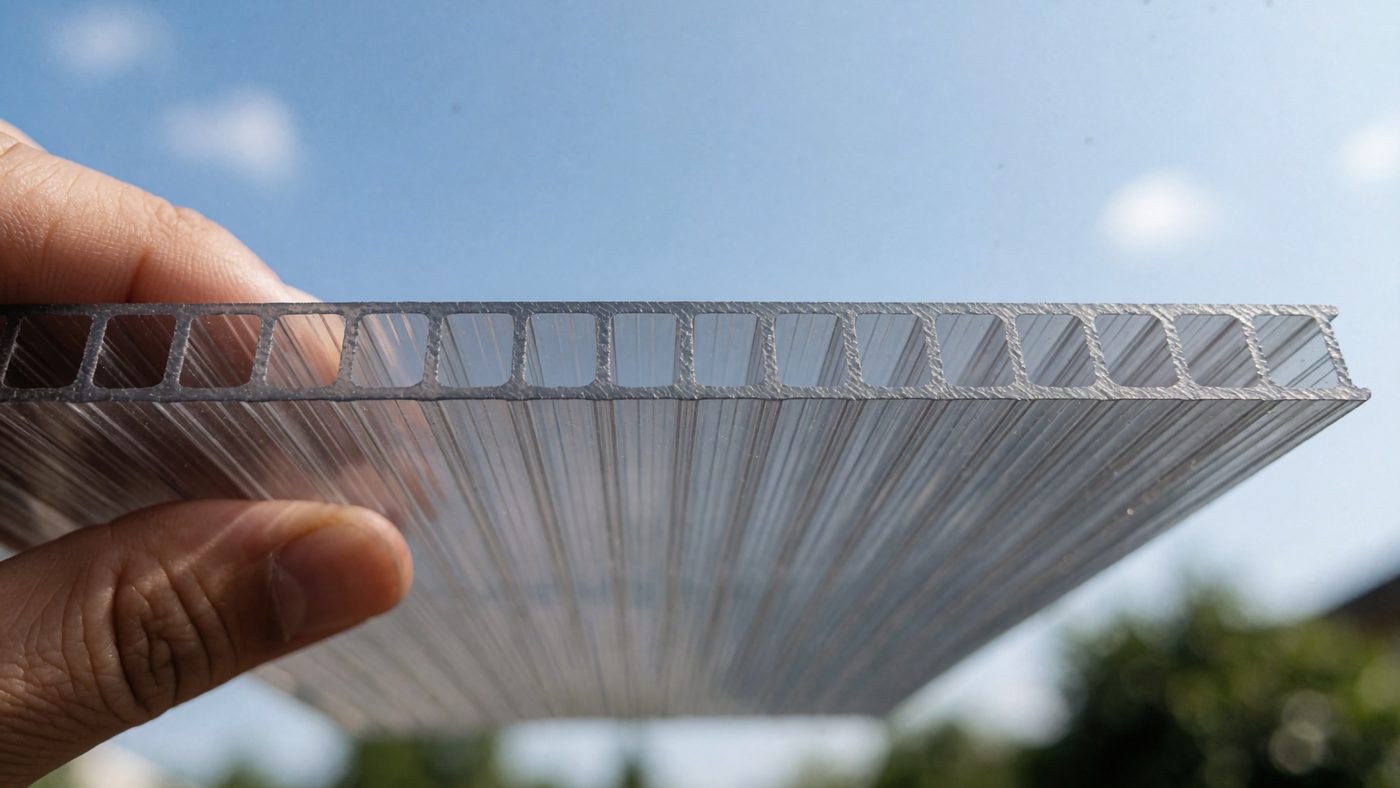
Polycarbonate's insulation value comes from a completely different mechanism: the ribbed, multi-wall construction traps air between the sheets, and trapped air is what actually resists heat flow. This is why single-wall (solid) polycarbonate, which is just a flat sheet, no air gap, does not insulate meaningfully better than glass, while twin-wall and multiwall sheet do, because they're carrying that dead-air layer built into the material itself. Manufacturer R-value data (R-value measures resistance to heat flow, the higher the number, the better the insulation) bears this out precisely:
| Polycarbonate structure | R-value (insulation) | Light transmission |
|---|---|---|
| Twin-wall, 6mm | R-1.6 | — |
| Twin-wall, 8mm | R-1.7 | — |
| Twin-wall, 10mm | R-1.9 | ~82% |
| Triple-wall, 10mm | R-2.1 | ~74% |
| Triple-wall, 16mm | R-2.5 | — |
| Triple-wall, 25mm | R-2.94 | — |
| 5-wall, 16mm | R-2.78 | ~64% |
The trade-off is direct and consistent: more walls and more thickness means a higher R-value (better insulation) and a lower light transmission percentage. There's no version of multiwall polycarbonate that gives you both maximum light and maximum heat retention, you're choosing a point on that scale.
Polythene film has no such air-gap structure by default; it's a single skin, so its baseline heat retention is the weakest of the three. Some manufacturers sell "thermal" polythene grades with additives specifically aimed at reducing heat loss and condensation drip rather than relying on trapped air.
Durability, lifespan and cost
| Material | Typical lifespan | Fragility | Relative cost |
|---|---|---|---|
| Glass | Permanent structural material; does not degrade in sunlight | Fragile — cracks/shatters on impact; toughened glass needed for doors and impact-prone panels | Highest |
| Polycarbonate (single or twin/multiwall) | Multi-year to multi-decade depending on grade; UV-stabilised sheet resists yellowing far longer than film | Resists breakage and adverse weather well; twin/multiwall softer to walk into but won’t shatter | Mid-range |
| Polythene film | UV warranties of 4-5 years on commercial-grade UK film; usable life commonly extends several years beyond the warranty | Least durable — tears, and UV degradation embrittles it over time | Lowest, but the film itself is a wear part that needs periodic replacement |
A UK polythene film supplier's 600 gauge (150 micron) "Thermal Anti-Drip" film carries a 4-year UV warranty; its 720 gauge (180 micron) equivalent carries a 5-year UV warranty and is 20% thicker than the standard grade. A heavier 800 gauge (200 micron) black/white film, sold for animal housing and storage rather than crop growing, is rated for up to 10 years. Thicker covers are consistently more weather-resistant than thinner ones. For the structure-type cost comparison, polytunnel upfront cost against greenhouse, and how often a tunnel cover needs replacing as a proportion of total ownership cost, see the polytunnel vs greenhouse comparison.
Polycarbonate sits in the middle on every axis: it costs more than film but less than glass, resists impact far better than glass, and, because it's UV-stabilised sheet rather than a thin flexible skin, has a materially longer service life than film without matching glass's effective permanence.
One real maintenance point specific to twin-wall and multiwall sheet: the internal air channels that give it its insulation value can also let in algae and dirt over time, usually through the open cut ends at the top and bottom of each panel, gradually dulling the sheet's clarity from the inside where a simple wipe of the outer surface won't reach. Panels sold with breathable tape over the open ends, or capped and sealed at installation, resist this far longer than sheet left with bare, open channel ends.
As a rough ballpark from one UK greenhouse retailer's current listings: a 6x4 horticultural glass greenhouse starts around £395-£520, a toughened-glass equivalent around £520, and a comparable polycarbonate greenhouse (6x6) starts around £395, broadly in the same band as standard glass despite the durability and weight advantage, though prices vary by brand, glazing thickness and retailer. A polythene-covered polytunnel undercuts both by a wide margin for the same covered growing area, since you're buying a steel hoop frame and a roll of film rather than a framed and glazed structure, that price gap is the main reason film remains the standard choice for anyone prioritising covered square footage over permanence.
Weight and structural requirements
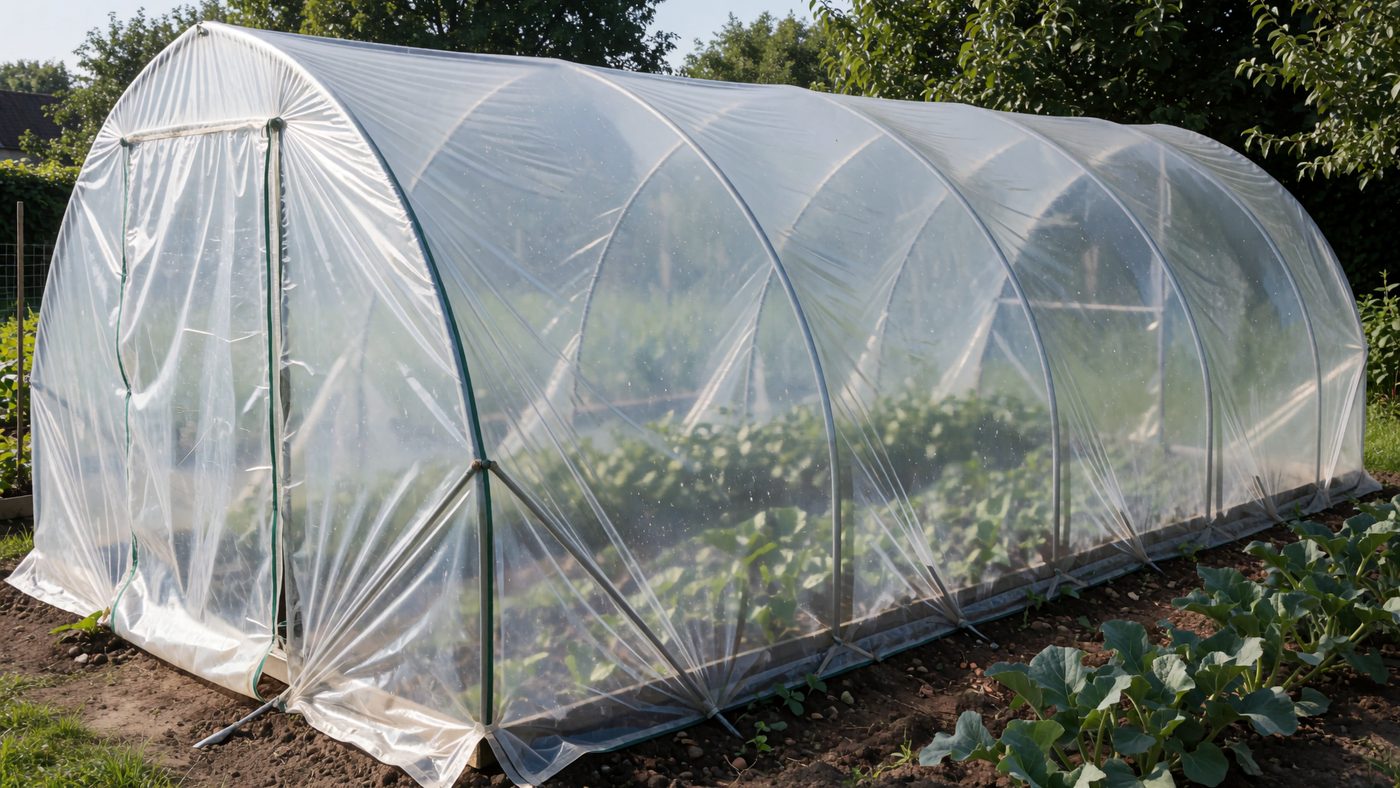
This is the part of the decision that's easy to skip past on a spec sheet but has real practical consequences. Glass is heavy, it needs a rigid, properly founded frame designed to carry that load, which is why glass greenhouses are aluminium- or timber-framed structures on a solid base, not something boltedA plant switching early into flowering and seed production, usually triggered by stress, after which leaves, roots or bulbs turn bitter or unusable. Full page → onto a lightweight hooped frame. Polycarbonate sheet is dramatically lighter for a given panel size, which is part of why it turns up on both traditional greenhouse frames and lighter aluminium kits; it also tolerates a less-than-perfectly-square frame better than glass, which will crack under the twisting stress a slightly out-of-true frame puts on it, where polycarbonate simply flexes. Polythene film carries almost no structural load consideration at all, it's stretched over a hooped steel frame and tensioned, which is precisely why polytunnels can use a much lighter, cheaper frame than an equivalent-sized greenhouse.
The practical DIY implication: a self-build or a kit going up on a domestic base is far more forgiving with polycarbonate or film than with glass. Glazing a frame with glass panels is heavier, more exacting work, and a frame not designed for the load shouldn't be glazed in it after the fact.
Snow and hail load is a separate structural question from the glazing material's own weight, and it applies to all three: a roof carrying a covering of wet snow, or standing up to a hail shower, is a load the frame and panel fixings need to handle regardless of whether the glazing itself is glass, polycarbonate or film. A steep-enough roof pitch that snow slides off rather than sitting and building up matters more here than in most of England, and a hooped polytunnel frame's curved profile already does this reasonably well by shape alone; a flat or shallow-pitch roof on any structure is the one that needs the sturdier build to carry standing snow.
Condensation and ventilation
Condensation forms on glazing material when warm, moist air inside the structure meets a cold glazing surface and cools past the point where it can hold that moisture as vapour, so it condenses out as water droplets. In a glasshouse or polytunnel this happens regardless of glazing material, and the fix is the same: maintain airflow (a fan or adequate vents, roughly one square metre of ridge ventilation for every five square metres of floor area gives a full air change every two minutes) rather than rely on the glazing itself to prevent it. Getting that airflow right matters more in a Scottish winter, when the same short, low-light days that make light transmission worth chasing also bring longer stretches of cold, damp air pressing against the glazing.
Some polythene film is manufactured specifically to address condensation drip: "anti-drip" film grades use additives that spread condensation into a continuous film that runs down the inside of the cover instead of falling on the crop as individual drips.
UV degradation of polythene film
Polythene film is the only one of the three materials that visibly ages under UV exposure within a normal ownership timeframe, glass doesn't degrade in sunlight, and UV-stabilised polycarbonate is rated for far longer service life. UV radiation breaks down the film's polymer structure over time: embrittlement, cracking and eventual tearing, rather than a sudden failure. UK suppliers back their commercial-grade film with 4-year (600 gauge/150 micron) to 5-year (720 gauge/180 micron and heavier grades) UV warranties, with real-world service life commonly extending some years past the warranty. The warranty length is the practical figure to plan a replacement cycle around.
Scotland's wind angle
Scotland's average wind climate runs higher than the UK as a whole, a real reason to buy the heavier film gauge and get the tensioning right on an exposed Scottish site, rather than treat a generic UK-wide polytunnel spec sheet as automatically sufficient. Met Office long-term averages (1991-2020) put mean annual wind speed for the Scotland region at 10.76 knots (about 12.4 mph), against a UK-wide average of 9.27 knots (about 10.7 mph), and lower again at the sheltered, inland Edinburgh Gogarbank station specifically, 8.15 knots (about 9.4 mph), a reminder that the Scotland-wide average is itself pulled up by the more exposed coastal and island sites, not a flat figure that applies equally everywhere in the country.
That's an average wind speed, not a gust or storm-event figure, so it doesn't on its own set a tear-risk threshold for a specific cover. The failure mode most closely associated with wind damage to polythene film, flapping and eventual tearing at fixing points under gusts, is a function of tensioning and anchoring as much as of average regional windiness, covered in securing a greenhouse or polytunnel against wind. Glass and polycarbonate don't flap the way film does, since they're rigid panels held in glazing bars rather than a tensioned skin, but they face their own wind risk: a panel that isn't seated and clipped properly can work loose and lift in a gust the same way a loose roof tile does, which is a fitting-quality issue rather than a property of the material itself.
Which material for which situation
A permanent glasshouse in a garden that's staying put for decades, in a sheltered spot, on a solid base: glass. It's the only material with genuinely indefinite lifespan, the best light transmission, and real heat-reflecting behaviour, and if the structure and base are built to carry it, its fragility is a manageable risk rather than a daily concern. This is the traditional choice for a reason.
A budget polytunnel for extending the summer growing season, replaced or re-covered on a known cycle: polythene film, on a properly tensioned hooped frame. It's the cheapest way to cover the most growing area, it's light enough for a simple frame and DIY erection, and treating the cover as a wear part you'll replace inside a decade, rather than expecting permanence from it, is the realistic way to own one. Choose the heavier gauge (720 over 600) if the site is exposed, given Scotland's higher average wind climate.
A structure that needs to survive an exposed site, curious pets, children, or garden tools without shattering, and where a full glass-and-masonry build isn't realistic: polycarbonate. Twin-wall or multiwall on a lightweight aluminium or timber frame gets most of the durability and a meaningful chunk of the insulation value of a permanent structure, without glass's weight and fragility. Within polycarbonate, lean towards twin-wall over heavier multiwall if the growing priority is light-hungry crops (tomatoes, chillies, seedlings under lights); lean towards multiwall if the priority is season extension and frost protection over maximum light.
A small cold frame or propagator lid: thin single-wall (solid) polycarbonate or twin-wall in a small gauge is the practical standard, light enough to lift on and off by hand, close to glass in light transmission at thin gauges, and far more forgiving of an accidental knock than a glass-lidded frame.
Common questions
How long does polytunnel plastic actually last in Scotland?
UK commercial-grade polythene film carries manufacturer UV warranties of 4 years (600 gauge/150 micron) to 5 years (720 gauge/180 micron), with real-world service life often extending several years beyond the warranty on well-tensioned, well-maintained covers. Scotland's regional average wind speed runs higher than the UK-wide figure, a reason to favour the heavier gauge and solid tensioning on an exposed site, since flapping and fixing-point wear, not UV alone, is what usually ends a film cover early.
Can I put glass in a lightweight polytunnel-style frame?
No, glass is significantly heavier than polycarbonate or film and needs a frame and foundation designed to carry that load. A hooped steel polytunnel frame is built for a tensioned film skin, not rigid heavy glazing; putting glass on a frame not designed for it is a structural risk, not just a cosmetic mismatch.
Is single-wall polycarbonate worth buying, or should I go straight to twin-wall?
Single-wall (solid) polycarbonate mainly earns its place where impact resistance matters more than insulation, a cold frame lid, a propagator cover, or anywhere glass would be a breakage risk but heat retention isn't the priority. For a structure you want to hold overnight warmth in, twin-wall or multiwall is the material actually built to do that job; single-wall is a lighter, tougher stand-in for glass, not a budget version of twin-wall.
Can I add insulation to any of these glazing materials once the structure is up?
Yes, the material choice covered here is about the primary glazing, not what you can add to it afterwards. Bubble wrap and rigid liner panels can go inside glass, polycarbonate or film structures alike to boost winter heat retention.
Sources
7 sources, recorded with what each was used for
- RHS: Greenhouses, Choosing the Right One: Glass light transmission (~90%) and heat-reflecting behaviour, generic polycarbonate light transmission (~83%), general glazing durability/weight comparison
- RHS: Greenhouse, Ventilation and Shading: Ventilation rate guidance and airflow/condensation mechanism
- Polycarbonate Store: Multi-Wall Polycarbonate, Insulation R-Value & Light Transmission (trade/commercial technical data): Twin-wall/triple-wall/5-wall R-value and light transmission table
- GOODLIFE Polycarbonate Panels: Light Transmission in Polycarbonate Sheets by Thickness (trade/commercial technical data): Single-wall (solid) polycarbonate light transmission at thin gauges and the general thickness-vs-transmission trend
- Premier Polytunnels: Polythene Films (trade/commercial product data): Polythene gauge/micron specifications, UV warranty lengths, anti-drip film technology
- Met Office: Location-Specific Long-Term Averages: 1991-2020 mean annual wind speed figures for Scotland, the UK overall, and Edinburgh Gogarbank
- Greenhouse Stores: Which Greenhouse? Compare Glazing, Sizes & Prices (UK retailer, commercial listings): Illustrative current price range for a glass versus polycarbonate greenhouse